Atoms & Physics
How Far Is a Light-Year? Space Distances Made Simple
Quick answer
A light-year is about 5.88 trillion miles (9.46 trillion kilometers): the distance light travels in one year at roughly 186,000 miles per second. It measures distance, not time. The nearest star, Proxima Centauri, is 4.24 light-years away, about 25 trillion miles, and the Andromeda galaxy is about 2.5 million light-years away.
On this page
Space is so big that miles stop being useful. The Sun is 93 million miles away, which is already hard to picture. The next nearest star is about 25 trillion miles away. So astronomers describe the big distances in a way that is easier to hold in your head: how long light takes to cross them.
That gives us the light-year, one of the most misunderstood words in science. Here is what it measures, how far it reaches, and what it says about the sky you see at night.
What is a light-year?
A distance. NASA's Space Place defines it as how far light travels in one Earth year. Light moves at about 186,000 miles (300,000 kilometers) per second, and nothing in the universe is faster. Keep that up for a full year and you cover about 5.88 trillion miles (9.46 trillion kilometers), according to NASA.
The name trips people up because "year" sounds like time. It works the way "the airport is two hours away" does: we use a travel time to describe how far something is. The light-year just uses light as the traveler.
How do light-seconds, light-minutes and light-days add up?
Each step is light traveling for a longer time. NASA gives the distance of one light-day as 16,094,799,096 miles (25,902,068,356 kilometers). Divide that by 24, 1,440 or 86,400 and you get the light-hour, light-minute and light-second. Multiply it by 365 and you are back at the light-year.
| Unit | Light travels for | Distance (approx.) | A real example |
|---|---|---|---|
| Light-second | 1 second | 186,000 miles (300,000 km) | The Moon is 1.3 light-seconds away |
| Light-minute | 1 minute | 11.2 million miles (18 million km) | The Sun is about 8 minutes 20 seconds away; Mars is 3 to 22 minutes away |
| Light-hour | 1 hour | 671 million miles (1.08 billion km) | Neptune is about 4 hours 10 minutes away |
| Light-day | 24 hours | 16.1 billion miles (25.9 billion km) | Voyager 1 on Nov. 18, 2026 |
| Light-year | 1 year | 5.88 trillion miles (9.46 trillion km) | Proxima Centauri is 4.24 light-years away |
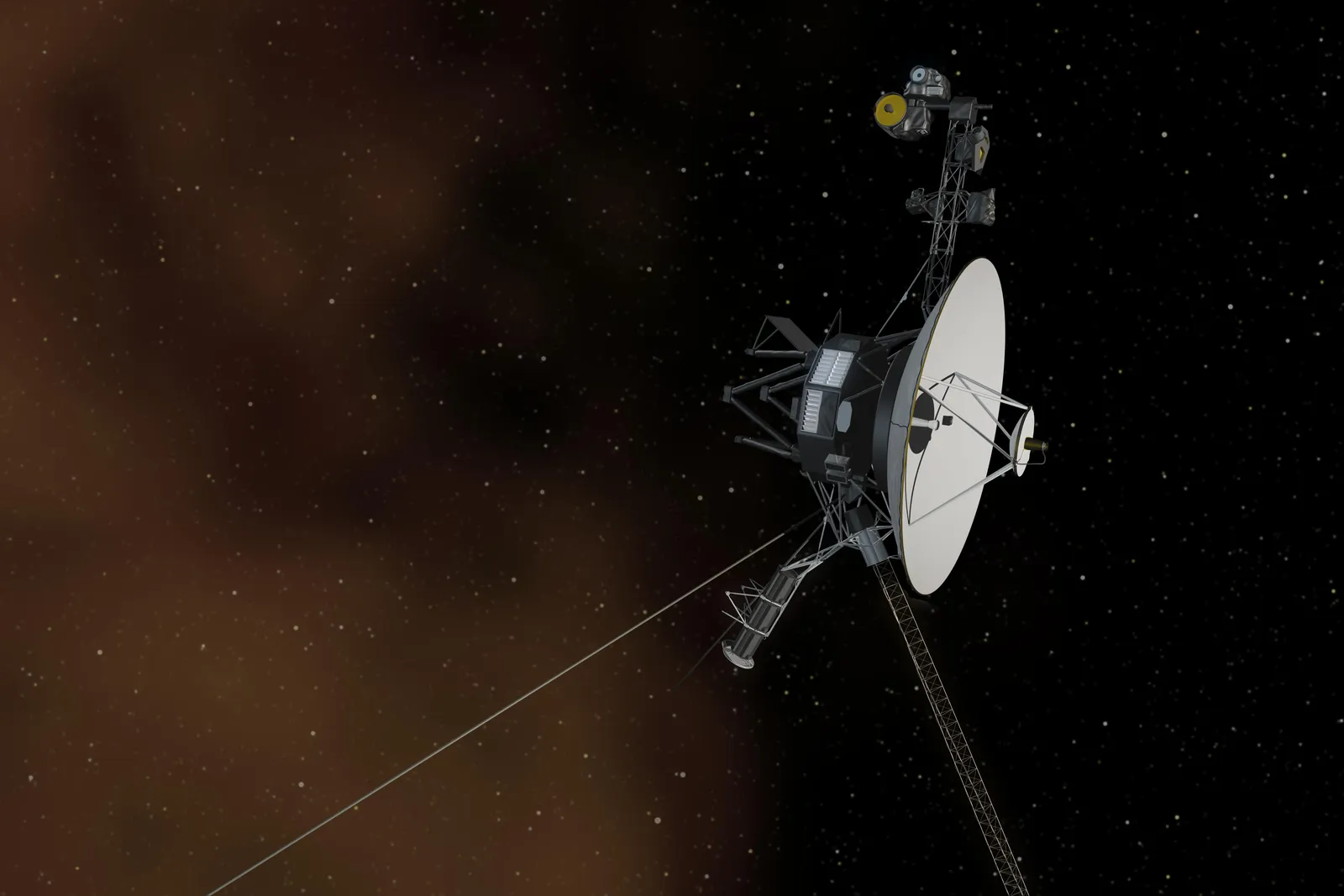
The farthest human-made object, Voyager 1, needed 49 years of flying to cover one light-day. A light-year is 365 of them.
How far is the nearest star in light-years?
Proxima Centauri, the nearest star to the solar system, is 4.24 light-years away, according to NASA. That is about 24.95 trillion miles (40.15 trillion kilometers). It is a small, dim star with about one-eighth the mass of the Sun, and it is too faint to see with the naked eye even though it is our closest neighbor. It belongs to a triple star system with Alpha Centauri A and B.
The light you would catch from Proxima left it 4.24 years ago. A spacecraft is much slower. NASA says Voyager 1 is leaving the solar system at about 3.5 astronomical units per year, one astronomical unit being the Earth-Sun distance of about 93 million miles. That is roughly 325 million miles a year. At that pace, 24.95 trillion miles would take about 77,000 years, and a single light-year would take about 18,000 (our arithmetic, using NASA's numbers).
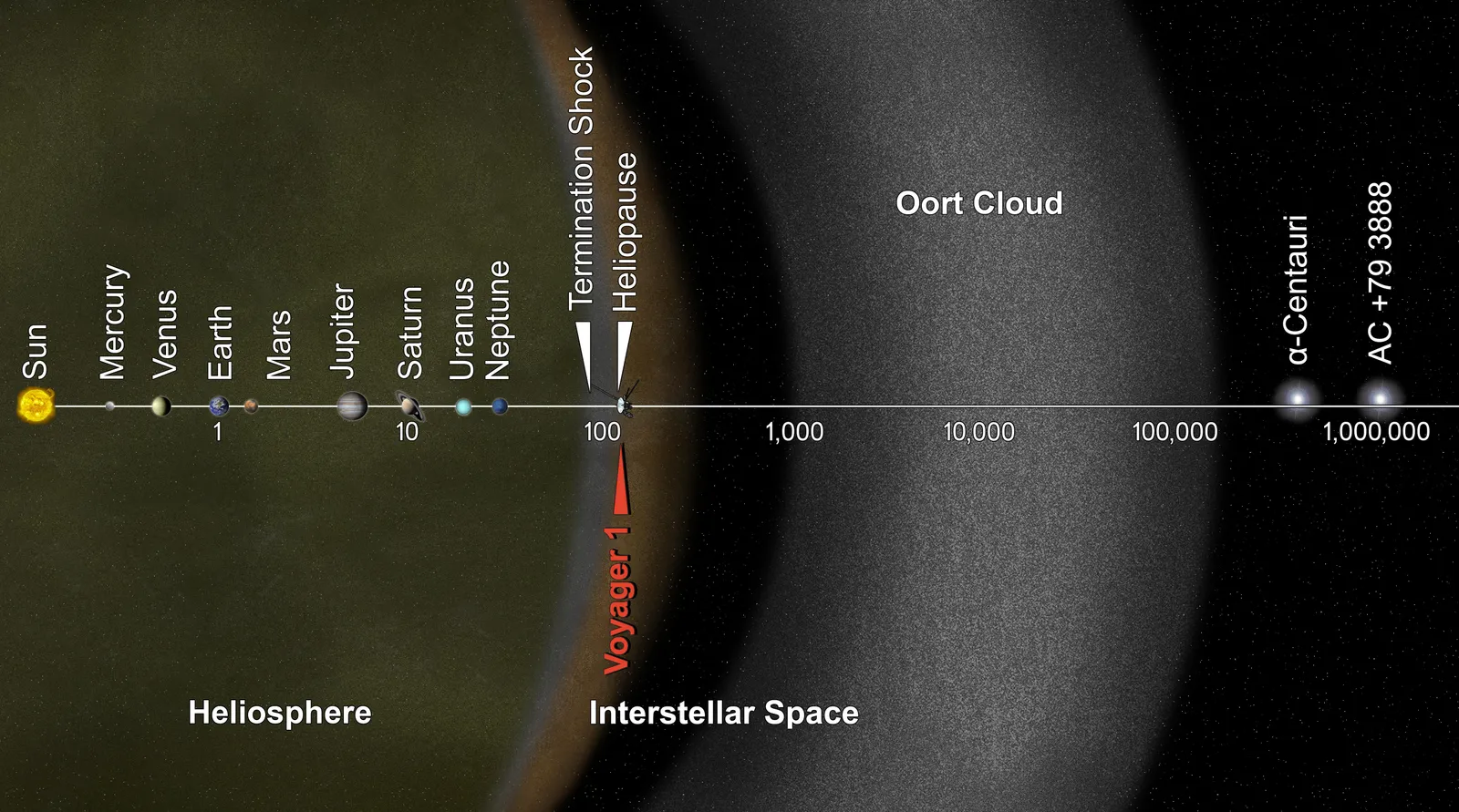
Voyager 1 is not aimed at Proxima Centauri. NASA says it will pass within 1.7 light-years of a star called AC +79 3888, in the constellation Ursa Minor, in the year 40,272.
Why do astronomers use light-years instead of miles?
Because the numbers get out of hand. NASA's Space Place points out that a light-year is about 6 trillion miles, a 6 with 12 zeros behind it. Once you leave the neighborhood of the Sun, the distances in miles are too long to read or compare. In light-years they fit on one line:
| Place | Distance |
|---|---|
| Proxima Centauri, the nearest star | 4.24 light-years |
| Polaris, the North Star | About 320 light-years |
| The center of the Milky Way | About 26,000 light-years |
| Andromeda, the nearest large galaxy | About 2.5 million light-years |
| GN-z11, a galaxy seen by Hubble in 2016 | About 13.4 billion light-years |
Does looking far away mean looking back in time?
Yes. Light takes time to arrive, so the farther away something is, the older the light you are getting from it. NASA's Space Place puts it plainly: when we use powerful telescopes to look at distant objects, we are actually looking back in time.
It starts close to home. The Sun you see is the Sun of about eight minutes ago. Polaris looks the way it did about 320 years ago. Andromeda, one of only ten galaxies NASA says can be spotted from Earth with the naked eye, shows up as it was about 2.5 million years ago. And for GN-z11, NASA says it is 13.4 billion light-years away, so today we can see it as it was 13.4 billion years ago.
That is not a flaw in telescopes. It is simply how light works, and it is why astronomers can study the early universe: its light is still arriving.
How big is the Milky Way in light-years?
About 100,000 light-years across, and NASA says it probably contains 100 to 400 billion stars. Our own Sun sits far from the middle: the center of the galaxy is about 26,000 light-years away.
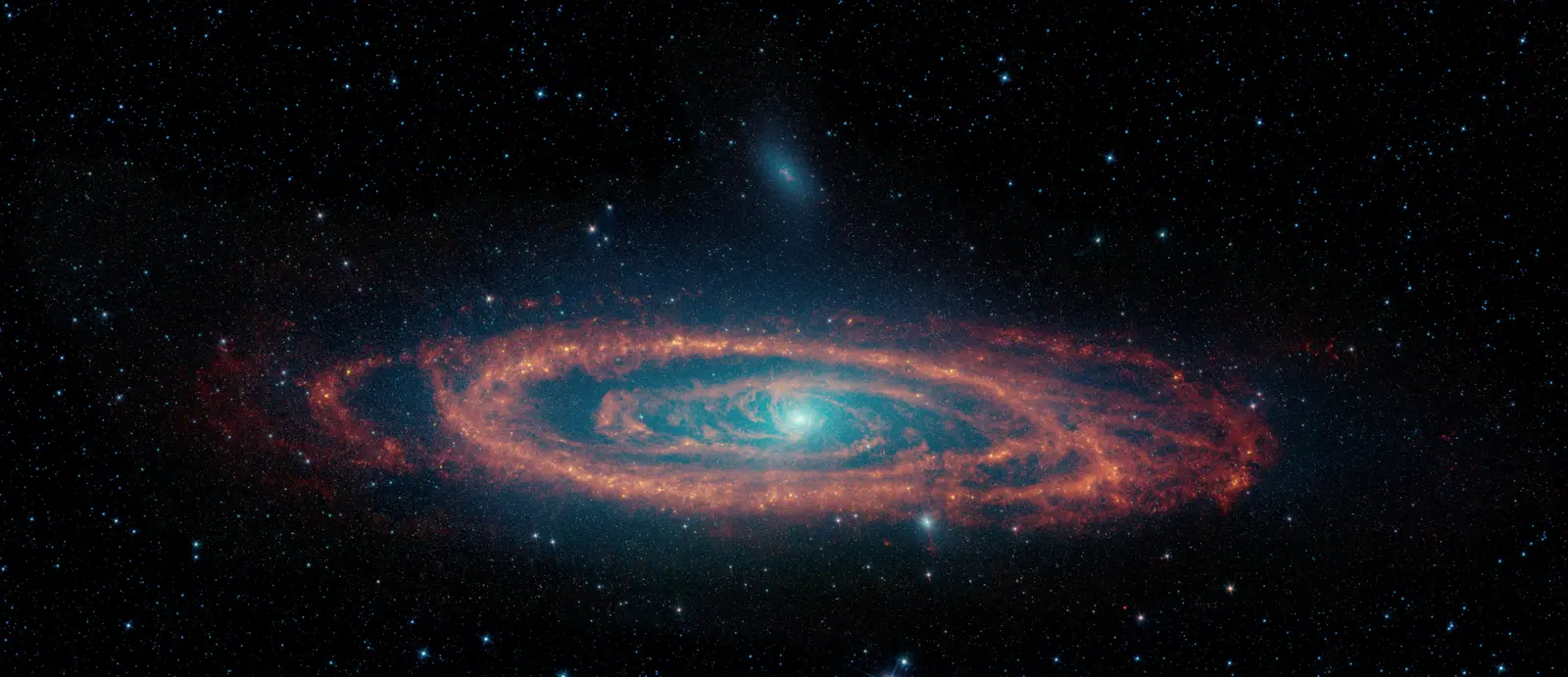
Seen that way, Andromeda's distance becomes easier to feel. At about 2.5 million light-years, the nearest large galaxy is roughly 25 Milky Way widths away. Even so, in the sky it is big. NASA describes the infrared view above as nearly 3.8 degrees across, close to the width of eight full Moons side by side.
Frequently asked questions
How far is a light-year in miles?
About 5.88 trillion miles, or 9.46 trillion kilometers, according to NASA. NASA's Space Place rounds it to about 6 trillion miles.
Is a light-year a measure of time?
No. It is a measure of distance: how far light travels in one year. The word "year" only tells you how long the light travels.
How many light-years away is the nearest star?
Proxima Centauri, the nearest star to the solar system, is 4.24 light-years away, about 24.95 trillion miles, according to NASA.
How long would it take to travel one light-year?
At the pace Voyager 1 is leaving the solar system, about 3.5 astronomical units per year according to NASA, roughly 18,000 years. That is our own arithmetic, not a NASA figure.
How far is a light-day?
About 16.1 billion miles (25.9 billion kilometers). Voyager 1 reaches that distance from Earth on November 18, 2026.
How far away is the Andromeda galaxy?
About 2.5 million light-years, which makes it the nearest large galaxy to the Milky Way, according to NASA. The light we see from it left about 2.5 million years ago.
Sources
- NASA Space Place, "What Is a Light-Year?" (accessed October 18, 2026)
- NASA Science, "Voyager 1: What Is a Light-Day" (accessed October 18, 2026)
- NASA Science, "Our Milky Way Galaxy: How Big is Space?" (updated April 22, 2024)
- NASA Science, "Hubble's New Shot of Proxima Centauri, Our Nearest Neighbor" (November 2013)
- NASA Science, "Voyager: Frequently Asked Questions" (accessed October 18, 2026)
- NASA/JPL-Caltech, "Andromeda" (PIA15416)
- NASA/JPL-Caltech, "The Infrared Face of the Andromeda Galaxy" (PIA26276)

Founder and editor, Orbit and Atom
I write Orbit and Atom to explain space and science in plain English, starting from what NASA, ESA and the mission teams publish. Every article lists its sources at the end so you can read them yourself.