Night Sky
Hunter's Moon 2026: When to See October's Full Moon
Quick answer
The Hunter's Moon, October's full Moon, is at its fullest around 4 a.m. UT on October 26, 2026. That is the night of October 25 in the U.S. Central and Pacific time zones, and just after midnight Eastern. The Moon looks full on the evenings of October 24, 25 and 26. Look east around sunset, when the Moon rises, and watch it climb.
On this page
October's full Moon has a name that sounds like it belongs in a hunting story: the Hunter's Moon. The name is old, the date is easy to check, and the Moon is easy to see. You only need to know which evenings to step outside.
Here is when the Moon is full in 2026, why it gets its name, and why it seems to show up early on the horizon so many nights in a row.
When is the Hunter's Moon in 2026?
NASA's October 2026 skywatching guide lists the full Moon on October 25. The first quarter came on October 18, and the Moon has been growing toward full since then.
The Moon is full at the same instant everywhere on Earth, so only the clock time changes. NASA's hourly Moon-phase data for 2026 put the peak at about 4 a.m. Universal Time (UT) on October 26. In U.S. time zones that works out to about 9 p.m. Pacific and 11 p.m. Central on October 25, and just after midnight Eastern on October 26 (our conversion from the NASA data). That is why NASA's guide shows October 25.
| Time zone | Full Moon (peak) |
|---|---|
| Universal Time (UT) | About 4 a.m., October 26 |
| Eastern | Just after midnight, October 26 |
| Central | About 11 p.m., October 25 |
| Mountain | About 10 p.m., October 25 |
| Pacific | About 9 p.m., October 25 |
When the Moon is full on October 25-26, 2026, by time zone. NASA's hourly Moon-phase data put the peak at about 4 a.m. UT on October 26; the conversions are ours.
You do not need to catch the exact minute. The same NASA data show the Moon is 98% or more illuminated on the evenings of October 24, 25 and 26 in the U.S. (our reading of the hourly values). To the eye, all three nights look like a full Moon.
Why is it called the Hunter's Moon?
Because of when it falls. NASA defines a Harvest Moon as the full Moon nearest the start of fall, the autumnal equinox, and in 2026 NASA's September guide put the Harvest Moon on September 26. By the usual convention, the next full Moon is the Hunter's Moon.
The name comes from folklore. In a caption for the Astronomy Picture of the Day, NASA says the full Moon of this time of year is "traditionally called the Hunter's Moon" and that "according to lore, the name is a fitting one because this Full Moon lights the night during a time for hunting." A 2019 NASA post adds that various Native American tribes named the October Moon after the falling leaves of autumn and the fattening of deer and other animals. The same post lists Blood Moon and Sanguine Moon as other names for it.
These are traditional names, not scientific ones. The Moon does not change in any way because of its name, and the Hunter's Moon is not a special kind of full Moon.
Why does the Moon rise so soon after sunset these nights?
Because of a quirk of autumn. NASA explains that a full Moon rises around sunset and sets around sunrise. Normally, each night the Moon rises noticeably later than the night before. NASA's Earth Observatory says that day-to-day change in moonrise time is smallest in the months around the fall equinox at higher northern latitudes, because of the small angle between the horizon and the ecliptic, the path the Sun and Moon follow across the sky.
In plain terms, the Moon's path meets the horizon at a shallow angle this time of year, so it climbs into view at nearly the same time on several evenings in a row. The result is a bright Moon waiting for you soon after dark instead of rising late at night.
When and where should you look?
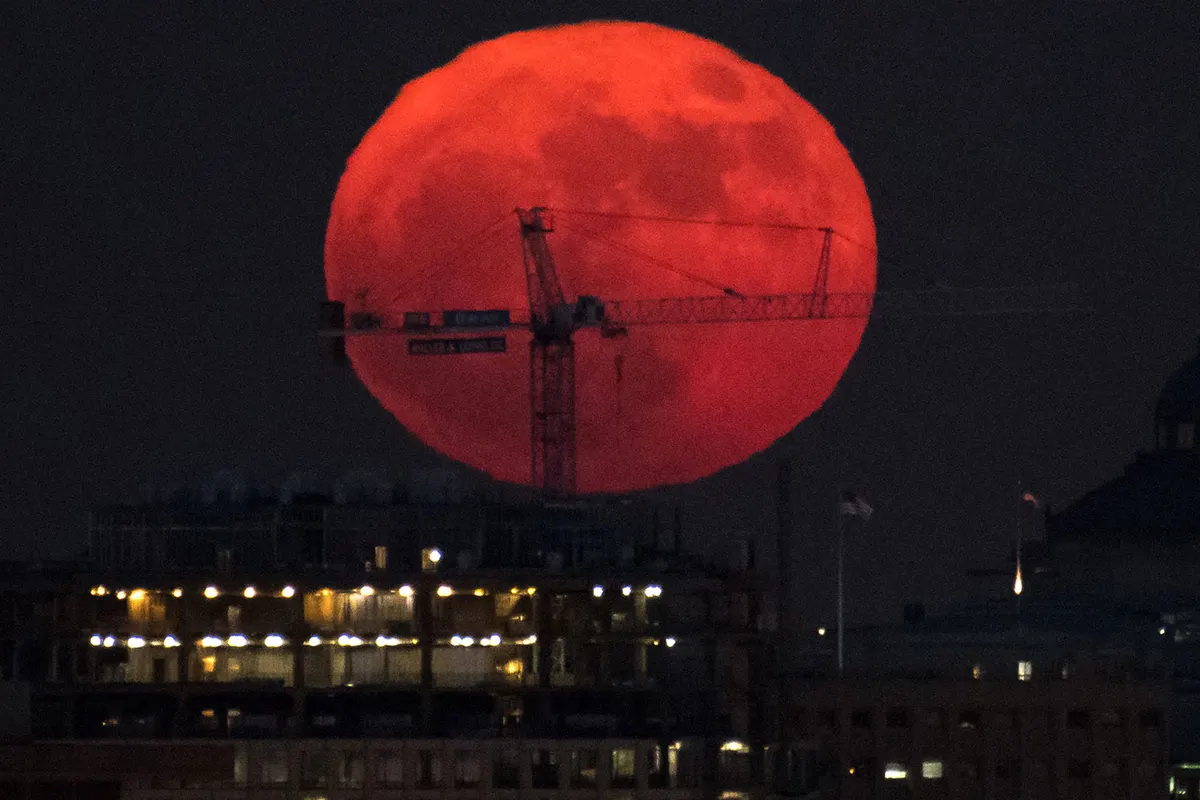
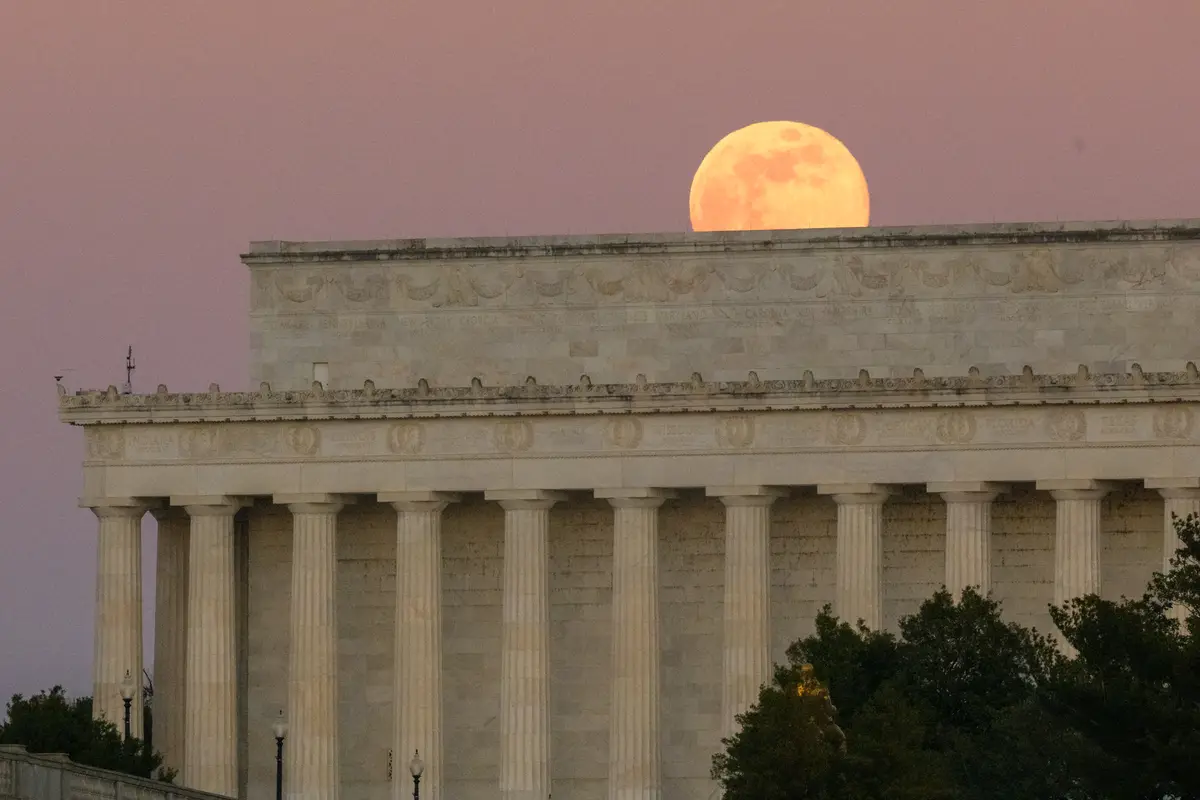
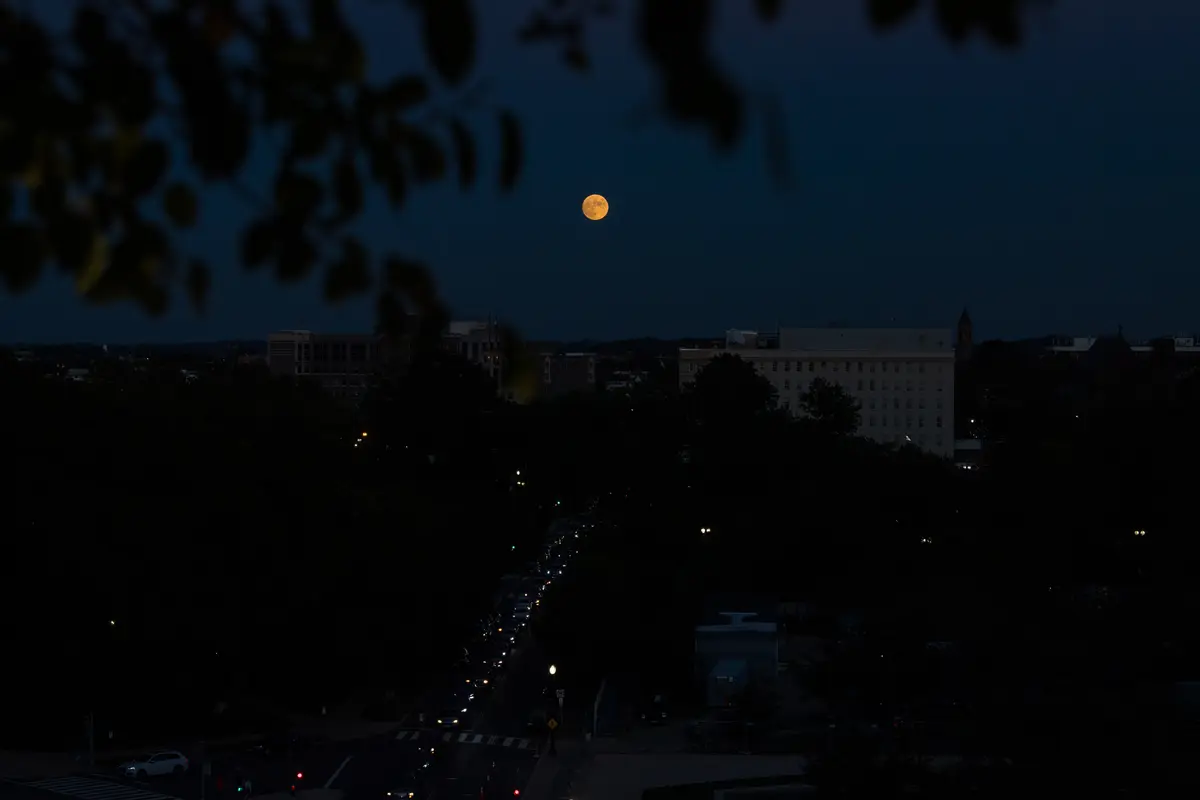
Look east at sunset. A full Moon rises around then, so the best view of the Hunter's Moon comes as it clears the horizon and climbs. Check a local almanac or a sky app for your moonrise time, since it depends on where you live.
- Pick an open view to the east. A hill, a field, the top floor of a parking garage or a beach works. Trees and buildings hide the Moon while it is low.
- Go out for sunset. The Moon comes up around then, so you can watch it climb and see how the sky changes.
- Try more than one night. The evenings of October 24, 25 and 26 all give a nearly full Moon. If it is cloudy on the 25th, you have another try.
- Bring binoculars if you have them. They are optional, but they show more of the dark patches on the Moon's face.
The Moon is full for everyone, so this works in the Southern Hemisphere too. The seasonal name, though, follows the Northern Hemisphere's fall.
What else is in the sky this week?
A few things, and the Moon is part of all of them.
- October 21-22: the Orionid meteor shower peaks. NASA notes that a bright waxing gibbous Moon "will wash out some of the fainter meteors this year." We cover the best time to look in our Orionid meteor shower guide.
- October 25 (UT date October 26): the Hunter's Moon.
- October 27-28: NASA says the Moon passes near the Pleiades star cluster, also known as the Seven Sisters, in the evening sky. Look east. Our Moon and Pleiades guide has the details.
Saturn is also easy to find this month. NASA says it reached opposition on October 4, which makes the ringed planet visible for much of the night.
Why does the Moon change shape every month?
NASA explains that the Sun always lights half of the Moon, and the phases depend on how much of that lit half we can see from Earth as the Moon travels through its orbit. The cycle repeats about every 29.5 days. The Moon takes about 27.3 days to complete one revolution, but 29.5 days to go from one new Moon to the next, because Earth is also moving around the Sun.
That is why a full Moon comes about once a month, and why the Hunter's Moon is followed by a November full Moon about a month later. For more sky events by date, see the Night Sky section.
Frequently asked questions
When is the Hunter's Moon in 2026?
NASA lists the full Moon on October 25, 2026. NASA's hourly Moon data put the peak at about 4 a.m. Universal Time on October 26, which is the night of October 25 in the U.S. Central and Pacific time zones and just after midnight Eastern.
Why is October's full Moon called the Hunter's Moon?
It is the traditional name for the full Moon that follows the Harvest Moon in fall. NASA says that according to lore, this Moon lights the night during a time for hunting. Various Native American tribes also named the October Moon after falling leaves and fattening deer.
What was the Harvest Moon in 2026?
NASA's September 2026 guide put the Harvest Moon on September 26. NASA defines a Harvest Moon as the full Moon nearest the start of fall, the autumnal equinox.
What time does the Hunter's Moon rise?
A full Moon rises around sunset and sets around sunrise, according to NASA. The exact time depends on where you live, so check a local almanac or a sky app for your moonrise time.
Why does the Moon rise at nearly the same time on several nights in fall?
NASA's Earth Observatory says the day-to-day change in moonrise time is smallest in the months around the fall equinox at higher northern latitudes. The reason is the small angle between the horizon and the ecliptic, the path the Sun and Moon follow across the sky.
Do I need a telescope to see the Hunter's Moon?
No. The full Moon is easy to see with your eyes. Binoculars are optional and show more of the dark patches on its face.
Sources
- NASA Science, "What's Up: October 2026 Skywatching Tips from NASA" (accessed October 20, 2026)
- NASA Science, "What's Up: September 2026 Skywatching Tips from NASA" (accessed October 20, 2026)
- NASA Science, "Moon Phases" (accessed October 20, 2026)
- NASA Scientific Visualization Studio, "Moon Phase and Libration, 2026" (hourly data, UT; accessed October 20, 2026)
- NASA Earth Observatory, "Earth from the Moon: A Different Perspective on the Harvest Moon" (published October 4, 2004; updated January 30, 2026)
- NASA Science, "Harvest Moon" (accessed October 20, 2026)
- NASA, "Out With the Harvest, In With the Hunt" (September 19, 2019)
- NASA, Astronomy Picture of the Day, "The Falcon and the Hunter's Moon" (October 14, 2022)

Founder and editor, Orbit and Atom
I write Orbit and Atom to explain space and science in plain English, starting from what NASA, ESA and the mission teams publish. Every article lists its sources at the end so you can read them yourself.