Night Sky
The Moon Meets the Pleiades on Oct. 27-28: How to See It
Quick answer
On the evening of October 27, 2026, the Moon passes within about 1° of the Pleiades star cluster, less than two Moon-widths away at its closest. Look east once the Moon has risen. It will be 95% lit, bright enough to wash out the cluster's fainter stars, so binoculars help you find the cluster. From some places, the Moon even covers a few of its stars.
On this page
The Moon travels past a famous star group almost every month, and most of those meetings go unnoticed. This one is worth stepping outside for. On the night of October 27 the Moon slides right up to the Pleiades, the small, fuzzy cluster of stars also known as the Seven Sisters.
Here is when the two are closest, where to look, what the Moon's glare does to the view and why the whole thing is over within a day.
When does the Moon meet the Pleiades?
NASA's October 2026 skywatching guide says: "Oct. 27–28: The Moon passes near the Pleiades star cluster, also known as the Seven Sisters." NASA's sky chart for the event, looking east, is set for about 11 p.m. on October 27.
NASA's hourly Moon data for 2026 let us work out the closest moment. The Moon is nearest the cluster at about 1 a.m. Universal Time (UT) on October 28, when it is about 0.9° from the cluster's center. That is the evening of October 27 in the United States: about 9 p.m. Eastern, 8 p.m. Central, 7 p.m. Mountain and 6 p.m. Pacific (our conversion). In Central Europe it is about 2 a.m. on October 28.
The gap stays under 2° for roughly six hours, from about 10:30 p.m. UT on October 27 to about 4 a.m. UT on October 28 (our reading of the hourly values). You do not have to be there at the exact minute.
| Evening (U.S.) | Moon lit | Gap from the Pleiades |
|---|---|---|
| October 26 | 99% | About 14° |
| October 27 | 95% | About 1.4° |
| October 28 | 88% | About 16° |
How far the Moon is from the Pleiades on three evenings, at 3 a.m. UT (11 p.m. Eastern, 8 p.m. Pacific). Moon positions and phase are from NASA's hourly data; the gaps are our calculation, measured from the center of the Earth.
A fist held at arm's length covers roughly 10° of sky, so on the evenings before and after, the Moon sits about a fist and a half from the cluster. On October 27 it is almost on top of it.
What are the Pleiades?
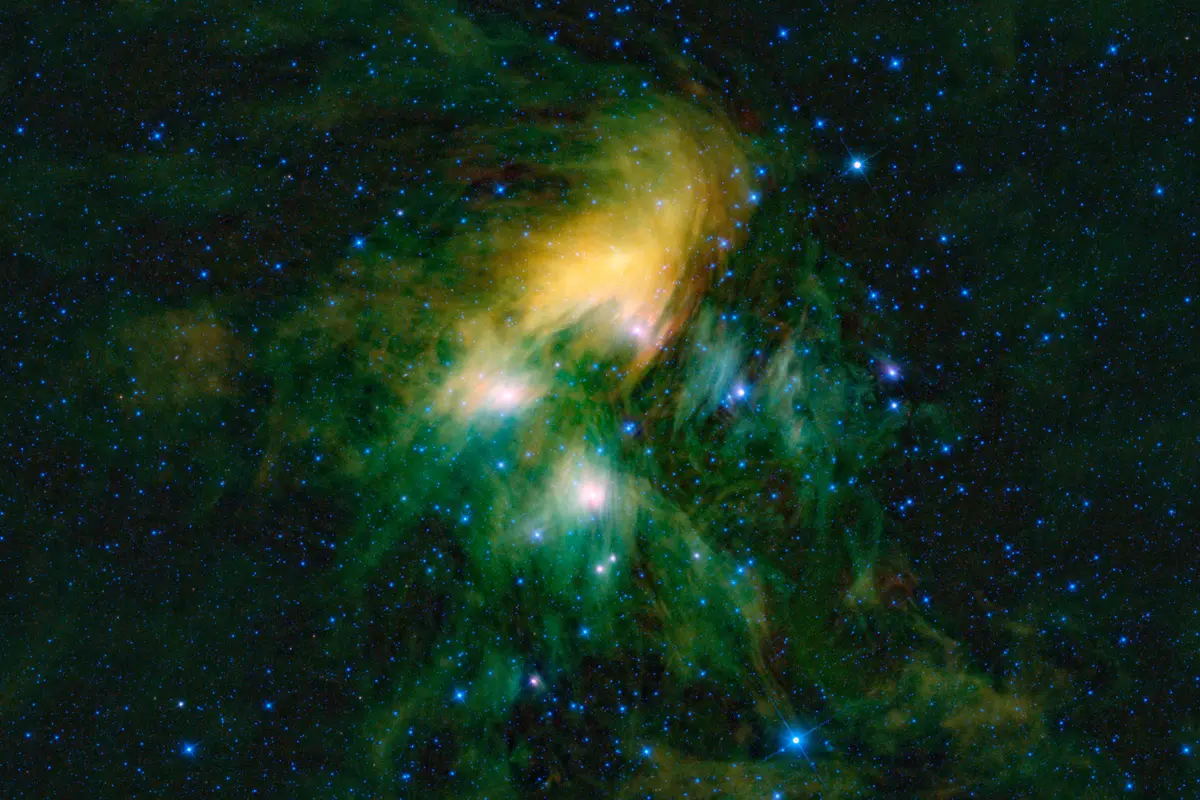
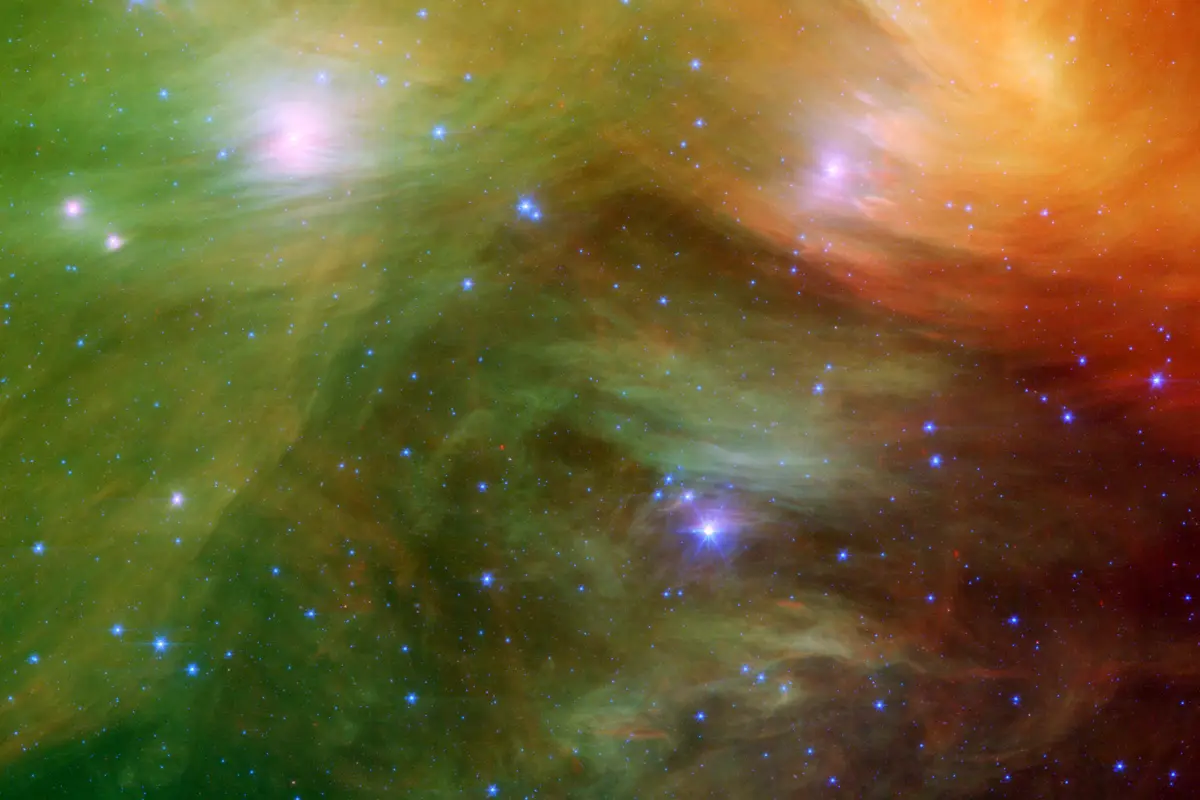
An open star cluster in the constellation Taurus, catalogued as M45. NASA describes an open cluster as a group of stars loosely bound to each other that will eventually go their separate ways. The Pleiades are one of the closest star clusters to Earth. Hubble measured the distance at about 440 light-years, and NASA's WISE team gives about 436. NASA says studies put the cluster's age at about 100 million years, much younger than our Sun, and its Night Sky Network calls them "teenage stars."
The brightest members are the seven sisters and their two parents, according to NASA's Spitzer team, and thousands of fainter stars belong to the cluster too. Because the cluster is about 440 light-years away, the light you see left it in the 1580s (our arithmetic).
Where should you look?
East, in the evening. NASA's advice for the event is to look east as the Moon and the cluster climb higher into the night sky. The bright Moon is the easy part to find.
- Pick a clear view to the east and northeast. Trees and rooftops hide both the Moon and the cluster while they are low.
- Check your moonrise time. The Moon rises in the evening this week. In the Mountain and Pacific time zones the pair is close for a few hours after the Moon clears the horizon.
- Find the Moon, then look beside it. NASA says the Pleiades look like a slightly fuzzy grouping of 6 to 7 stars.
- Use the other bright stars to check your sky. NASA's chart for the evening also marks Capella, Aldebaran, Betelgeuse, Rigel and Saturn.
- Try again on October 26 or 28. The Moon is far from the cluster by then, but the cluster is easier to see without the Moon next to it.
The low Moon may look unusually big as it rises. That is an illusion of perception, not a real change in size; we explain it in our guide to the Moon illusion.
What will you actually see?
A very bright Moon with a faint smudge of stars next to it. The Moon is about 0.55° wide, so at its closest it is about 1.7 Moon-widths from the center of the cluster (our calculation from NASA's data). The chart below shows its path.
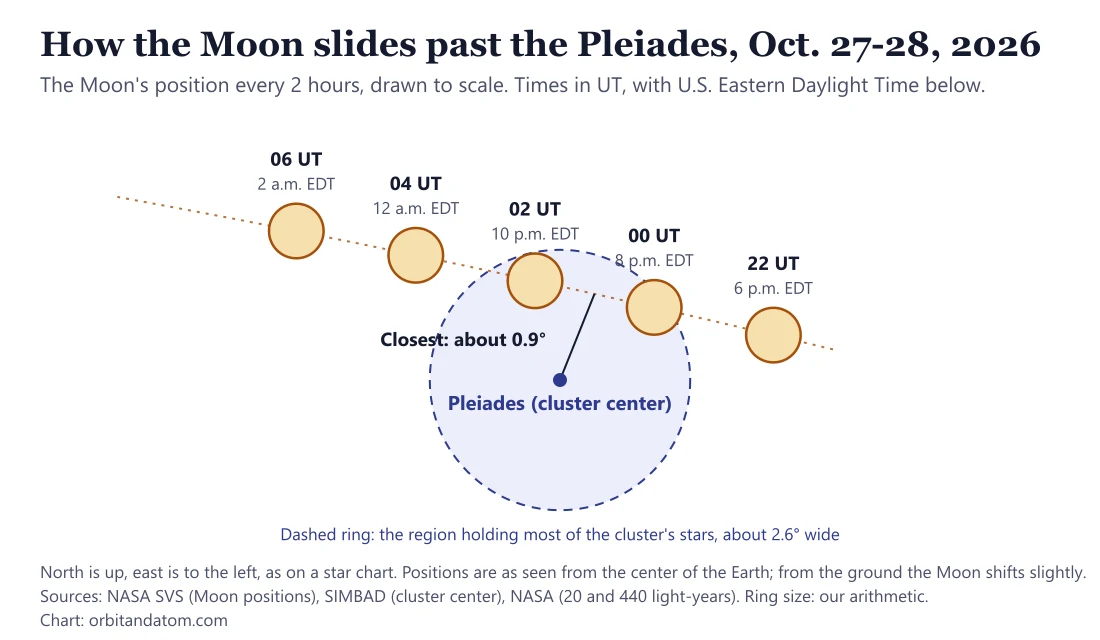
Two things to expect. First, the glare. A Moon that is 95% lit outshines most of the cluster's stars, so you will probably see fewer than the six or seven NASA mentions. Second, the occultation. Astronomy writer Jeffrey Hunt's sky calendar says that on October 27 the Moon "covers stars in the cluster." Whether stars disappear behind the Moon depends on where you stand: our 0.9° gap is measured from the center of the Earth, and from the ground the Moon's position shifts by up to about a degree. NASA's guide describes the event only as the Moon passing near the cluster. For exact times from your town, look for an occultation timetable from a local planetarium or astronomy club.
Do you need binoculars?
You do not need them to see the Pleiades, but they help. NASA says the cluster is "visible to the unaided eye, but binoculars or a telescope reveal more spectacular detail." Its Night Sky Network adds that binoculars bring out lots of extra stars.
With the Moon this close, binoculars have two jobs: finding the cluster and showing the stars the glare hides. Brace your elbows on a fence or a car roof, or move so a roof edge, a tree or your outstretched hand blocks the Moon. Hunt also warns that looking at a bright Moon through binoculars or a telescope can leave an afterimage, like the spots after a camera flash.
Why does the Moon pass the stars so fast?
Because it orbits Earth quickly. NASA says the Moon takes about 27.3 days to complete a revolution. In NASA's hourly data the Moon moves about 14.6° across the sky against the stars in the 24 hours from October 27 to 28, or about 0.6° an hour (our calculation). That is a little more than its own width every hour, which is why the close meeting lasts one evening and not a week.
It is also why the Moon looks different from night to night. NASA notes that the Moon rises later each day, and our Hunter's Moon guide explains the full Moon that came just before this meeting.
What else is in the sky this week?
- October 25: the full Moon, the Hunter's Moon, on NASA's calendar.
- October 27-28: the Moon meets the Pleiades.
- All month: NASA says Saturn reached opposition on October 4, which makes the ringed planet visible for much of the night. Our planets in order guide has the basics.
The Orionid meteor shower peaked on October 21-22, with a bright Moon washing out fainter meteors; our Orionid guide has the details, and the Leonid meteor shower guide covers the next one. For every date in one place, see the meteor shower calendar and the Night Sky section.
Frequently asked questions
When does the Moon pass near the Pleiades?
NASA lists the event on October 27-28, 2026. NASA's hourly Moon data put the closest moment at about 1 a.m. Universal Time on October 28, which is about 9 p.m. Eastern, 8 p.m. Central, 7 p.m. Mountain and 6 p.m. Pacific on October 27 (our conversion).
How close does the Moon get to the Pleiades?
About 0.9° from the center of the cluster at the closest moment, as seen from the center of the Earth (our calculation from NASA data). The Moon is about 0.55° wide, so that is about 1.7 Moon-widths. From the ground, the Moon's position shifts slightly.
Will the Moon cover stars in the Pleiades?
From some places, yes. Astronomy writer Jeffrey Hunt's sky calendar says the Moon covers stars in the cluster on October 27. NASA describes it only as passing near the cluster. Whether it happens where you live depends on your location, so check a local occultation timetable.
Can you see the Pleiades without binoculars?
Yes. NASA says the Pleiades are visible to the unaided eye and look like a slightly fuzzy grouping of 6 to 7 stars. With the Moon this close, its glare will hide the fainter ones, and binoculars help.
How far away are the Pleiades, and how old?
NASA's Hubble measurements put the cluster about 440 light-years away, and NASA's WISE team gives about 436. NASA says studies find the cluster is about 100 million years old, much younger than our Sun.
What is the best night to look?
October 27 is the night of the close meeting. If it is cloudy, the Moon is still near the Pleiades region of sky on October 26 and 28, about 14° to 16° away at 11 p.m. Eastern, and the cluster is easier to see with the Moon farther off.
Sources
- NASA Science, "What's Up: October 2026 Skywatching Tips from NASA" (accessed October 25, 2026)
- NASA Scientific Visualization Studio, "Moon Phase and Libration, 2026" (hourly Moon positions, phase and size, UT; accessed October 25, 2026)
- NASA Night Sky Network, "Spot the Young Stars of the Hyades and Pleiades" (updated November 2023)
- NASA Science, "Hubble Refines Distance to Pleiades Star Cluster" (June 1, 2004)
- NASA Photojournal, "Seven Sisters Get WISE" (updated September 23, 2025)
- NASA Photojournal, "The Seven Sisters Pose for Spitzer" (2007)
- NASA Science, "Moon Phases" (updated August 3, 2026)
- SIMBAD Astronomical Database, Cl Melotte 22 (the Pleiades), cluster coordinates (accessed October 25, 2026)
- Jeffrey L. Hunt, "2026, October 26-28: Moon and Pleiades," When the Curves Line Up (October 17, 2026), an independent sky calendar

Founder and editor, Orbit and Atom
I write Orbit and Atom to explain space and science in plain English, starting from what NASA, ESA and the mission teams publish. Every article lists its sources at the end so you can read them yourself.