Night Sky
Meteor Shower Calendar 2026-2027: Every Major Peak
Quick answer
The meteor shower to plan around this year is the Geminids on Dec. 13-14, 2026: 40 to 50 meteors an hour under a Moon only 15% lit. Seven major showers peak between October and August 2027: Orionids (Oct. 21-22), Leonids (Nov. 16-17), Geminids, Quadrantids (Jan. 3-4), Lyrids (Apr. 22-23), Eta Aquariids (May 5-6) and Perseids (Aug. 12-13). Moonlight will spoil the Orionids, Lyrids and Perseids.
On this page
A meteor shower is easy to plan for once you know three things: the night it peaks, how many meteors you might see, and where the Moon will be. This calendar puts all three in one place for every major shower from this October through August 2027.
It uses peak dates and rates from NASA, and Moon conditions from the American Meteor Society (AMS), which tracks each peak night against that night's Moon.
When is every major meteor shower from 2026 to 2027?
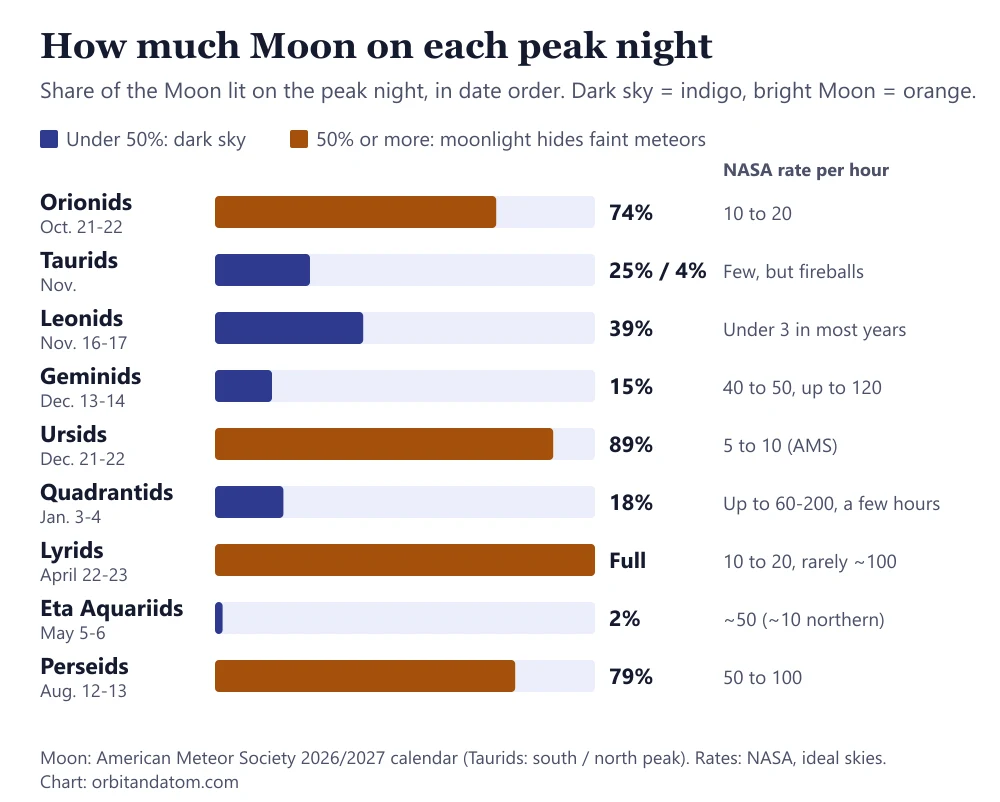
Here are the peaks in order. The "Moon" column shows how much of the Moon is lit on the peak night, as listed in the AMS calendar. A thin Moon leaves the sky dark. A bright one hides the fainter meteors.
| Shower | Peak night | Rate (per hour) | Parent body | Moon |
|---|---|---|---|---|
| Orionids | Oct. 21-22, 2026 | 10 to 20 | Comet 1P/Halley | 74%, waxing gibbous (bright) |
| Taurids | Early to mid-Nov. 2026 (AMS: Nov. 4-5 south, Nov. 11-12 north) | Few, but known for fireballs | Comet 2P/Encke | 25% and 4% (dark) |
| Leonids | Nov. 16-17, 2026 | Fewer than 3 in most years | Comet 55P/Tempel-Tuttle | 39%, waxing crescent |
| Geminids | Dec. 13-14, 2026 | 40 to 50, up to 120 | Asteroid 3200 Phaethon | 15%, waxing crescent (dark) |
| Ursids | Dec. 21-22, 2026 (AMS) | 5 to 10 (AMS) | Comet 8P/Tuttle (AMS) | 89%, waxing gibbous (bright) |
| Quadrantids | Jan. 3-4, 2027 | Up to 60 to 200, for a few hours | Asteroid 2003 EH1 | 18%, waning crescent (dark) |
| Lyrids | April 22-23, 2027 (AMS: April 21-22) | 10 to 20, rarely about 100 | Comet C/1861 G1 Thatcher | Full Moon (bright) |
| Eta Aquariids | May 5-6, 2027 | About 50 (about 10 in the Northern Hemisphere) | Comet 1P/Halley | 2%, waning crescent (dark) |
| Perseids | Aug. 12-13, 2027 | 50 to 100 | Comet 109P/Swift-Tuttle | 79%, waxing gibbous (bright) |
Peak nights, rates, parent bodies and Moon conditions. Dates and rates: NASA unless marked. Moon: AMS 2026/2027 calendar. Rates are NASA's figures for ideal sky conditions, so expect fewer from a typical backyard.
The highlighted rows are the three showers that pair a good rate with a thin Moon. The AMS shower pages and its calendar differ by a few percentage points on some Moon figures, so treat the percentages as a guide and check a sky app the week of the peak.
Which meteor showers are the best to watch?
Going by the NASA rates and the AMS Moon figures above, three stand out.
- Geminids, Dec. 13-14, 2026. NASA lists 40 to 50 meteors an hour under dark skies, and up to 120 in perfect conditions. The Moon is only 15% lit. NASA also notes the Geminids come from an asteroid, 3200 Phaethon, not a comet.
- Quadrantids, Jan. 3-4, 2027. NASA says the peak is "much shorter" than most, only a few hours, and lists up to 60 to 200 meteors an hour in perfect conditions. The AMS puts the predicted peak near 3:30 UT on Jan. 4 and says it favors Europe and western Asia. The Moon is a thin 18% crescent.
- Eta Aquariids, May 5-6, 2027. The Moon is almost new, at 2%. NASA says the Southern Hemisphere is the better place to watch: it lists about 50 meteors an hour at the peak, but only about 10 for the Northern Hemisphere.
The Perseids, usually the most popular shower of the year, face a 79% Moon in 2027, so the AMS expects significant interference. They are still worth a look, especially in the hours when the Moon is low or down.
What is the next meteor shower?
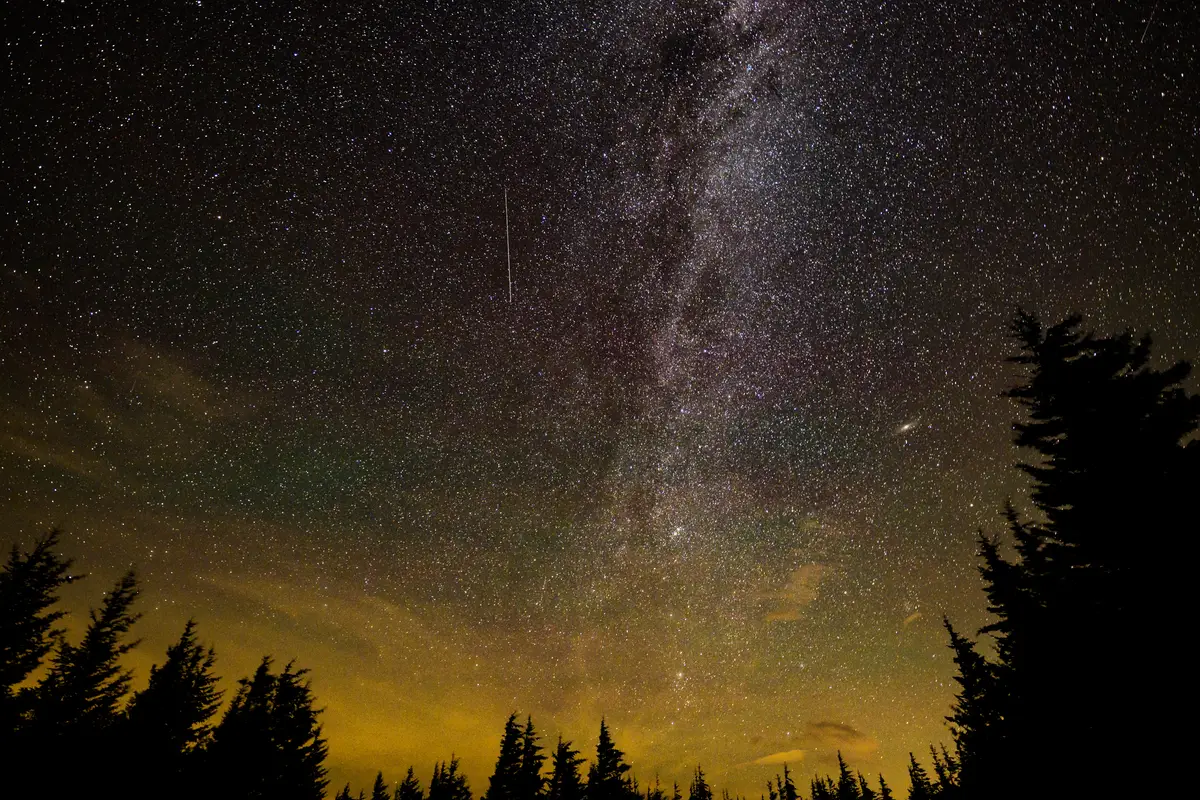
The Orionids, on the night of October 21 into the morning of October 22. NASA says a bright waxing gibbous Moon "will wash out some of the fainter meteors this year" and that the best chance may come in the few hours before dawn, after the Moon sets. The Moon grows to full a few days later, as we explain in our Hunter's Moon guide.
After that come the Taurids. NASA says they are fast meteors, about 65,000 mph (104,607 kph), and that the shower "often" shows fireballs on or around Halloween. The AMS lists two peaks, a southern one around November 4-5 and a northern one around November 11-12, both under a very small Moon. Then the Leonids arrive on November 16-17.
Why are the Leonids famous if they are so faint most years?
Because of the storms. NASA says the Leonids often produce as few as three meteors an hour, but about every 33 years the debris from comet 55P/Tempel-Tuttle peaks as a storm. In 1966, NASA says, thousands of meteors a minute fell through Earth's atmosphere during a 15-minute period. The last Leonid storm took place in 2002, and the AMS says the next dense debris encounter is expected in 2099. A normal year, like 2026, is a quiet one. Our Leonid guide for 2026 has the best hours to look.
Why does the same meteor shower come back every year?
NASA explains that a meteor shower happens when Earth passes through the trail of dusty debris left by a comet. Earth crosses the same trails at about the same point in its orbit each year, so the showers return on nearly the same dates. NASA's example is the Perseids, which peak around August 12 every year.
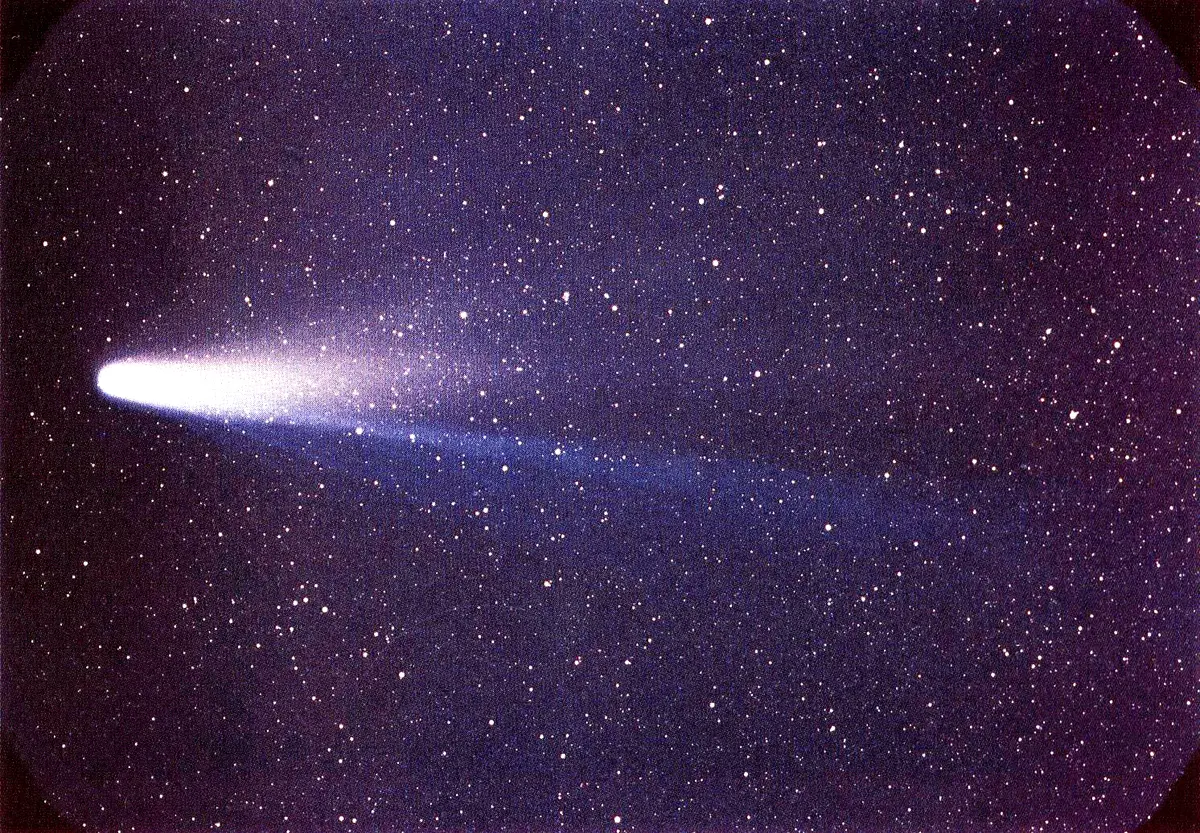
Most showers come from comets. The Perseids come from comet 109P/Swift-Tuttle, and the Orionids and Eta Aquariids both come from Halley's comet. A few come from asteroids instead. NASA says the Geminids come from 3200 Phaethon and the Quadrantids from 2003 EH1, which may be a "dead comet."
The pieces are small. NASA says meteoroids range from dust grains to small asteroids. While one is in space it is a meteoroid. When it enters the atmosphere at high speed and burns up, it is a meteor, the streak you see. If a piece survives and lands, it is a meteorite.
How do you watch a meteor shower?
NASA's shower pages give the same short advice, and it works for every shower on this list.
- Get away from city lights. A park, a field or a dark road works much better than a lit street.
- Lie flat on your back and take in as much of the sky as you can. NASA suggests feet toward the south for the Geminids, toward the east for the Leonids, the Lyrids and the Eta Aquariids.
- Give your eyes about 30 minutes to adjust. NASA says your eyes will adapt in about that time, and the meteors become easier to see.
- Dress for the cold. NASA suggests a sleeping bag, blanket or lawn chair, especially for the winter showers.
- Check the Moon. For the Lyrids, NASA's advice is to watch in the dark hours after moonset and before dawn.
You do not need a telescope or binoculars. They narrow your view and make meteors harder to catch. For more sky events by date, see our Night Sky section.
Frequently asked questions
When is the next meteor shower?
The Orionids, on the night of October 21 into the morning of October 22, 2026. NASA says a bright waxing gibbous Moon will wash out some of the fainter meteors, and the best chance may come in the few hours before dawn, after the Moon sets.
What is the best meteor shower of 2026-2027?
The Geminids, on December 13-14, 2026, are the strongest of the group with a thin Moon. NASA lists 40 to 50 meteors an hour under dark skies and up to 120 in perfect conditions, and the AMS lists the Moon at 15%.
When are the Perseids in 2027?
NASA lists the Perseid peak night as August 12-13, and says the shower peaks around August 12 every year. The AMS lists the Moon at 79% on that night in 2027, so expect significant moonlight.
Are the Lyrids on April 21-22 or April 22-23, 2027?
NASA lists the peak night as April 22-23, 2027. The AMS calendar lists April 21-22 and a full Moon. Both are within the same two-night window, so look on both nights, after the Moon sets if you can.
Why are the Quadrantids hard to catch?
NASA says their peak is much shorter than most showers, only a few hours, compared with about two days for others. The AMS puts the predicted peak near 3:30 UT on January 4, 2027, and says it favors Europe and western Asia.
Do I need a telescope to watch a meteor shower?
No. NASA's advice is to find a dark spot away from city lights, lie flat, look up to take in as much sky as possible and give your eyes about 30 minutes to adjust.
Where do meteors in a shower come from?
Mostly from comets. NASA says a shower happens when Earth passes through the trail of dusty debris a comet left behind. The Geminids and Quadrantids come from asteroids instead.
Sources
- NASA Science, "Meteor Showers" (last updated September 21, 2026; accessed October 20, 2026)
- American Meteor Society, "2026/2027 Meteor Shower Calendar" (Moon conditions, Ursids and Taurids; accessed October 20, 2026)
- NASA Science, "What's Up: October 2026 Skywatching Tips from NASA" (accessed October 20, 2026)
- NASA Science, "Orionids" (last updated August 13, 2026)
- NASA Science, "2P/Encke" (last updated November 3, 2024)
- NASA Science, "Leonids" (last updated August 13, 2026)
- NASA Science, "Geminids" (last updated August 13, 2026)
- NASA Science, "Quadrantids" (last updated August 13, 2026)
- NASA Science, "Lyrids" (last updated August 13, 2026)
- NASA Science, "Eta Aquariids" (last updated August 13, 2026)
- NASA Science, "Perseids" (last updated August 13, 2026)
- NASA Science, "Meteors & Meteorites: Facts" (last updated February 14, 2025)

Founder and editor, Orbit and Atom
I write Orbit and Atom to explain space and science in plain English, starting from what NASA, ESA and the mission teams publish. Every article lists its sources at the end so you can read them yourself.