Solar System & Missions
The Planets in Order From the Sun, With Sizes and Distances
Quick answer
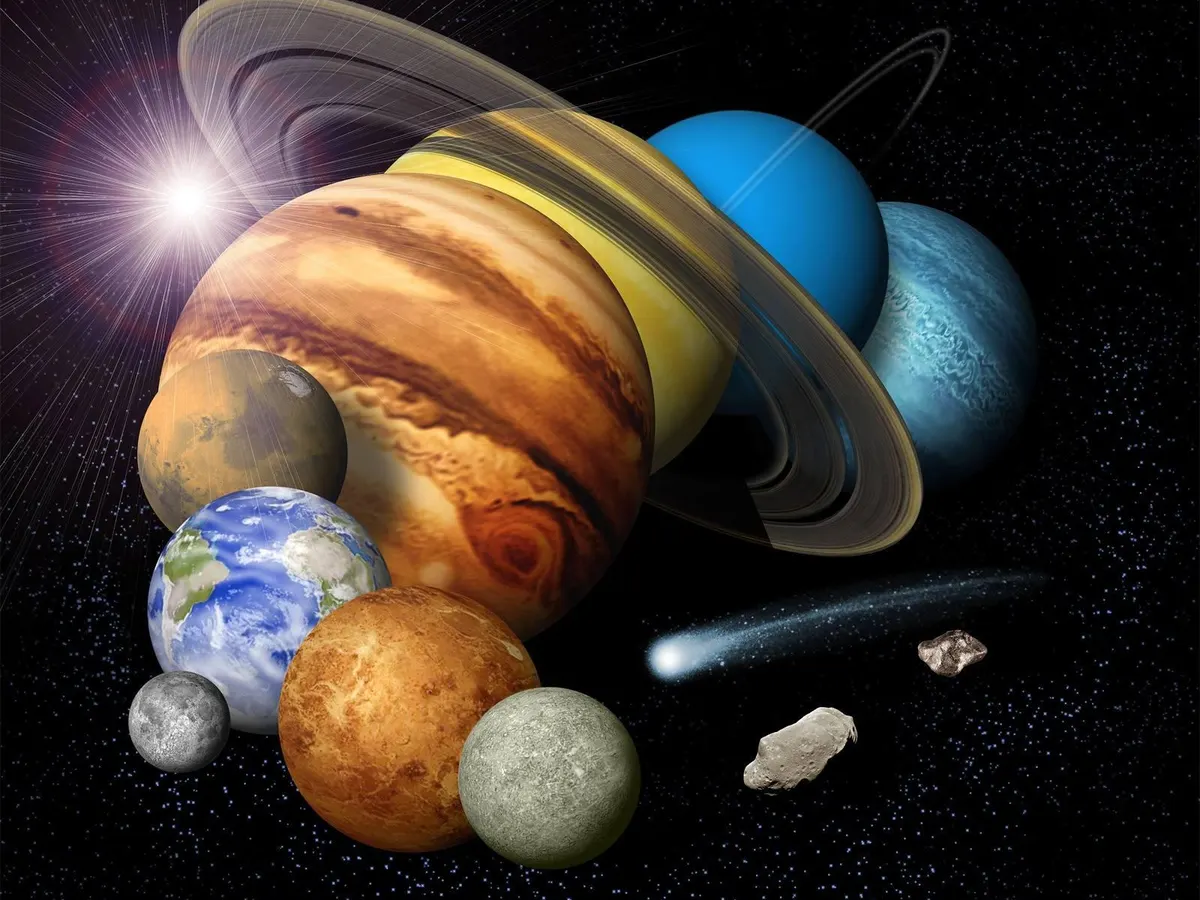
The eight planets in order from the Sun are Mercury, Venus, Earth, Mars, Jupiter, Saturn, Uranus and Neptune. Mercury is closest, about 36 million miles (58 million km, or 0.4 AU) away. Neptune is farthest, about 2.8 billion miles (4.5 billion km, or 30 AU). Jupiter is the largest planet and Mercury the smallest. Pluto is not on the list: NASA counts it as one of five dwarf planets.
On this page
Our solar system has eight planets, and they always come in the same order. The order is easy to learn. The sizes and distances are the part that surprises people, because the gaps between the outer planets are much bigger than the gaps between the inner ones.
Here is the full list, from the Sun outward, with the numbers NASA publishes for each planet: distance, size, how long a day and a year last, and how many moons each one has.
What are the planets in order from the Sun?
NASA's planet guide gives the order this way: Mercury, Venus, Earth, Mars, Jupiter, Saturn, Uranus and Neptune. Mercury is closest to the Sun, and Neptune is the eighth and most distant planet. NASA says the solar system has "eight planets," and that the count changed from nine to eight in 2006, when Pluto was reclassified (more on that below).
- Mercury, the smallest planet
- Venus, the sixth largest
- Earth, the fifth largest
- Mars, the seventh largest
- Jupiter, the largest
- Saturn, the second largest
- Uranus, the third largest
- Neptune, the fourth largest
Notice that size does not follow the order. The four planets closest to the Sun are the small ones, and the next four are far bigger. Between Mars and Jupiter, the fourth and fifth planets, lies the main asteroid belt.
How far is each planet from the Sun?
Astronomers measure these distances in astronomical units (AU). One AU is the distance from the Sun to Earth, so the number tells you how many "Earth distances" a planet sits from the Sun. NASA's figures:
(m,t,p)=>t+fig('/img/planets-distance-from-sun-in-au-chart.webp','Bar chart of the average distance of the eight planets from the Sun in astronomical units, from 0.4 for Mercury to 30 for Neptune',1000,666,'Average distance from the Sun, in astronomical units (1 AU = the Earth-Sun distance). Chart: Orbit and Atom, from NASA planet Quick Facts.')+p than the last one. From Earth to Mars the gap is about 0.5 AU. From Uranus to Neptune it is about 11 AU. Neptune sits about 30 times farther from the Sun than we do.Distances are averages because planetary orbits are not perfect circles. The AU is the right ruler inside the solar system, but it is too small for the stars. For that you need the light-year, which we explain in How Far Is a Light-Year?
How big is each planet?
From smallest to largest, NASA's size ranking runs Mercury, Mars, Venus, Earth, Neptune, Uranus, Saturn and Jupiter. The table above shows how lopsided it is. Jupiter is about 139,822 km across, which is roughly 11 times the width of Earth (our arithmetic: 139,822 divided by 12,756). Earth and Venus are close to twins in size, 12,756 km against 12,104 km.
Uranus and Neptune are nearly the same size too, at 51,118 km and 49,528 km, and both are about four times as wide as Earth (our arithmetic). Mercury, at about 4,880 km, is only a little more than a third of Earth's width.
Mars is the one most often pictured as a small red world. If you wonder why it looks red, we cover it in Why Is Mars Red? The Answer Changed in 2025. Seen at its real size, it is a little more than half the width of Earth (our arithmetic: 6,780 divided by 12,756).
How long are a day and a year on each planet?
A "day" here means one full spin of the planet, and a "year" means one trip around the Sun. Both change a lot from planet to planet.
| Planet | One rotation (day) | One orbit (year) | Moons |
|---|---|---|---|
| Mercury | 59 Earth days | 88 Earth days | 0 |
| Venus | 243 Earth days | 225 Earth days | 0 |
| Earth | 23.9 hours | 365.25 days | 1 |
| Mars | 24.6 hours | 687 Earth days | 2 |
| Jupiter | About 9.9 hours | About 12 Earth years | 115 |
| Saturn | About 10.7 hours | About 29.4 Earth years | 293 |
| Uranus | About 17 hours | About 84 Earth years | 29 |
| Neptune | About 16 hours | About 165 Earth years | 16 |
Rotation period ("day"), orbital period ("year") and known moons. Source: NASA planet Quick Facts, accessed October 20, 2026; Saturn and Uranus moon counts from NASA's moons pages, as of August 2026.
A few of these are strange. On Venus, a day is longer than a year: it turns once every 243 Earth days but circles the Sun in 225. NASA adds that Venus spins in the opposite direction from most planets, so the Sun rises in the west and sets in the east.
Mercury has its own twist. It turns once every 59 Earth days, but NASA says a full day-night cycle there, from one sunrise to the next, lasts 176 Earth days. That is exactly two Mercury years (our arithmetic: 2 times 88).
The giants spin fast. Jupiter has the shortest day on the list, about 9.9 hours, even though it is by far the biggest planet. At the other end, one year on Neptune lasts about 165 Earth years. NASA also notes that Uranus is tilted by 97.77 degrees, which means it spins almost on its side.
Mars is the one with a day most like ours: 24.6 hours, against Earth's 23.9. Its year, though, lasts 687 Earth days, or about 1.9 Earth years (our arithmetic).
How many moons does each planet have?
It depends on the planet, and the counts keep growing. Mercury and Venus have none, although NASA notes that Venus has a quasi-satellite named Zoozve, a near-Earth asteroid that stays close to the planet. Earth has one Moon, and Mars has two, Phobos and Deimos.
The outer planets have far more. NASA lists 115 officially recognized moons for Jupiter, 293 confirmed for Saturn (as of August 2026, with more waiting for confirmation and official naming), 29 for Uranus and 16 for Neptune. Moon counts change as new ones are found, so check NASA's pages for the latest numbers. NASA also says the four giant planets have rings. Saturn's are the famous ones, and they can nearly vanish from view: see Where Did Saturn's Rings Go? Why They Looked So Thin.
What lies between and beyond the planets?
NASA says most asteroids orbit the Sun between Mars and Jupiter, in the main asteroid belt. Its Solar System page counts about 1.4 million asteroids and about 4,000 comets in total.
NASA says there are five officially recognized dwarf planets: Ceres, Pluto, Haumea, Makemake and Eris. They are not counted among the eight planets.
Why is Pluto not one of the planets anymore?
Because the definition changed in 2006. NASA explains that the International Astronomical Union (IAU) defined a dwarf planet as an object that orbits the Sun and is "large enough to pull itself into a nearly round shape," but "has not been able to clear its orbit of debris." Pluto fits that description, and the change "reduced the solar system census from nine planets to eight."
Pluto is still a fascinating world. NASA lists it at about 1,477 miles (2,377 km) across, about 39 AU from the Sun, with a year of about 248 Earth years and five known moons: Charon, Nix, Hydra, Kerberos and Styx. For a spacecraft that has gone farther still, read Voyager 1 Will Be One Light-Day From Earth on Nov. 18, 2026.
Frequently asked questions
What are the planets in order from the Sun?
Mercury, Venus, Earth, Mars, Jupiter, Saturn, Uranus and Neptune. Mercury is the closest to the Sun and Neptune is the farthest.
How many planets are in the solar system?
Eight, according to NASA. The solar system also has five officially recognized dwarf planets: Ceres, Pluto, Haumea, Makemake and Eris.
Which planet is the biggest and which is the smallest?
Jupiter is the largest planet and Mercury is the smallest, according to NASA. Saturn is second largest, then Uranus, Neptune, Earth, Venus and Mars.
What is an astronomical unit (AU)?
It is the average distance from the Sun to Earth, about 93 million miles or 150 million kilometers. Astronomers use it to measure distances inside the solar system, such as 30 AU for Neptune.
Which planet has the longest day?
Venus. It takes about 243 Earth days to rotate once, which is longer than its 225-day year, according to NASA.
Which planet has the most moons?
Saturn, with 293 confirmed moons as of August 2026, according to NASA. Jupiter has 115 officially recognized moons. The counts change as more moons are confirmed.
Why is Pluto not a planet?
In 2006 the International Astronomical Union defined a dwarf planet as an object that orbits the Sun and is large enough to be nearly round, but has not cleared its orbit of debris. Pluto fits that description, so NASA counts it as a dwarf planet.
Sources
- NASA Science, "About the Planets" (page last updated October 14, 2026; accessed October 20, 2026)
- NASA Science, "Our Solar System" (page last updated October 19, 2026; accessed October 20, 2026)
- NASA Science, "Mercury Facts" (accessed October 20, 2026)
- NASA Science, "Venus Facts" (accessed October 20, 2026)
- NASA Science, "Earth Facts" (accessed October 20, 2026)
- NASA Science, "Mars Facts" (accessed October 20, 2026)
- NASA Science, "Jupiter Facts" (accessed October 20, 2026)
- NASA Science, "Saturn Facts" (accessed October 20, 2026)
- NASA Science, "Saturn Moons" (count as of August 2026; page last updated September 22, 2026; accessed October 24, 2026)
- NASA Science, "Uranus Moons" (count as of August 2026; page last updated September 22, 2026; accessed October 24, 2026)
- NASA Science, "Uranus Facts" (accessed October 20, 2026)
- NASA Science, "Neptune Facts" (accessed October 20, 2026)
- NASA Science, "Pluto Facts" (accessed October 20, 2026)
- NASA Science, "Asteroids" (page last updated September 21, 2026; accessed October 20, 2026)
- NASA/JPL, "Solar System Montage with Eight Planets Artist Concept" (PIA10969)
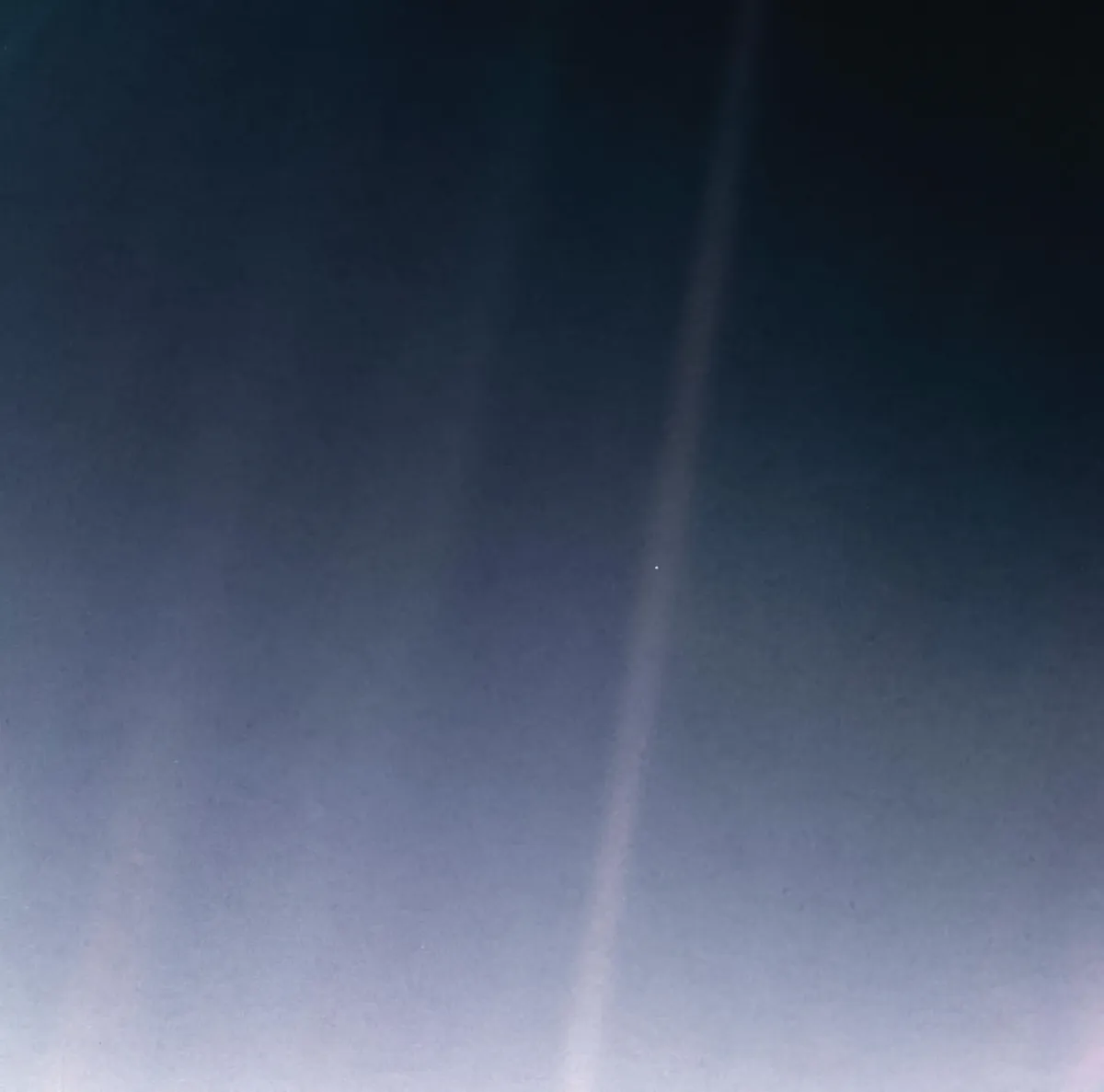
- NASA/JPL-Caltech, "Pale Blue Dot Revisited" (PIA23645)

Founder and editor, Orbit and Atom
I write Orbit and Atom to explain space and science in plain English, starting from what NASA, ESA and the mission teams publish. Every article lists its sources at the end so you can read them yourself.