Solar System & Missions
When Will Halley's Comet Return? What to Expect in 2061
Quick answer
Halley's Comet returns in 2061. A 2025 research paper predicts its closest pass to the Sun on July 28, 2061, on a loop that averages 76 years. It reached the farthest point of its orbit, beyond Neptune, on December 9, 2023, and is now heading back in. Unlike in 1986, it will be on the same side of the Sun as Earth, which should make it an easier sight.
On this page
- When will Halley's Comet return?
- Where is Halley's Comet right now?
- What will Halley's Comet look like in 2061?
- Who first worked out that Halley's Comet comes back?
- What did spacecraft learn about Halley in 1986?
- Will a spacecraft meet Halley in 2061?
- Can you see Halley's Comet before 2061?
- FAQ
- Sources
Halley's Comet is the one comet many people can hope to see twice in a lifetime, and it is on its way back right now. You just can't see it yet. It is out beyond Neptune, far too faint for any telescope you can buy, and it will not reach the inner solar system for another 35 years.
Here is when it comes back, where it is today, what to expect in 2061, and the one way you can see a piece of Halley this very month.
When will Halley's Comet return?
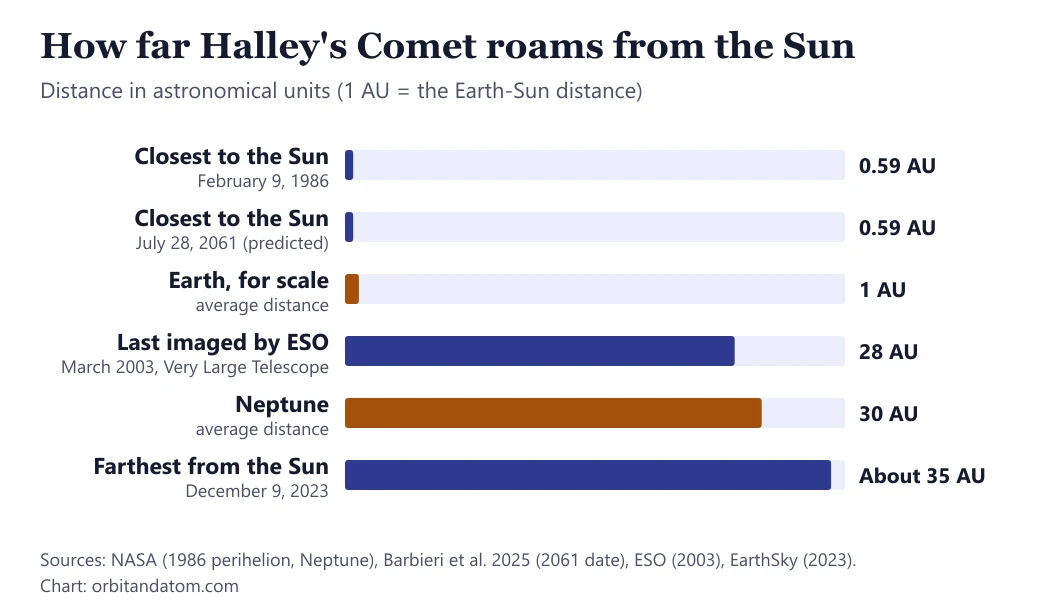
In 2061. NASA says the comet "will return in 2061 on its regular 76-year journey around the Sun." The most detailed date we found comes from a 2025 research paper by Barbieri and colleagues: closest approach to the Sun, called perihelion, on July 28, 2061, at about 0.59 AU. That is roughly six tenths of the Earth-Sun distance, well inside the orbit of Earth.
Treat the date as a prediction, not a promise. The "76 years" is an average. NASA lists Halley's orbit as short as 74.42 years (1835 to 1910) and as long as 79.25 years (451 to 530), and EarthSky notes its path cannot be predicted with perfect precision. The last perihelion was on February 9, 1986, so a perihelion on July 28, 2061 makes this lap about 75.5 years (our arithmetic), a little shorter than average.
The comet has been on this orbit for a long time. NASA says it has followed its current path for at least 16,000 years, and that each trip around the Sun strips an estimated 1 to 3 meters of material from its surface.
Where is Halley's Comet right now?
Far from the Sun, and coasting back. Halley reached the farthest point of its orbit, called aphelion, on December 9, 2023. NASA lists that farthest distance as 35.25 AU, or 5.27 billion kilometers, well beyond the orbit of Neptune. Since then it has been falling back toward the Sun.
The last time anyone photographed it was in March 2003, when ESO's Very Large Telescope in Chile caught it at 28.06 AU as a point of light of magnitude 28.2, nearly a billion times fainter than the faintest star you can see with your eyes in a dark sky. ESO's team concluded that "all cometary activity has now ceased": out there Halley is a dark, quiet lump of ice and rock, with no glowing head and no tail. Sunlight will wake it up again as it comes in.
What will Halley's Comet look like in 2061?
Better placed than in 1986, with one honest caveat: nobody knows yet exactly how bright it will be. The 2025 paper says Halley "will be better positioned for observation from terrestrial observers than during the 1985-1986 apparition," because this time it will be on the same side of the Sun as Earth. Closest approach to Earth comes on July 29, 2061, one day after perihelion, at 0.477 AU (about 71.4 million kilometers).
| Halley's Comet | 1986 | 2061 (predicted) |
|---|---|---|
| Closest to the Sun | Feb. 9 (0.59 AU) | July 28 (0.59 AU) |
| Closest to Earth | 0.42 AU | July 29 (0.48 AU) |
| Position | Less favorable | Same side as Earth |
| Brightness | About 2, like Polaris | About -0.3 to -3 |
Halley's Comet in 1986 and in 2061. Brightness is in magnitudes: lower is brighter. 1986: NASA, Scientific American. 2061: predictions from Barbieri et al. (2025), Scientific American (2014) and Eni Scuola (2024).
Two things stand out. First, Halley will not come closer to Earth than in 1986; the gain is in the timing. It passes closest to Earth just a day after it passes closest to the Sun, so it should be near its brightest when it is near us. Second, the brightness forecasts disagree. Scientific American gave about -0.3 in 2014, and Eni Scuola gave about -3, "clearly visible to the naked eye," in 2024. In astronomy, lower numbers are brighter, so both are brighter than 1986. But a comet is a fuzzy patch, which looks fainter than a star with the same number. In 2014, NASA's Bill Cooke put it plainly: "It's not going to be a fairly spectacular apparition."
We found no sky chart for 2061 from NASA or ESA, so how high Halley will climb, and from which parts of the world it will look best, is still an open question. Forecasts made 35 years ahead will keep changing as astronomers track the comet on its way in.
Who first worked out that Halley's Comet comes back?
People have been watching it for a very long time. NASA says sightings linked to Halley go back more than 2,000 years, and the comet appears in the Bayeux Tapestry, which shows the sky of 1066. In 1705, Edmond Halley used Newton's theory of gravity to show that the bright comets of 1531, 1607 and 1682 were one comet, and predicted it would return in 1758. It carries his name today.

The closest Halley has ever come to Earth, according to NASA, was in the year 837, at 0.033 AU (about 4.9 million kilometers, our arithmetic), when it reached about magnitude -3.5.
What did spacecraft learn about Halley in 1986?
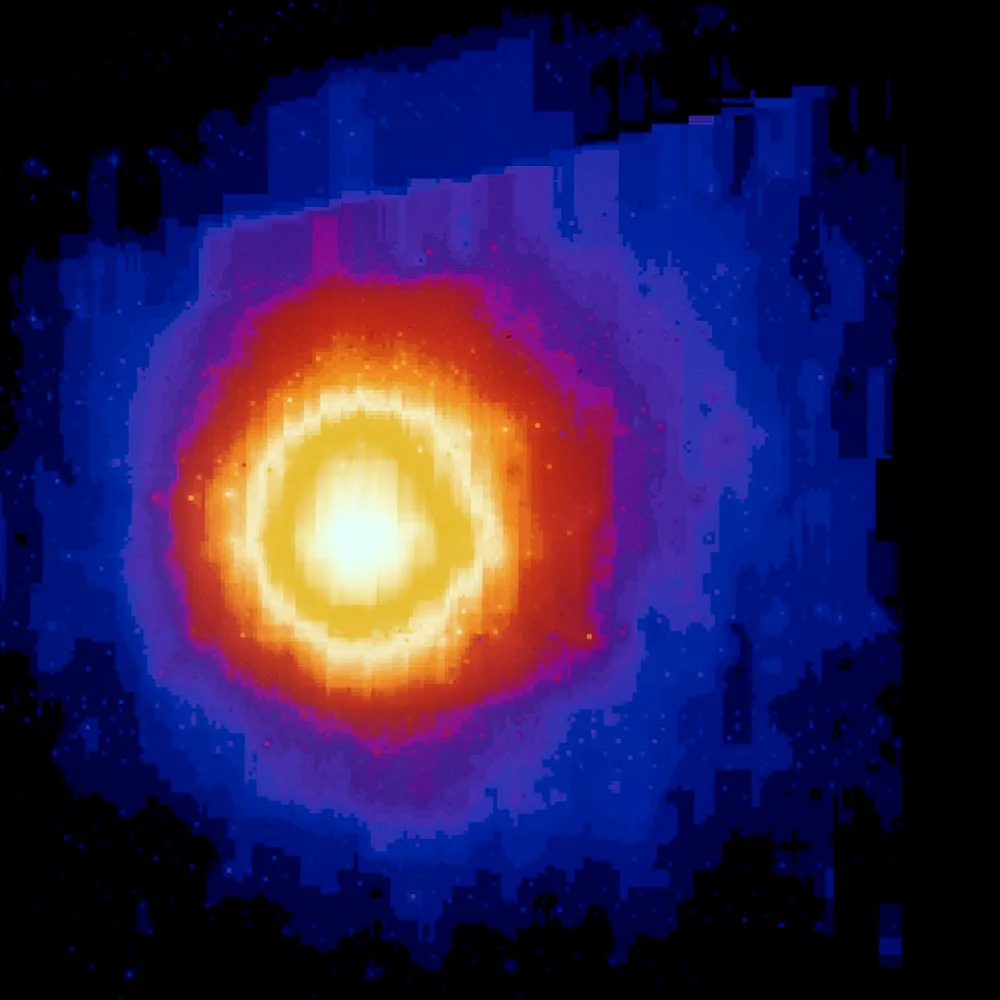
A lot, because for the first time a fleet of spacecraft went to meet a comet. NASA lists Japan's Suisei and Sakigake, the Soviet Union's Vega 1 and Vega 2, the international ISEE-3, and Europe's Giotto. ESA's Giotto went closest: it passed within 596 kilometers of the nucleus on March 14, 1986. It found that "the surface is very dark and that bright jets of gas and dust spring out of its nucleus," and "found the first evidence of organic material in a comet," in ESA's words.
NASA puts the nucleus at about 9.3 by 5 miles (15 by 8 kilometers), with an albedo of 0.03: it reflects only about 3% of the light that hits it, which makes it one of the darkest objects in the solar system. Giotto paid for its close look. ESA says a particle weighing about one gram hit the spacecraft 7.6 seconds before closest approach, sent it spinning and cut off contact with Earth. Giotto survived, contact was restored within 32 minutes, and in 1992 it flew past a second comet, Grigg-Skjellerup, at a distance of just 100 to 200 kilometers.
Will a spacecraft meet Halley in 2061?
It could, but nothing is approved. The 2025 paper that gives the 2061 dates proposes a mission called HCREM, which would not fly past Halley but rendezvous with it and stay alongside. In the plan, the spacecraft leaves Earth on August 18, 2036, gets a boost from Jupiter on September 3, 2037, and meets the comet on October 2, 2056, at about 13 AU, while the comet is still far from the Sun. It would use nuclear-powered electric thrusters. The authors say the scenario "requires launching before 2040."
That is a research proposal in a paper submitted to a scientific journal, not a funded mission, and we found no space agency announcement for it. For a spacecraft that really is on a long road out, see Voyager 1 Will Be One Light-Day From Earth on Nov. 18, 2026.
Can you see Halley's Comet before 2061?
Not the comet, but you can see a piece of it. NASA says debris from Halley's nucleus makes two weak meteor showers every year: the Eta Aquariids in May and the Orionids in October. When Earth crosses the trail, grains left behind by earlier passes burn up in our atmosphere as streaks of light. The Orionids peaked on the night of October 21 to 22, 2026, and stay active, at a lower rate, until early November. We explain how to watch them in Orionid Meteor Shower 2026: Peak Night and When to Look.
The next one is the Eta Aquariids, with a peak around May 5-6, 2027. Dates for every major shower are in the Meteor Shower Calendar 2026-2027. To see how far out Halley's path reaches compared with the planets, including Neptune, see Planets in Order From the Sun, With Sizes and Distances, and for how to think about such distances, How Far Is a Light-Year? Space Distances Made Simple.
Frequently asked questions
When will Halley's Comet return?
NASA says it will return in 2061. A 2025 research paper predicts its closest approach to the Sun on July 28, 2061, and its closest approach to Earth on July 29, 2061. Dates this far ahead are predictions and can shift.
When was Halley's Comet last seen?
Its last perihelion was on February 9, 1986, and a fleet of spacecraft met it that year. The last time it was photographed at all was in March 2003, by ESO's Very Large Telescope, at 28 AU from the Sun.
Where is Halley's Comet now?
Far beyond Neptune, heading back toward the Sun. It reached the farthest point of its orbit on December 9, 2023. NASA lists that distance as 35.25 AU, or 5.27 billion kilometers.
How often does Halley's Comet come back?
About every 76 years on average. NASA lists individual orbits from 74.42 years to 79.25 years, so the exact date changes from one return to the next.
How bright will Halley's Comet be in 2061?
No one knows exactly. Scientific American gave a forecast of about magnitude -0.3 in 2014, and Eni Scuola gave about -3 in 2024. In both cases it would be brighter than in 1986, when it was about as bright as Polaris.
Can you see Halley's Comet in 2026?
No, it is far too faint. But Earth passes through its debris trail every year, which makes the Orionid meteor shower in October and the Eta Aquariids in May.
Has a spacecraft ever visited Halley's Comet?
Yes. In 1986 several spacecraft met it, and ESA's Giotto passed within 596 kilometers of the nucleus, finding a very dark surface, bright jets of gas and dust, and the first evidence of organic material in a comet.
Sources
- NASA Science, "1P/Halley" (page last updated November 3, 2024; accessed October 22, 2026)
- ESA, "Giotto overview" (accessed October 22, 2026)
- Barbieri, C. et al., "Preparing for the 2061 return of Halley's comet: A rendezvous mission with an innovative imaging system" (2025, arXiv:2502.12816, submitted to Planetary and Space Science; a preprint, not yet peer reviewed as far as we could see). Source of the 2061 dates and the HCREM proposal.
- Scientific American, "Is Seeing a Comet Like Halley's a Once-in-a-Lifetime Event?" (June 11, 2014; accessed October 22, 2026). Source of the magnitude forecast of about -0.3 and the Bill Cooke quote.
- Eni Scuola, "Halley's Comet heads for Earth: next encounter in 2061" (May 13, 2024; accessed October 22, 2026). Used only for the brightness forecast of about -3.
- EarthSky, "Comet Halley reaches its farthest point from the sun, aphelion, Dec. 9, 2023" (December 8, 2023; accessed October 22, 2026)
- Space Flight Now, "New image of Comet Halley out in the cold" (September 2, 2003), reproducing the ESO press release eso0328 (accessed October 22, 2026)
- NASA Ames image caption for the Pioneer Venus Orbiter ultraviolet image of Halley, as reproduced on Wikimedia Commons (accessed October 22, 2026)
- NASA Ames, "C-141 Kuiper Airborne Imagery of Comet Halley (New Zealand Expedition)," ARC-1986-AC86-0720-4, via Wikimedia Commons

Founder and editor, Orbit and Atom
I write Orbit and Atom to explain space and science in plain English, starting from what NASA, ESA and the mission teams publish. Every article lists its sources at the end so you can read them yourself.