Solar System & Missions
How Many Moons Does Saturn Have? The Count Keeps Growing
Quick answer
Saturn has 293 confirmed moons, according to NASA's count as of August 2026, more than any other planet. The total keeps growing because astronomers keep finding small, irregular moons only a few kilometers across, by stacking many telescope images. Fewer than a quarter have official names. The two famous ones are Titan, bigger than Mercury, and Enceladus, with an ocean under its ice.
On this page
- How many moons does Saturn have right now?
- How does Saturn compare with Jupiter and the other planets?
- Why did Saturn's moon count jump so much?
- What kind of moons are the new ones?
- When were Saturn's moons discovered?
- What does "confirmed" mean, and which moons have names?
- What makes Titan, Saturn's biggest moon, special?
- What makes Enceladus special?
- Will Saturn's moon count keep growing?
- FAQ
- Sources
If you looked this up before March 2025, the answer was 146. If you looked it up later in 2025, it was 274. The number has moved again since then, and it will move again.
Here is the current count, where it comes from, why it keeps rising, and which of Saturn's moons are worth knowing by name.
How many moons does Saturn have right now?
NASA's Saturn moons page says Saturn has 293 confirmed moons "as of August 2026," far more than any other planet in our solar system. The page was last updated on September 22, 2026. NASA's JPL list of planetary satellites shows the same total.
You may still see 274 elsewhere. That was the count after a big announcement in March 2025, and NASA's own Saturn Facts page still gives 274 as of March 2025, so it has not caught up. It also says more Saturn moons are waiting for confirmation. Here is how the official count has climbed:
| When | Moons | What happened |
|---|---|---|
| Before March 2025 | 146 | The count before the big announcement. |
| March 11, 2025 | 274 | The IAU recognizes 128 new moons found by a team led by Edward Ashton. |
| March 2026 | 285 | The Minor Planet Center confirms 11 more, each likely 1 to 2 km across. |
| August 2026 | 293 | NASA's current count. JPL's table credits eight more moons to later 2026 circulars (our reading of the table). |
Saturn's confirmed moon count, step by step. Sources: EarthSky and UBC (2025), IAU Minor Planet Center announcement of March 26, 2026, NASA Science (page updated September 22, 2026).
How does Saturn compare with Jupiter and the other planets?
It is not close. On the same JPL list, Jupiter has 115 moons, Uranus 29, Neptune 16 and Mars 2. Together those four add up to 162 (our sum), so Saturn on its own has more moons than all of them combined.
For the full planet-by-planet picture, with sizes and distances, see The Planets in Order From the Sun, With Sizes and Distances.
Why did Saturn's moon count jump so much?
Because astronomers got much better at spotting very small, very faint moons. The 2025 jump came from a team led by Edward Ashton of the Institute of Astronomy and Astrophysics at Academia Sinica in Taiwan, with Brett Gladman of the University of British Columbia among the authors. They used the Canada-France-Hawaii Telescope on Mauna Kea, watched the sky around Saturn from 2019 to 2021, and went back for three months in 2023.
The trick, as UBC describes it, is combining many images to strengthen the signal of an object too faint to show up in any single picture. When the International Astronomical Union recognized the discovery on March 11, 2025, 128 moons were added at once.
The same team kept going. In March 2026 the IAU announced 11 more, likely only 1 to 2 kilometers across. Eight further moons followed in later 2026 circulars. That is tiny: NASA's moons page says Saturn's moons range from one larger than the planet Mercury down to others "as small as a sports arena."
What kind of moons are the new ones?
Almost all are small, irregular moons. NASA's Astronomy Picture of the Day for August 11, 2026 notes that most of Saturn's known moons are small, irregular satellites in tilted outer orbits, some only a few kilometers across or less. EarthSky describes the new ones as potato-shaped, like Mars's little moons Phobos and Deimos.
Where did they come from? Gladman says they are "likely all fragments of a smaller number of originally captured moons" that were broken apart by violent collisions, either with other Saturnian moons or with passing comets. The team suggests a collision within the last 100 million years. That also explains the numbers: one big breakup can leave behind dozens of small moons at once.
When were Saturn's moons discovered?
Slowly at first, then all at once. Christiaan Huygens found Titan on March 25, 1655, and NASA's table lists only nine Saturn moons found before 1900. The Voyager Science Team is credited with Atlas, Prometheus and Pandora in 1980. Then came the survey era. We tallied JPL's table of 293 moons by the discovery year it lists:
| Discovery year | Moons | Mostly credited to |
|---|---|---|
| Before 1900 | 9 | Telescope observers, from Titan (1655) to Phoebe (1898). |
| 1966 to 1990 | 9 | Several observers, plus the Voyager Science Team in 1980. |
| 2000 to 2003 | 13 | A team including Brett Gladman and J. Kavelaars. |
| 2004 to 2009 | 106 | Scott Sheppard, David Jewitt and colleagues; 8 credited to Cassini's imaging team. |
| 2019 to 2023 | 156 | Edward Ashton, Brett Gladman and colleagues. |
Saturn's 293 moons by discovery year, as listed in NASA/JPL's table (our tally). Many of the later moons were announced years after the year shown.
More than half of Saturn's moons (156 of 293) come from observations made in just five years. For how the Voyager spacecraft got to Saturn in the first place, see Voyager 1 Is About to Be One Light-Day From Earth.
What does "confirmed" mean, and which moons have names?
A moon counts once the IAU's Minor Planet Center validates it. The IAU explains the steps: the center checks that the observations do not match a known object, calculates likely orbits to confirm that an orbit around Saturn is more likely than one around the Sun, and cross-references earlier observations to build confidence.
Names come later. Once an orbit is accurate, the discoverers can propose a name, and the IAU says the new Saturn moons will be named from Gallic, Inuit and Norse mythologies. Until then a moon carries a provisional label such as S/2023 S 51. In JPL's table, 63 of the 293 moons have an official name and 230 have only a label (our count), so fewer than a quarter are named.
What makes Titan, Saturn's biggest moon, special?
Size and air. NASA says Titan is bigger than Earth's Moon and larger even than the planet Mercury. Its radius is about 1,600 miles (2,575 kilometers), which makes it about 5,150 kilometers across (our doubling). Titan is about 759,000 miles (1.2 million kilometers) from Saturn.
It is also the only moon with a thick atmosphere. NASA says the pressure at Titan's surface is about 60 percent greater than on Earth, and the surface has clouds, rain, rivers, lakes and seas of liquid hydrocarbons like methane and ethane.
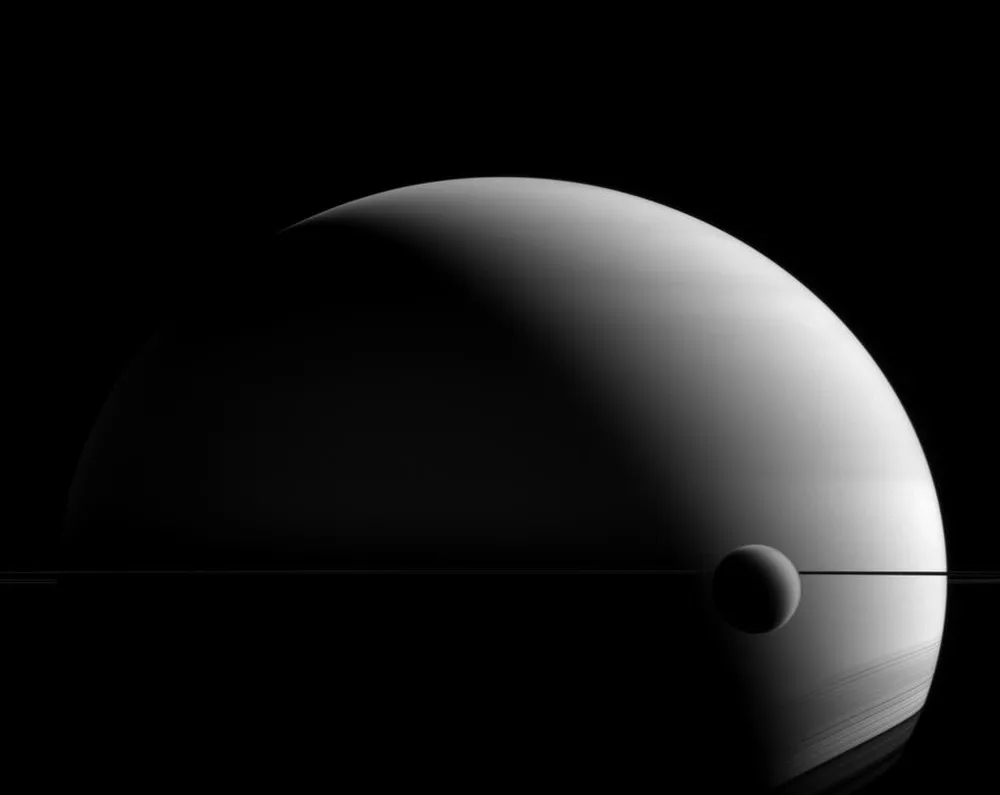
Titan is also a destination. NASA's Dragonfly rotorcraft is scheduled to launch no earlier than July 2028 and arrive in late 2034, to fly between locations on Titan and study its chemistry.
What makes Enceladus special?
A small moon with a big surprise. NASA says Enceladus is only about 310 miles (500 kilometers) across, yet it has a global ocean under a thick icy shell. In 2005, Cassini found icy water particles and gas gushing from the moon's surface. Later gravity measurements showed the jets are fed by a global ocean inside the moon, under an ice shell that averages roughly 12 to 16 miles thick.
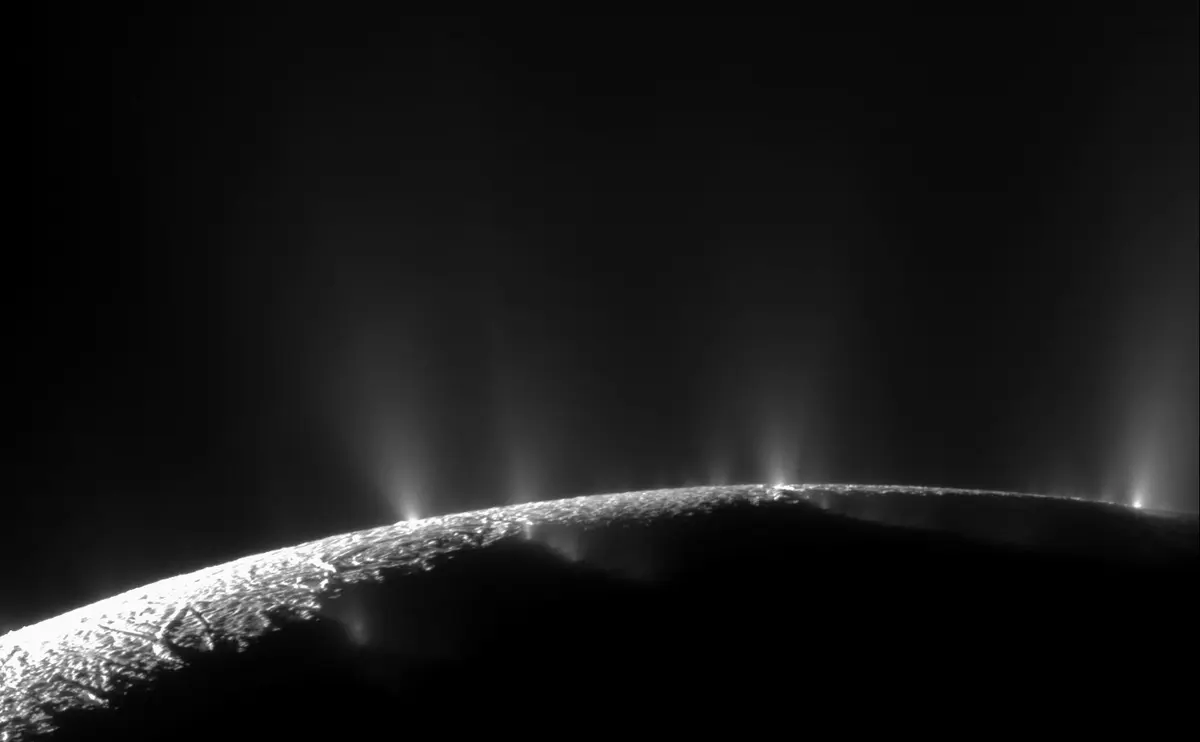
The jets come from cracks near the south pole, and the material eventually supplies Saturn's E ring. William Herschel spotted Enceladus on August 28, 1789. NASA's moons page names both Titan and Enceladus as high-priority destinations for future deep-space missions.
Will Saturn's moon count keep growing?
Most likely. NASA's Astronomy Picture of the Day says the total will probably keep growing, and NASA's Saturn Facts page says more moons are waiting for confirmation. The remaining ones are the hardest to find: a few kilometers or less, far from Saturn and very dim.
So treat any number as a snapshot. NASA's page is dated August 2026, and a single new announcement can change it. If you want to see Saturn itself, it reached opposition on October 4, 2026, and our Saturn rings guide explains what to look for. And if you are out after dark this weekend, the Hunter's Moon, the full Moon of October 25-26, is the one moon you can see without a telescope.
Frequently asked questions
How many moons does Saturn have?
NASA says Saturn has 293 confirmed moons as of August 2026, more than any other planet. The count was 274 after March 2025 and 146 before that, and more moons are waiting for confirmation.
Why does Saturn have so many moons?
Many of them appear to be fragments. Researchers say the small, irregular moons are likely pieces of a smaller number of captured moons that were broken apart by collisions, possibly within the last 100 million years. Better telescopes and image stacking also let astronomers find moons only a few kilometers across.
How many moons does Saturn have compared with Jupiter?
On NASA's JPL list, Saturn has 293 moons and Jupiter has 115. Uranus has 29, Neptune 16 and Mars 2, so Saturn has more than those four planets combined.
What is the biggest moon of Saturn?
Titan. NASA says it is bigger than Earth's Moon and larger than the planet Mercury, with a radius of about 2,575 kilometers and a thick atmosphere.
How many of Saturn's moons have names?
About 63 of 293 in NASA/JPL's table, according to our count. The rest have provisional labels such as S/2023 S 51 until their orbits are firm and the discoverers propose names.
Why do websites give different numbers for Saturn's moons?
Because the count keeps changing. It was 146, then 274 in March 2025, then 285 in March 2026, and NASA now says 293. NASA's Saturn Facts page still shows 274 as of March 2025.
Is there a mission planned to Saturn's moons?
Yes. NASA's Dragonfly rotorcraft is scheduled to launch to Titan no earlier than July 2028 and arrive in late 2034. NASA also lists Titan and Enceladus as high-priority destinations for future missions.
Sources
- NASA Science, "Saturn Moons" (count "as of August 2026"; page last updated September 22, 2026; accessed October 24, 2026)
- NASA Science, "Saturn Facts" (page last updated October 15, 2026; accessed October 24, 2026). Still lists 274 moons as of March 2025.
- NASA/JPL Solar System Dynamics, "Planetary Satellite Discovery Circumstances" (table of Saturn's 293 moons, with Jupiter 115, Uranus 29, Neptune 16, Mars 2; accessed October 24, 2026). Our tallies come from this table.
- International Astronomical Union, "MPC New Moons Saturn Jupiter" (March 26, 2026; accessed October 24, 2026)
- University of British Columbia, "Saturn still reigns supreme as moon king with 128 new moons" (March 2025; accessed October 24, 2026)
- EarthSky, "128 new Saturn moons just announced. Incredible!" (March 2025; accessed October 24, 2026). Used for the earlier count of 146 and the potato shape.
- NASA, Astronomy Picture of the Day, "Six Moons of Saturn" (August 11, 2026; accessed October 24, 2026). Used for the text only.
- NASA Science, "Titan Facts" (page last updated October 19, 2026; accessed October 24, 2026)
- NASA Science, "Titan" (page last updated April 28, 2025; accessed October 24, 2026)
- NASA Science, "Enceladus" (page last updated November 4, 2024; accessed October 24, 2026)
- NASA Science, "Dragonfly" (page last updated October 19, 2026; accessed October 24, 2026)
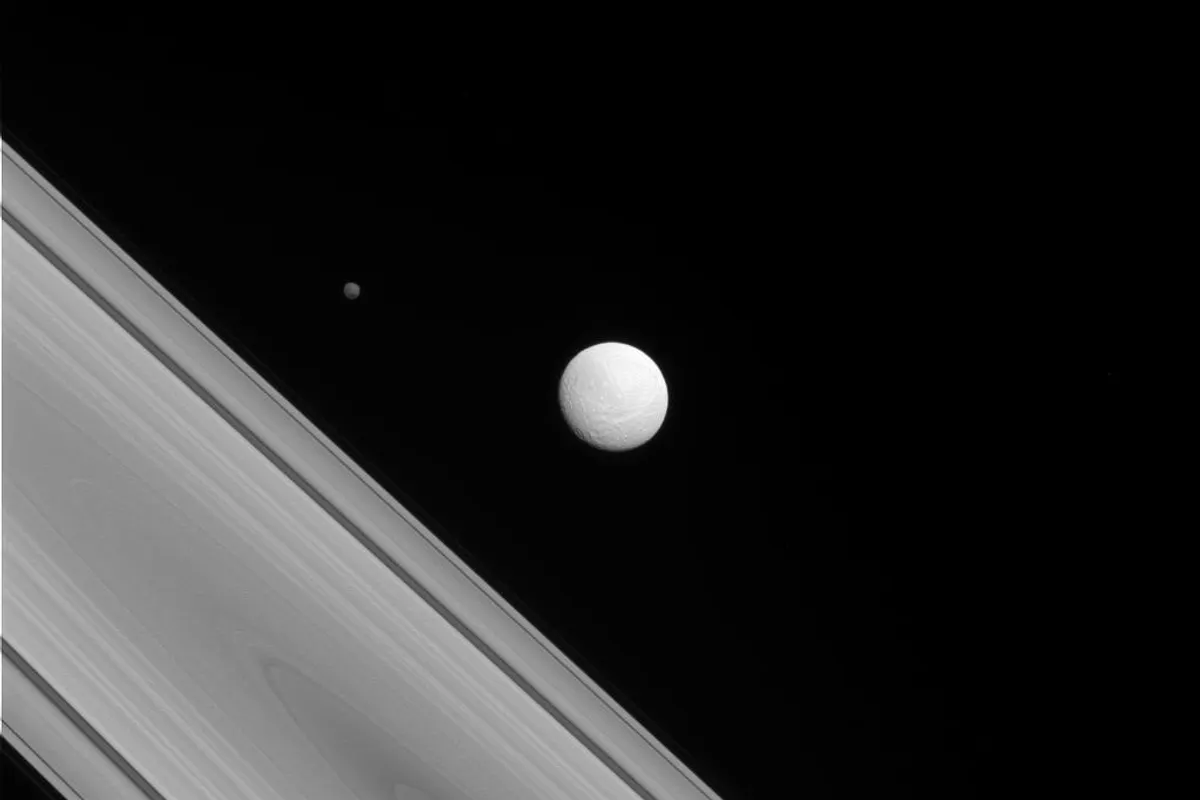
- NASA/JPL-Caltech, "The Odd Trio" (PIA18283)
- NASA/JPL-Caltech, "Veiled Worlds" (PIA18335)
- NASA/JPL, "Bursting at the Seams: the Geyser Basin of Enceladus" (PIA11688)

Founder and editor, Orbit and Atom
I write Orbit and Atom to explain space and science in plain English, starting from what NASA, ESA and the mission teams publish. Every article lists its sources at the end so you can read them yourself.