Solar System & Missions
Where Did Saturn's Rings Go? Why They Looked So Thin
Quick answer
Saturn's rings did not go anywhere. They are only about 30 feet (10 meters) thick in the main rings, so when Earth lined up with their edge on March 23, 2025, almost nothing was left to see. They are opening again. At the October 4, 2026 opposition they were tilted about 7.5 degrees toward us, still a thin oval.
On this page
If you looked at Saturn through a telescope in the spring of 2025, you may have wondered what happened to the rings. Some people thought the planet had lost them. It had not. Even now, in October 2026, the rings are still quite narrow, which is why they look slim next to the famous pictures.
Here is what actually happened, how thin the rings really are, and how to see Saturn while it is at its best this year.
Did Saturn's rings really disappear?
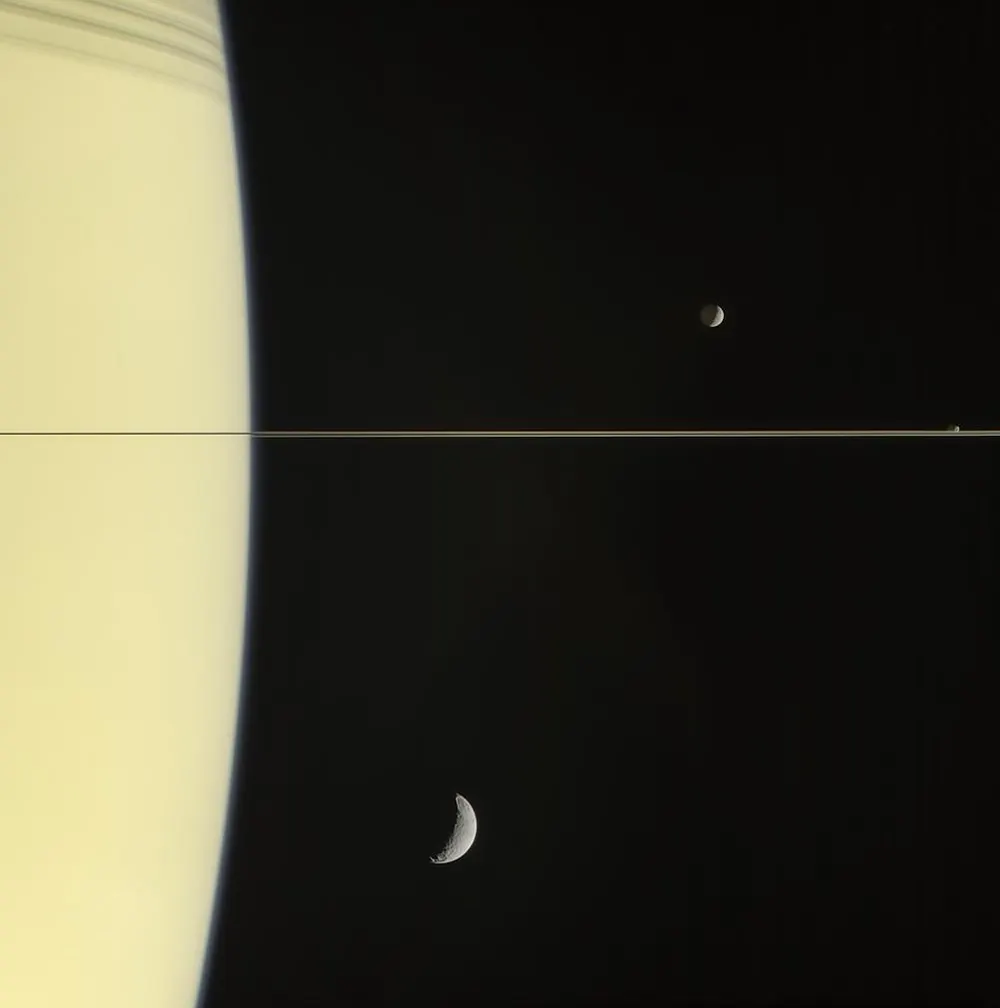
No. They only seemed to. NASA's Hubble pages explain that the rings "appear to disappear when viewed with a small telescope" when they are seen edge-on. Even then, NASA says, they "do not disappear completely because the edge of the rings reflects sunlight."
People have been fooled by this for a long time. NASA's Astronomy Picture of the Day notes that when Saturn's "appendages" disappeared in 1612, Galileo did not understand why. Nobody had seen a ring around a planet before, so a ring that vanished made no sense.
How thin are Saturn's rings?
Astonishingly thin. NASA's Saturn facts say the ring system extends up to 175,000 miles (282,000 kilometers) from the planet, yet the vertical height of the main rings is "typically about 30 feet (10 meters)." That means the rings reach about 28 million times farther out than they are thick (our arithmetic: 282,000,000 meters divided by 10). NASA's Astronomy Picture of the Day puts it another way: the rings are "confined to a plane many times thinner, in proportion, than a razor blade."
The rings are not solid. NASA says they are made of billions of small chunks of ice and rock coated with other materials such as dust. The pieces range from grains of dust to chunks as big as a house, and a few are as large as mountains. When you look at them edge-on, you are looking through a layer only a few pieces deep.
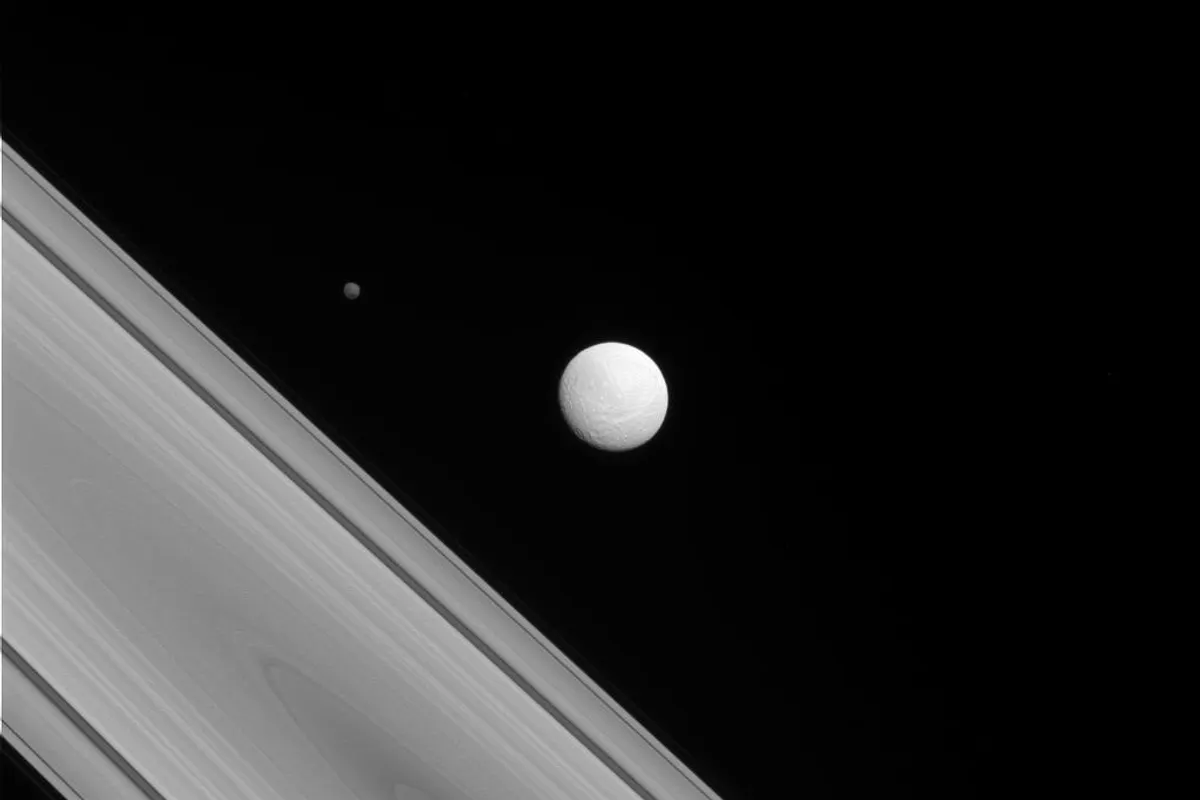
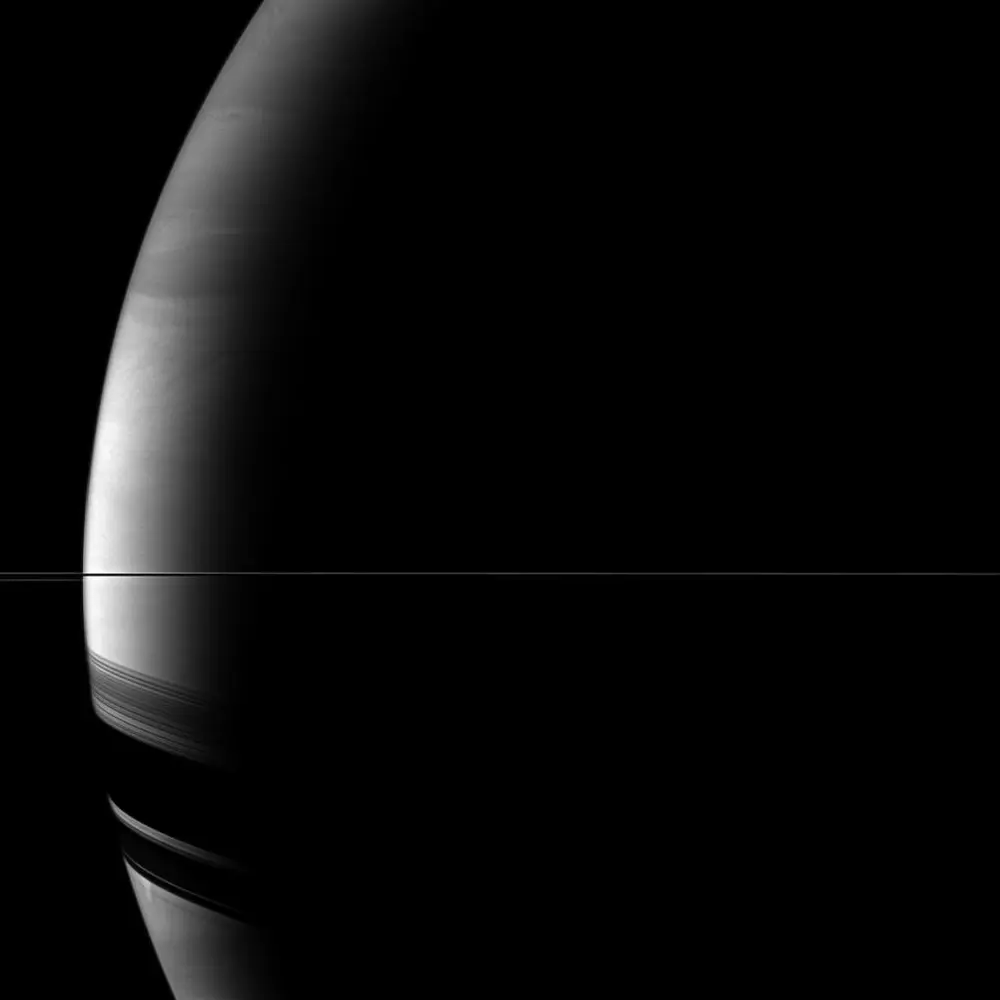
A thin layer still casts a long shadow. The Cassini image below shows the rings as a bare line across the middle of the frame, while their shadow falls broadly across Saturn's southern hemisphere.
Why do the rings look different from year to year?
Because of Saturn's tilt. NASA says its axis is tilted by 26.73 degrees with respect to its orbit around the Sun, and Saturn takes about 29.4 Earth years to go around once. The rings circle Saturn's equator, so they are tilted by the same amount, and they keep pointing the same way in space while the planet travels. As a result, our view from Earth changes slowly. Sometimes we look down on the top face of the rings, sometimes on the bottom face, and twice in each orbit we see them edge-on.
NASA's Hubble pages put numbers on it: "Twice during the 29.5 years, the rings are edge-on to the Sun," and the crossings seen from Earth "generally occur on 13 to 16 year intervals." The same thing happens to sunlight: NASA's Cassini picture of Saturn, taken about a month after the August 2009 equinox, notes that the shadow the rings cast on the planet "remains narrow."
When were the rings edge-on in 2025, and where are they now?
NASA's 1995 Hubble article already listed the date: March 23, 2025, when Earth passed through the plane of the rings. The same article lists the previous crossing, on September 4, 2009. It also lists the next favorable ones for October 15, 2038, April 1, 2039 and July 9, 2039.
We checked these dates by calculating the tilt from Saturn's position and pole direction (our calculation). It matches NASA's dates, and it gives the following tilts, with a bit of context:
| Date | Tilt | What it means |
|---|---|---|
| March 23, 2025 | 0.0° | Rings edge-on to Earth. Saturn was also only about 9 degrees from the Sun, so it was hard to see at all. |
| November 23, 2025 | 0.4° | Still nearly edge-on. |
| October 4, 2026 | 7.5° | Opposition. The rings are open, but only a narrow oval. |
| October 4, 2027 | 13.3° | Opening up. |
| October 4, 2028 | 18.6° | Clearly open. |
| June 1, 2031 | 26.3° | Close to the widest. The Farmers' Almanac puts the maximum at 26.5° in 2031. |
Tilt of Saturn's rings as seen from Earth, in degrees. Our calculation from Saturn's position, checked against NASA's crossing dates. The October 2026 value also agrees with the Farmers' Almanac figure of about 7.5 degrees.
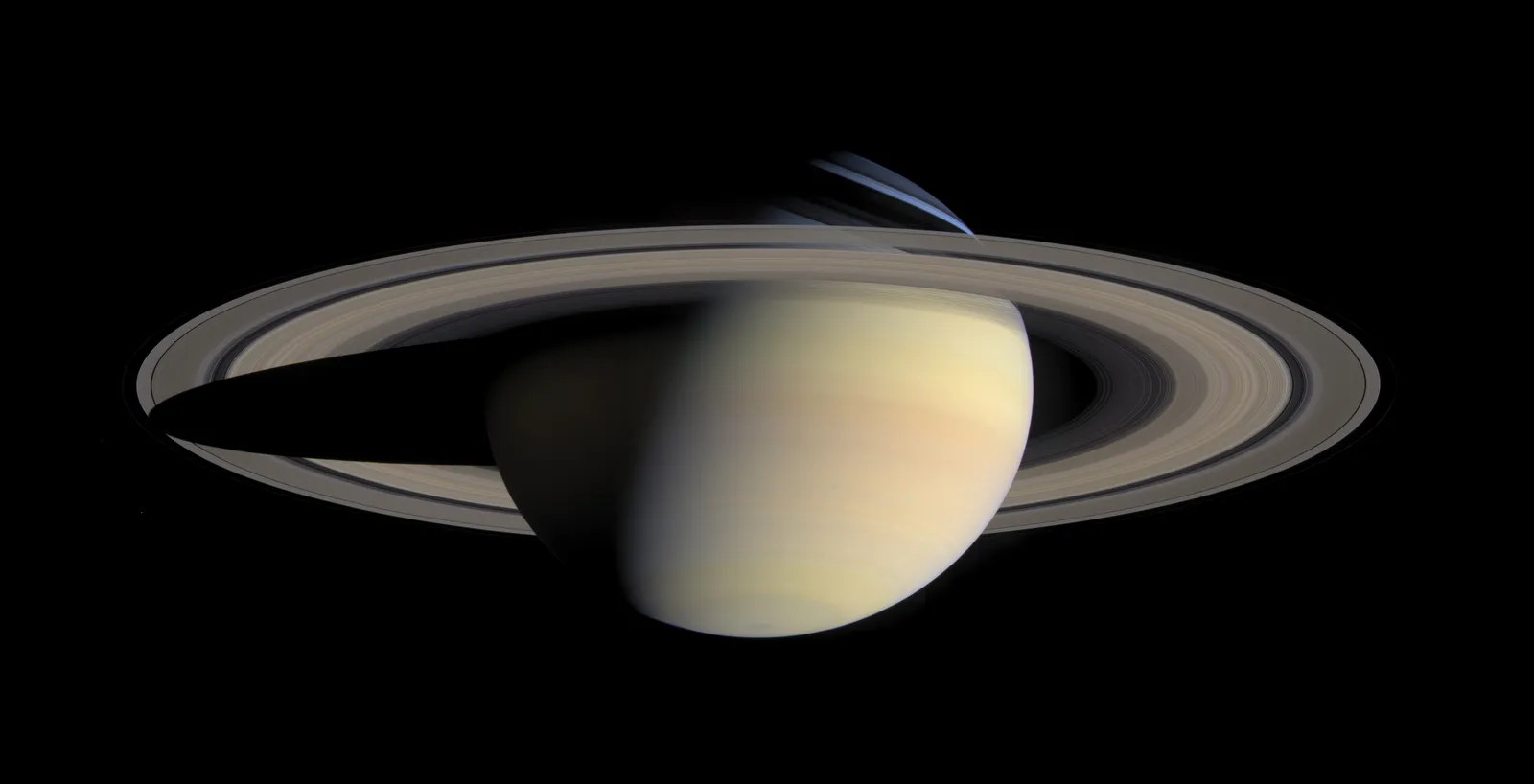
So the answer to the title is simple. The rings did not go anywhere. They turned their edge to us, and since then they have been opening by a few degrees every year. In 2026 you see them as a narrow ellipse, not the wide hoop of the Cassini portrait at the top of this page.
How can you see Saturn and its rings this month?
Saturn is well placed right now. NASA's October 2026 skywatching guide says that on October 4 Saturn reached opposition, "giving skywatchers one of the year's best opportunities to see the ringed planet." At opposition Earth sits between the Sun and Saturn, so the planet rises around sunset and stays up for much of the night. NASA's sky chart for the evening of October 4, around 9 p.m., has Saturn above the eastern horizon, with the bright star Fomalhaut to the southeast.
You will need a telescope for the rings. The Farmers' Almanac advises a small telescope at about 25x, which is enough to show them clearly as rings. It also warns that this year you should expect a tight line, not a wide hoop. That is exactly the 7.5-degree tilt in the table.
If you are out looking at the sky anyway, the Orionid meteor shower peaks around the same time. We explain it in Orionid Meteor Shower 2026: When to See Halley's Comet Dust.
When will the rings be edge-on again?
Not for a long time. Saturn takes about 29.4 years to orbit, and Earth crosses the ring plane about every 15 years on average. NASA's article lists the next crossings for October 2038, April 2039 and July 2039, and our calculation agrees. Between now and then, the rings keep opening toward their widest view around 2031.
For where Saturn sits among the other worlds, with its distance, size and moon count, see The Planets in Order From the Sun, With Sizes and Distances.
Frequently asked questions
Did Saturn lose its rings in 2025?
No. On March 23, 2025, Earth lined up with the edge of the rings, so they looked like a thin line or disappeared in small telescopes. NASA says they do not vanish completely because the edge still reflects sunlight. The rings have been opening since.
How thick are Saturn's rings?
NASA says the main rings are typically about 30 feet (10 meters) thick, while the ring system extends up to 175,000 miles (282,000 kilometers) from the planet.
How often do Saturn's rings look edge-on?
NASA says ring-plane crossings seen from Earth generally come 13 to 16 years apart, about every 15 years. The rings are also edge-on to the Sun twice during Saturn's 29.5-year orbit.
Why do Saturn's rings change shape?
Saturn's axis is tilted by 26.73 degrees, and the rings tilt with it. As Saturn orbits the Sun, we see the rings from above, edge-on or from below, so their apparent width changes over the years.
Can you see Saturn's rings in October 2026?
Yes, with a telescope. Saturn reached opposition on October 4, so it rises around sunset and is up for much of the night. The Farmers' Almanac says a small telescope at about 25x shows the rings clearly, as a tight oval this year.
When will Saturn's rings look widest?
The Farmers' Almanac lists the widest view, about 26.5 degrees, in 2031. We calculate about 26 degrees in mid-2031 and a little more in 2032.
When is the next time the rings will be edge-on?
NASA lists the next ring-plane crossings seen from Earth for October 15, 2038, April 1, 2039 and July 9, 2039.
Sources
- NASA Science, "Saturn Facts" (page last updated October 15, 2026; accessed October 21, 2026)
- NASA Science, "Saturn" (page last updated October 15, 2026; accessed October 21, 2026)
- NASA Science, "What's Up: October 2026 Skywatching Tips from NASA" (published October 1, 2026, last updated October 2, 2026; accessed October 21, 2026)
- NASA Science, "Hubble Views Saturn Ring-Plane Crossing" (published June 5, 1995, last updated March 20, 2025; accessed October 21, 2026)
- NASA Science, "Saturn's Rings Edge-on" (Hubble, May 22, 1995; page last updated August 17, 2025; accessed October 21, 2026)
- NASA, Astronomy Picture of the Day, "Crossing Saturn's Ring Plane" (November 16, 2025; accessed October 21, 2026)
- Farmers' Almanac, "Saturn Is at Its Brightest of 2026, With Its Rings Barely Open" (updated October 6, 2026; accessed October 21, 2026). Used for the ring tilt of about 7.5 degrees and the telescope advice.
- NASA/JPL, "The Greatest Saturn Portrait...Yet" (PIA06193)
- NASA/JPL-Caltech, "Postcard from the Ring Plane" (PIA18323)
- NASA/JPL, "Thin Line, Broad Shadows" (PIA12754)
- NASA/JPL, "Post-Equinox Color" (PIA11613), on the shadow of the rings a month after the August 2009 equinox

Founder and editor, Orbit and Atom
I write Orbit and Atom to explain space and science in plain English, starting from what NASA, ESA and the mission teams publish. Every article lists its sources at the end so you can read them yourself.