Atoms & Physics
What Is Inside an Atom? Protons, Neutrons, Electrons and More
Quick answer
An atom is made of protons, neutrons and electrons. Protons (positive) and neutrons (no charge) sit in a tiny central nucleus, and electrons (negative) surround it in a cloud. The nucleus holds more than 99.9% of the atom's mass. Protons and neutrons are not the end of the story: each is built from three quarks held together by gluons.
On this page
- What are the three main parts of an atom?
- What is in the nucleus of an atom?
- Where are the electrons, and do they orbit like planets?
- What are protons and neutrons made of?
- How does this fit into the Standard Model?
- What makes one element different from another?
- Can we study single atoms in space?
- FAQ
- Sources
Everything with mass, from a rock to a star, is made of atoms. The word comes from the idea of something that cannot be cut any further, but atoms turned out to have parts, and some of those parts have parts too.
Here is what is inside an atom, from the outside in: the electrons, the nucleus, and the quarks inside the nucleus. We will also look at how a different count of the same particles gives you a different element.
What are the three main parts of an atom?
Protons, neutrons and electrons. The U.S. Nuclear Regulatory Commission (NRC) describes the atom as the basic building block of matter and lists these three subatomic particles. Protons carry a positive charge, electrons a negative charge, and neutrons carry no charge. Protons and neutrons make up the nucleus in the center, and the electrons form a cloud around it.
When an atom has the same number of protons and electrons, it is neutral. If it gains or loses electrons, it becomes an ion, which the U.S. Department of Energy (DOE) says is negative when electrons are added and positive when they are removed.
| Particle | Charge | Where it is | Made of | Mass compared with a proton |
|---|---|---|---|---|
| Proton | Positive | Nucleus | Two up quarks and one down quark | 1 (the reference) |
| Neutron | None | Nucleus | One up quark and two down quarks | About 1.0014 times a proton |
| Electron | Negative | Cloud around the nucleus | Nothing smaller known (elementary) | About 1/1,836 of a proton |
What is in the nucleus of an atom?
Protons and neutrons, held together by the strong force, which the DOE calls the strongest known fundamental force. Ernest Rutherford discovered in 1911 that a nucleus sits at the core of every atom.
The strange part is how little room it takes. According to the DOE, the nucleus holds more than 99.9% of an atom's mass but makes up much less than 0.01% of its volume. The DOE gives two pictures to help: a Moon squeezed to the density of a nucleus would fit inside Yankee Stadium, and a single grain of sand holds more than 10 million trillion nuclei.
The particles themselves are tiny. NIST's 2022 recommended value for the radius of a proton is about 0.84 femtometers, and a femtometer is one quadrillionth of a meter.
Where are the electrons, and do they orbit like planets?
Not like planets. The DOE says scientists now believe electrons surround the nucleus in a cloud divided into shells, and that they do not sit at specific points. Each region simply has a different probability of containing an electron, a result of quantum mechanics.
Shells farther from the nucleus hold more electrons and carry more energy. The DOE adds that when the outer shells are full, an element is much less reactive, which is why the noble gases barely react with anything. And when an electron falls back toward the nucleus, it gives off a photon whose wavelength is specific to each element.
Electrons are light. NIST's 2022 values put a proton at about 1,836 times the mass of an electron, which is why the DOE says electrons have essentially no mass compared with protons and neutrons. The DOE also says electrons are elementary: they are not made of anything smaller, as far as we know.
What are protons and neutrons made of?
Quarks. The DOE says protons contain two up quarks and one down quark, while neutrons contain one up quark and two down quarks. Quarks come in six kinds: up, down, charm, strange, top and bottom. The DOE adds that quarks have fractional electric charge and that, as far as we know, they cannot be split into smaller parts.
The quarks are bound by gluons, which carry the strong force. They are the only fundamental particles with a property called color charge, but the name has nothing to do with real colors. The strong force is so powerful that quarks are never found alone. The DOE says the only way to separate them is to create quark-gluon plasma, a state so hot and dense that protons and neutrons melt. The whole universe was filled with it until a fraction of a second after the Big Bang.
The idea of quarks was proposed in 1964, and the first evidence came in 1968 at SLAC. The sixth and heaviest, the top quark, was first seen at Fermilab in 1995.
How does this fit into the Standard Model?
CERN explains that all matter around us is made of elementary particles, in two families: quarks and leptons, six of each, arranged in three generations. The up and down quarks form the first generation, and the electron and the electron neutrino are the first-generation leptons, which puts the particles of this article in one family.
The Standard Model also covers three of the four fundamental forces. Gravity is not part of it, and CERN notes that the theory does not explain the complete picture: questions such as what dark matter is remain open.
What makes one element different from another?
The number of protons. The NRC calls it the atomic number, and says two atoms with the same number of protons belong to the same element. Carbon has six protons, the DOE notes, and the usual form also has six neutrons.
The number of neutrons can change without changing the element. Atoms of one element with different neutron counts are called isotopes, according to the NRC, and the balance between neutrons and protons affects whether a nucleus is stable. Unstable ones undergo radioactive decay. Electrons then decide how an atom behaves around others: they can be shared or passed along to form the bonds that make molecules.
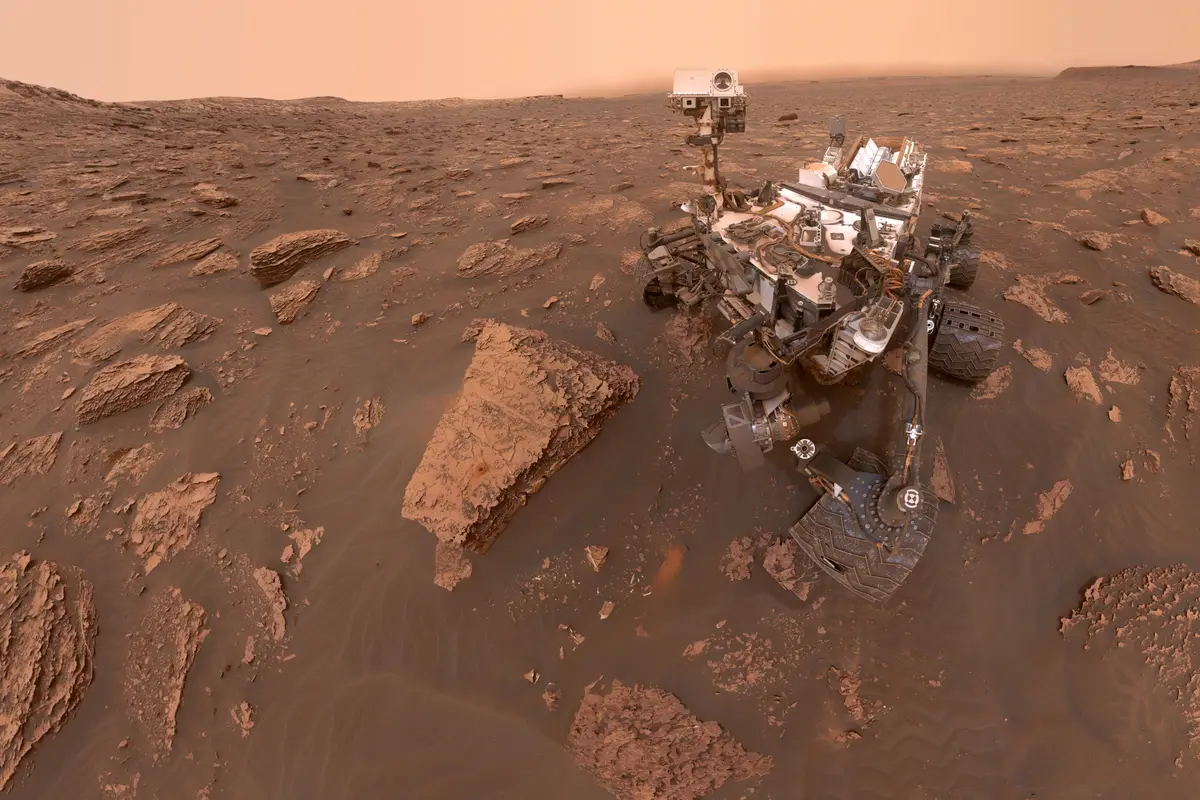
You can see the result far from the lab. On Mars, the surface and the dust are full of rusted iron minerals, which is what makes the planet red, as we explain in Why Is Mars Red?
Can we study single atoms in space?
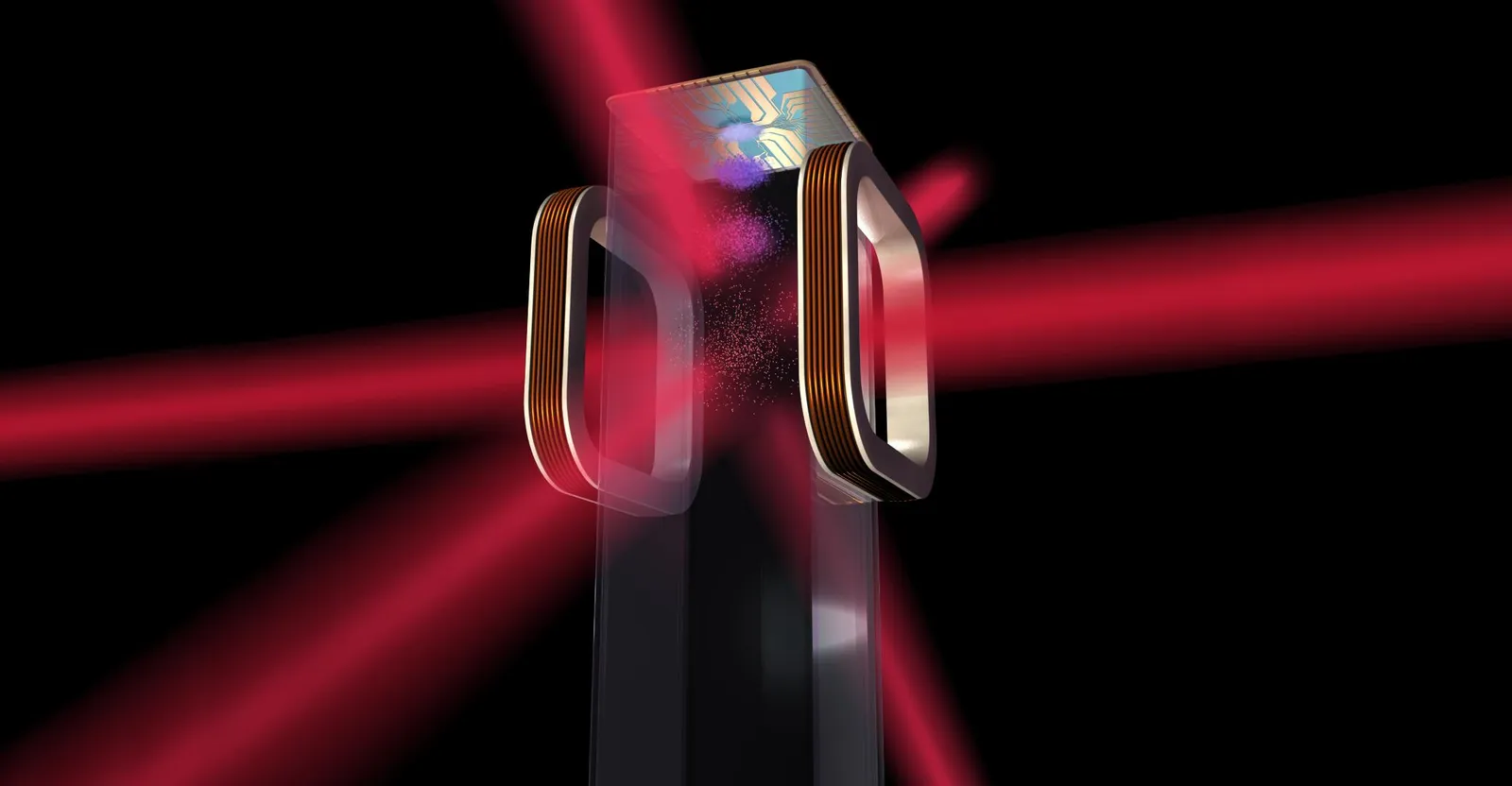
Yes, and NASA does. The Cold Atom Laboratory (CAL) on the International Space Station chills clouds of atoms to produce Bose-Einstein condensates, which NASA's Jet Propulsion Laboratory calls a fifth state of matter. Near absolute zero, the atoms behave more like waves than particles and take on the same lowest-energy wave identity, forming what NASA describes as a single "super atom."
NASA announced in July 2018 that CAL had made these condensates in orbit for the first time. They were as cold as 100 nanokelvin, one ten-millionth of a degree above absolute zero, colder than the average temperature of deep space, about 3 kelvin. In microgravity, the cloud can be watched for 5 to 10 seconds at a time, compared with fractions of a second on Earth.
The scale of atoms is the opposite end of the ruler from the one in How Far Is a Light-Year? Between the two, you can describe nearly every object in the universe.
Frequently asked questions
What are the three main parts of an atom?
Protons, neutrons and electrons. Protons are positive, electrons are negative and neutrons have no charge. Protons and neutrons form the nucleus, and electrons surround it in a cloud.
What is inside a proton and a neutron?
Quarks. According to the U.S. Department of Energy, a proton contains two up quarks and one down quark, and a neutron contains one up quark and two down quarks, bound together by gluons.
Are electrons made of anything smaller?
Not as far as we know. The Department of Energy describes electrons as elementary particles, which means they are not made of smaller particles.
How much of an atom is empty space?
Most of it. The nucleus holds more than 99.9% of the mass but much less than 0.01% of the volume, according to the Department of Energy. The rest is the region where electrons are found.
Do electrons orbit the nucleus like planets around the Sun?
No. The Department of Energy says electrons do not sit at specific points. They form a cloud divided into shells, and each region has a different probability of containing an electron.
What decides which element an atom is?
The number of protons in its nucleus, called the atomic number, according to the Nuclear Regulatory Commission. Atoms with the same proton count but different neutron counts are isotopes of the same element.
Sources
- U.S. Nuclear Regulatory Commission, "What is an Atom?" (page dated September 8, 2026; accessed October 19, 2026)
- U.S. Department of Energy, "DOE Explains...Nuclei" (accessed October 19, 2026)
- U.S. Department of Energy, "DOE Explains...Protons" (accessed October 19, 2026)
- U.S. Department of Energy, "DOE Explains...Electrons" (accessed October 19, 2026)
- U.S. Department of Energy, "DOE Explains...Quarks and Gluons" (accessed October 19, 2026)
- CERN, "The Standard Model" (accessed October 19, 2026)
- NIST, CODATA 2022: proton-electron mass ratio, neutron-proton mass ratio and proton rms charge radius (accessed October 19, 2026)
- NASA/JPL, "Space Station Experiment Reaches Ultracold Milestone" (July 27, 2018)
- NASA/JPL-Caltech, "NASA Cold Atom Laboratory CAL Chip Artist Concept" (PIA17794)

Founder and editor, Orbit and Atom
I write Orbit and Atom to explain space and science in plain English, starting from what NASA, ESA and the mission teams publish. Every article lists its sources at the end so you can read them yourself.