Atoms & Physics
What Are Quarks? What Protons and Neutrons Are Made Of
Quick answer
Protons and neutrons are made of quarks, particles that, as far as we know, cannot be split into anything smaller. A proton holds two up quarks and one down quark, and a neutron holds one up quark and two down quarks. Gluons bind them with the strong force, so tightly that quarks are never found alone.
On this page
In my guide to what is inside an atom, the nucleus looked like the bottom of the story: protons and neutrons packed in a speck. It is not the bottom. Each proton and each neutron has parts of its own, and those parts behave in ways that still surprise physicists.
I read the U.S. Department of Energy (DOE) explainers, CERN's pages on the Standard Model and on heavy-ion collisions, and the Particle Data Group tables for the numbers. Here is what quarks are, how they fit together and where the mass of a proton really comes from.
What are quarks?
Quarks are the building blocks of protons and neutrons. The DOE says that current understanding is that quarks and gluons are indivisible, so they cannot be broken into smaller components. That makes them elementary particles, like the electron.
There are six kinds, which the DOE names up, down, charm, strange, top and bottom, with a wide range of masses. Only the first two matter for ordinary matter. CERN explains that all stable matter in the universe is made from the first generation of particles, and any heavier ones quickly decay into the next most stable level.
| Quark | Charge | Mass | Generation |
|---|---|---|---|
| Up | +2/3 | 2.16 MeV | First |
| Down | -1/3 | 4.70 MeV | First |
| Charm | +2/3 | 1.27 GeV | Second |
| Strange | -1/3 | 93.5 MeV | Second |
| Top | +2/3 | 172.56 GeV | Third |
| Bottom | -1/3 | 4.18 GeV | Third |
The six quarks. Charge and mass: Particle Data Group (2025 update); generations: CERN. Light-quark masses are estimates, and the top mass comes from direct measurements.
The charges are fractions of the charge of a proton, and the DOE points out that quarks are the only elementary particles with a fractional electric charge. The masses are in MeV (million electronvolts) and GeV (a thousand MeV), the units particle physicists use. The top quark, at about 184 times the mass of a proton by my math, is by far the heaviest.
The idea of quarks was proposed in 1964, and the DOE says evidence for them showed up in experiments in 1968 at the Stanford Linear Accelerator Center. The heaviest and last one found, the top quark, was first seen at Fermilab in 1995.
What are protons and neutrons made of?
Three quarks each. According to the DOE, a proton contains two up quarks and one down quark, while a neutron contains one up quark and two down quarks. Adding the charges from the table shows why the pairing works: two ups and a down give +2/3 +2/3 -1/3 = +1, a proton, and one up with two downs give +2/3 -1/3 -1/3 = 0, a neutron. That sum is my own arithmetic, using the Particle Data Group charges.
Particles built from quarks are called hadrons, and the DOE notes that protons and neutrons are the two everyday ones. The three quarks that give a proton its identity are called valence quarks. The DOE adds that inside protons and neutrons there are also sea quarks, which constantly pop in and out of existence. So "three quarks" is the count that never changes, not everything that is going on inside.
If you want the bigger picture, from electrons to the nucleus, my guide to what is inside an atom covers the whole stack.
What holds quarks together?
Gluons, which carry the strong force. The DOE says gluons have no electric charge, and that both quarks and gluons have a different kind of charge, called color charge. The colors are only names, the DOE stresses: they are not related to actual colors. The force that connects the color charges is the strong nuclear force, which the DOE calls the most powerful force involved in holding matter together, far stronger than gravity, electromagnetism or the weak force.
CERN adds a rule that explains why you never meet "red" or "blue" in the real world: quarks come in three colors and only mix in ways that form colorless objects. Three quarks, one of each color, make a proton or a neutron.
Why has nobody ever seen a single quark?
Because the strong force makes it extremely difficult to pull one out. The DOE says that quarks and gluons are therefore bound inside composite particles, and that the only way to separate them is to create a state of matter called quark-gluon plasma, where the density and temperature are so high that protons and neutrons melt.
So the quarks are not hidden by a lack of instruments. In ordinary matter, they are simply never loose. Everything we know about them comes from smashing particles together and studying the debris.
Where does the mass of a proton come from?
Mostly not from the quarks. This is the part I find hardest to believe. NIST's 2022 value for the mass of a proton is about 938 MeV. The Particle Data Group's estimates for two up quarks and one down quark add up to about 9 MeV (2.16 + 2.16 + 4.70). That is roughly 1% of the proton, a figure I worked out from those two sources.
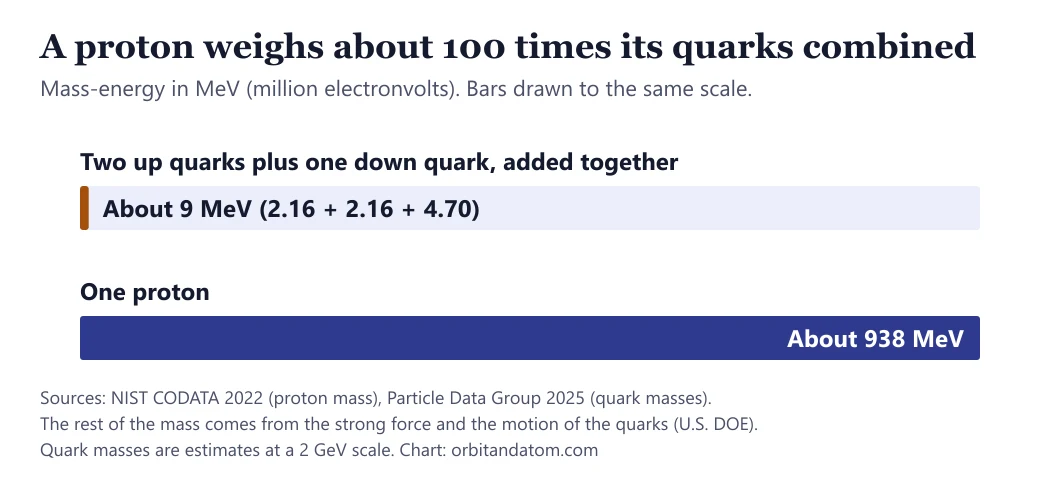
The DOE explains where the rest comes from. It says the interaction between quarks and gluons is responsible for almost all of the perceived mass of protons and neutrons, and it adds that this is where "we get our mass." A DOE research summary from 2024 puts it this way: most of the mass emerges from intricate quark dynamics, including their motion, and is governed primarily by the strong force mediated by gluons.
The same summary describes an experiment at the Thomas Jefferson National Accelerator Facility that worked out where the gluon-generated part sits inside the proton, published in Nature in 2023. It is a reminder that this is active research, not a closed chapter. The quark masses themselves are model-dependent estimates, so I would read the 1% as "very small", not as a precise accounting.
The weight of everything you can touch, then, is mostly energy from the strong force, not the mass of the particles inside. For what happens when neutrons are packed together on the scale of a star, see my guide to neutron stars.
How do scientists study quarks?
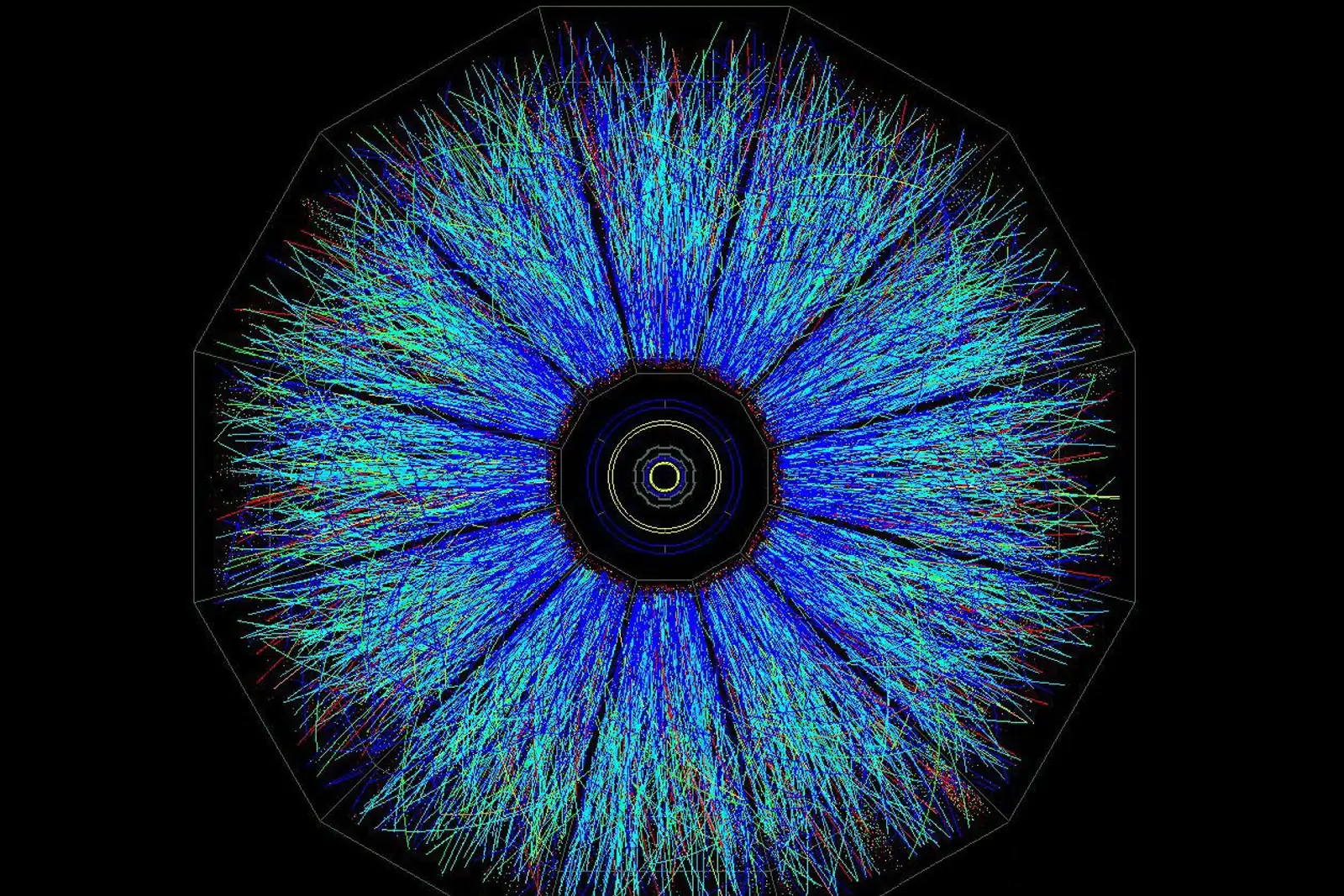
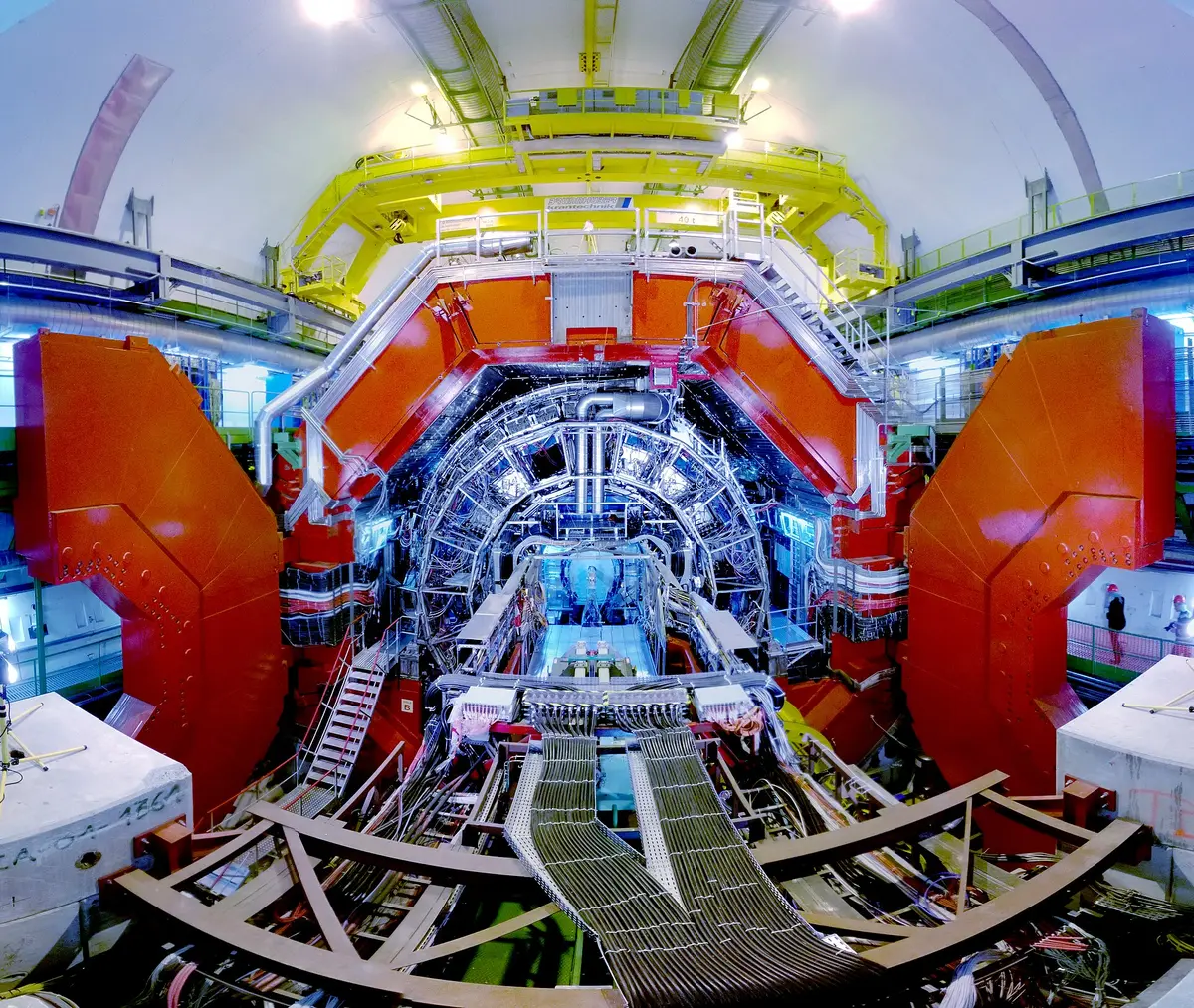
By melting protons and neutrons on purpose. CERN describes how powerful accelerators collide heavy ions, such as gold or lead nuclei, head-on, with the hundreds of protons and neutrons in each nucleus hitting at energies of a few trillion electronvolts each. This forms a tiny fireball in which everything "melts" into a quark-gluon plasma.
The fireball cools almost instantly, and the quarks and gluons recombine into ordinary matter that flies out in all directions. CERN says the debris includes pions and kaons, made of a quark and an antiquark, protons and neutrons, made of three quarks, and even many antiprotons and antineutrons. If antimatter is new to you, I cover it in What Is Antimatter?
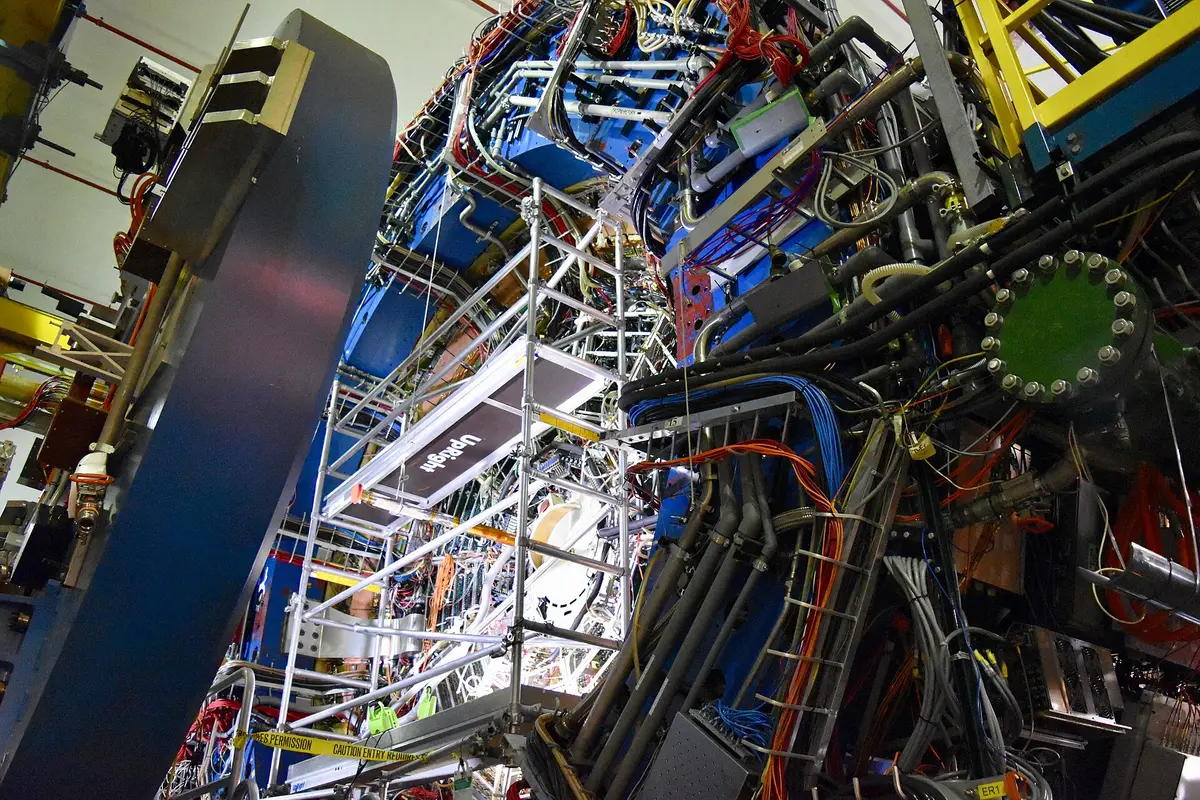
CERN reports that an early discovery was that the plasma behaves more like a perfect fluid with small viscosity than like a gas, which many researchers had expected. It also describes "jets," sprays of particles from quarks or gluons that scatter back to back. At RHIC, the STAR experiment saw in 2003 that one of the two jets was often weakened or erased, an effect called jet quenching, because it had to push through the fireball, which CERN says is 30 to 50 times as dense as an ordinary nucleus. The ALICE, ATLAS and CMS experiments at CERN's Large Hadron Collider have since confirmed the effect at higher energies.
Was the early universe a soup of quarks?
For a very brief time, yes. CERN says that for a few millionths of a second after the Big Bang, the universe was filled with a hot, dense soup dominated by quarks and gluons, which were bound only weakly and free to move on their own. The DOE says this plasma permeated the entire universe until a few fractions of a second after the Big Bang, when it cooled enough for quarks and gluons to freeze into protons and neutrons.
That is why heavy-ion collisions are described as recreating conditions close to the very early universe. For how we know the age and history of everything that followed, see my guide to how old the universe is.
What is still not understood about quarks?
A fair amount. CERN notes that the Standard Model, the theory that includes quarks, is well tested but does not explain the complete picture: it leaves out gravity and does not answer questions such as what dark matter is or why there are three generations of quarks and leptons. I wrote about the first of those in What Is Dark Matter?
The strong force itself is hard to calculate. The DOE calls the theory behind it, quantum chromodynamics, notoriously difficult to solve, and says it is simulated on supercomputers. CERN adds that understanding jet-quenching measurements is one of the most important problems in the theory today. In my opinion, this is what makes quarks interesting beyond the textbook picture: the three-quark sketch is true, and it is also a very small part of what a proton is.
Frequently asked questions
What are quarks?
Quarks are elementary particles that make up protons and neutrons. The U.S. Department of Energy says that, as far as current understanding goes, they cannot be broken into smaller components. There are six kinds: up, down, charm, strange, top and bottom.
What are protons and neutrons made of?
Three quarks each. A proton contains two up quarks and one down quark, and a neutron contains one up quark and two down quarks, held together by gluons.
What holds quarks together?
Gluons, which carry the strong force. According to the Department of Energy, it is the most powerful force involved in holding matter together, much stronger than gravity, electromagnetism and the weak force.
Can a quark exist by itself?
Not in ordinary matter. The strong force makes it extremely difficult to separate quarks, so they stay bound inside particles. The only way to free them is a quark-gluon plasma, which is so hot and dense that protons and neutrons melt.
Do quarks make up most of a proton's mass?
No. From NIST and Particle Data Group figures, two up quarks and one down quark add up to about 9 MeV, roughly 1% of the proton's 938 MeV. The Department of Energy says most of the mass comes from the strong force and the motion of the quarks.
Do the colors of quarks mean real colors?
No. Red, green and blue are only names for the three kinds of color charge. The Department of Energy says they are not related to actual colors.
How do scientists study quarks?
By colliding heavy nuclei, such as gold or lead, at accelerators like RHIC in the United States and the Large Hadron Collider at CERN. The collisions briefly make a quark-gluon plasma, and the debris is studied to learn how quarks and gluons behave.
Sources
- U.S. Department of Energy, "DOE Explains...Quarks and Gluons" (last updated March 11, 2026; accessed November 17, 2026)
- U.S. Department of Energy, "DOE Explains...Protons" (last updated March 9, 2026; accessed November 17, 2026)
- U.S. Department of Energy Office of Science, "Scientists Locate the Missing Mass Inside the Proton" (February 14, 2024)
- CERN, "The Standard Model" (accessed November 17, 2026)
- CERN, "Heavy ions and quark-gluon plasma" (accessed November 17, 2026)
- Particle Data Group, "Quarks" summary table (2024 review, 2025 update: charges and masses)
- NIST, CODATA 2022: proton mass energy equivalent in MeV (accessed November 17, 2026)

Founder and editor, Orbit and Atom
I write Orbit and Atom to explain space and science in plain English, starting from what NASA, ESA and the mission teams publish. Every article lists its sources at the end so you can read them yourself.