Atoms & Physics
Does It Really Rain Diamonds on Neptune and Uranus?
Quick answer
Possibly, but no one has seen it. Laser experiments at SLAC in California and at the European XFEL in Germany squeezed plastic and watched tiny diamonds form at pressures and temperatures like those deep inside Neptune and Uranus. No spacecraft has entered either planet, so diamond rain is a well-tested idea, not an observation.
On this page
- What is the diamond rain idea?
- What do we actually know about the insides of Neptune and Uranus?
- How did scientists test it in a lab?
- What did the later experiments add?
- What is measured, what is predicted and what is still a hypothesis?
- Could this happen on other planets?
- So does it rain diamonds on Neptune and Uranus?
- FAQ
- Sources
The line is easy to remember: it rains diamonds on Neptune and Uranus. It shows up in textbooks, documentaries and social posts, usually stated as fact, and it never quite says who saw it.
Nobody saw it. What exists is a set of laboratory experiments that make a strong case for the idea. This guide separates what those experiments showed, what the scientists predict from them and what is still open. My sources are the NASA planet pages and the SLAC and European XFEL releases, each opened on November 15, 2026 and linked at the bottom. I could not open the papers themselves, which sit behind a login, so everything below comes from the releases.
What is the diamond rain idea?
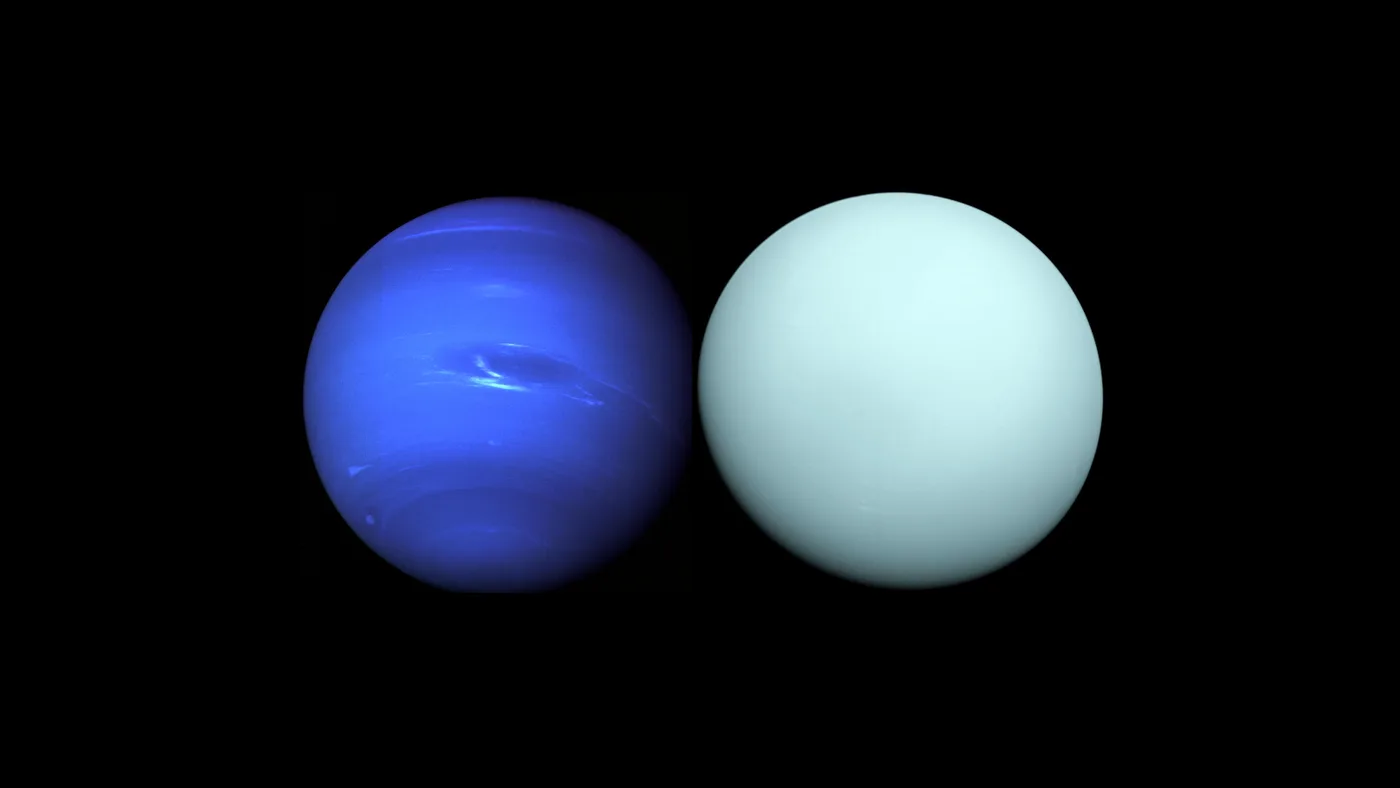
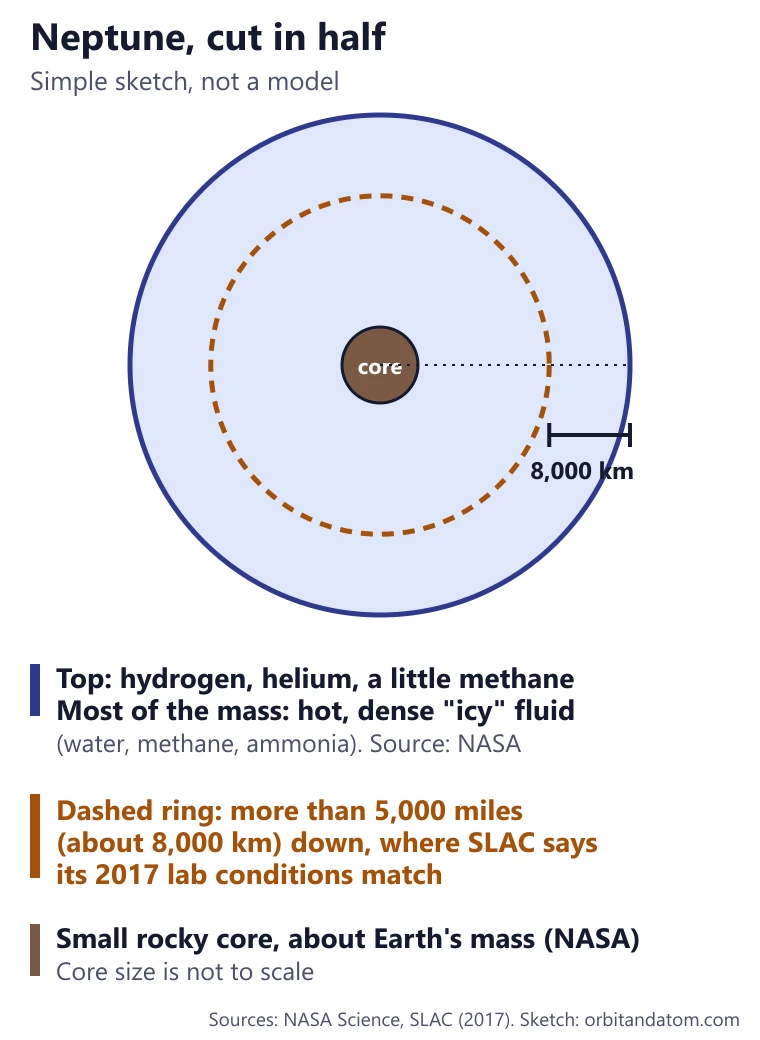
It starts with what Neptune and Uranus are made of. NASA calls them ice giants and says that 80 percent or more of each planet's mass is a hot, dense fluid of "icy" materials, meaning water, methane and ammonia, sitting above a small rocky core. Methane is a carbon-and-hydrogen molecule. The idea is that deep inside, the pressure is so high that these molecules break apart, the carbon is squeezed into diamond, and the diamonds sink toward the core.
The SLAC release of 2017 puts it this way: diamonds are hypothesized to form more than 5,000 miles (about 8,000 km, by my conversion) below the surface of the two planets. The authors think it is possible that, over thousands of years, the diamonds slowly sink through the ice layers and gather in a thick layer around the core.
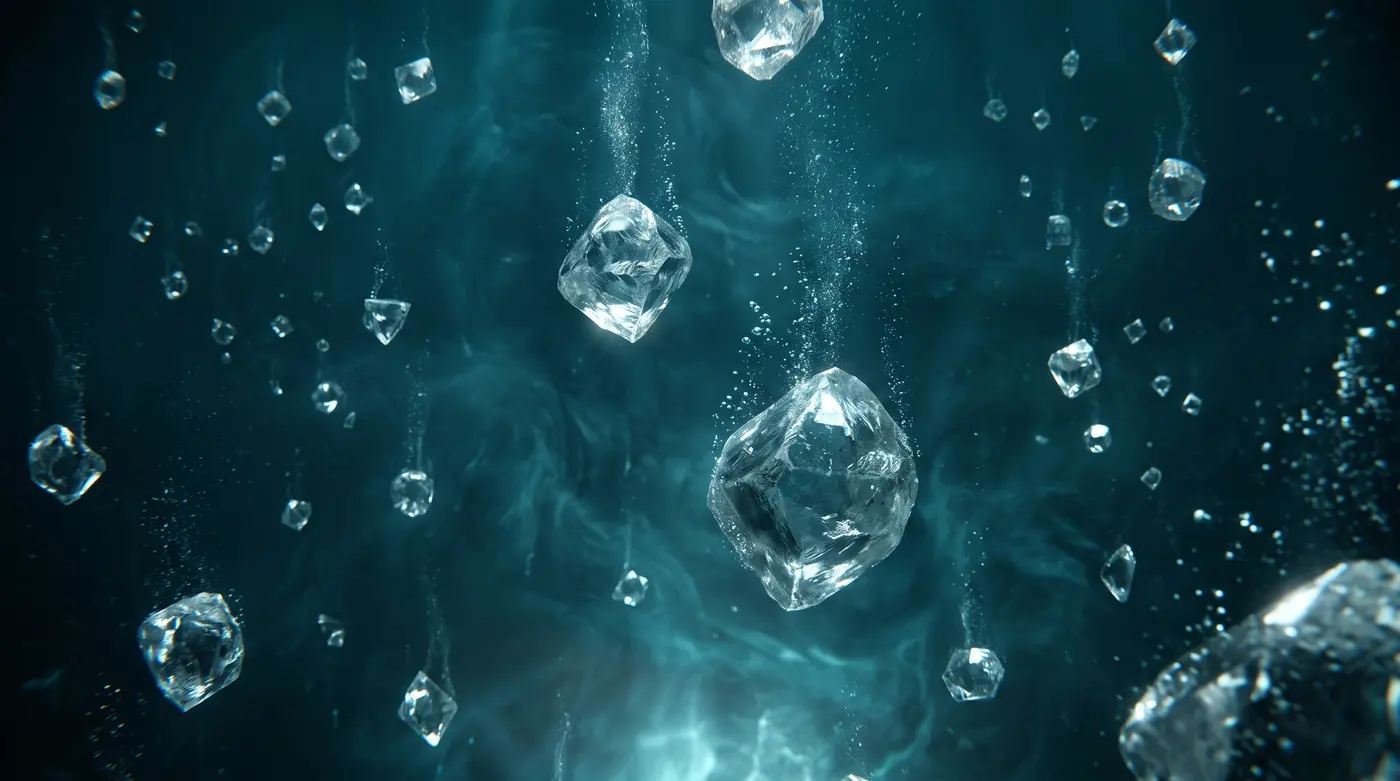
So "rain" is a loose word. It would not be a shower you could stand under. It would be solid carbon sinking through a fluid thousands of kilometers down, out of sight. One more point: NASA's own Neptune and Uranus pages, which I read in full, do not mention diamonds at all. The idea comes from the research papers, not from NASA's planet summaries.
What do we actually know about the insides of Neptune and Uranus?
Much less than for Earth. Voyager 2 is the only spacecraft that has visited either planet, flying past Uranus in January 1986 and Neptune in 1989. It passed by outside the atmosphere. Nothing has ever gone inside, so the interior is inferred from measurements made from outside.
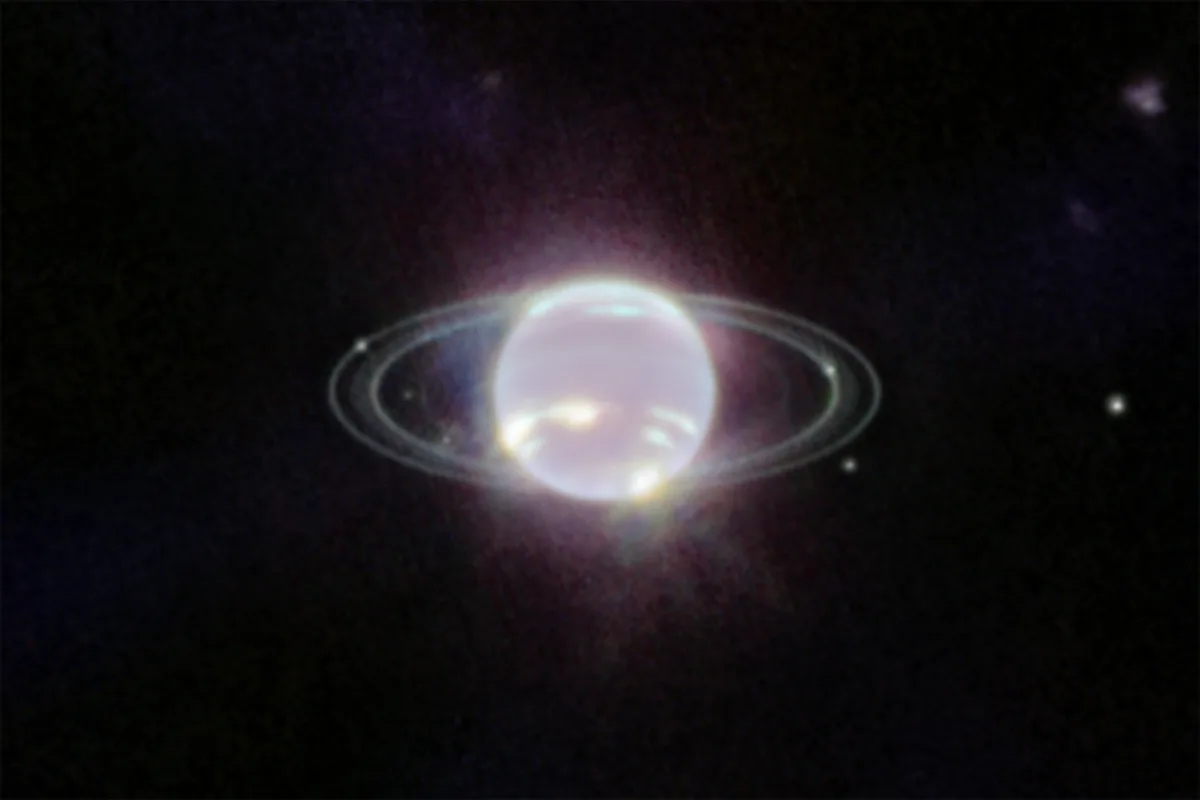
NASA lists Neptune at 49,528 km (30,775 miles) across and Uranus at 51,118 km (31,763 miles), at average distances of about 30 and 19 astronomical units from the Sun. Their atmospheres are mostly hydrogen and helium with a little methane. Below that, NASA describes the hot dense fluid and a small rocky core. For Neptune it says the core is solid with about the mass of Earth, and for Uranus it says the temperature near the core reaches about 4,982 °C (9,000 °F).
That temperature matters, because it tells you why the interior is a hard place to copy on Earth. For more on where these two planets sit, see my guide to the planets in order from the Sun, and for Webb's other pictures, my guide to its biggest discoveries.
How did scientists test it in a lab?
With a laser and an X-ray flash. In an experiment published in Nature Astronomy on August 21, 2017, a team led by Dominik Kraus of Helmholtz-Zentrum Dresden-Rossendorf used the Matter in Extreme Conditions instrument at SLAC's Linac Coherent Light Source, an X-ray free-electron laser. Optical lasers sent shock waves through polystyrene, a plastic of carbon and hydrogen that stands in for methane-type compounds. X-ray pulses lasting about 50 femtoseconds, which is 50 millionths of a billionth of a second, then took pictures of the plastic as it changed.
What they saw, according to SLAC, was small diamond structures up to a few nanometers wide, and nearly every carbon atom of the plastic ended up in them. A nanometer is one billionth of a meter. SLAC calls it the first unambiguous observation of high-pressure diamond formation from mixtures, and says earlier experiments could not capture it in real time. ScienceAlert's report of the paper gives conditions of about 5,000 K and 150 gigapascals, which is roughly 4,700 °C (8,500 °F) and about 1.5 million times the air pressure at sea level (my conversions).
This is a stand-in, and the authors treat it that way. Plastic is not the real mix, and the diamonds in the experiment are far smaller than anything that would matter on a planet. The release says the team planned to apply the same methods to other processes.
What did the later experiments add?
Two things: more realistic ingredients and a shallower start. A short list of the three steps:
| Year | Sample | What the release reports |
|---|---|---|
| 2017 | Polystyrene | Nanodiamonds seen forming in real time |
| 2022 | PET plastic, with oxygen | Diamonds grew at lower pressure and temperature |
| 2024 | Polystyrene film | Formation starts shallower than assumed |
Three experiments, as described in the SLAC and European XFEL releases. The papers themselves are listed in the sources.
In September 2022, a team led by Zhiyu He, with Kraus among the authors and work done at the same SLAC instrument, published in Science Advances. They used PET plastic, the kind used in food packaging and bottles, because it adds oxygen and so comes closer to the mix inside the planets. SLAC says oxygen makes diamond formation more likely, so the nanodiamonds formed and grew over a wider range of conditions, again up to a few nanometers wide. The team also reported evidence that superionic water, sometimes called hot, black ice, might form alongside the diamonds. The release says they planned further experiments with liquid ethanol, water and ammonia samples, and quotes one researcher saying that to model planets accurately you need to get as close as possible to the real composition.
In January 2024, European XFEL in Germany released results led by Mungo Frost of SLAC. They used a polystyrene film, a diamond-anvil setup with lasers and X-ray pulses from the European XFEL, and temperatures above 2,200 °C (about 4,000 °F). Their finding, in the release's words, is that diamond formation from carbon compounds already starts at lower pressures and temperatures than assumed, which means diamond rain could begin at a shallower depth than thought.
What is measured, what is predicted and what is still a hypothesis?
This is the part that headlines skip. In my view it is the most useful way to read the story.
| Level | Claim |
|---|---|
| Seen in a lab | Tiny diamonds form from hydrocarbon plastics under shock |
| Predicted | On the planets they grow much bigger and sink |
| Open | Heat, magnetic fields and what really sits inside |
How I sort the claims. "Release" means the SLAC or European XFEL press release I read.
On the second row, SLAC says the diamonds on Neptune and Uranus would become much larger than the lab ones, maybe millions of carats in weight. A carat is 0.2 gram, so a million carats is about 200 kilograms (my math). That is a prediction from the experiment, not a measurement. Nobody has the sample, and Voyager 2 could not look inside.
The open row is where the most interesting questions sit. The 2017 release says falling diamonds could be an extra source of energy, generating heat. The 2022 release says superionic water could explain the unusual magnetic fields of Uranus and Neptune. In the 2024 release, Frost says the diamond rain probably influences how those complex magnetic fields form, and that currents of conductive fluids can act as a kind of dynamo. Note the words "could" and "probably." In my opinion, these are ideas worth testing, not conclusions, and the releases word them that way.
Could this happen on other planets?
The 2024 release says diamond rain could occur on mini-Neptunes, exoplanets smaller than Neptune and Uranus, and the 2017 release says it could affect how astronomers relate mass and radius for planets outside our solar system. Both are cautious statements: they say what could follow if the lab result holds in real planets. If you like the way astronomers reason about distant worlds from limited data, see how they find exoplanets, and my other diamond story, the truth about the diamond planet 55 Cancri e, which is about a rocky planet and not an ice giant.
It also helps to remember what a diamond is: carbon atoms locked in a rigid crystal pattern. If you want the basics of those atoms, my guide to what is inside an atom covers them.
So does it rain diamonds on Neptune and Uranus?
My answer is "it may, and the lab work says it can." Experiments with lasers and X-rays have shown that diamonds can form from carbon-and-hydrogen material under pressures and temperatures tied to the interiors of these planets, and newer work says it can start at gentler conditions. What no one has done is detect diamonds inside either planet. Until a mission goes there, which is a long way off, the statement stays a hypothesis backed by experiments.
To keep exploring, my guides cover the planets in order, how exoplanets are found and Atoms & Physics.
Frequently asked questions
Does it really rain diamonds on Neptune and Uranus?
It may, but no one has observed it. Lab experiments formed tiny diamonds at pressures and temperatures like those inside the two planets. No spacecraft has entered either planet to check.
How do scientists know diamonds can form there?
They shock-compress plastic with lasers and watch it with X-rays. In 2017 a SLAC team saw nanodiamonds form in polystyrene, and later experiments with oxygen-bearing plastic and at lower conditions saw the same.
How deep would the diamonds form?
SLAC says more than 5,000 miles (about 8,000 km) below the surface, matching its 2017 experiment. A 2024 result says formation starts at lower pressure and temperature, so possibly shallower.
How big would the diamonds be?
The lab diamonds are a few nanometers wide. SLAC predicts those on the planets would be much larger, maybe millions of carats in weight. That is a prediction, not a measurement.
Does NASA say it rains diamonds on Neptune?
NASA's Neptune and Uranus pages describe a hot, dense fluid of water, methane and ammonia around a small rocky core, and do not mention diamond rain. The idea comes from research papers and releases.
Could diamond rain explain the magnetic fields of Uranus and Neptune?
It is a proposed explanation. SLAC says superionic water could explain the unusual fields, and a lead author of the 2024 work says diamond rain probably influences them. Neither is a confirmed result.
Has a spacecraft ever gone inside Neptune or Uranus?
No. Voyager 2 is the only spacecraft to visit either planet, flying past Uranus in 1986 and Neptune in 1989. It did not enter the atmosphere.
Sources
- NASA Science, Neptune facts (page updated October 15, 2026; accessed November 15, 2026). Used for the interior, size, distance, atmosphere and Voyager 2.
- NASA Science, Uranus facts (page updated October 15, 2026; accessed November 15, 2026). Used for the interior, the core temperature, size and distance.
- SLAC, "Scientists Create 'Diamond Rain' that Forms in the Interior of Icy Giant Planets" (August 21, 2017; accessed November 15, 2026). Used for the 2017 experiment and the predictions.
- ScienceAlert, "Scientists Recreate the Diamond Rains of Neptune and Uranus in The Lab" (August 22, 2017; accessed November 15, 2026). Used only for the temperature and pressure of the 2017 experiment.
- Kraus et al., "Formation of diamonds in laser-compressed hydrocarbons at planetary interior conditions," Nature Astronomy (2017). The article page asks for a login; I read the SLAC release instead.
- SLAC, "'Diamond rain' on giant icy planets could be more common than previously thought" (September 2, 2022; accessed November 15, 2026). Used for the oxygen experiment and the superionic water idea.
- He et al., "Diamond formation kinetics in shock-compressed C-H-O samples recorded by small-angle X-ray scattering and X-ray diffraction," Science Advances (September 2, 2022). The publisher page did not open for me; I read the SLAC release instead.
- European XFEL release as published by Phys.org (January 8, 2024; accessed November 15, 2026). Used for the 2024 experiment.
- Frost et al., "Diamond precipitation dynamics from hydrocarbons at icy planet interior conditions," Nature Astronomy (2024). The article page asks for a login; I read the release instead.
- NASA Image and Video Library, PIA01492 (Neptune, Voyager 2) and PIA18182 (Uranus, Voyager 2), used for the cover.

Founder and editor, Orbit and Atom
I write Orbit and Atom to explain space and science in plain English, starting from what NASA, ESA and the mission teams publish. Every article lists its sources at the end so you can read them yourself.