Stars & Galaxies
James Webb Space Telescope: Its Biggest Discoveries So Far
Quick answer
Webb's biggest discoveries so far include MoM-z14, currently the farthest galaxy detected, seen 280 million years after the big bang; the first clear carbon dioxide in the atmosphere of a planet outside our solar system; early black holes hiding in "little red dots"; and sharper views of Neptune's rings and the Pillars of Creation. It has kept reaching further back in time since its first images in July 2022.
On this page
- What is the James Webb Space Telescope?
- What did Webb's first deep field show?
- What is the farthest galaxy Webb has found?
- What are Webb's "little red dots"?
- What did Webb find out about a very early black hole?
- Did Webb find carbon dioxide on another planet?
- What has Webb learned about rocky planets like TRAPPIST-1 c?
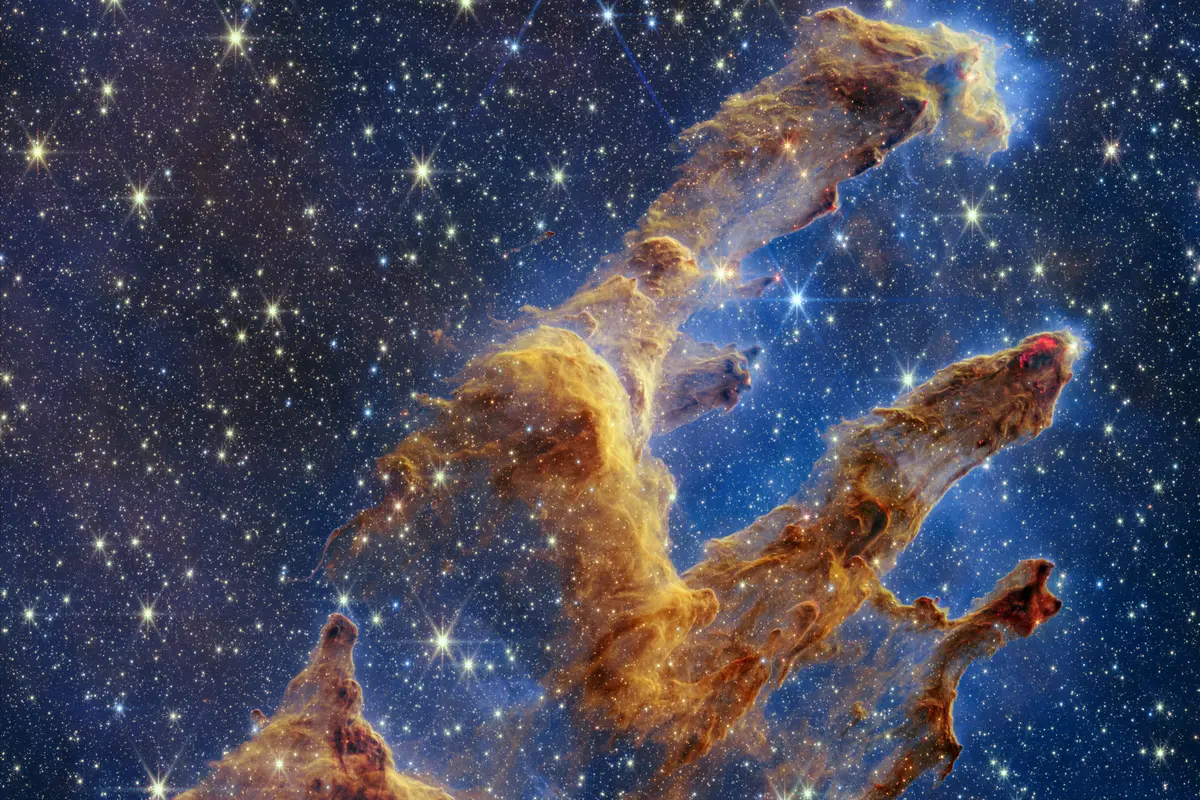
- What did Webb reveal in the Pillars of Creation?
- What has Webb seen in our own solar system?
- What is Webb finding now?
- FAQ
- Sources
On Christmas Day 2021, a telescope with a segmented, gold-coated mirror left Earth, flew 1.5 million kilometers out and started collecting some of the oldest light in the universe. It has not slowed down since.
Webb has now produced a long list of results, and some of them changed what astronomers expected. Here are the biggest, one by one, each with the NASA page it comes from.
What is the James Webb Space Telescope?
Webb is an infrared space telescope run by NASA with ESA and the Canadian Space Agency. NASA says it launched on December 25, 2021, and arrived at its working spot on January 24, 2022. That spot is the second Lagrange point, or L2, about 1.5 million kilometers (1 million miles) from Earth. Unlike Hubble, Webb does not orbit Earth. It orbits the Sun, staying in line with us.
NASA says its first science images came out in July 2022, and that its work is organized around four themes: the early universe, galaxies over time, the life cycle of stars and other worlds. The discoveries below touch all four. For the star theme, our Betelgeuse explainer shows what happens at the end of a star's life.
| Discovery | When | What it showed |
|---|---|---|
| First Deep Field | July 2022 | Thousands of galaxies in a tiny patch of sky |
| CO2 on WASP-39 b | Aug 2022 | First clear carbon dioxide in an exoplanet's atmosphere |
| Neptune's rings | Sep 2022 | Clearest view of the rings in over 30 years |
| Pillars of Creation | Oct 2022 | Newly forming stars inside the pillars |
| TRAPPIST-1 c | Jun 2023 | No thick carbon dioxide atmosphere on a rocky planet |
| Little red dots | Jan 2025 | Many may be growing black holes |
| MoM-z14 | Jan 2026 | The farthest galaxy detected, 280 million years after the big bang |
| QSO1 | May 2026 | First direct black hole mass in the first billion years |
Webb's biggest discoveries at a glance. Sources: NASA Science news releases, linked at the end of this article.
What did Webb's first deep field show?
Thousands of galaxies in a patch of sky NASA compares to a grain of sand held at arm's length. The image, released on July 12, 2022, shows the galaxy cluster SMACS 0723 and includes, in NASA's words, "the faintest objects ever observed in the infrared."
The picture took 12.5 hours of exposure. NASA says that reached depths beyond Hubble's deepest fields, which took weeks. The cluster itself also works as a lens: its combined mass bends and magnifies the light of galaxies far behind it, which is why some of them are stretched into arcs. NASA says the light of one galaxy in the image traveled for 13.1 billion years to reach Webb.
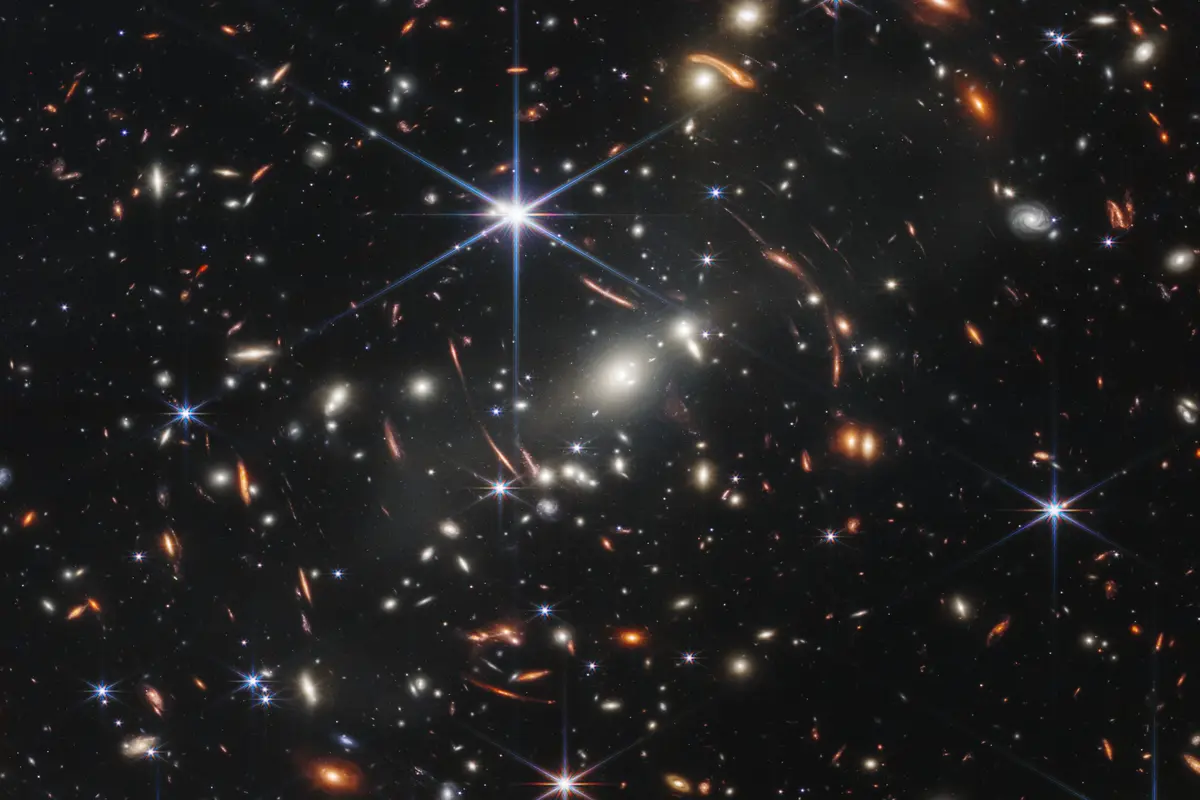
Light that old is a time machine, as our light-year guide explains: the farther away something is, the further back in time you are looking.
What is the farthest galaxy Webb has found?
MoM-z14, at least for now. NASA announced on January 28, 2026 that Webb's NIRSpec instrument had confirmed its distance, a redshift of 14.44. NASA says we see it as it was only 280 million years after the big bang, and that its light traveled for roughly 13.5 of the universe's estimated 13.8 billion years. Its image page calls it "currently the farthest galaxy ever detected."
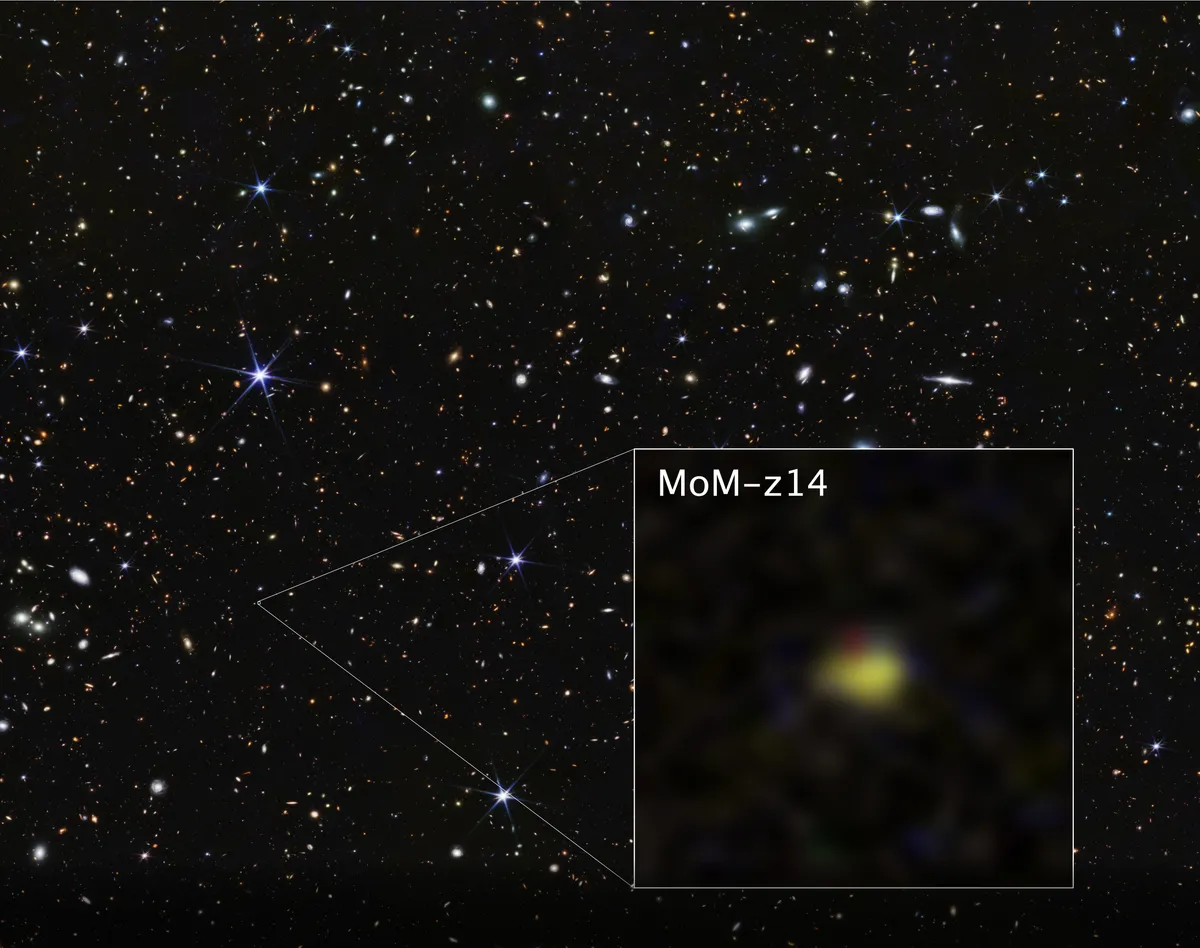
The surprise is how much is there. NASA says the galaxy is brighter, more compact and more chemically enriched than astronomers expected for such an early time, and that bright galaxies like it are "100 times more" common than theoretical studies predicted before Webb launched. It also holds an unusual amount of nitrogen. Because the galaxy is so young, NASA says there was not enough time for generations of stars to make that much, and one proposed explanation is supermassive stars.
There is a second payoff. NASA says MoM-z14 gives another clue for mapping the timeline of reionization, the period when early starlight cleared the dense hydrogen gas of the young universe. That was one of Webb's original goals. The lead author of the paper, published in the Open Journal of Astrophysics, is Rohan Naidu of MIT's Kavli Institute.
What are Webb's "little red dots"?
Small, compact red objects that Webb found in large numbers in the early universe. NASA says they first showed up in Webb's December 2022 data and that astronomers did not know what they were. In January 2025, a team that built one of the largest samples to date reported that they appear in large numbers around 600 million years after the big bang, and that their numbers drop sharply around 1.5 billion years.
About 70 percent of the dots with spectra showed fast-moving gas, which the team reads as a sign of an accretion disk around a supermassive black hole. In short, many of them may be black holes in the middle of growing. NASA is clear that this is still debated: nobody yet knows why they disappear at later times, and each answer raises new questions.
What did Webb find out about a very early black hole?
That one of them was enormous almost from the start. In a May 27, 2026 release, NASA reports on QSO1, a little red dot seen about 700 million years after the big bang, magnified by the galaxy cluster Abell 2744. Webb's NIRSpec mapped hydrogen gas orbiting the black hole and measured its mass at about 50 million Suns, which NASA says is "the first direct measurement of a black hole mass within the first billion years after the big bang."
The black hole makes up at least two-thirds of QSO1's total mass, far more than in nearby galaxies. NASA says that points to a black hole that formed without a stellar collapse and without a massive host galaxy, evidence for primordial or direct-collapse black holes, which have been theorized but not confirmed. It is one object, and the measurement assumes the gas orbits under the black hole's gravity alone, so the team is now analyzing similar objects. For the basics, see our black hole guide.
Did Webb find carbon dioxide on another planet?
Yes, in August 2022, on a planet called WASP-39 b. NASA calls it the first clear evidence of carbon dioxide in the atmosphere of a planet outside our solar system. WASP-39 b is a puffy, very hot gas giant about 700 light-years away. It has about a quarter of Jupiter's mass, a diameter about 1.3 times Jupiter's, and circles its Sun-like star in just over four Earth days.
Webb's NIRSpec found the signal as "a small hill" in the spectrum between 4.1 and 4.6 microns, a gap in the starlight that carbon dioxide leaves as the light filters through the planet's air. Researchers told NASA that carbon dioxide molecules are sensitive tracers of how a planet formed, and that the result bodes well for detecting atmospheres on smaller, Earth-sized planets.
What has Webb learned about rocky planets like TRAPPIST-1 c?
That it is a hot, close-in world and that a Venus-like thick atmosphere is unlikely. TRAPPIST-1 c is one of seven rocky planets around an ultracool red dwarf star about 40 light-years away. In a June 19, 2023 release, NASA says Webb's MIRI measured a dip in brightness of just 0.04 percent as the planet passed behind its star, which puts its dayside at roughly 380 kelvins (about 225 °F).
That makes it, in NASA's words, "the coolest rocky exoplanet ever characterized based on thermal emission." NASA says it is unlikely to be a true Venus analog with a thick carbon dioxide atmosphere and sulfuric acid clouds. Any atmosphere would be extremely thin, and the data fit either a bare rock or a very thin carbon dioxide layer. A follow-up study of full orbits of TRAPPIST-1 b and c is planned to narrow it down, which is a first step toward reading the air of Earth-sized worlds.
What did Webb reveal in the Pillars of Creation?
Stars in the making, hidden from view in older pictures. The pillars sit in the Eagle Nebula, 6,500 light-years away. Hubble photographed them in visible light in 1995 and again in 2014. In NASA's October 19, 2022 release of Webb's near-infrared view, the dusty pillars look semi-transparent and rusty red, and bright red orbs mark newly forming stars.
NASA says dense knots of gas and dust collapse under their own gravity, heat up and eventually become stars. The wavy, lava-like lines at the edges of the pillars are jets and shocks from young stars, which NASA estimates are only a few hundred thousand years old. Webb sees infrared light, which human eyes cannot, so the colors in the picture are chosen to represent it. Almost no background galaxies show up, because gas and dust in our own galaxy block the view.
What has Webb seen in our own solar system?
Among other things, the sharpest look at Neptune's rings in decades. NASA's Neptune release of September 21, 2022 says the image shows the rings more clearly than at any time in over thirty years. Voyager 2 was the first spacecraft to observe the planet, in 1989, and the faint, dusty rings had not been seen in the infrared before, Neptune expert Heidi Hammel told NASA.
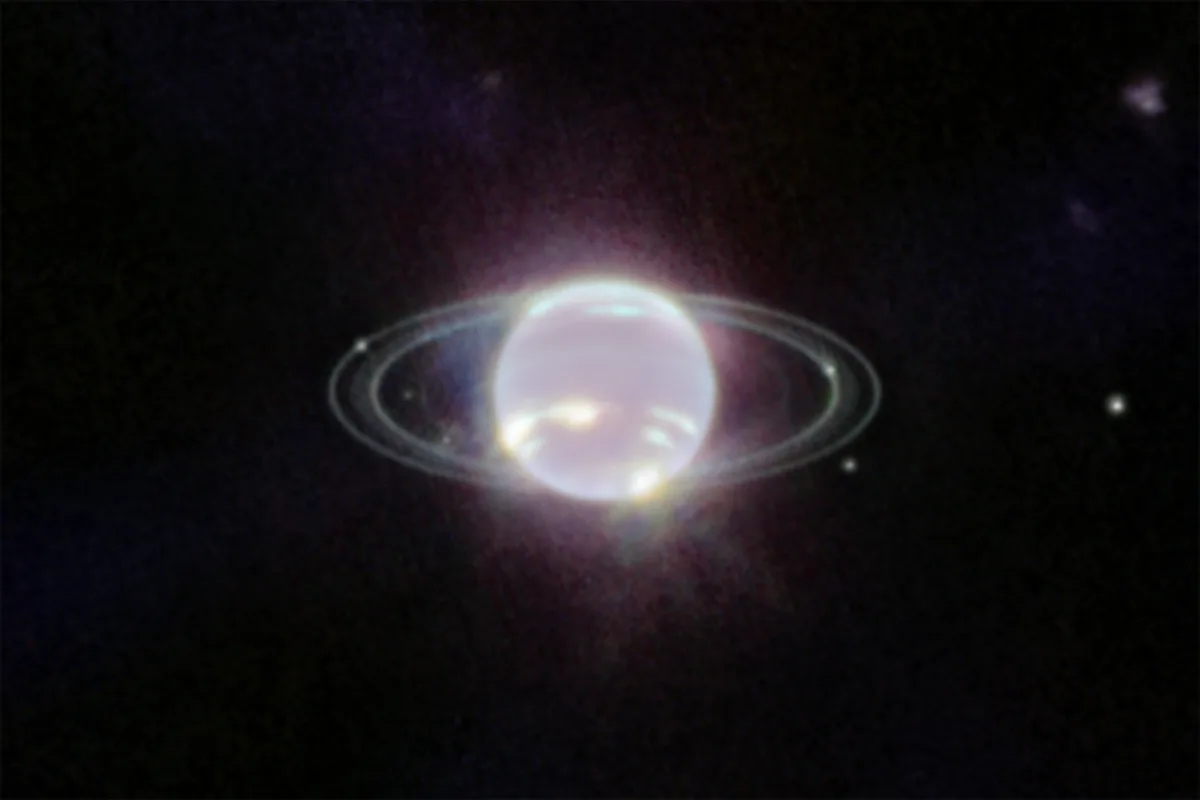
Webb captured seven of Neptune's 14 known moons. The brightest dot in the frame is Triton, which reflects about 70 percent of the sunlight that hits it. Neptune itself looks dark in near-infrared because methane absorbs the light, except where high-altitude methane-ice clouds show up as bright streaks, including a band of clouds around the southern pole. Our planets in order guide shows where Neptune sits, and the Saturn rings article covers another ring system.
What is Webb finding now?
The list keeps growing. NASA's Webb news page for October 2026 includes a measurement of the distance to the most distant fast radio burst known so far, on October 8, new images of stellar jets in a nebula, on October 6, and Webb data on planet-shattering collisions, on October 1. In June, NASA reported that Webb detected methane on the interstellar comet 3I/ATLAS. The telescope also joins other missions that explore worlds up close, such as Europa Clipper.
Frequently asked questions
What is the biggest discovery of the James Webb Space Telescope?
There is no single answer, but the most cited are MoM-z14, currently the farthest galaxy detected (280 million years after the big bang), and the first clear carbon dioxide in an exoplanet atmosphere, on WASP-39 b in 2022.
What is the farthest galaxy Webb has seen?
MoM-z14, according to NASA. Webb confirmed its redshift at 14.44 and we see it as it was about 280 million years after the big bang.
What are "little red dots"?
Small, compact red objects Webb found in the early universe. Many may be growing supermassive black holes, since about 70 percent of those with spectra showed fast-moving gas, but NASA says their nature is still debated.
Has Webb found an atmosphere on a rocky planet?
For TRAPPIST-1 c, NASA says Webb ruled out a thick carbon dioxide atmosphere and that any atmosphere would be extremely thin. Follow-up observations are planned.
Where is the James Webb Space Telescope?
At the second Lagrange point (L2), about 1.5 million kilometers from Earth. NASA says it orbits the Sun rather than Earth and arrived there on January 24, 2022.
When did Webb launch and take its first images?
It launched on December 25, 2021. NASA released its first science images in July 2022, starting with the First Deep Field of galaxy cluster SMACS 0723.
Did Webb take the first picture of the Pillars of Creation?
No. Hubble photographed them in 1995 and 2014 in visible light. Webb's 2022 near-infrared image shows the pillars semi-transparent, with newly forming stars inside.
Sources
- NASA Science, James Webb Space Telescope mission page (accessed October 28, 2026). Source of the launch date, L2 location, four science themes and the October 2026 and June 2026 news items.
- NASA Science, "NASA's Webb Delivers Deepest Infrared Image of Universe Yet" (July 12, 2022; accessed October 28, 2026)
- NASA Science, "NASA Webb Pushes Boundaries of Observable Universe Closer to Big Bang" (January 28, 2026; accessed October 28, 2026)
- NASA Science, "COSMOS Field MoM-z14 Galaxy (NIRCam Image)" (accessed October 28, 2026)
- NASA Science, "Newfound Galaxy Class May Indicate Early Black Hole Growth, Webb Finds" (January 14, 2025; accessed October 28, 2026)
- NASA Science, "NASA's Webb Reveals Black Hole That Formed Before Its Galaxy" (May 27, 2026; accessed October 28, 2026)
- NASA Science, "NASA's Webb Detects Carbon Dioxide in Exoplanet Atmosphere" (August 25, 2022; accessed October 28, 2026)
- NASA Science, "Webb Rules Out Thick Carbon Dioxide Atmosphere for Rocky Exoplanet" (June 19, 2023; accessed October 28, 2026)
- NASA Science, "NASA's Webb Takes Star-Filled Portrait of Pillars of Creation" (October 19, 2022; accessed October 28, 2026)
- NASA Science, "New Webb Image Captures Clearest View of Neptune's Rings in Decades" (September 21, 2022; accessed October 28, 2026)
- NASA Science, "Pillars of Creation (NIRCam Image)": image credit and observation date (August 14, 2022)

Founder and editor, Orbit and Atom
I write Orbit and Atom to explain space and science in plain English, starting from what NASA, ESA and the mission teams publish. Every article lists its sources at the end so you can read them yourself.