Solar System & Missions
Europa Clipper: Where Is It Now, and When Does It Reach Jupiter?
Quick answer
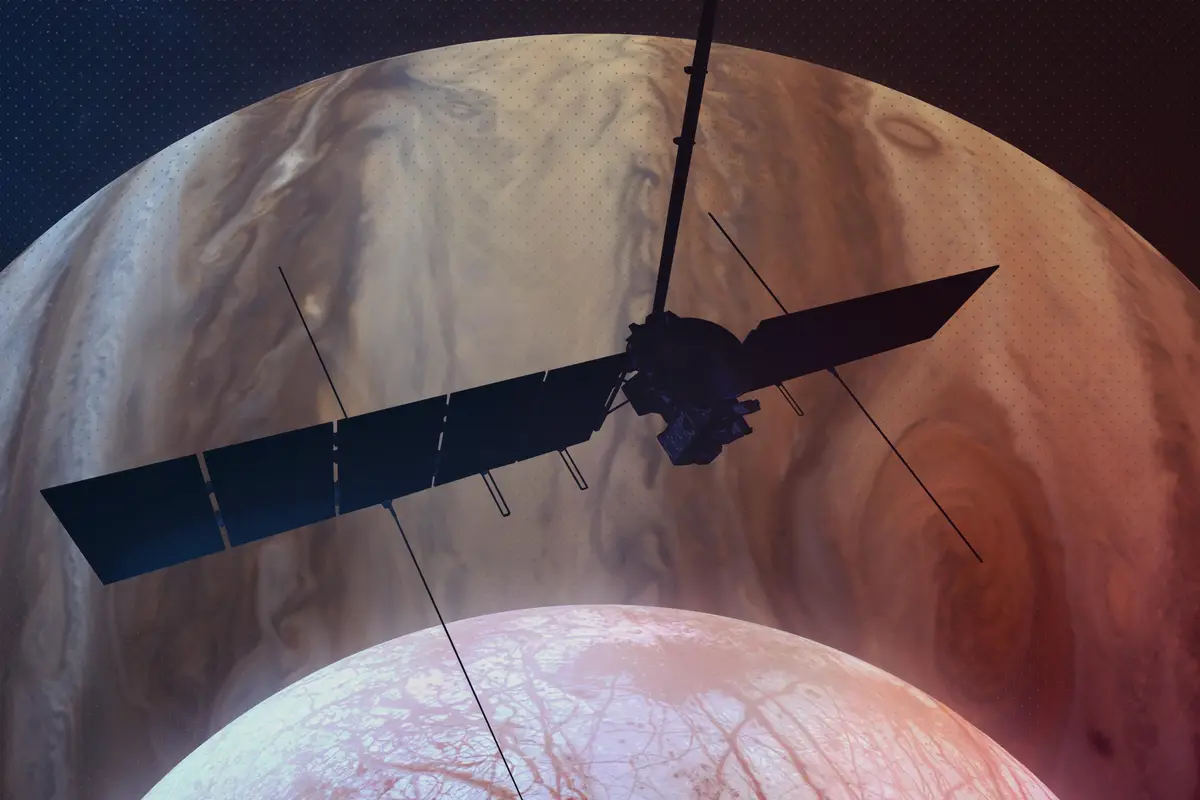
Europa Clipper is on the second leg of its trip, heading back toward Earth for a gravity assist on December 3, 2026, about five weeks from now. The swing past Earth, roughly 2,000 miles up, sets the spacecraft on course to reach Jupiter in April 2030. It will then make nearly 50 close flybys of Europa, the icy moon that may hide an ocean with twice as much water as Earth's.
On this page
- Where is Europa Clipper right now?
- When does Europa Clipper reach Jupiter?
- Why does it go back to Earth before heading to Jupiter?
- What happens when Europa Clipper arrives?
- Why does it orbit Jupiter instead of Europa?
- What will Europa Clipper look for?
- What should you watch for between now and 2030?
- FAQ
- Sources
Europa Clipper has been flying for two years, and it still has more than three years to go before it reaches its target. The trip is not a straight line. It swung past Mars in March 2025 and is now looping back toward Earth for a second boost.
Here is where the spacecraft stands, the dates still ahead, why it takes such a long route and what it will look for once it arrives.
Where is Europa Clipper right now?
On its way back to Earth. NASA launched the spacecraft on October 14, 2024, and it used Mars's gravity on March 1, 2025 to reshape its path around the Sun. JPL explained at the time that the spacecraft would leave Mars on a path that returns it past Earth.
That return pass is the next big event. NASA's mission page lists the Earth gravity assist for December 3, 2026, and the mission timeline puts the closest approach at about 2,000 miles (3,200 kilometers) above Earth. From today, October 26, that is 38 days away (our count).
NASA's mission pages do not publish a daily distance. For a live view of the spacecraft's position, NASA points to its Eyes on the Solar System tool.
When does Europa Clipper reach Jupiter?
In April 2030, according to NASA. JPL's mission overview gives April 11, 2030 for the engine burn that puts the spacecraft into orbit around Jupiter. The whole journey was planned as about five and a half years.
| Milestone | Date | Status |
|---|---|---|
| Launch (Falcon Heavy, Kennedy Space Center) | October 14, 2024 | Done |
| Mars gravity assist, about 550 miles (884 km) up | March 1, 2025 | Done |
| Earth gravity assist, about 2,000 miles (3,200 km) up | December 3, 2026 | Next: 38 days away |
| Jupiter orbit insertion | April 2030 (JPL: April 11) | About 3.5 years away |
| First Europa science campaign begins | May 2031 | Ahead |
| Possible end of mission | September 2034 | Ahead |
Europa Clipper's main dates. Sources: NASA Science mission page (updated September 10, 2026), NASA mission timeline (updated September 24, 2026) and JPL's mission overview. The status column is as of October 26, 2026 and the day counts are our arithmetic.
Counting from launch to April 11, 2030, today is day 742 of 2,005, so the spacecraft is about 37% of the way through its cruise in time (our arithmetic). It is closer to the start of its trip than to the end.
Why does it go back to Earth before heading to Jupiter?
Because the rocket alone could not do it. NASA's release on the Mars flyby explained that a gravity assist saves propellant and time. Without the two assists, the spacecraft would need extra fuel, which adds weight and cost, or a much longer trip.
The total path from Earth to Jupiter is about 1.8 billion miles (2.9 billion kilometers), JPL says. That is the length of the winding route, not the straight-line distance between the planets. On approach to Mars, the spacecraft was moving at about 15.2 miles per second relative to the Sun, and it left at about 14 miles per second. The Earth flyby is the second slingshot, and together with Mars it gives the spacecraft the energy to reach Jupiter.
The Mars pass was also a rehearsal. The team used it to calibrate the thermal imager and to test the radar with all of its parts working together for the first time, something that could not be done on Earth before launch.
What happens when Europa Clipper arrives?
First comes a braking burn. NASA says the engines slow the spacecraft over about six hours so that Jupiter's gravity can capture it. A flyby of Ganymede, one of Jupiter's big moons, comes right around that time. JPL says it passes within about 120 miles (200 kilometers) of the surface.
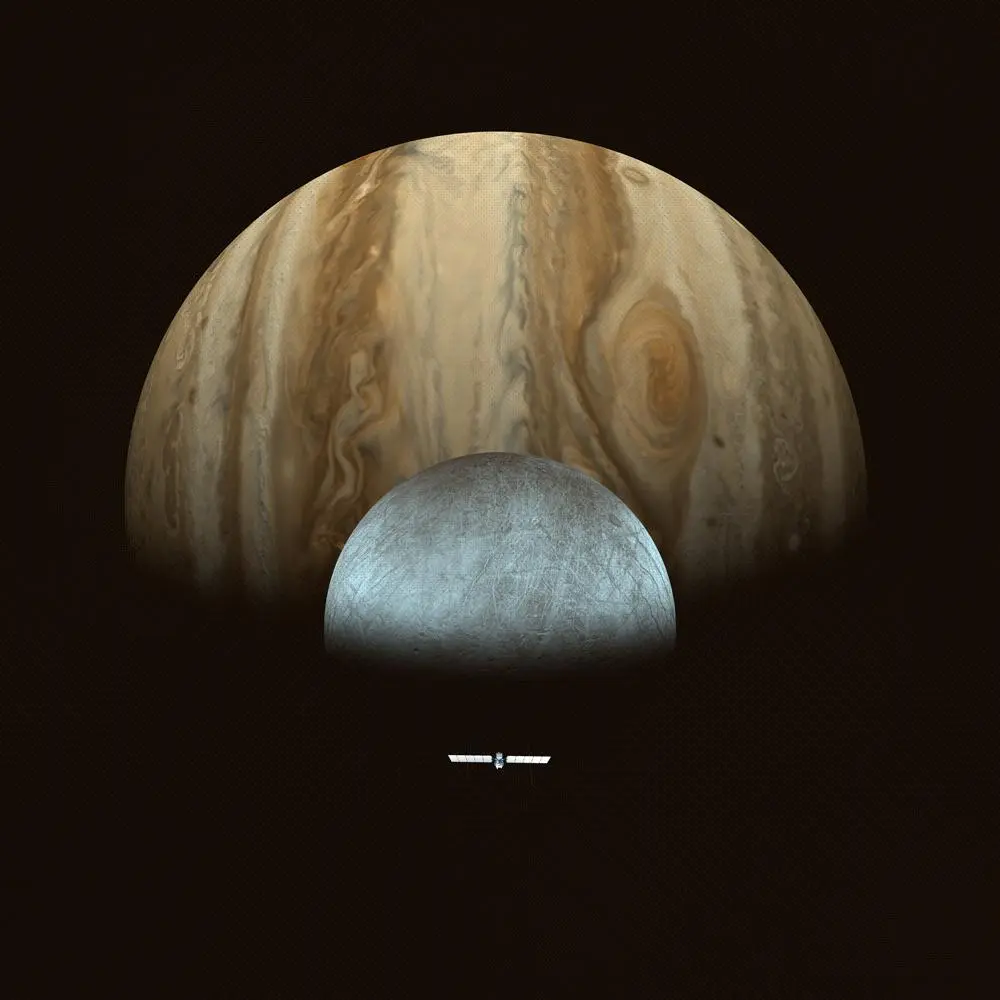
Then the long setup. NASA's timeline says the team shapes the orbit starting in October 2030, using several flybys of Galilean moons, including Ganymede, to line up with Europa's orbit. The first Europa flyby comes in spring 2031, and the first science campaign begins in May 2031, with closest approaches as low as 16 miles (25 kilometers). A second campaign starts in May 2033.
In all, JPL counts 49 dedicated Europa flybys, plus 7 of Ganymede and 9 of Callisto to shape the path. NASA lists a possible end of mission in September 2034, with a planned impact into Ganymede. That is a little over four years of work at Jupiter, our reading of the dates.
Why does it orbit Jupiter instead of Europa?
Radiation. Europa circles Jupiter inside a band of intense radiation produced by the planet's strong magnetic field. JPL says Jupiter has the most intense radiation of any planet in the solar system, and the tour is designed to observe as much of Europa as possible while limiting time in the hazardous zones.
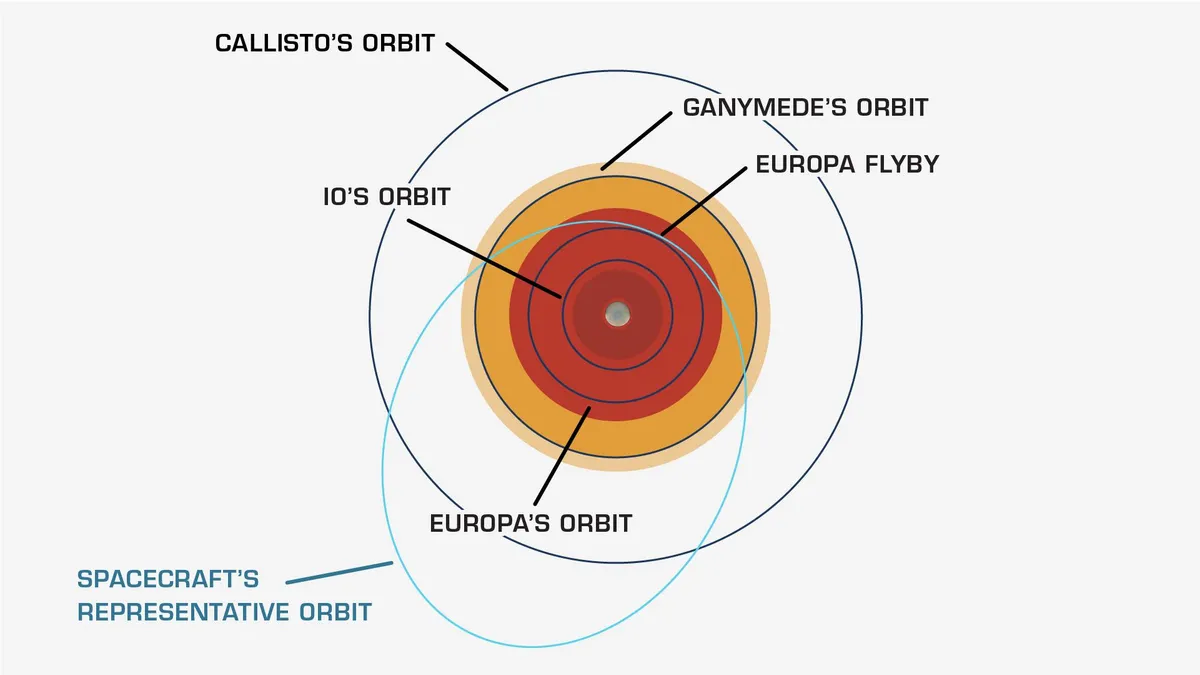
So the spacecraft flies a long ellipse. NASA's diagram caption says it dips in for dozens of close flybys of Europa and, between each pass, retreats to a safer distance from which it can transmit its data back to Earth. Each flyby covers a different spot, so the passes together map almost the whole moon.
What will Europa Clipper look for?
Whether Europa has places that could support life. That is the mission's main goal, and NASA breaks it into three objectives: the thickness of the ice shell and how it interacts with the ocean below, the moon's composition, and its geology. NASA's Europa page says scientists believe a saltwater ocean under the ice holds about twice as much water as Earth's global ocean, which is why it calls Europa one of the most promising places in the solar system to look for conditions suited to life.
The spacecraft carries nine science instruments, plus a gravity experiment that uses its radio system. They include an ice-penetrating radar, a magnetometer, a visible-light imager, a thermal imager and two mass spectrometers, one for gas and one for dust. The craft itself is big: about 16 feet (5 meters) tall and more than 100 feet (30.5 meters) wide with its solar arrays out, with a dry mass of 7,145 pounds (3,241 kilograms). Four of its radar antennas are 57.7 feet (17.6 meters) long each.
Europa is not the only ocean world in the outer solar system. For another one, see our guide to Saturn's moons, where Enceladus hides an ocean of its own. For where Jupiter sits among the planets, see The Planets in Order From the Sun.
What should you watch for between now and 2030?
The Earth flyby on December 3, 2026 is the next checkpoint. After it, the spacecraft has about 1,225 days to go to Jupiter, or roughly 3.4 years (our arithmetic). Then comes the long wait: the first Europa science campaign does not start until May 2031.
It is a very different pace from older deep-space trips. Voyager 1, which launched in 1977, will soon be so far away that its radio signals take a full day to reach us. Our Voyager 1 light-day guide covers how far a single spacecraft can go. And if you want something to look at in the sky this week, the Moon passes close to the Pleiades on October 27 and 28.
Frequently asked questions
Where is Europa Clipper now?
It is on the leg that brings it back toward Earth after its Mars flyby of March 1, 2025. NASA lists an Earth gravity assist for December 3, 2026. NASA's Eyes on the Solar System tool shows its live position.
When will Europa Clipper reach Jupiter?
In April 2030, according to NASA. JPL's mission overview gives April 11, 2030 for the orbit insertion burn, which lasts about six hours.
When does Europa Clipper fly by Earth?
On December 3, 2026, according to NASA's mission page, at about 2,000 miles (3,200 kilometers) above Earth. It is a gravity assist that adds speed for the rest of the trip.
Why did Europa Clipper fly by Mars?
A Mars gravity assist reshaped its orbit around the Sun and set up the Earth flyby, saving propellant and time. The pass on March 1, 2025 was also used to test the radar and calibrate the thermal imager.
When will Europa Clipper start studying Europa?
The first Europa flyby comes in spring 2031, and NASA's timeline says the first science campaign begins in May 2031. The mission plans nearly 50 close flybys, as close as 16 miles (25 kilometers) above the surface.
Why doesn't Europa Clipper orbit Europa itself?
Europa sits inside one of Jupiter's most powerful radiation zones. The spacecraft orbits Jupiter in a long ellipse, dips in for each flyby and retreats to a safer distance between passes to send its data home.
What is Europa Clipper looking for?
Places beneath Europa's surface that could support life. It will study the ice shell and the ocean below it, the moon's composition and its geology, with nine science instruments and a gravity experiment.
Sources
- NASA Science, "Europa Clipper" (page last updated September 10, 2026; accessed October 26, 2026). Used for the December 3, 2026 Earth flyby, the April 2030 arrival, 49 flybys and nine instruments.
- NASA Science, "Europa Clipper Mission Timeline" (page last updated September 24, 2026; accessed October 26, 2026)
- NASA Science, "Europa Clipper Mission Overview" (page last updated June 25, 2025; accessed October 26, 2026). Used for the spacecraft size and mass.
- NASA/JPL, Europa Clipper press kit, "Overview" (accessed October 26, 2026). Used for the April 11, 2030 insertion date, the flyby counts and the radiation tour design.
- NASA/JPL, "NASA's Europa Clipper Uses Mars to Go the Distance" (February 25, 2025; accessed October 26, 2026)
- NASA/JPL, "NASA's Europa Clipper: Millions of Miles Down, Instruments Deploying" (November 25, 2024; accessed October 26, 2026)
- NASA Science, "Europa" (page last updated September 24, 2026; accessed October 26, 2026)
- NASA/JPL, "Eyes on the Solar System": live position of Europa Clipper (not used for numbers in this article)
- NASA/JPL-Caltech, "Europa Clipper Spies Jupiter and Europa (Artist's Concept)" (PIA26442)
- NASA/JPL-Caltech, "Europa Clipper's Elliptical Orbit" (PIA26436)
- NASA/JPL-Caltech, "Europa Clipper Approaches Its Target (Artist's Concept)" (PIA26445)

Founder and editor, Orbit and Atom
I write Orbit and Atom to explain space and science in plain English, starting from what NASA, ESA and the mission teams publish. Every article lists its sources at the end so you can read them yourself.