Stars & Galaxies
When Will Betelgeuse Explode, and Will We See It in Daytime?
Quick answer
Not anytime soon. NASA says Betelgeuse isn't likely to explode for about another 100,000 years, and the 2019-2020 "Great Dimming" that sparked the rumors was a dust cloud, not a warning sign. When it does go, one simulation says the supernova would stay visible in daylight for about a year. At roughly 700 light-years, it is too far away to harm Earth.
On this page
- What kind of star is Betelgeuse?
- When will Betelgeuse explode?
- What was the Great Dimming of Betelgeuse?
- Does Betelgeuse have a companion star?
- Will we see the Betelgeuse supernova in daytime?
- Is a Betelgeuse supernova dangerous to Earth?
- Could Betelgeuse have exploded already?
- How can you see Betelgeuse yourself?
- FAQ
- Sources
Betelgeuse is the orange star at the shoulder of Orion, and it is dying. It is a red supergiant, a star so big and so old that it will end in a supernova. What nobody can tell you is the date.
In 2019 the star got strangely faint, headlines said an explosion was near, and the question has been popular ever since. Here is what NASA, ESO and other observatories actually say about when, how bright and how safe.
What kind of star is Betelgeuse?
A huge, cool and short-lived one. NASA describes it as a red supergiant about 700 times the size of the Sun, around 15 times as massive and roughly 10 million years old. The Sun, by comparison, is nearly 5 billion years old. NASA says that if Betelgeuse replaced the Sun at the center of our solar system, its surface would stretch past the orbit of Jupiter.
| Property | What NASA says |
|---|---|
| Distance | About 700 light-years (650 in a January 2026 release) |
| Size | About 700 times the Sun, past Jupiter's orbit if placed where the Sun is |
| Mass | Around 15 times the Sun |
| Age | Roughly 10 million years |
| Expected supernova | Not for about another 100,000 years |
Betelgeuse at a glance. Sources: NASA Science "What is Betelgeuse?" (updated March 9, 2026) and NASA Hubble's January 5, 2026 release. NASA's pages give slightly different distances, from about 650 to 725 light-years, because the star is hard to measure.
Because Betelgeuse is so massive, it is on a fast track. Our black hole guide explains that NASA says stars with more than eight times the Sun's mass end their lives in a supernova. At around 15 Suns, Betelgeuse is well above that line.
When will Betelgeuse explode?
NASA's answer is that it "isn't likely to happen for about another 100,000 years." That sounds like a very long time, and for us it is. For a star, it is a short step: Betelgeuse is about 10 million years old, so 100,000 years is about 1% of its life so far (our arithmetic).
It is also an estimate, not a countdown. Astronomers cannot read an exact date from a star, so the honest version is "probably not in our lifetimes, and probably not in the lifetimes of our great-great-grandchildren." ESO puts it more simply: astronomers do not think it is happening now.
What was the Great Dimming of Betelgeuse?
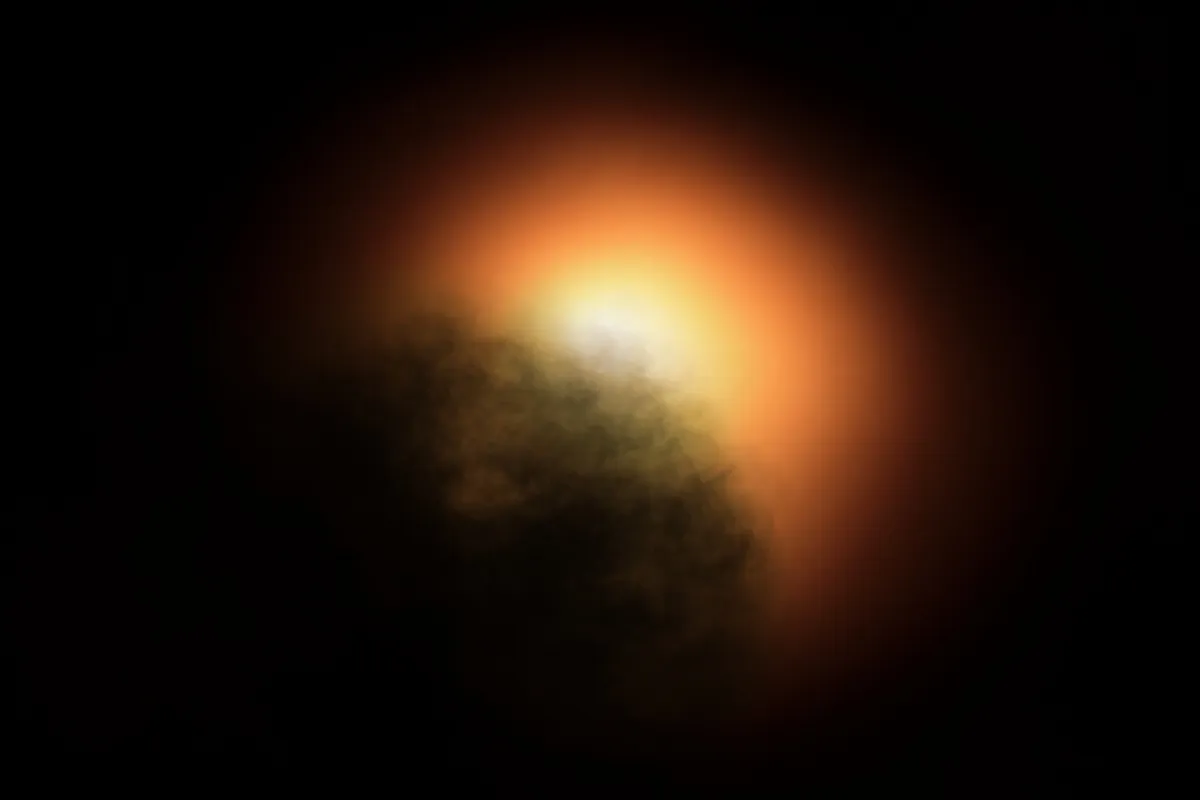
A dust cloud, not the start of an explosion. Starting in fall 2019, NASA says, the star dimmed by about 60% within months. By April 2020 it was back to normal.
Hubble and ground-based data showed what happened. A giant convection bubble pushed superhot material out from the star. It cooled, turned into dust and blocked light from about a quarter of the star's surface. NASA says the piece that broke away weighed roughly several times as much as our Moon.
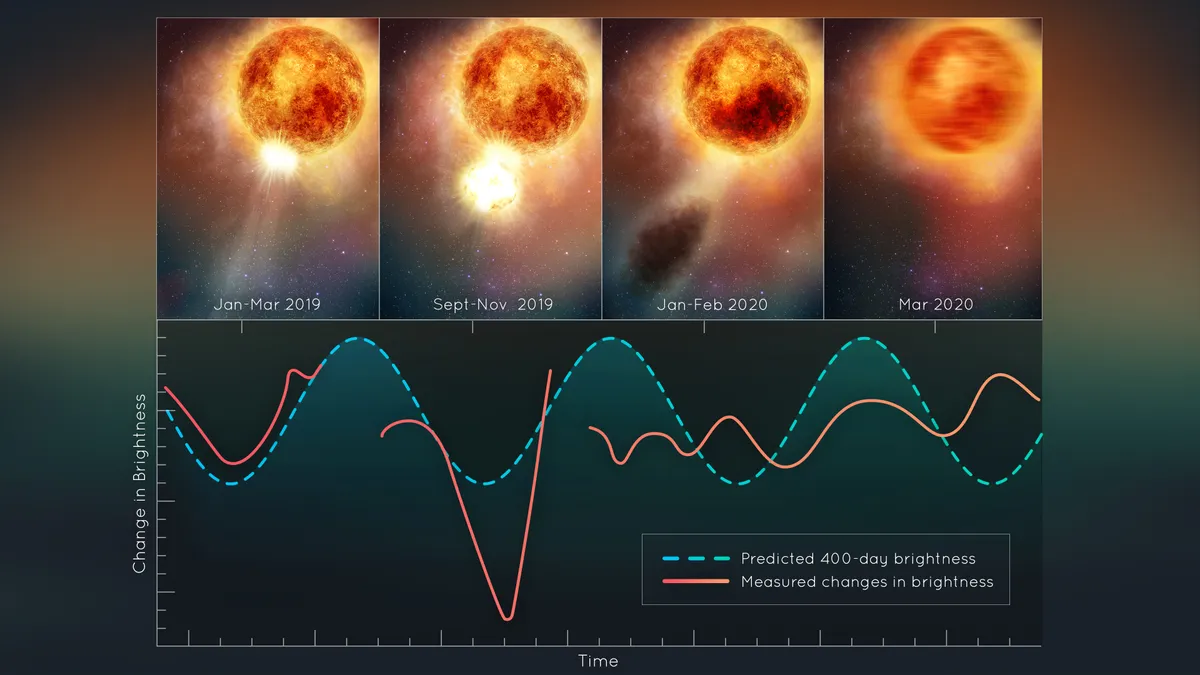
NASA was direct about what it meant. The star's behavior "is not evidence the star is about to blow up anytime soon." The event did leave a mark, though: Betelgeuse's well-known 400-day brightness cycle, tracked for almost 200 years, went quiet for a while.
Does Betelgeuse have a companion star?
Very likely, and the evidence got stronger this year. In July 2025, a team led by NASA's Steve Howell reported a faint star right beside Betelgeuse in images from the Gemini North telescope in Hawai'i. The team proposed the name Siwarha, "her bracelet."
In January 2026, NASA announced that Hubble had caught its "wake": a trail of denser gas the companion leaves in Betelgeuse's atmosphere each time it passes in front, about every six years or 2,100 days. Then in July 2026, ESO reported what it called the clearest image yet of the companion, which it calls Betelgeuse B, taken with the Very Large Telescope in Chile.
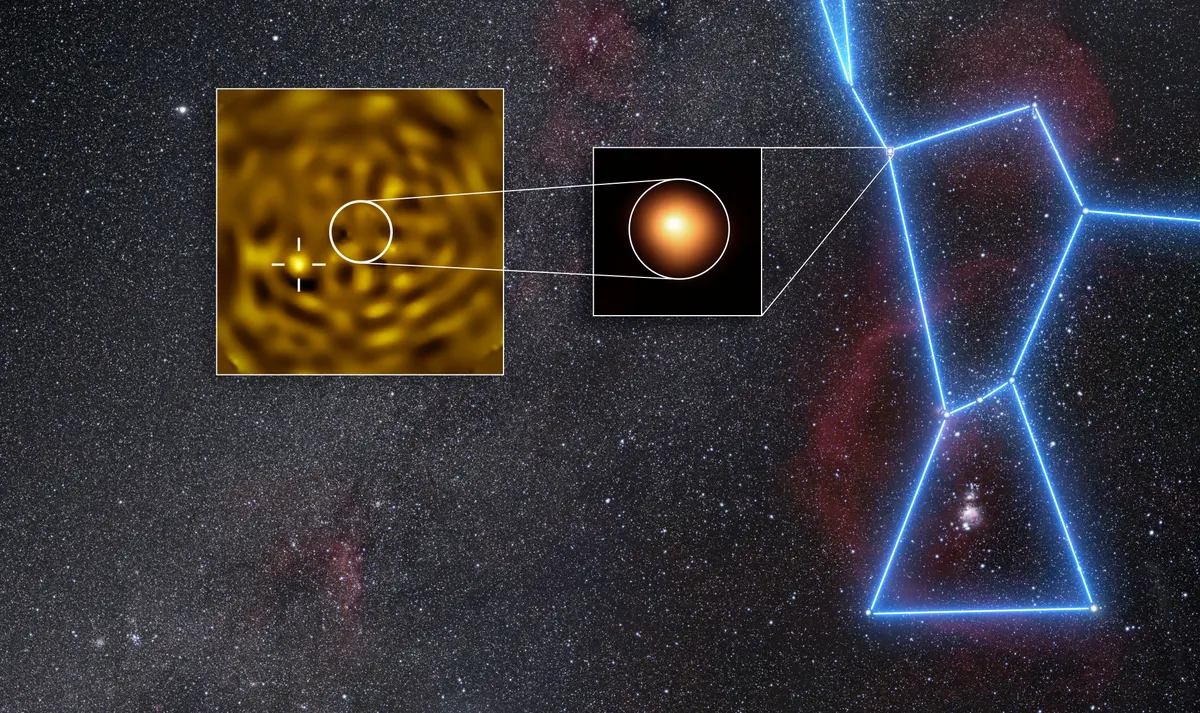
It is not settled. The Gemini team called its detection tentative and estimated about 1.6 times the Sun's mass, while ESO's new observations point to two to three solar masses. ESO says confirming it needs a follow-up look, and whether the companion changes how Betelgeuse ages is still an open question. NASA says astronomers are planning new observations for the companion's next emergence in 2027.
Will we see the Betelgeuse supernova in daytime?
Probably yes, if a simulation by two UC Santa Barbara researchers, reported by Astronomy magazine in 2020, is close. It put the peak at about the brightness of a half Moon, roughly nine times fainter than a full Moon. That would stay bright for more than three months, be visible in daylight for about a year, and remain a naked-eye star at night for several years as it fades.
That is one model, and the brightness of a real supernova depends on details nobody can know ahead of time. The comparison to remember is simple: Betelgeuse would go from the 10th brightest star in the night sky to a point of light you can spot with the Sun up. For a sense of how bright a full Moon is, see our Hunter's Moon guide.
Astronomers may even get a warning. According to Astronomy magazine, instruments could detect neutrinos or gravitational waves from the explosion up to a day before the light arrives.
Is a Betelgeuse supernova dangerous to Earth?
No. The same Astronomy magazine report says a supernova would have to be within perhaps several dozen light-years to harm life on Earth. Betelgeuse is about 700 light-years away, many times farther than that.
Could Betelgeuse have exploded already?
Technically, yes, and we would not know yet. NASA says the light from Betelgeuse takes about 700 years to reach Earth. The light reaching your eyes tonight left the star in the early 1300s (our arithmetic: 2026 minus 700), so any explosion since then is news that has not arrived.
It is a fun thought, but not a likely one. As we explain in our light-year guide, looking at distant stars is always looking back in time. And the 100,000-year estimate says the odds that the explosion fell inside that 700-year window are small.
How can you see Betelgeuse yourself?
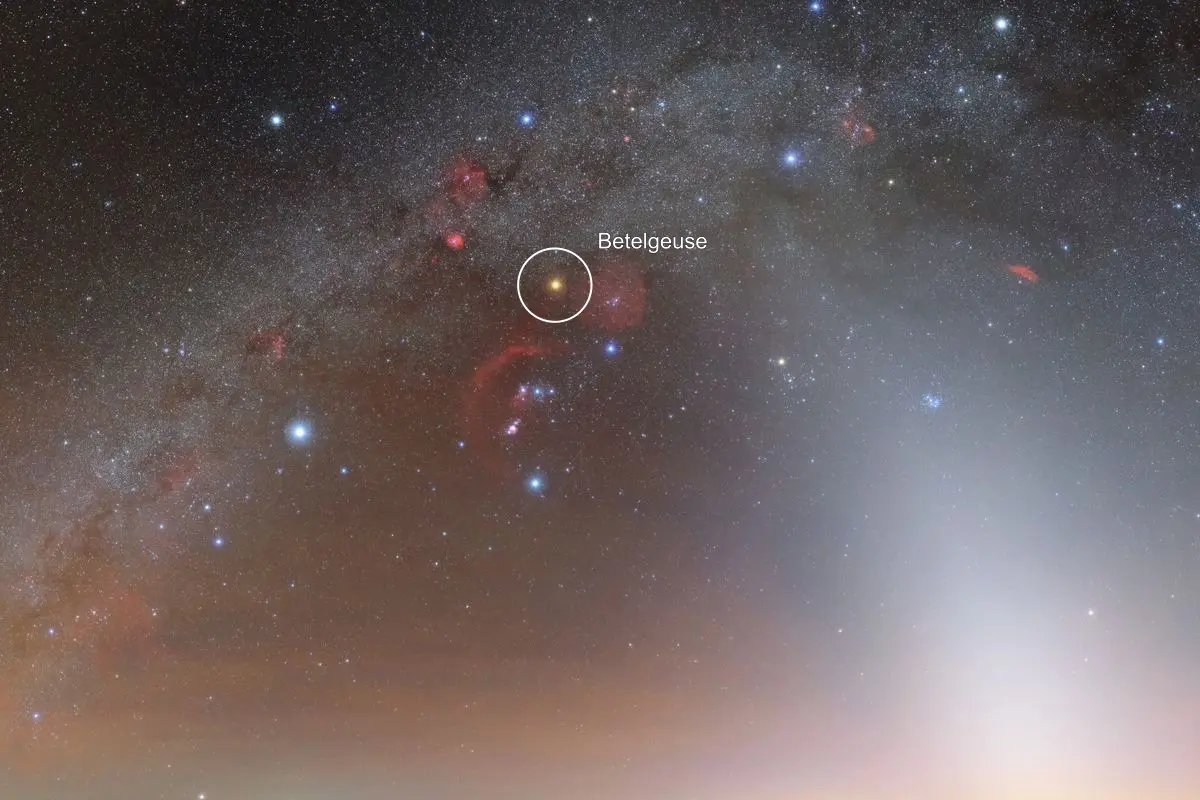
Find the constellation Orion, the hunter, and look for the bright orange star at its shoulder. Its color is the giveaway: NOIRLab notes that it glows a cool red next to its hot, blue neighbors, and that it is usually the 10th brightest star in the night sky.
It also shows up in other sky events. Betelgeuse is the star near the point where the Orionid meteors appear to start, and NASA's chart for the Moon and Pleiades on October 27 and 28 marks it too. To place Orion and other bright stars among the planets, see The Planets in Order From the Sun, where Jupiter's orbit is a handy yardstick for Betelgeuse's size.
Frequently asked questions
When will Betelgeuse explode?
NASA says it is not likely to happen for about another 100,000 years. It is an estimate, and astronomers cannot give an exact date. ESO says the star is not exploding now.
Will we see the Betelgeuse supernova in the daytime?
Probably. A 2020 simulation reported by Astronomy magazine says it would peak at about half-Moon brightness, stay bright for more than three months and be visible in daylight for about a year.
Is Betelgeuse about to go supernova because it dimmed?
No. The 2019-2020 Great Dimming was caused by a dust cloud from material the star ejected. NASA says it is not evidence that the star is about to blow up anytime soon.
How far away is Betelgeuse?
About 700 light-years, according to NASA. Its pages give values from about 650 to 725 light-years, because the distance to a star this large and variable is hard to pin down.
Could a Betelgeuse supernova hurt Earth?
No. A supernova would have to be within perhaps several dozen light-years to harm life on Earth, according to Astronomy magazine. Betelgeuse is about 700 light-years away.
Does Betelgeuse have a companion star?
Very likely. Gemini North reported a tentative detection in 2025, Hubble saw its wake in January 2026 and ESO's Very Large Telescope took what it calls the clearest image yet in July 2026. Astronomers plan more observations in 2027.
How big is Betelgeuse compared with the Sun?
About 700 times the size of the Sun, according to NASA. Placed at the center of our solar system, its surface would extend past the orbit of Jupiter.
Sources
- NASA Science, "What is Betelgeuse? Inside the Strange, Volatile Star" (page last updated March 9, 2026; accessed October 26, 2026). Used for distance, size, mass, age, the 100,000-year estimate and the 2019-2020 dimming.
- NASA Science, "Hubble Finds that Betelgeuse's Mysterious Dimming Is Due to a Traumatic Outburst" (August 13, 2020, updated March 31, 2025; accessed October 26, 2026)
- NASA Science, "Hubble Sees Red Supergiant Star Betelgeuse Slowly Recovering After Blowing Its Top" (August 11, 2022, updated March 20, 2025; accessed October 26, 2026)
- NASA Science, "NASA Hubble Helps Detect 'Wake' of Betelgeuse's Elusive Companion Star" (January 5, 2026; accessed October 26, 2026)
- NASA/JPL, "NASA Scientist Finds Predicted Companion Star to Betelgeuse" (July 23, 2025; accessed October 26, 2026)
- AAS Nova, "Betelgeuse's Companion Star May Have Been Seen at Last" (July 23, 2025; accessed October 26, 2026). Used for the 1.6 solar mass estimate and the tentative nature of the detection.
- ESO, "Astronomers find strongest evidence yet that Betelgeuse has a companion" (eso2611, July 28, 2026; accessed October 26, 2026)
- Astronomy magazine, Eric Betz, "When Betelgeuse goes supernova, what will it look like from Earth?" (February 14, 2020, updated May 18, 2023; accessed October 26, 2026). Source of the brightness simulation (UC Santa Barbara) and the danger distance.
- NSF NOIRLab, "Stellar Red Giant Above KPNO" (iotw2319a), photo by T. Slovinský
- ESO, ESA/Hubble, M. Kornmesser, "Betelgeuse's Dust Cloud (Artist's Impression)" (heic2014a)
- NASA, ESA, Elizabeth Wheatley (STScI), "Disruption of the Red Supergiant Star Betelgeuse (Artist's Illustration)"
- ESO/M. Montargès et al., "VLT images of Betelgeuse and its companion" (eso2611a)

Founder and editor, Orbit and Atom
I write Orbit and Atom to explain space and science in plain English, starting from what NASA, ESA and the mission teams publish. Every article lists its sources at the end so you can read them yourself.