Stars & Galaxies
What Is a Black Hole? A Plain-English Guide
Quick answer
A black hole is a place where gravity is so strong that nothing, not even light, can escape once it crosses a boundary called the event horizon. It is not an empty hole but a huge amount of matter packed into a tiny space. Many form when a massive star dies, and astronomers have now photographed two: the one in the galaxy M87 in 2019 and the one at the center of our Milky Way in 2022.
On this page
- What is a black hole?
- What are the parts of a black hole?
- How does a black hole form?
- What types of black holes are there?
- How do astronomers find something that gives off no light?
- Have we really photographed a black hole?
- Could a black hole swallow Earth or the Sun?
- What would happen if you fell into a black hole?
- FAQ
- Sources
Black holes are the most extreme objects we know, and also among the most misunderstood. They do not roam space swallowing everything in reach, and they are not holes. They are very dense objects, and astronomers have now found some, measured them and even photographed two.
Here is what a black hole is, what it is made of, how it forms, the different sizes, how scientists find something that gives off no light, and what the two famous pictures actually show.
What is a black hole?
An object so dense that its gravity lets nothing escape. NASA describes black holes as "huge concentrations of matter packed into very tiny spaces." They are not literal holes. The gravity just beneath the event horizon is strong enough that, in NASA's words, "nothing – not even light – can escape."
The event horizon is the boundary that matters. NASA calls it the black hole's surface, though it is not a solid surface: inside it, "the velocity needed to escape the black hole exceeds the speed of light." Nothing crosses back out, which is why a black hole neither emits nor reflects light. Even the nucleus of Halley's Comet, one of the darkest objects in the solar system, reflects about 3% of the light that hits it, as we explain in When Will Halley's Comet Return? A black hole reflects none.
What are the parts of a black hole?
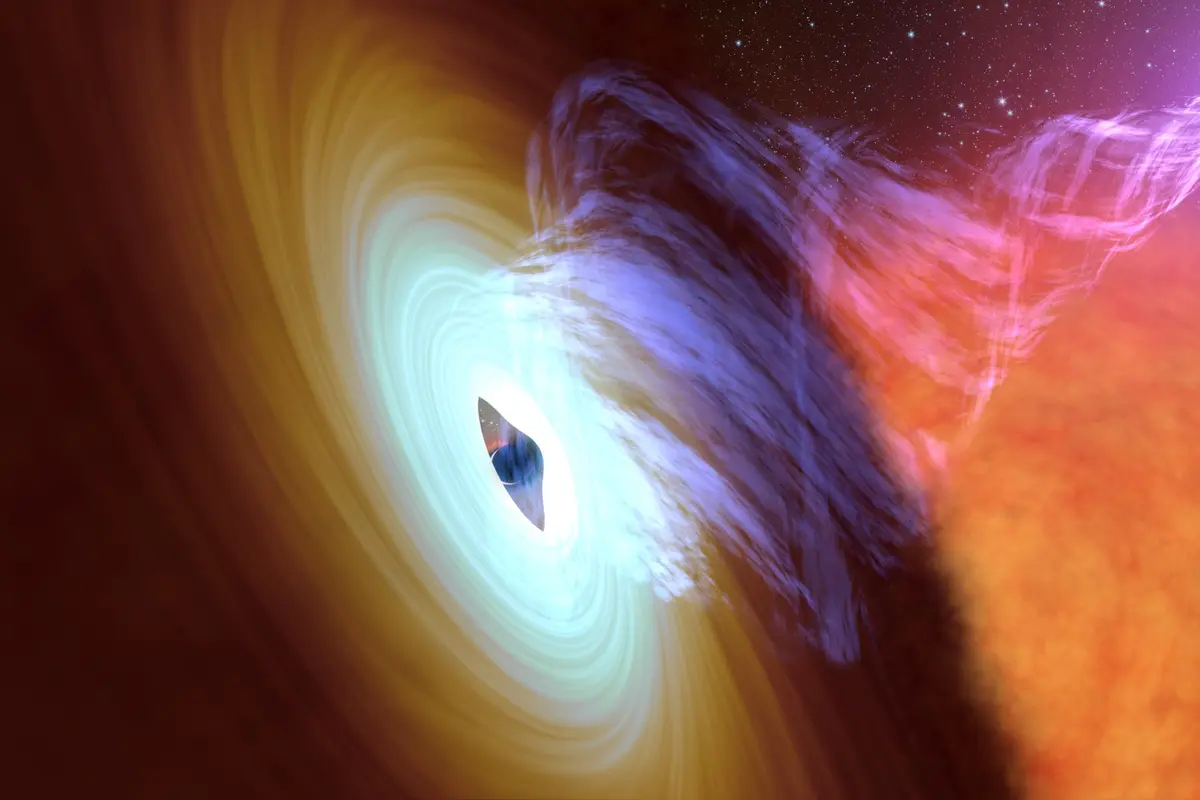
Five things are worth knowing, all from NASA's description of a black hole's anatomy. Only the first two are the black hole itself. The rest is what it does to its surroundings.
| Part | What it is |
|---|---|
| Event horizon | The boundary beyond which escaping would take more than the speed of light |
| Singularity | At the center, relativity predicts matter crushed to infinite density |
| Accretion disk | A hot, bright, fast-spinning disk of matter spiraling in; the black hole's main source of light |
| Shadow and light rings | The dark zone left by the event horizon and bent light, with thin rings of light at its edge |
| Jets | Two beams of particles shot out in opposite directions at close to the speed of light |
The parts of a black hole. Source: NASA Science, "Black Hole Anatomy."
Two details stand out. First, nobody knows if the singularity is a physical thing: NASA says astronomers do not know whether it is a real structure or only a mathematical one. Second, the shadow looks bigger than the black hole. NASA says the dark zone is roughly twice the size of the black hole's actual surface, because gravity bends the light around it, like a lens.
Jets are real and enormous. NASA says jets from supermassive black holes can reach hundreds of thousands of light-years, and astronomers do not fully understand how they form. To get a feel for those distances, see How Far Is a Light-Year?
How does a black hole form?
The best-understood way is the death of a massive star. NASA says a star with more than eight times the Sun's mass ends its life in a supernova, and stars of around 20 solar masses or more leave behind a black hole: "the star's core collapses into a stellar-mass black hole."
Our own Sun will not do that. NASA says the Sun would need to be about 20 times more massive to end as a black hole. Instead, in some 6 billion years it will end up as a white dwarf, a small, dense remnant that glows from leftover heat. If you want to place the Sun among the planets first, see Planets in Order From the Sun.
The giants are less clear. NASA says the origins of supermassive black holes are unknown. Some formed within the first billion years after the Big Bang, and they grow by consuming smaller objects and by merging when galaxies collide. Medium-sized ones are thought to come from collisions between stellar-mass black holes. Everything that falls into one starts out as ordinary matter, made of atoms; for what those are made of, see What Is Inside an Atom?
What types of black holes are there?
Astronomers sort them by mass, and the range is enormous. NASA lists four groups, and one of them has never been found.
| Type | Mass | Example |
|---|---|---|
| Stellar-mass | A few to hundreds of Suns | Gaia BH3, about 33 Suns |
| Intermediate-mass | Roughly 100 to hundreds of thousands of Suns | A candidate of about 50,000 Suns, not confirmed |
| Supermassive | Hundreds of thousands to billions of Suns | Sagittarius A*, about 4 million Suns |
| Primordial (hypothetical) | From about 100,000 times less than a paperclip to about 100,000 Suns | None confirmed |
Types of black holes by mass, with one example each. "Suns" means times the mass of the Sun. Source: NASA Science, "Black Hole Types."
Stellar-mass black holes are the common kind. NASA says binaries have revealed about 50 suspected or confirmed ones in the Milky Way, and scientists estimate there may be up to 100 million in our galaxy. Supermassive ones sit in galaxy centers: "almost every large galaxy, including our Milky Way, has a supermassive black hole at its center."
The intermediate ones are the "missing link." NASA says scientists are puzzled by the size gap between stellar-mass and supermassive black holes and are actively hunting for examples, but candidates have been hard to confirm. Primordial black holes are only a theory: NASA says they would have formed in the first second after the universe began.
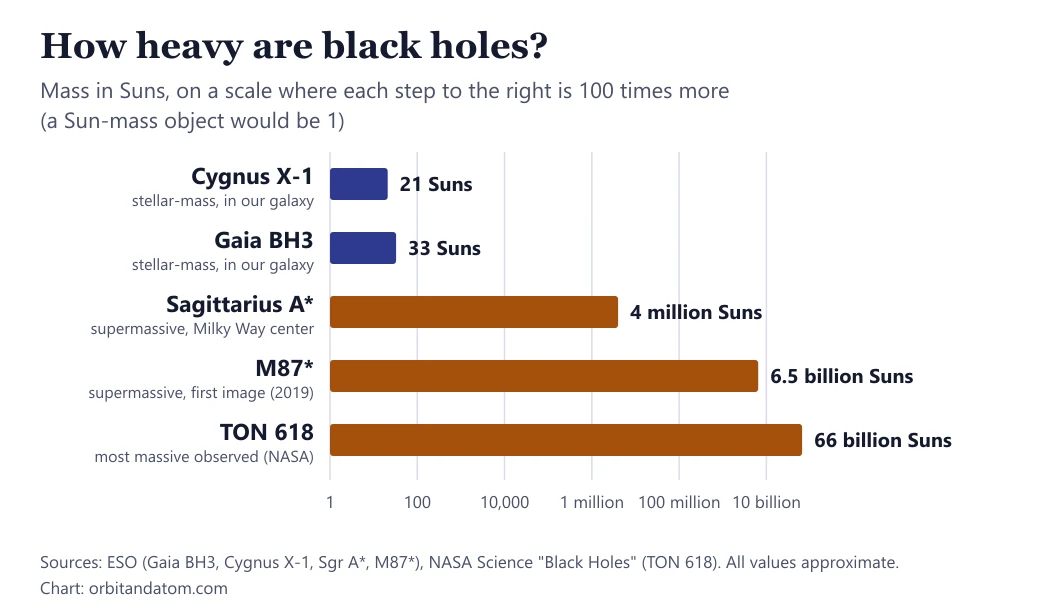
The records are on NASA's list: the heaviest black hole observed is TON 618, at 66 billion Suns, and the lightest known weighs 3.8 Suns and is paired with a star. The fastest spinner, GRS 1915+105, turns over 1,000 times per second.
How do astronomers find something that gives off no light?
By what it does to everything around it. NASA says black holes "don't emit or reflect light, making them effectively invisible to telescopes," so astronomers look for other signs: light, including X-rays, from an accretion disk; the orbits of nearby stars; gravitational waves, the ripples NASA says come from mergers of black holes or neutron stars; and gravitational lensing, the bending of light that passes close by.
A recent find shows how it works. In 2024, ESA's Gaia mission spotted a star that wobbled as if something heavy were tugging on it, and that something was a black hole now called Gaia BH3. Follow-up data from ESO's Very Large Telescope confirmed its mass of about 33 Suns, which makes it the heaviest stellar-mass black hole known in the Milky Way. The next heaviest, Cygnus X-1, has about 21. ESA puts Gaia BH3 at 590 parsecs, or 1,926 light-years, which makes it the second-closest known black hole to Earth. "No one was expecting to find a high-mass black hole lurking nearby, undetected so far," said Pasquale Panuzzo, who led the study.
The closest known one, according to NASA, is Gaia BH1, about 1,500 light-years away. For comparison, Voyager 1, the most distant spacecraft, reaches one light-day from Earth on November 18, 2026, as we explain in Voyager 1 Will Be One Light-Day From Earth on Nov. 18, 2026.
Have we really photographed a black hole?
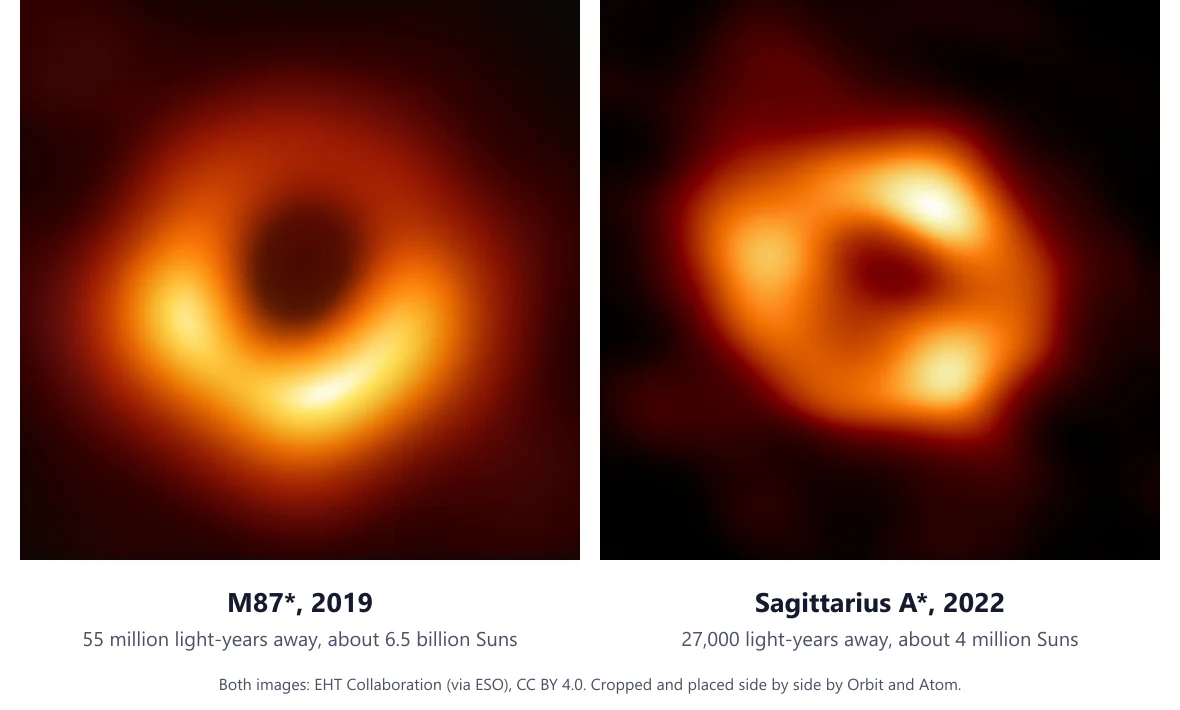
Yes, twice, with a catch: the pictures show the glowing gas and the shadow, not the black hole itself. Both come from the Event Horizon Telescope (EHT), which links radio observatories around the world into one virtual telescope as big as the Earth.
The first image came on April 10, 2019. It showed the supermassive black hole in the galaxy Messier 87, about 55 million light-years away and about 6.5 billion times the Sun's mass. ESO said the event horizon is just under 40 billion kilometers across, and the shadow about 2.5 times larger. It was built from a 2017 campaign with eight ground-based radio telescopes. "We have taken the first picture of a black hole," said project director Sheperd Doeleman.
The second came on May 12, 2022: Sagittarius A*, the black hole at the center of our own galaxy, about 27,000 light-years away and about 4 million times the Sun's mass. It was observed over several nights in April 2017 by eight observatories. It is more than a thousand times smaller and less massive than M87*, yet the two look alike near their edges. "We were stunned by how well the size of the ring agreed with predictions from Einstein's Theory of General Relativity," said EHT project scientist Geoffrey Bower.
Could a black hole swallow Earth or the Sun?
No. NASA says "there is no danger of the Earth" being pulled into the black hole at the center of the Milky Way, and that black holes are too far away to pull in matter from our solar system. A black hole also cannot eat everything: NASA is blunt that "there is no way a black hole would eat an entire galaxy."
The idea that a black hole "sucks things in" mixes up two things. Gravity depends on mass, not on being a black hole. NASA says that if the Sun were somehow replaced by a black hole of the same mass, the planets' orbits would stay the same. The real problem would be the lost sunlight, which NASA says would be disastrous for life on Earth.
What would happen if you fell into a black hole?
Nothing good. "It certainly wouldn't be good!" NASA says. Gravity would stretch you vertically and squeeze you horizontally, an effect called spaghettification. No one has ever fallen in, since no black hole is close enough to reach.
What happens deeper inside is open. NASA says our knowledge of the inside comes from Einstein's General Theory of Relativity, and the center, the singularity, may be real or only math. Black holes can also shrink: Stephen Hawking proposed that they lose energy through Hawking radiation, and in theory they eventually evaporate. For most known black holes, NASA says, that would take much longer than the age of the universe.
Frequently asked questions
What is a black hole in simple terms?
A very dense object whose gravity is so strong that nothing, not even light, can escape from inside its event horizon. NASA calls black holes "huge concentrations of matter packed into very tiny spaces."
Can anything escape a black hole?
Not once it crosses the event horizon. NASA says that inside this boundary, the speed needed to escape is greater than the speed of light, so nothing gets back out, not even X-rays.
How are black holes formed?
Stellar-mass black holes form when the core of a massive star collapses after a supernova. NASA says the origins of supermassive black holes are unclear, though some formed within the first billion years after the Big Bang.
Will the Sun become a black hole?
No. NASA says the Sun would need to be about 20 times more massive. In some 6 billion years it will end up as a white dwarf instead.
What is the closest black hole to Earth?
NASA lists Gaia BH1, about 1,500 light-years away, as the nearest known. Gaia BH3, about 33 Suns and 1,926 light-years away according to ESA, is the second closest.
Have scientists photographed a black hole?
Yes, twice. The Event Horizon Telescope released an image of the black hole in galaxy M87 on April 10, 2019, and of Sagittarius A*, at the center of our galaxy, on May 12, 2022. The images show the glowing gas and the shadow.
Can a black hole destroy Earth?
NASA says there is no danger of Earth being pulled into the black hole at the center of the Milky Way. Even a black hole with the Sun's mass would not pull in the planets; the lost sunlight would be the problem.
What is the biggest black hole?
NASA lists TON 618 as the most massive observed, at 66 billion times the Sun's mass. It also says the black hole in Holmberg 15A holds at least 40 billion Suns.
Sources
- NASA Science, "Black Holes" (page last updated August 12, 2026; accessed October 23, 2026)
- NASA Science, "Black Hole Types" (page last updated August 12, 2026; accessed October 23, 2026)
- NASA Science, "Black Hole Anatomy" (page last updated August 12, 2026; accessed October 23, 2026)
- NASA Science, "10 Questions You Might Have About Black Holes" (published September 23, 2019; last updated November 6, 2024; accessed October 23, 2026)
- NASA, "Why the Sun Won't Become a Black Hole" (September 26, 2019; accessed October 23, 2026)
- ESO, "Astronomers Capture First Image of a Black Hole," press release eso1907 (April 10, 2019; accessed October 23, 2026)
- ESO, first image of the black hole at the center of the Milky Way, press release eso2208 (May 12, 2022; accessed October 23, 2026)
- ESO, "Most massive stellar black hole in our galaxy found," press release eso2408 (April 16, 2024; accessed October 23, 2026)
- ESA Gaia, "Gaia spots Milky Way's most massive black hole of stellar origin" (April 16, 2024; accessed October 23, 2026)
- NASA/JPL-Caltech, "Black Hole With Jet (Artist's Concept)" (PIA22085)

Founder and editor, Orbit and Atom
I write Orbit and Atom to explain space and science in plain English, starting from what NASA, ESA and the mission teams publish. Every article lists its sources at the end so you can read them yourself.