Atoms & Physics
Do Astronauts Age Slower? Time Dilation, GPS and Interstellar
Quick answer
Yes, but only by a tiny amount. ESA says astronauts on the International Space Station, moving at about 28,800 km/h, return from a six-month stay about 0.007 seconds younger than people on the ground. The same physics matters for GPS: its satellite clocks run 38 microseconds fast every day, and navigation would fail without the correction.
On this page
Astronauts orbit Earth at about 28,800 kilometers per hour, and according to Einstein, that speed changes how fast their clocks tick. So the question is fair: do they really age more slowly than the rest of us?
They do, and scientists have measured it. The difference is real but very small, and the same effect decides whether your phone knows where you are. Here is how it works, in plain words.
Do astronauts really age slower than people on Earth?
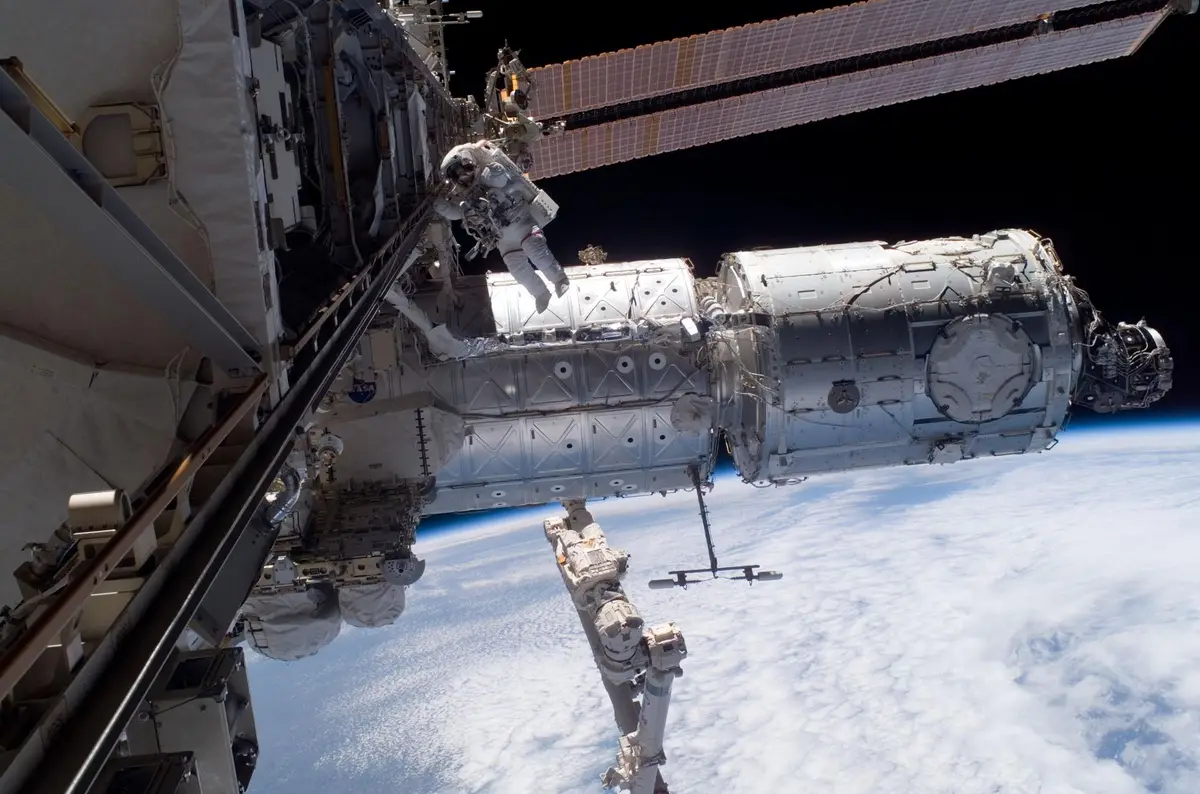
Yes, by a sliver. In a 2019 ESA release, the agency said that Einstein predicted time slows down the faster you travel, and that atomic clocks flown on aircraft have confirmed it. For the crew of the International Space Station, ESA put the result at 0.007 seconds: after a six-month flight at about 28,800 km/h, the astronauts come home that much younger than if they had stayed on the ground.
Seven thousandths of a second is nothing you could feel, and nobody lives longer because of it. What makes it interesting is that it is predicted by physics and confirmed by clocks. The effect is called time dilation.
What is time dilation, in simple terms?
It means that clocks do not tick at the same rate everywhere. Two things change the pace, and NASA describes both in its guide to general relativity:
- Speed. A clock on a fast-moving satellite appears to run behind an identical clock on Earth.
- Gravity. The farther you are from Earth's center, the less curved space-time is, and a clock there ticks faster than one on the ground.
ESA and NIST both describe these effects as time lost or gained by a person, not just by a machine. The catch is size. The ISS moves at about 8 kilometers per second, which is roughly 1 in 37,500 of the speed of light (our arithmetic, using light's 300,000 km/s). At that speed the change is tiny, which is why ESA's number is in thousandths of a second.
| Case | Cause | Effect |
|---|---|---|
| ISS crew, 6 months | Speed | 0.007 seconds younger |
| GPS satellite | Speed + gravity | 38 microseconds faster per day |
| Lab clocks, 33 cm apart | Height | 90 billionths of a second in 79 years |
| Miller's planet (film) | Black hole gravity | 1 hour = 7 years (about 60,000x) |
Where time dilation shows up. Sources: ESA (2019) for the ISS, NASA and NIST (2025) for GPS, NIST (2010) for the lab clocks, and the two Interstellar papers listed below. Miller's planet is the film's story, not a measurement.
The last row is far beyond anything astronauts have experienced. To get big effects you need speeds close to the speed of light, which our light-year guide puts at about 186,000 miles per second, or extremely strong gravity.
Why does GPS need time dilation to work?
Because GPS finds your position by timing radio signals, and the satellites' clocks are off from ours. NASA explains that GPS satellites orbit at about 20,000 km. Their speed makes their clocks run behind by about 7 microseconds per day. Weaker gravity at that height makes them run ahead by about 45 microseconds per day. The net result is that the clocks tick faster by about 38 microseconds each day, a figure NIST repeats.
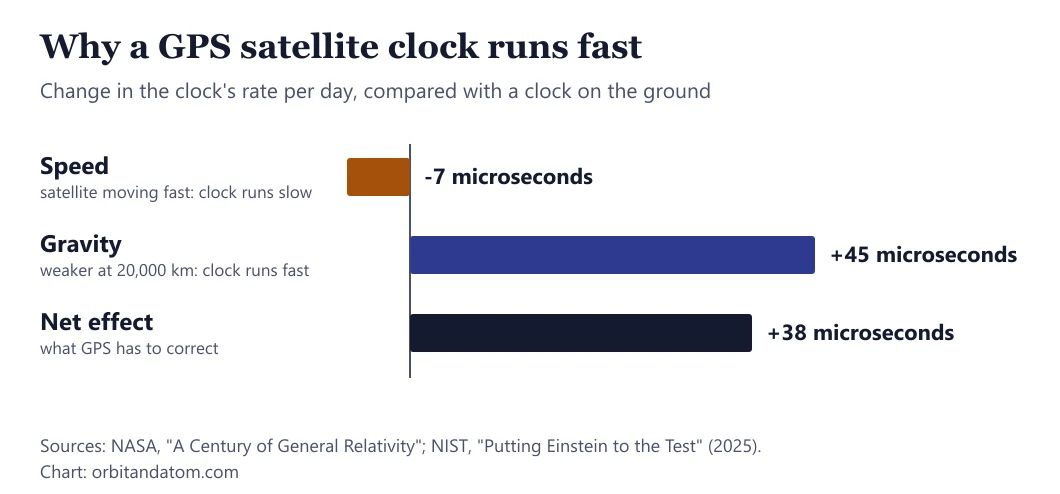
A microsecond is a millionth of a second, so 38 of them sounds like nothing. For GPS it is a lot. In an article from NASA Goddard, the agency says that unless these effects are accounted for, the errors would accumulate at about 10 km per day. Your new favorite restaurant would be nowhere near where the GPS thought it was. NASA also says these relativity effects are nearly 1,000 times greater than the timing precision GPS needs, and that without correcting for them, position errors would grow so fast that the system would be useless for navigation within minutes. NIST says engineers realized they had to correct for relativity to give accurate time on Earth.
Can we measure time dilation without going to space?
Yes, with clocks that are extremely precise. In 2010, NIST compared two aluminum ion clocks, each based on the "ticking" of a single aluminum ion. One of them keeps time to within a second in about 3.7 billion years.
The team found that the clock raised by 33 centimeters, about a foot, ran faster because it felt weaker gravity. It also saw a moving clock tick slightly slower at speeds comparable to a car traveling about 20 miles per hour. NIST said the height effect adds up to roughly 90 billionths of a second over a 79-year lifetime, far too small for people to perceive. It is the same physics as the ISS, shrunk down to a tabletop. To see why atoms make such good clocks, see our guide to what is inside an atom.
Is the time dilation in Interstellar real?
The physics is real. The setup is a stretch. In the film, one hour on Miller's planet equals seven years on Earth. That is a time dilation factor of about 60,000 (our arithmetic: seven years is about 61,000 hours).
Physicist Jean-Pierre Luminet explains that clocks near a black hole's event horizon are strongly slowed compared with distant clocks, so the idea itself holds. The problem is the orbit. For a black hole that does not spin, a stable orbit cannot get closer than three times its Schwarzschild radius, and the time dilation there is small. A 2026 paper by Dhingra, Dhurandhar and Mitra finds that orbits close enough exist only if the black hole spins extremely fast, nearly at its maximum possible spin.
Kip Thorne, who was the film's executive producer and science consultant, knew the number was a stretch. According to Luminet, Thorne's book says the huge factor was a "non-negotiable" request from the director, and that Thorne's calculations showed it was "marginally possible (although very unlikely)." So the film did not break physics. It picked the most extreme case that physics allows. For more on how these objects work, see our black hole guide.
What would it take to age much slower?
Either a speed close to the speed of light or a place with extremely strong gravity. The ISS is nowhere near either: at roughly 1/37,500 of light speed, the effect is thousandths of a second.
Distance and time are tied together in other ways too. Light from Betelgeuse takes about 700 years to reach us, and light needs about a day to reach Voyager 1 this November. Those are delays in travel, not changes in the clock, but both come from the same fact: the speed of light is the limit.
Frequently asked questions
Do astronauts age slower than people on Earth?
Yes, but only slightly. ESA says astronauts on the International Space Station return from a six-month flight about 0.007 seconds younger than if they had stayed on the ground, because of their speed of about 28,800 km/h.
Is time dilation real or just a theory?
It is real and measured. ESA notes that atomic clocks flown on aircraft confirmed it, NIST measured it between two lab clocks 33 centimeters apart, and GPS satellites depend on correcting it every day.
Why does GPS need Einstein's relativity?
GPS satellite clocks run about 38 microseconds per day faster than clocks on the ground: speed slows them by about 7 and weaker gravity speeds them up by about 45. NASA says that without correcting for this, position errors would grow by about 10 km per day, and its relativity brochure adds that the system would be useless for navigation within minutes.
Is Miller's planet in Interstellar scientifically possible?
Only in an extreme case. Time dilation of about 60,000 requires a black hole spinning nearly at its maximum rate. Thorne's calculation, as described by physicist Jean-Pierre Luminet, showed it was marginally possible but very unlikely.
Does time slow down in space itself?
Not because it is space. Clock rates change with speed and with gravity. A clock far from Earth's gravity ticks faster, and a clock moving fast ticks slower, which is why GPS needs both corrections.
Can time dilation help astronauts live longer?
Not in any way that matters. The ISS effect is about 0.007 seconds in six months, according to ESA, far too small to notice.
Does time feel different to astronauts in space?
That is a different question from time dilation. ESA has run an experiment in which astronauts estimate how long a target stays on a screen, to study how time is perceived in space. It is about the brain, not clocks.
Sources
- ESA, "Timing is everything" (February 26, 2019; accessed October 26, 2026). Source of the 0.007-second figure and the ISS speed of about 28,800 km/h.
- NIST, "Putting Einstein to the Test" (created April 3, 2025, updated April 17, 2025; accessed October 26, 2026). Source of the GPS figures: 7 microseconds slower, 45 faster, 38 net.
- NASA Physics of the Cosmos, "A Century of General Relativity" (NP-2014-10-194-GSFC, revised March 2016; accessed October 26, 2026). Used for the GPS altitude, the 7, 45 and 38 microsecond figures and the effect on navigation.
- NASA Goddard, "100 Years of General Relativity" (NASA Blueshift, November 25, 2015; accessed October 26, 2026 through an archived copy from December 16, 2024, because the original page is no longer online). Source of the 10 km per day figure.
- NIST, "NIST Pair of Aluminum Atomic Clocks Reveal Einstein's Relativity at a Personal Scale" (September 23, 2010; accessed October 26, 2026)
- Jean-Pierre Luminet, "The Warped Science of Interstellar" (arXiv:1503.08305, 2015; accessed October 26, 2026). Used for the 1 hour = 7 years factor and for Thorne's calculation as described from his book. We did not read the book itself.
- Harleen Dhingra, Sanjeev Dhurandhar and Sanjit Mitra, "The Physics presented in the Film Interstellar and its Astrophysical Applications" (arXiv:2606.01921, June 2026; accessed October 26, 2026)
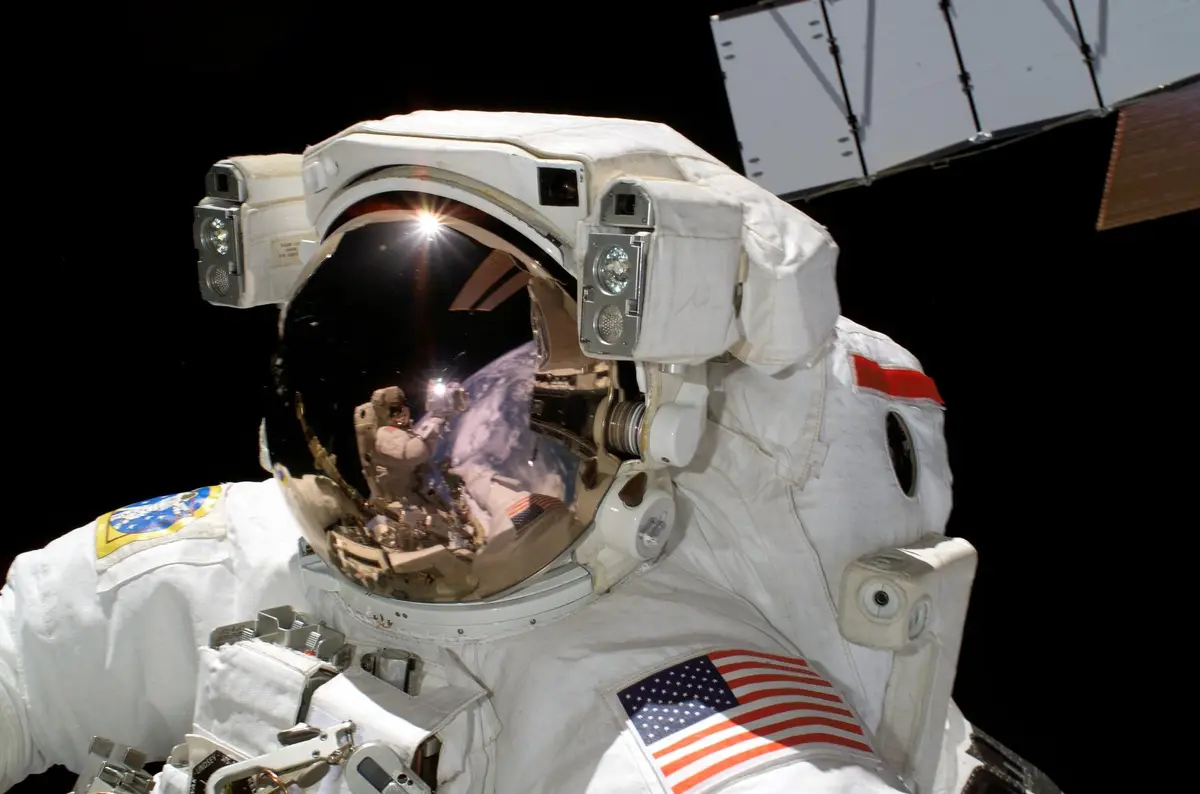
- NASA, ISS013-E-49639, Piers Sellers and Michael Fossum on a spacewalk (July 8, 2006)
- NASA, ISS016-E-012617, Peggy Whitson on a spacewalk (November 24, 2007)

Founder and editor, Orbit and Atom
I write Orbit and Atom to explain space and science in plain English, starting from what NASA, ESA and the mission teams publish. Every article lists its sources at the end so you can read them yourself.