Atoms & Physics
Why Is the Sky Blue? And Why Sunsets Turn Red
Quick answer
The sky is blue because air molecules scatter the short, blue waves of sunlight in every direction far more than the long, red ones. At sunset the Sun is low, so its light crosses much more air. Most of the blue is scattered out of the beam, and the reds and oranges are what reach your eyes. Mars does the opposite: a reddish daytime sky and a blue glow around the setting Sun.
On this page
At noon the sky is a deep, clean blue. A few hours later the same sky is orange and red. The Sun did not change, and neither did the air. What changed is the path the light takes to reach you.
The explanation takes only two ideas: sunlight is a mix of colors, and air bounces some colors around much more than others. Here is how it works, with NASA's help.
Why is the sky blue?
Because air scatters blue light more than any other visible color. NASA's Space Place explains that sunlight looks white but contains all the colors of the rainbow, a mix that Isaac Newton separated with a glass prism, as the Royal Museums Greenwich recalls. When that light reaches Earth's atmosphere, gases and particles scatter it in every direction.
Blue light is scattered the most because it travels in shorter, smaller waves. Red light has longer waves, and it passes through the air with much less bouncing. The Met Office names the effect Rayleigh scattering, after Lord Rayleigh, who discovered it, and says it is done mainly by the nitrogen and oxygen molecules of the air. Scattering gets stronger as the wavelength gets shorter.
The result is that blue light from the Sun arrives at your eyes from every part of the sky, not only from the direction of the Sun. That is why the whole sky looks blue. Those molecules are made of atoms, which our guide to the atom opens up.
Why isn't the sky violet?
Violet light has even shorter waves than blue, and it does scatter more. Two things keep the sky from looking violet. The Met Office says our eyes are more sensitive to blue, and that there is less violet in sunlight to begin with. The Royal Museums Greenwich gives the same two reasons: human eyes are better at detecting blue, and more of the sunlight entering the atmosphere is blue rather than violet.
What you see is the sum of all the scattered colors, weighted by how well your eyes respond to them. That sum is blue.
Why do sunsets turn red and orange?
Because at sunset the light has to cross much more air. When the Sun is high, its light takes a short path through the atmosphere. When the Sun is low, at sunrise or sunset, the Met Office says the light passes through a thicker layer of atmosphere. NASA describes it the same way: the blue light is scattered out of the beam, and the reds and yellows pass straight through to your eyes.
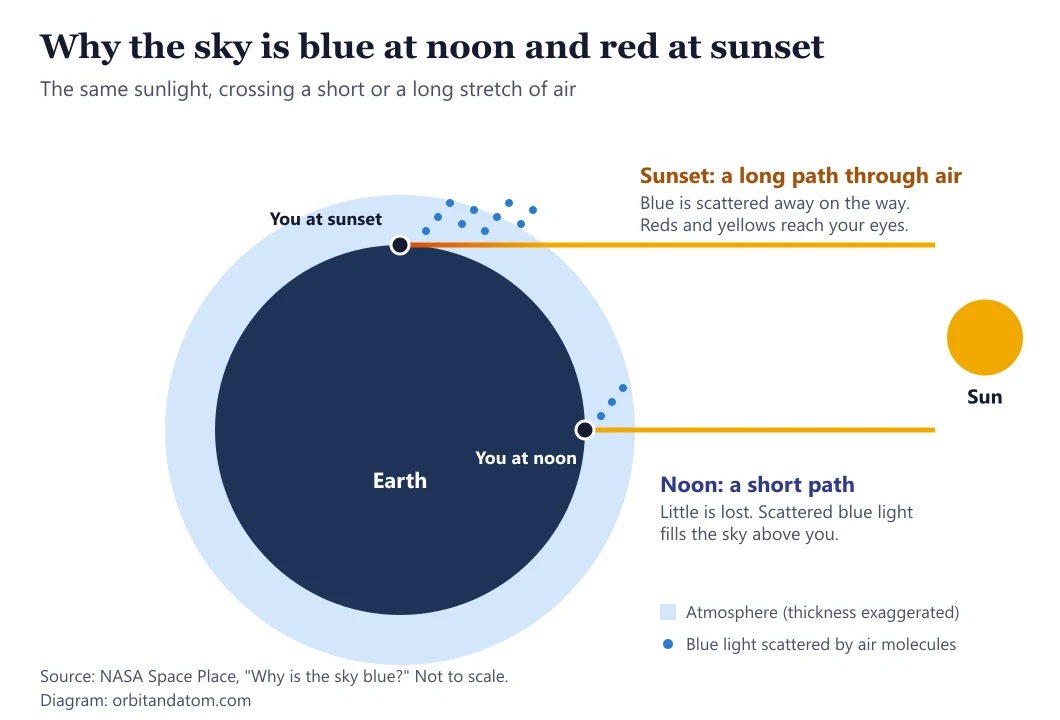
So the blue has not gone anywhere magical. It has been scattered sideways, away from the line between you and the Sun, and the colors that scatter less are what remain. Sunrises work the same way, which is why a low Sun in the morning looks just as warm.
Why is the sky paler near the horizon?
Because you are looking through more air. NASA explains that light reaching you from low in the sky has crossed so much atmosphere that its blue has been scattered and re-scattered many times, and the surface of Earth also reflects and scatters light, which mixes the colors. The Met Office says the extra scattering mixes in more white light and makes the blue less intense.
Look straight up on a clear day and the blue is deepest. Look toward the horizon and it fades toward white.
Why are some sunsets more intense than others?
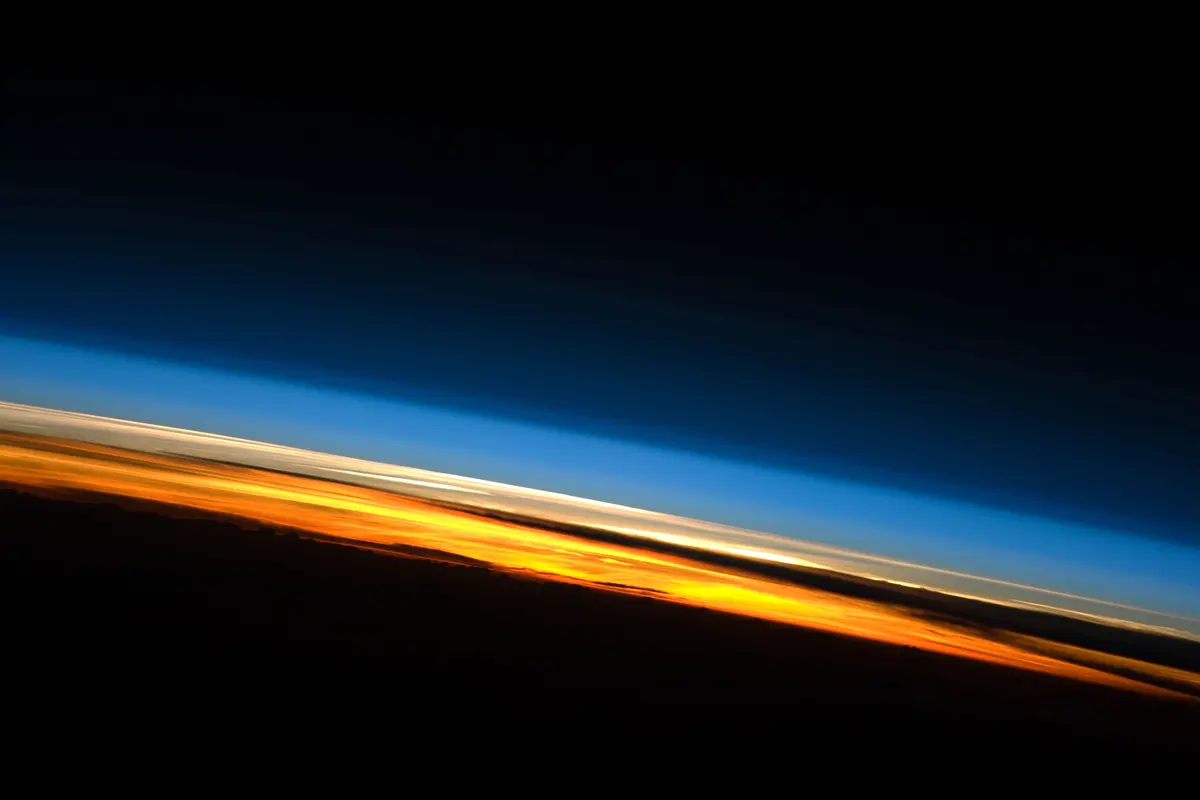
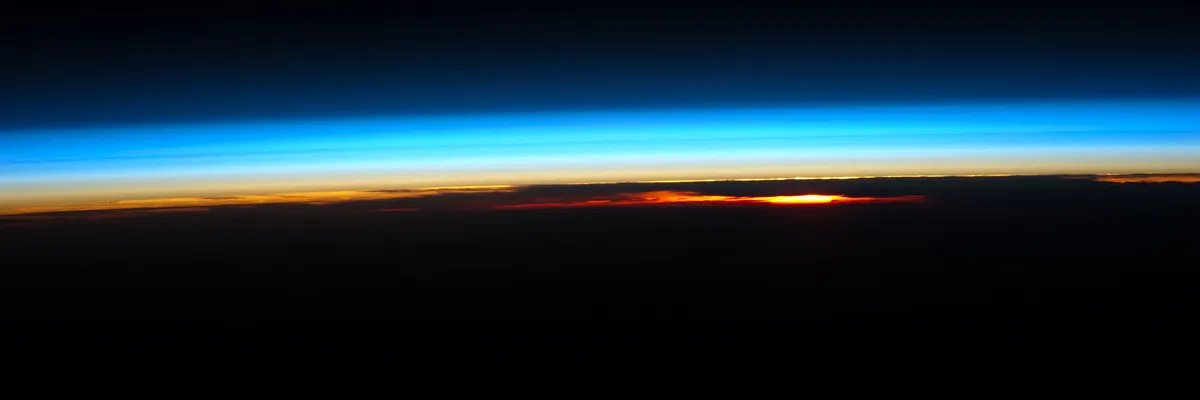
Because the air is not always the same. NASA says dust, pollution and other airborne particles, called aerosols, can also scatter blue light, and that this can make the whole western sky look red at sunset. In the caption of the cover photo, NASA says the variations in color are due mainly to differing amounts of clouds or aerosols.
That photo was taken from orbit, looking edge-on at the atmosphere. NASA's caption reads the layers like this: the deep orange and yellow is the lowest layer, the troposphere, where nearly all the clouds and water vapor are, and the blue above marks the upper atmosphere as it fades into space. The astronauts on the International Space Station see 16 sunrises and sunsets a day, because they circle Earth at over 28,000 km/h, as our time dilation article explains. Each one lasts only a few seconds.
What color are the sky and the sunsets on Mars?
Almost the reverse of Earth. NASA says Mars has a very thin atmosphere, mostly carbon dioxide, with fine dust in it, and its daytime sky looks orange or reddish. At sunset, the sky around the Sun turns blue.
The cause is the dust, not the gas. NASA's Mars Pathfinder team found in 1997 that the dust absorbs blue light, which gives the sky its reddish tint, but that, because of the size of the grains, some blue light is scattered into the area around the Sun. They also ruled out water-ice clouds: the blue comes from the dust itself. It only shows up near sunrise and sunset, when sunlight crosses the most dust.
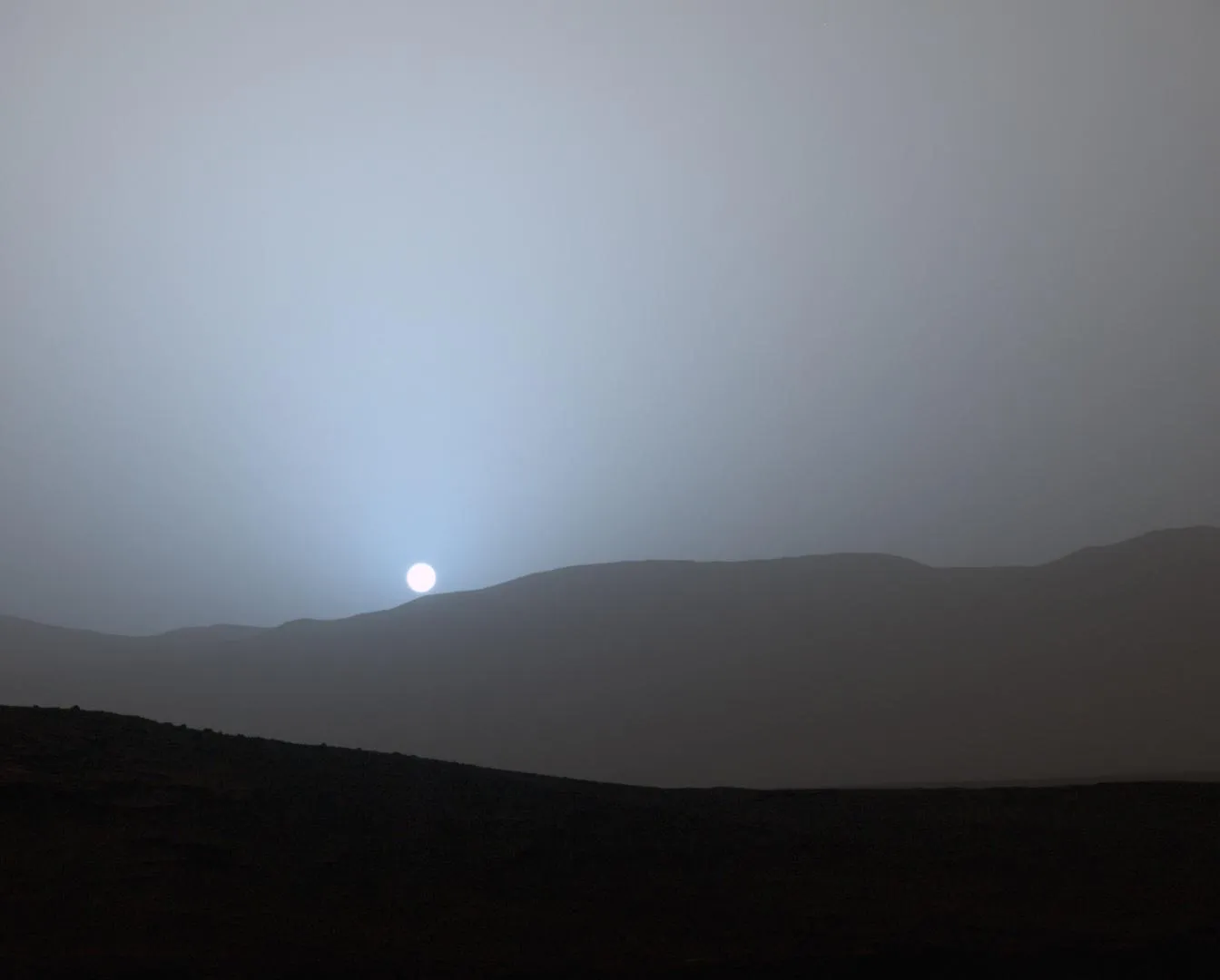
NASA's Curiosity rover saw the same thing in 2015. NASA explains that the fine dust in the Martian air scatters blue light more efficiently than red and yellow, so the blue stays close to the Sun while the other colors spread wider, and the effect is strongest at sunset. For why that dust is red in the first place, see our article on why Mars is red, and for where Mars sits among its neighbors, our planets in order guide.
The horizon has other tricks too. If you have ever wondered why the Moon looks so big when it is low, our Moon illusion article explains that one.
Frequently asked questions
Why is the sky blue?
Because air scatters blue light more than other colors. Sunlight contains all the colors, and gas molecules bounce its short blue waves around the sky far more than its long red waves, so blue seems to come from everywhere.
Why isn't the sky violet?
Violet scatters even more than blue, but our eyes are more sensitive to blue and sunlight contains less violet to begin with, according to the Met Office and the Royal Museums Greenwich.
Why are sunsets red and orange?
At sunset the Sun is low, so its light crosses a much thicker layer of atmosphere. The blue light is scattered out of the beam, and the reds and yellows reach your eyes.
Why is the sky whiter near the horizon?
Light from low in the sky has crossed so much air that its blue has been scattered many times, and the surface of Earth reflects and scatters light too. NASA and the Met Office both say this mixes in white light and makes the blue weaker.
Does pollution make sunsets redder?
It can. NASA says dust, pollution and other particles can also scatter blue light, which can make the whole western sky look red at sunset. NASA's caption for the cover photo adds that color variations come mainly from differing amounts of clouds or aerosols.
What color is the sky on Mars?
During the day it looks orange or reddish, because Martian dust absorbs blue light. Around the setting Sun it turns blue, as NASA's Mars Pathfinder and Curiosity photographed.
Who explained why the sky is blue?
The scattering behind it is called Rayleigh scattering, after Lord Rayleigh (John William Strutt), who discovered it, according to the Royal Museums Greenwich.
Sources
- NASA Space Place, "Why is the sky blue?" (page updated July 31, 2026; accessed October 27, 2026). Source of the scattering, horizon, sunset, aerosol and Mars descriptions.
- Met Office, "Why the sky is blue and sunsets red" (accessed October 27, 2026). Source of Rayleigh scattering by nitrogen and oxygen, the violet question and the thicker layer of air at sunrise and sunset.
- Royal Museums Greenwich, "Why is the sky blue?" (accessed October 27, 2026). Source of the Newton prism, the name of Rayleigh scattering and the eye-sensitivity explanation.
- NASA/JPL-Caltech, "Sunset in Mars' Gale Crater" (PIA19400; accessed October 27, 2026)
- NASA/JPL, "Color Variations in the Sky at Sunset" (PIA00917, Mars Pathfinder, sol 24; accessed October 27, 2026)
- NASA, ISS023-E-057948, sunset over the southern Indian Ocean (May 25, 2010). Source of the layer description and the 16 sunrises and sunsets per day.
- NASA, ISS027-E-013302, Earth's atmospheric limb and sunset over southwestern Asia (April 15, 2011)

Founder and editor, Orbit and Atom
I write Orbit and Atom to explain space and science in plain English, starting from what NASA, ESA and the mission teams publish. Every article lists its sources at the end so you can read them yourself.