Stars & Galaxies
Is There Really a Planet Made of Diamond? The Truth About 55 Cancri e
Quick answer
No one has shown that 55 Cancri e is made of diamond. A 2012 Yale study said the planet's size and weight could fit a carbon-rich interior, but a 2013 re-measurement of its star weakened that case, and NASA's Webb telescope later found signs of a gas atmosphere over a sea of magma. The diamond idea is an unconfirmed hypothesis, not a finding.
On this page
- Where did the diamond planet idea come from?
- What is 55 Cancri e actually like?
- What weakened the diamond case?
- What did Webb find in 2024?
- Does Webb's result settle the diamond question?
- Is the atmosphere itself settled?
- Is there a diamond planet anywhere?
- How could astronomers settle it?
- FAQ
- Sources
Few exoplanet headlines have lasted like this one: a world twice the size of Earth, a third of it diamond. It appeared in 2012, spread everywhere, and is still repeated today as if astronomers had found a planet covered in jewels.
They did not. This guide separates what the 2012 study actually said, what happened to its main assumption, and what NASA's James Webb Space Telescope has found there since. The sources are NASA, ESA, Yale, the University of Manchester and the research papers behind them. I read each one on November 15, 2026, and list them at the end.
Where did the diamond planet idea come from?
In October 2012, Yale University announced new research led by Nikku Madhusudhan, with Kanani Lee and Olivier Mousis, under the headline "Nearby super-Earth likely a diamond planet." The paper, accepted by The Astrophysical Journal Letters, is titled "A Possible Carbon-rich Interior in Super-Earth 55 Cancri e." Note the word "possible."
The reasoning went like this. Astronomers can measure a planet's size when it crosses in front of its star, and its mass from the tug it gives the star. Together those give its density, and density hints at what it is made of. The Yale team found that 55 Cancri e, at about twice Earth's radius and eight times its mass, could be explained by an interior rich in carbon, with iron, silicon carbide and possibly some silicates, and no water envelope. Earlier models had assumed an Earth-like recipe with a thick layer of superheated water.
The headline number came from Yale's own release: the study estimated that at least a third of the planet's mass, about three Earth masses, could be diamond. Lee, a Yale geophysicist, put the contrast plainly: Earth's interior holds less than one part in a thousand of carbon by mass.
A second ingredient mattered. The paper says a carbon-rich planet would be plausible if its birth disk had the same makeup as its star, and the star 55 Cancri had been reported to be carbon-rich. The authors also wrote that better estimates of the star's elements and observations of the planet's atmosphere were needed to narrow things down.
In my opinion, that is how the story should be read. The 2012 paper offered a carbon-rich interior as one explanation that fits the numbers, and asked for more data. The press turned "possible" into "likely" and then into "diamond planet."
What is 55 Cancri e actually like?
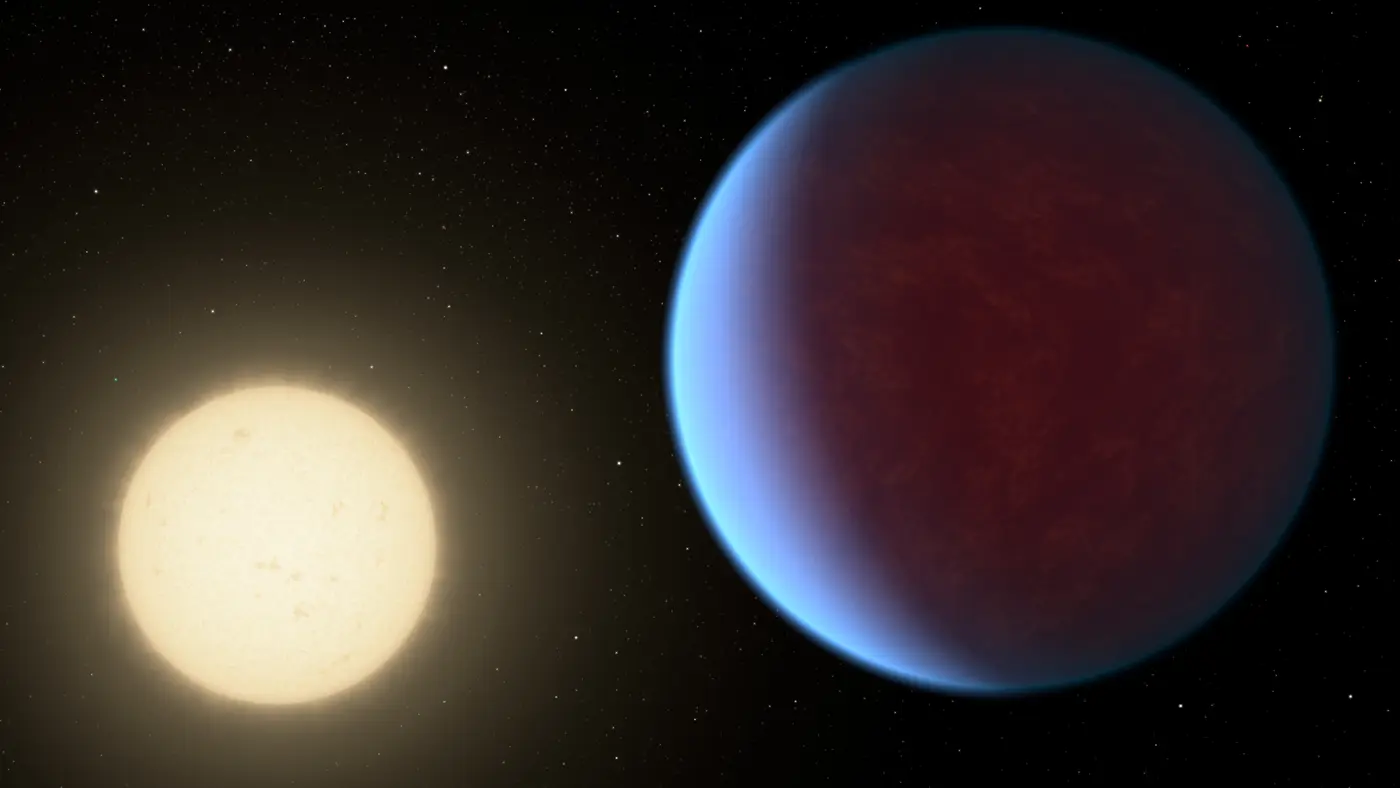
NASA describes it as a super-Earth, larger than Earth and smaller than Neptune, with a diameter nearly twice Earth's and a density slightly greater. Webb's team lists it at 1.95 Earth radii and 8.8 Earth masses. It is one of five known planets around 55 Cancri, a Sun-like star in the constellation Cancer about 41 light-years away. Yale notes the star is visible to the naked eye, though better through binoculars. NASA also lists an alternative name for it, Janssen.
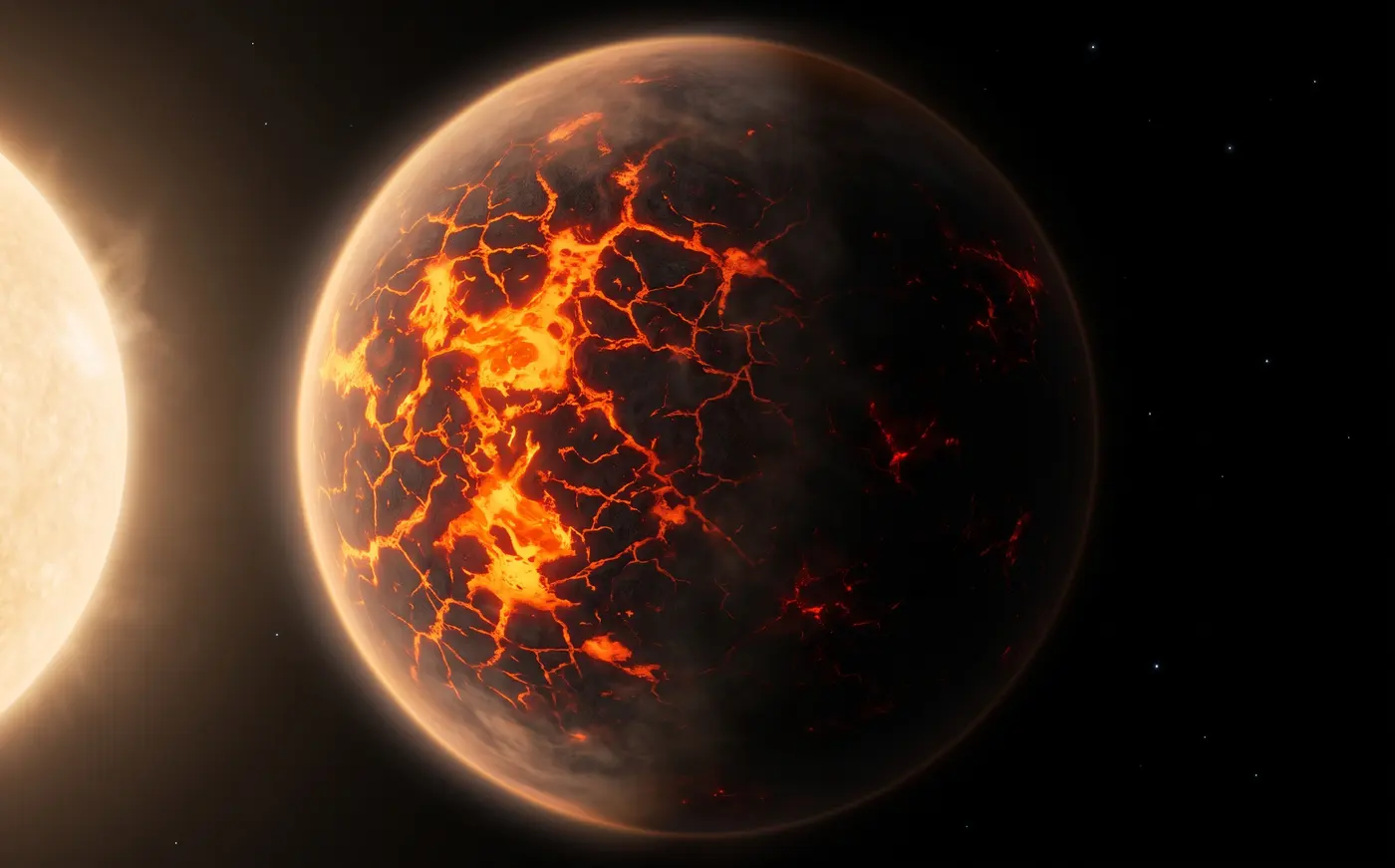
It is nowhere near a calm place. The planet orbits about 2.25 million kilometers (1.4 million miles) from its star, which NASA says is one twenty-fifth of the distance between Mercury and the Sun. A year there is shorter than a day: Yale's 2012 release put it at 18 hours. NASA says the surface is likely molten, a bubbling ocean of magma, and that the planet is likely tidally locked, with one side always facing the star.
Yale's 2012 figure for the temperature was about 2,150 °C (3,900 °F). Nothing about that is habitable, which is why the question here is only about what the planet is made of.
What weakened the diamond case?
The star. The carbon-rich idea leaned on a report that 55 Cancri holds more carbon than oxygen, a carbon-to-oxygen (C/O) ratio of 1.12, give or take 0.09. In 2013, a team led by Johanna Teske at the University of Arizona's Steward Observatory checked that number against more spectral lines. Oxygen measured from one line, at 6300 angstroms, is very sensitive to a nearby nickel line, especially in a metal-rich star like this one. Using additional indicators, they found a mean C/O of 0.78, give or take 0.08. Using the 6300-angstrom line alone, they got a value consistent with the earlier one, which is the point: the answer depended on which lines you trusted.
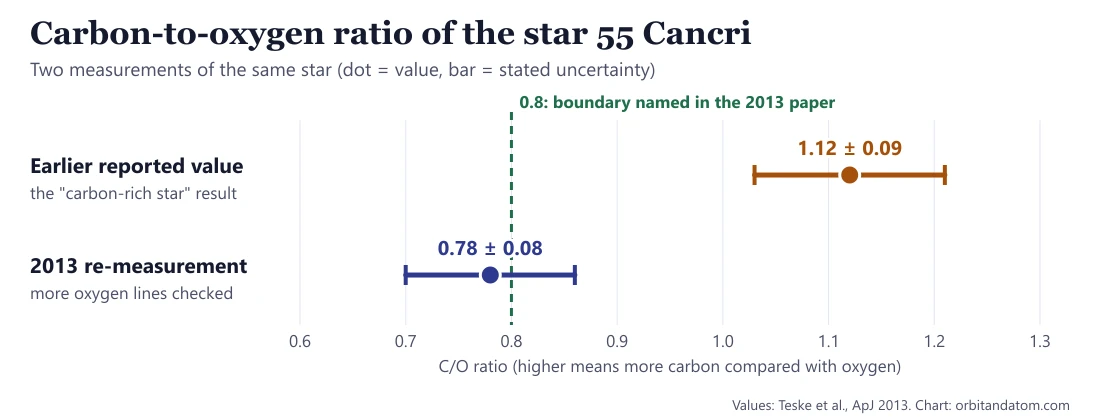
That matters because the paper says a C/O near 0.8 may place the system at "the sensitive boundary" between disks that build high-carbon planets and disks that build low-carbon ones. It is not a clean refutation. It is a warning that the evidence for a carbon-rich star was shakier than first thought, and the authors close by urging caution in measuring C/O in cool, metal-rich stars.
So the situation after 2013 was not "diamond ruled out." It was "the main supporting fact got weaker." In my view, that is a fair summary of where the idea has stood ever since.
What did Webb find in 2024?
Something about the planet's air, not its rock. In a paper in Nature on May 8, 2024, Renyu Hu of NASA's Jet Propulsion Laboratory and colleagues reported the first infrared spectrum of the planet from Webb's NIRCam and MIRI instruments, covering 4 to 12 microns. Webb cannot take a picture of 55 Cancri e. It measures the system's brightness as the planet swings behind the star, and the drop in light tells how much infrared the planet's day side gives off.
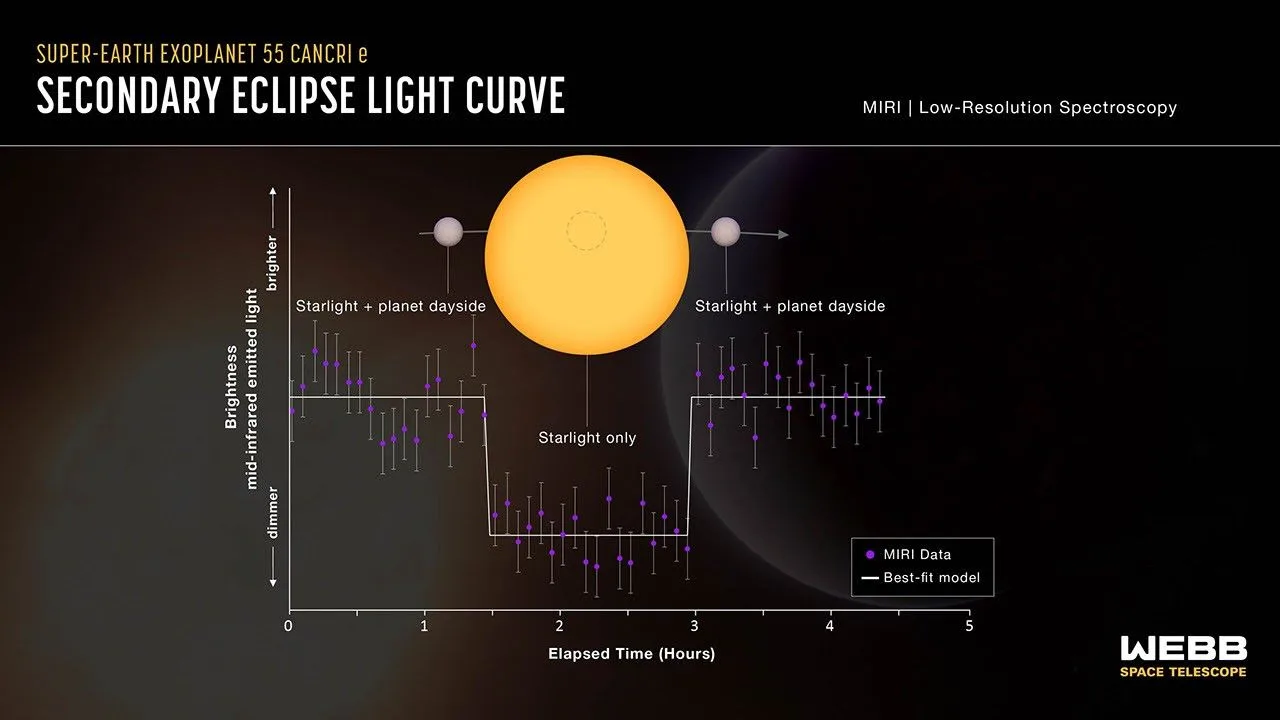
Two results stood out. First, the day side was cooler than a bare lava surface should be. NASA says a dark molten planet with little or no atmosphere should reach about 2,200 °C (4,000 °F), but MIRI showed about 1,540 °C (2,800 °F). Hu said that is a strong sign energy is being carried to the night side, most likely by a volatile-rich atmosphere. Lava currents alone cannot move enough heat. Second, the NIRCam data showed a dip between 4 and 5 microns, which carbon monoxide or carbon dioxide would cause.
The paper's abstract says the measurements rule out a lava world wrapped in only a thin vapor of rock, and indicate a real volatile atmosphere likely rich in CO2 or CO, one that a magma ocean could outgas and keep supplied. NASA calls it the best evidence to date for an atmosphere on a rocky planet beyond our solar system, and still uses careful wording: Webb "may have detected" it.
Does Webb's result settle the diamond question?
No, and it was not built to. Webb measured gas above the surface. The diamond idea is about the interior, deep below it. Nothing in NASA's release or in the paper's abstract tests for diamond, and the NASA release does not mention the 2012 claim.
There is one tension worth knowing. The 2012 paper's carbon-rich model explained the planet's mass and size with a solid interior and no volatile envelope. The Webb team describes a real atmosphere fed by gas dissolved in magma; NASA quotes Aaron Bello-Arufe: "Magma is not just crystals and liquid rock; there's a lot of dissolved gas in it, too." Those are two different pictures. In my opinion, the new data fit the second one more comfortably, but I did not find a paper that tests the two against each other, so I treat that as my reading, not a result.
What the atmosphere does give astronomers is a new window. NASA says the planet is far too hot to be habitable, but it could show how atmospheres, surfaces and interiors of rocky planets interact, and shed light on the early magma-ocean stages of Earth, Venus and Mars.
Is the atmosphere itself settled?
Not yet. NASA's release says analysis of additional eclipse observations is in progress, and papers since 2024 show how much is still open.
| Year | Study | What it reports |
|---|---|---|
| 2012 | Madhusudhan et al. | Mass and size can fit a carbon-rich interior |
| 2013 | Teske et al. | The star's C/O may be 0.78, not 1.12 |
| 2024 | Hu et al., Webb | Likely a CO2 or CO atmosphere over magma |
| 2025 | Zilinskas et al. | Composition still "elusive" |
| 2026 | Zhan and Koll | A thick, CO2-rich air fits best |
How the story has moved. The 2026 item is an arXiv preprint dated June 2026, so it may not have been through peer review. Sources are listed at the end.
In 2025, Mantas Zilinskas and colleagues ran more than 25,000 atmosphere models against the Webb data. Their paper in Astronomy & Astrophysics says the composition and properties of the atmosphere "remain elusive." One mix, hydrogen-free and dominated by nitrogen with some phosphorus monoxide and CO2, came out statistically favored, but water-, CO-, PH3- or silicon-bearing mixes still worked. They also note the planet's brightness varies from visit to visit, and suggest the atmosphere and the magma ocean may be trading gas.
A June 2026 preprint by Ruizhi Zhan and Daniel Koll took a different tool, a 3D climate model. It found the Webb spectra fit best with an atmosphere that is both thick, at least 10 bar (roughly ten times the air pressure at Earth's sea level, by my conversion), and rich in CO2, and ruled out thin or pure-CO versions. They also found ordinary weather cannot explain the changes in brightness. Two careful groups, two different answers on details, which is how a young measurement tends to look.
Is there a diamond planet anywhere?
There is one candidate, and it is a very different object. In 2011, an international team led by Matthew Bailes at Swinburne University of Technology reported a companion to a pulsar named PSR J1719-1438, about 4,000 light-years away in the constellation Serpens. The University of Manchester's release says the companion orbits in two hours and ten minutes, at 600,000 kilometers from the pulsar, is smaller than 60,000 kilometers across, and still has slightly more mass than Jupiter.
That density points to an odd origin. The team thinks the object is what remains of a once-massive star that lost over 99.9 percent of its mass to the pulsar, a stripped-down white dwarf. Michael Keith of CSIRO said the remnant is likely largely carbon and oxygen, and the team argues the density means the material is crystalline, so a large part of it may be similar to a diamond.
Two cautions. It is the core of a former star rather than a planet that formed in a disk, so it does not belong in the same bucket as 55 Cancri e. And "may be similar to a diamond" is the team's inference from density, not an observation. If you like neutron stars and pulsars, the system is a good reason to read more about them.
Diamond also shows up closer to home, as a hypothesis for the deep interiors of Neptune and Uranus. I explain what lab experiments have and have not shown in Does It Really Rain Diamonds on Neptune and Uranus?
How could astronomers settle it?
Not with one measurement. Mass and size alone fit more than one recipe, which is exactly what the 2012 paper said when it offered a carbon-rich option beside the water-world one. A firmer answer would need a better handle on the star's carbon and oxygen, and a clearer read of the atmosphere, which the extra Webb eclipses may provide. Zhan and Koll also say their results are meant as a guide for upcoming Webb observations of the planet.
Until then, my answer to the title is simple. There is no evidence in the papers I read that 55 Cancri e is made of diamond, and no evidence that it is not. What the data do show is a lava-covered super-Earth with a probable atmosphere of carbon dioxide or carbon monoxide, which in my opinion is a more interesting find than a jewelry story.
To place this planet in context, my guides cover how astronomers find exoplanets, the strangest planets ever found, Webb's biggest discoveries, how far a light-year really is and the planets of our own solar system in order. You can also browse Stars & Galaxies.
Frequently asked questions
Is 55 Cancri e really made of diamond?
No one has shown that. A 2012 Yale study said its size and mass could fit a carbon-rich interior with a lot of diamond, but it was a possibility, and later work weakened its main support. Nothing published confirms or rules out diamond.
What is 55 Cancri e?
A super-Earth about 41 light-years away, nearly twice Earth's diameter, orbiting the Sun-like star 55 Cancri. NASA says its surface is likely molten and that it is likely tidally locked.
Why did astronomers think it was a diamond planet?
The 2012 study found its mass and radius could be explained by a carbon-rich interior, and the star had been reported to be carbon-rich. Yale estimated at least a third of the planet's mass could be diamond.
What did the James Webb Space Telescope find on 55 Cancri e?
In 2024, Webb data showed a day side cooler than a bare lava surface should be and a dip in the spectrum linked to carbon monoxide or carbon dioxide. NASA says the planet may have an atmosphere, the best evidence yet for one on a rocky exoplanet.
Does 55 Cancri e have an atmosphere?
Probably, according to Webb, but the details are still debated. A 2025 modeling paper calls the composition elusive, and a 2026 preprint favors a thick, CO2-rich atmosphere.
Is there any planet known to be made of diamond?
No planet has been shown to be made of diamond. PSR J1719-1438 b, found in 2011, may be a stripped star core with much of it similar to diamond, based on its density.
How hot is 55 Cancri e?
NASA says Webb measured about 1,540 °C (2,800 °F) on the day side. Yale's 2012 release cited about 2,150 °C (3,900 °F).
Sources
- Yale News, "Nearby super-Earth likely a diamond planet" (October 11, 2012; accessed November 15, 2026). Used for the 2012 claim, the sizes, the year length and the one-third estimate.
- Madhusudhan, Lee and Mousis, "A Possible Carbon-rich Interior in Super-Earth 55 Cancri e" (arXiv abstract; accessed November 15, 2026). Used for the models and the stated limits.
- Teske et al., "Carbon and Oxygen Abundances in Cool Metal-rich Exoplanet Hosts: A Case Study of the C/O Ratio of 55 Cancri," The Astrophysical Journal 778, 132 (2013; arXiv abstract, accessed November 15, 2026). Used for the two C/O values.
- NASA Science, "NASA's Webb Hints at Possible Atmosphere Surrounding Rocky Exoplanet" (May 8, 2024; accessed November 15, 2026). Used for the planet's facts, the temperatures, the spectrum and the quotes.
- ESA, "Webb hints at atmosphere around rocky exoplanet" (accessed November 15, 2026). Used for the orbit distance in kilometers.
- Hu et al., "A secondary atmosphere on the rocky exoplanet 55 Cancri e," Nature 630, 609 (published May 8, 2024; arXiv abstract, accessed November 15, 2026). Used for the radius, mass and main result.
- Zilinskas et al., "Characterising the Atmosphere of 55 Cancri e: 1D Forward Model Grid for Current and Future JWST Observations" (Astronomy & Astrophysics, 2025; arXiv abstract, accessed November 15, 2026).
- Zhan and Koll, "Reinterpreting the JWST Observations of 55 Cancri e with a Non-Grey General Circulation Model" (arXiv preprint, June 2026; accessed November 15, 2026). Preprint, not necessarily peer reviewed.
- The University of Manchester, "A planet made of diamond" (2011; accessed November 15, 2026). Used for PSR J1719-1438 and its companion.

Founder and editor, Orbit and Atom
I write Orbit and Atom to explain space and science in plain English, starting from what NASA, ESA and the mission teams publish. Every article lists its sources at the end so you can read them yourself.