Stars & Galaxies
The Strangest Planets Ever Found: Lava Worlds, Iron Rain and More
Quick answer
The strangest confirmed planets include WASP-76 b, where iron vapor may condense into rain, HD 189733 b, a deep blue world that may rain glass, K2-141 b, a lava planet with simulated rock rain, and WASP-193 b, nearly as light as cotton candy. All are in NASA's Exoplanet Archive, but their weather is inferred from light and models, not photographed.
On this page
- Which exoplanets are the strangest?
- Does it really rain iron on WASP-76 b?
- Is there a planet where it rains glass?
- What would rock rain on K2-141 b look like?
- Can a lava planet hold on to an atmosphere?
- Which planet is as light as cotton candy?
- How close can a planet get to being torn apart?
- How do astronomers know any of this?
- So which one is the strangest?
- FAQ
- Sources
No spacecraft will visit a planet around another star in our lifetimes, so astronomers read these worlds from light. A small dip, a color shift or a missing signal is enough to estimate a temperature, a wind or a cloud. A few of the planets that come out of that work look like nothing in our own solar system.
NASA's exoplanet page sums up the range: "lava worlds covered in molten seas, puffy planets the density of Styrofoam and dense cores of planets still orbiting their stars." This guide picks six of them, all confirmed in the NASA Exoplanet Archive, which lists 6,470 confirmed planets as of November 16, 2026. For each one I read the NASA, ESO, university or paper source and separate what was measured from what is a model. The sources are listed at the end.
Which exoplanets are the strangest?
Strange is a matter of taste, so here is my shortlist, with a plain label for how solid each claim is.
| Planet | Strange feature | One year | How solid |
|---|---|---|---|
| WASP-76 b | Possible iron rain | 1.8 days | Inferred from a missing signal |
| HD 189733 b | Deep blue, possible glass rain | 2.2 days | Color measured, glass proposed |
| K2-141 b | Possible rock rain | 6.7 hours | Computer simulation |
| TOI-561 b | Lava world with thick air | 10.7 hours | Webb data, still interpreted |
| WASP-193 b | Cotton-candy density | 6.2 days | Measured, cause unknown |
| TOI-6255 b | Near tidal breakup | 5.7 hours | Measured, breakup predicted |
The six planets in this guide. Year lengths are orbital periods from the NASA Exoplanet Archive, checked November 16, 2026; the hours are my conversion from days. The last column is my summary of the sources listed at the end.
Does it really rain iron on WASP-76 b?
Probably, and the evidence is clever. WASP-76 b is an ultra-hot gas giant about 640 light-years away in the constellation Pisces. ESO says its day side climbs above 2,400 °C (about 4,350 °F), hot enough to turn metals such as iron into vapor, while the night side drops to around 1,500 °C (about 2,700 °F). The planet is tidally locked, so one face always looks at its star and the other stays dark.
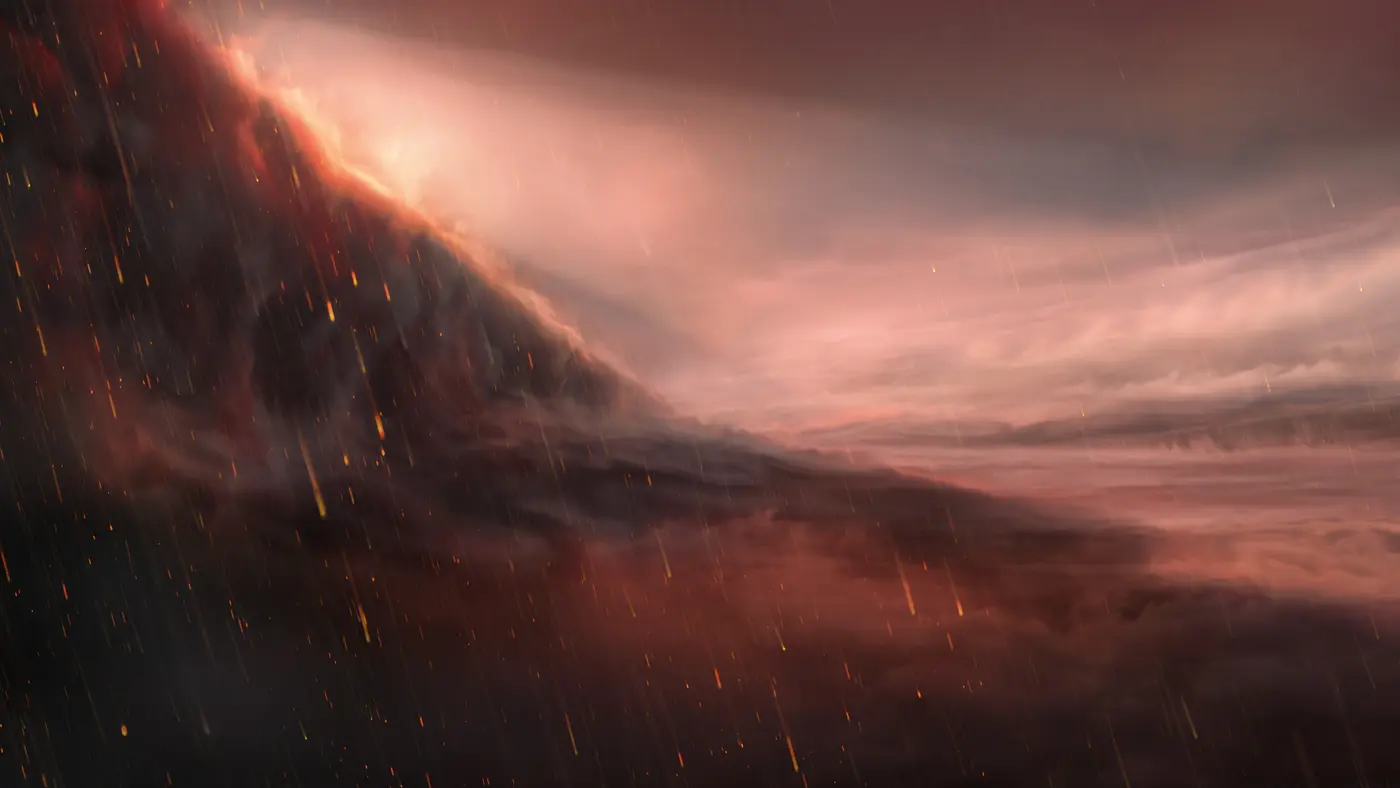
In 2020, a team led by David Ehrenreich at the University of Geneva used ESPRESSO, an instrument on ESO's Very Large Telescope in Chile, and published the result in Nature. They found a strong signal of iron vapor along the evening edge of the planet, where day turns to night, and no iron signal along the morning edge. ESO's explanation is that strong winds carry the vapor to the cooler night side, where it condenses into droplets and falls. As Ehrenreich put it: "One could say that this planet gets rainy in the evening, except it rains iron."
Notice what nobody saw: a falling drop. The team saw iron on one edge and none on the other, and rain is the best fit. ESO's own wording is that astronomers "suspect" it. The release also carries a correction worth knowing. It first gave the distance as 390 light-years and later fixed it to 640, so older pages that repeat 390 are out of date. The data came from ESPRESSO's very first science observations in September 2018.
Is there a planet where it rains glass?
Possibly: HD 189733 b. NASA says this hot Jupiter sits 63 light-years away, was discovered in 2005 and is one of the nearest planets that can be seen crossing the face of its star. In 2013, astronomers using Hubble worked out its real color, and it is a deep blue.
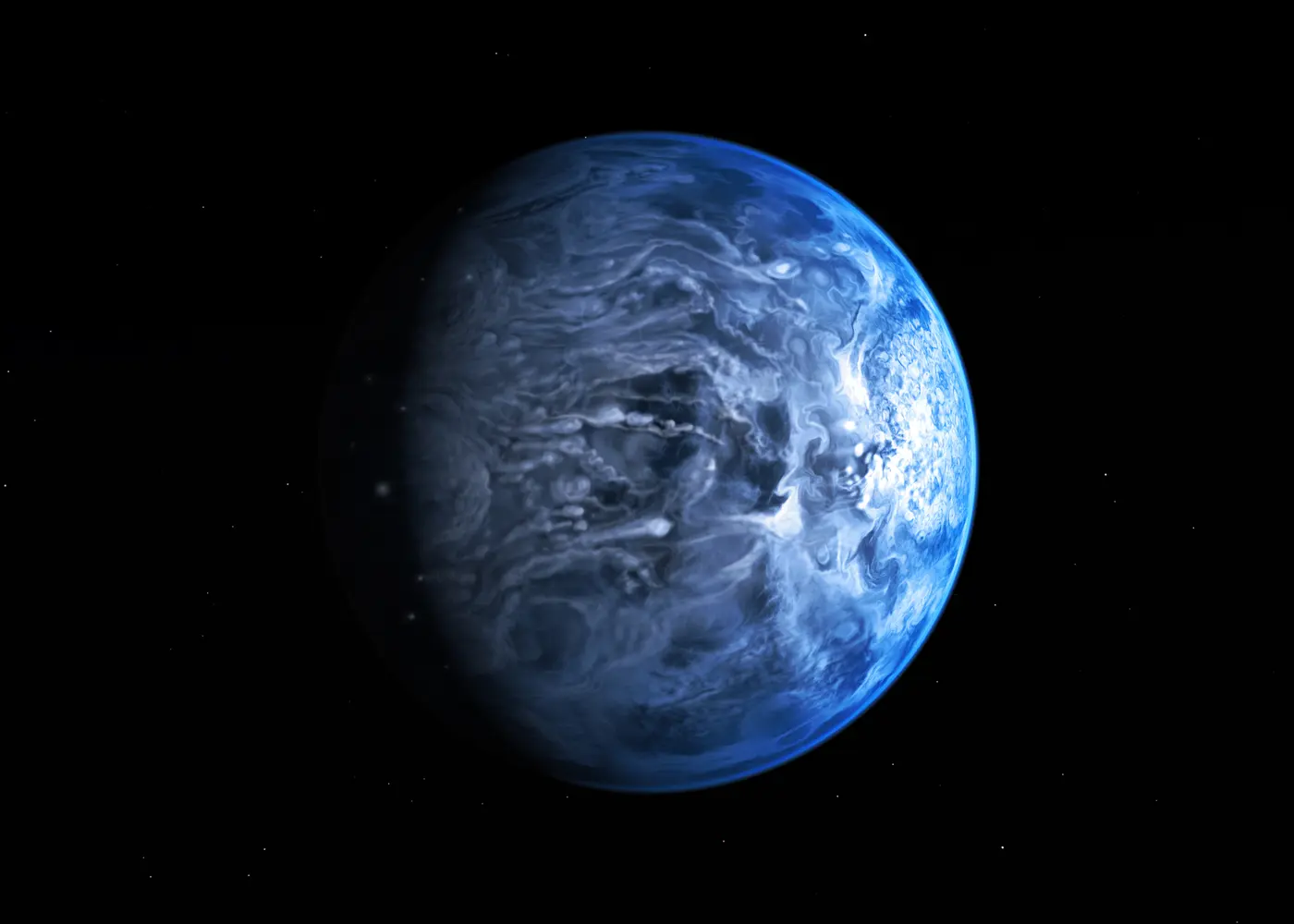
The trick is that the planet's orbit is edge-on as seen from Earth, so it passes behind its star on every lap. Hubble's spectrograph measured the color of the combined light before, during and after the planet vanished. The system dimmed by about one part in 10,000, and only in the blue. Frederic Pont of the University of Exeter said: "We saw the light becoming less bright in the blue, but not in the green or the red." So the thing that disappeared was blue.
It is not an ocean. NASA says the color comes from a hazy, blow-torched atmosphere and perhaps high clouds laced with silicate particles. Silicates condensing in that heat could form very small drops of glass that scatter blue light more than red, and NASA says the planet possibly rains glass, falling sideways in winds of 4,500 miles per hour (about 7,200 km/h by my conversion). The day side is nearly 1,100 °C (2,000 °F), and a 2007 Spitzer map showed the night side about 280 °C (500 °F) cooler, which should drive those winds. The planet orbits only 2.9 million miles (about 4.7 million km) from its star.
In my opinion, this is the best example of why the wording matters. The blue color is a measurement. The glass is a proposed explanation, and Pont said as much: "We obviously don't know much on the physics and climatology of silicate clouds, so we are exploring a new domain of atmospheric physics."
What would rock rain on K2-141 b look like?
This is the planet where the rain is the most theoretical, so I am labeling it clearly. NASA's discovery alert describes K2-141 b as a super-Earth about five times Earth's mass, circling an orange, Sun-like star in about six hours, a trip that takes Mercury 88 days. (The Archive's period of 0.28 days works out to about 6.7 hours.) A Neptune-size companion orbits the same star about every eight days. NASA adds that short-orbit rocky planets like this one might be lava-ocean worlds.
The rain comes from a 2020 computer study led by Giang Nguyen, with Nicolas Cowan at McGill University, published in Monthly Notices of the Royal Astronomical Society. McGill's summary of the simulations is vivid:
- The day side is at an estimated 3,000 °C (about 5,400 °F), hot enough to vaporize rock, and the night side is below −200 °C (about −330 °F).
- About two-thirds of the planet sits in perpetual daylight, because it is tidally locked.
- Vapor of sodium, silicon monoxide and silicon dioxide is swept to the night side by supersonic winds over 5,000 km/h (about 3,100 mph), where it falls back as rock "rain" into a magma ocean about 100 km deep.
The cycle is not as steady as Earth's water cycle. The study's abstract says a sodium atmosphere could not be sustained in a steady state, which suggests the surface will change over time. Cowan explains why astronomers care: "All rocky planets, including Earth, started off as molten worlds but then rapidly cooled and solidified. Lava planets give us a rare glimpse at this stage of planetary evolution." The team's next step is testing the predictions with telescopes such as Webb. Until then, rock rain on K2-141 b is a forecast, not an observation.
Can a lava planet hold on to an atmosphere?
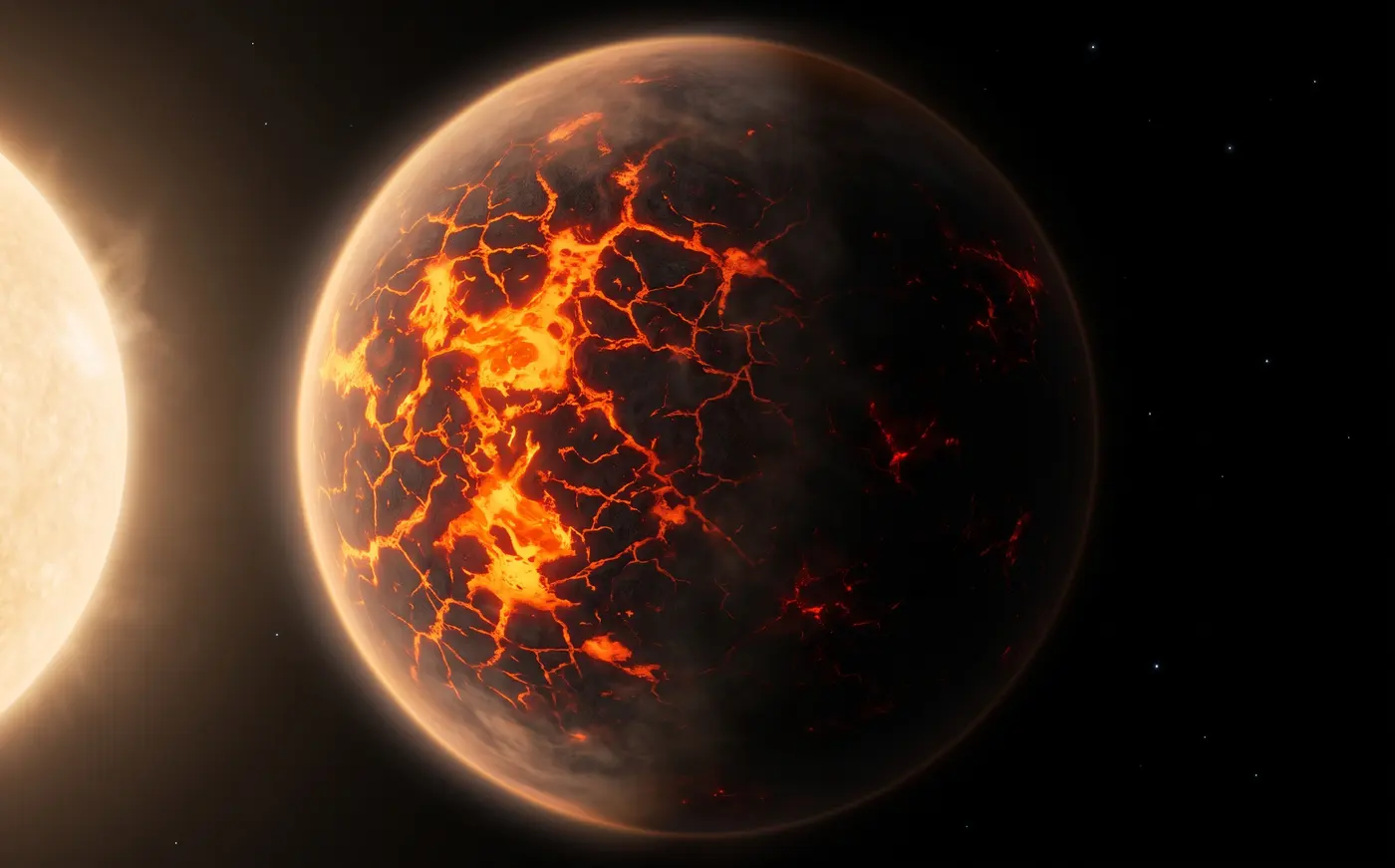
Webb says one can, at least on TOI-561 b. In a December 11, 2025 release, NASA called the result the strongest evidence yet for an atmosphere on a rocky planet outside our solar system. The planet is about 1.4 times Earth's radius and circles its star in under 11 hours, less than one million miles away, or one-fortieth of the distance between Mercury and the Sun. That puts its permanent day side far above the melting point of rock.
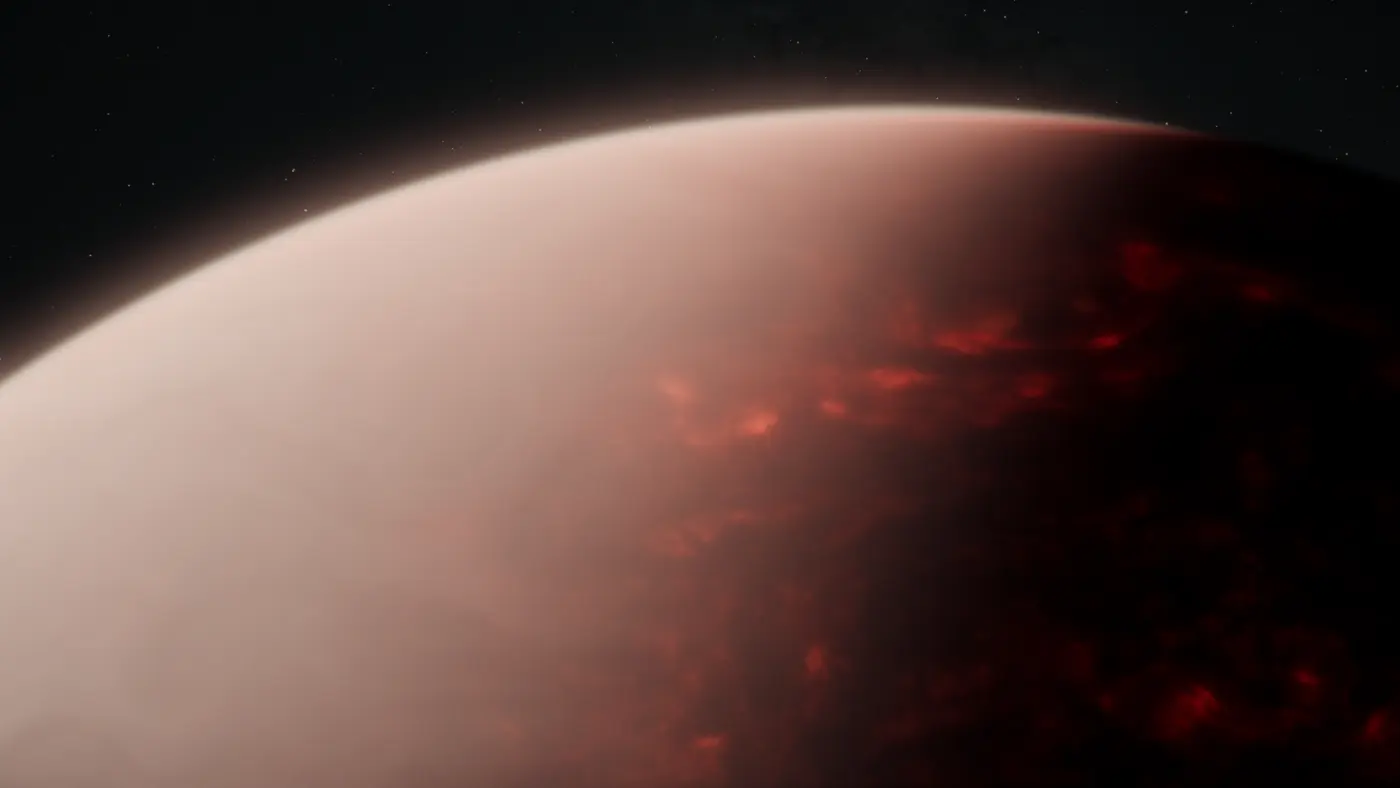
Two things made the team suspect air. First, the planet is oddly light for its size: the Archive lists about 4.1 g/cm³, against 5.5 for Earth. Johanna Teske of Carnegie Science, lead author of the paper in The Astrophysical Journal Letters, said: "It's not a super-puff, but it is less dense than you would expect if it had an Earth-like composition." Second, Webb's NIRSpec instrument measured the day side as it moved behind the star. A bare rock should reach about 2,700 °C (4,900 °F). Webb found closer to 1,800 °C (3,200 °F), still extremely hot but far cooler than expected.
The team's reading is that a thick, volatile-rich atmosphere carries heat to the night side, and that gases such as water vapor absorb some of the light. NASA's release also mentions bright silicate clouds as a possibility. Tim Lichtenberg of the University of Groningen described a balance between magma and air, with gases leaving the planet and the magma ocean pulling them back in: "It's really like a wet lava ball." NASA still words the result as what Webb data "suggest," and the open question is how such a small planet holds any atmosphere at all in that radiation. For a related case where Webb found hints of air over magma, see my guide to 55 Cancri e.
Which planet is as light as cotton candy?
WASP-193 b, announced in 2024. A team led by the University of Liège, with MIT and Spanish colleagues, reported it in Nature Astronomy. The planet is about 1,200 light-years away, 50 percent larger than Jupiter and seven times less massive. That gives it a density of about 0.059 grams per cubic centimeter. Jupiter is 1.33, Earth is 5.51 and cotton candy is about 0.05.
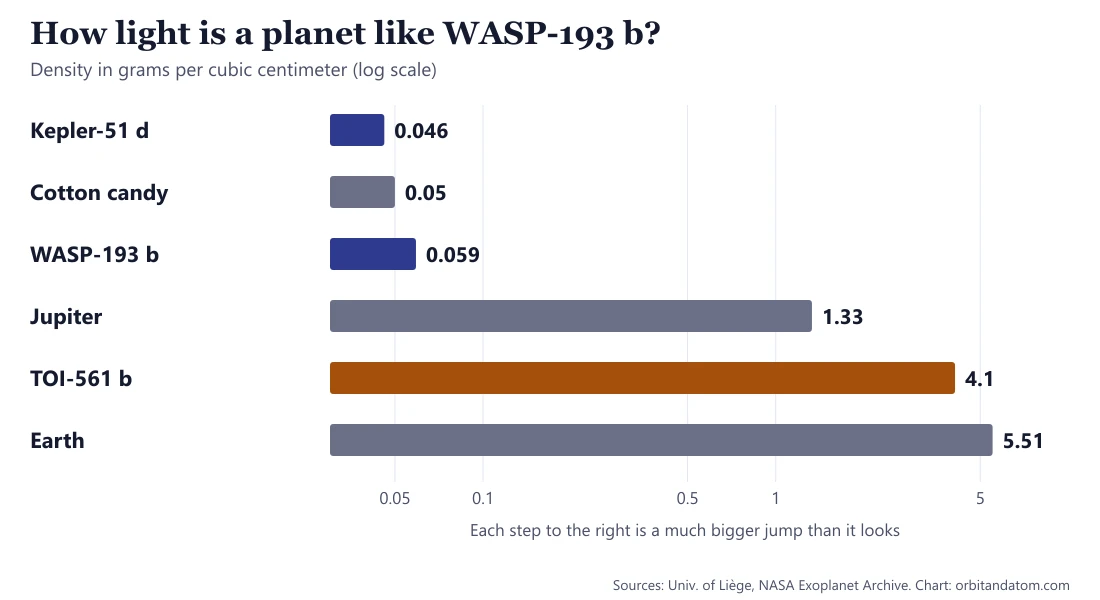
MIT's Julien de Wit said the planet is so light that it is hard to name a solid material like it: "The reason why it's close to cotton candy is because both are pretty much air. The planet is basically super fluffy." The team thinks it is mostly hydrogen and helium, with an atmosphere inflated tens of thousands of kilometers beyond Jupiter's.
The release calls it the second least dense planet found so far, after the much smaller Kepler-51 d, and notes that standard models of irradiated gas giants cannot reproduce its density. Francisco Pozuelos of the Instituto de Astrofísica de Andalucía said it is an outlier in all the formation theories. WASP-193 b was spotted by dips in starlight over a 6.25-day orbit, and its mass came from the HARPS and CORALIE spectrographs in Chile. I find it the most honest kind of strange: measured carefully, and still unexplained.
How close can a planet get to being torn apart?
TOI-6255 b is about as close as a rocky planet can sit. A 2024 paper led by Fei Dai describes it as Earth-sized, at 1.079 Earth radii and 1.44 Earth masses, with a year of only 5.7 hours. The Archive lists the star at about 66 light-years (my conversion from parsecs).
The authors say the planet is just outside its Roche limit, the distance inside which tides would pull it apart, with an orbital period 1.13 times the Roche period. They think the strong tides deform it into a stretched shape, with its long axis about 10 percent longer than its short one. Using an assumed tidal quality factor of about 107, they predict the orbit will shrink until the planet reaches the Roche limit in roughly 400 million years.
That last number is a prediction built on an assumption, not a measurement, and the authors present it that way. In my view, it is still a good reminder that these worlds are snapshots of short-lived situations.
How do astronomers know any of this?
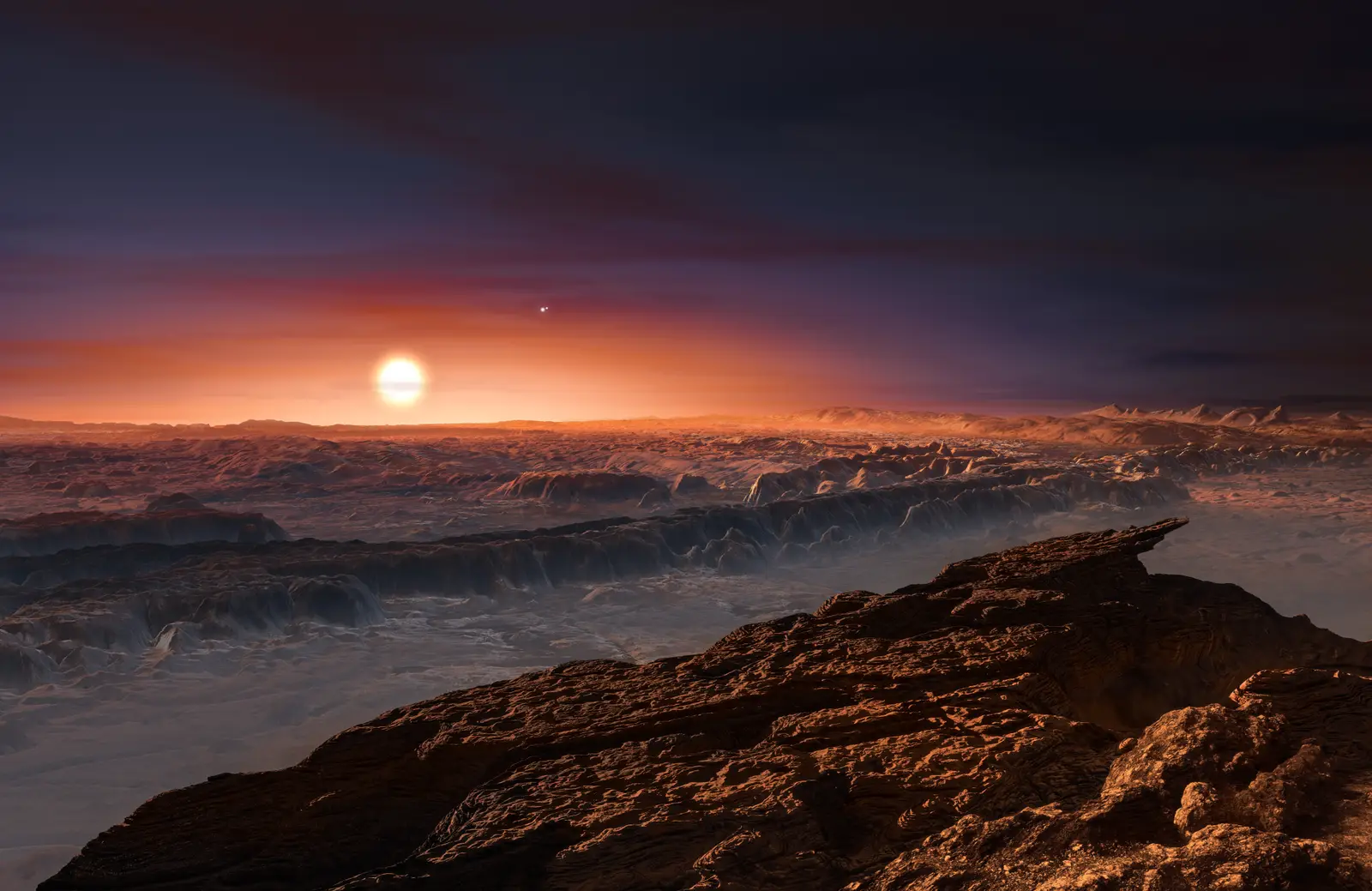
Almost every claim above rests on one of three tricks. Astronomers watch the star and planet together as the planet goes behind the star, which gave Hubble the blue color of HD 189733 b and Webb the day-side temperature of TOI-561 b. They split starlight that passes through a planet's edge and look for fingerprints of elements, which is how ESPRESSO caught iron on WASP-76 b. And they combine a planet's size and mass into a density, which flagged WASP-193 b and TOI-561 b as odd. The planets themselves stay points of light. The pictures here are illustrations, and each caption says so.
My guide to how exoplanets are found explains how the planets are detected in the first place, and the one on Webb's biggest discoveries covers the telescope behind several of these results.
So which one is the strangest?
My pick is WASP-193 b, because no one can yet explain it. Iron rain, glass rain and lava seas fit known physics even if they are extreme. A giant planet with the density of cotton candy does not fit the models astronomers use, according to its discoverers.
If you like extreme planets, two more of my guides cover claims that sound stranger than they are: Is there really a planet made of diamond? and Does it really rain diamonds on Neptune and Uranus? For scale, see how far a light-year really is and the planets of our own solar system in order. You can also browse Stars & Galaxies.
Frequently asked questions
What is the strangest planet ever found?
It depends on what you count as strange. WASP-193 b has the density of cotton candy and no accepted formation theory, WASP-76 b may rain iron, and K2-141 b may rain rock in simulations. All are confirmed in NASA's Exoplanet Archive.
Does it really rain iron on WASP-76 b?
ESO says astronomers suspect it. In 2020, ESPRESSO found iron vapor on the evening edge of the planet but not on the morning edge, which fits iron condensing into droplets on the night side. Nobody has watched a drop fall.
Is there a planet where it rains glass?
HD 189733 b may. NASA says Hubble measured its deep blue color in 2013 and that silicates could form tiny glass drops that scatter blue light. The color is measured; the glass rain is a proposed explanation.
What is a lava planet?
A rocky planet so close to its star that part of its surface is likely molten. K2-141 b and TOI-561 b are examples, and 55 Cancri e is another. Their day sides are extremely hot: Webb measured about 1,800 °C (3,300 °F) on TOI-561 b.
Which planet has the shortest year in this guide?
TOI-6255 b, an Earth-sized planet that orbits its star in 5.7 hours. K2-141 b takes about 6.7 hours and TOI-561 b about 10.7 hours, by the NASA Exoplanet Archive.
Is there a planet as light as cotton candy?
WASP-193 b comes close. Its density is about 0.059 grams per cubic centimeter, against about 0.05 for cotton candy, according to the University of Liège. Kepler-51 d is lighter still, but much smaller.
Can we see these planets in a telescope?
No. They appear only as points of light next to their stars, and astronomers study them through changes in that light. The pictures you see are artists' illustrations.
Sources
- ESO, "ESO Telescope Observes Exoplanet Where It Rains Iron," press release eso2005 (March 11, 2020, with a later distance correction; accessed November 16, 2026). Used for WASP-76 b.
- NASA Science, "NASA's Hubble Finds a True Blue Planet" (July 11, 2013; accessed November 16, 2026). Used for HD 189733 b, the color measurement and the glass-rain explanation.
- NASA Science, "Discovery alert! Iron-massive super Earth" (K2-141 b; accessed November 16, 2026). Used for the planet's mass, orbit and companion.
- McGill Reporter, "Supersonic winds, rocky rains forecasted on lava planet" (2020; accessed November 16, 2026). Used for the simulated weather of K2-141 b.
- Nguyen, Cowan, Banerjee and Moores, "Modelling the atmosphere of lava planet K2-141b" (arXiv abstract, October 2020; accessed November 16, 2026).
- NASA Science, "NASA's Webb Detects Thick Atmosphere Around Broiling Lava World" (December 11, 2025; accessed November 16, 2026). Used for TOI-561 b.
- University of Liège, "WASP-193b, a giant planet with a density similar to that of cotton candy" (May 2024; accessed November 16, 2026). Used for WASP-193 b and the density values.
- Dai et al., "An Earth-sized Planet on the Verge of Tidal Disruption" (arXiv abstract, July 30, 2024; accessed November 16, 2026). Used for TOI-6255 b.
- NASA Exoplanet Archive, planetary systems table queried by TAP on November 16, 2026 (6,470 confirmed planets; orbital periods and densities).
- NASA Science, Exoplanets (accessed November 16, 2026). Used for the "lava worlds" and "Styrofoam" description.

Founder and editor, Orbit and Atom
I write Orbit and Atom to explain space and science in plain English, starting from what NASA, ESA and the mission teams publish. Every article lists its sources at the end so you can read them yourself.