Stars & Galaxies
What Is the Closest Star to Earth After the Sun? Meet Proxima Centauri
Quick answer
The closest star to Earth after the Sun is Proxima Centauri, a small red dwarf about 4.24 light-years away, or roughly 25 trillion miles, according to NASA. It is too faint to see without a telescope. It belongs to the Alpha Centauri system and has at least one known planet, Proxima b. At its current speed, Voyager 1 would need more than 70,000 years to get there.
On this page
- Which star is closest to Earth after the Sun?
- Is Proxima Centauri the same as Alpha Centauri?
- Why can't you see the closest star?
- What planets orbit Proxima Centauri?
- Could Proxima b support life?
- How long would it take to get to Proxima Centauri?
- Will Proxima always be the closest star?
- FAQ
- Sources
On November 18, 2026, NASA calculated that Voyager 1 passed one light-day from Earth, a distance no human-made object had reached. It took the spacecraft 49 years. It feels like the edge of the map, so I looked up what is actually next on it.
The answer is a dim red star, and it is far, far beyond that milestone. NASA's figure for it is about 40 trillion kilometers (25 trillion miles). Voyager 1 would have to repeat its one light-day trip roughly 1,500 times over. In my arithmetic from NASA's numbers, that is the scale of the gap. I wrote about the milestone itself in Voyager 1 Is Now One Light-Day From Earth.
Which star is closest to Earth after the Sun?
Proxima Centauri. NASA's Voyager 1 light-day page puts it at "about 4.24 light-years away (or, about 24.95 trillion miles, or 40.15 trillion kilometers)." NASA's other pages round it slightly differently: one calls the trip "4.25 light-years," and its Imagine the Universe page says light needs 4.22 years to arrive. All of them agree on the main point, which is that it is just over four light-years.
The same Imagine the Universe page gives the distance in a unit that shows how lonely the Sun is: about 268,770 astronomical units. One astronomical unit is the distance from Earth to the Sun, so the nearest star sits nearly 270,000 times farther away than our own. If you want to feel that scale, my guide to how far a light-year really is walks through it step by step.
Is Proxima Centauri the same as Alpha Centauri?
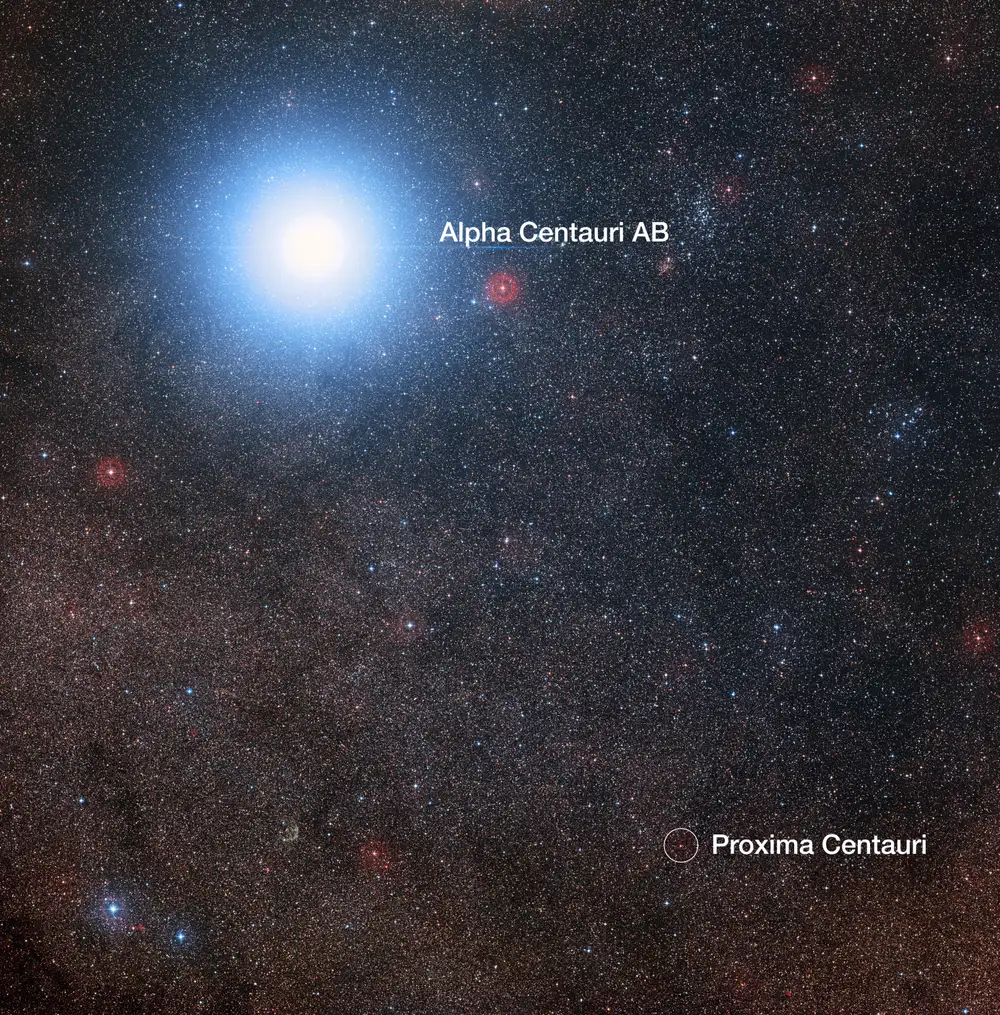
Not quite, and this is the part that trips people up. Alpha Centauri is a system of three stars, and Proxima is the third and smallest one. NASA explains that "Proxima is itself part of another star system. It is locked in a distant orbital relationship with two other stars, Alpha Centauri A and B."
The two bright stars, A and B, circle each other once every 80 years, according to NASA. They are about 4.35 light-years away, a little farther than Proxima, and NASA's Imagine the Universe page says they are separated by only 23 times the Earth-Sun distance. Proxima is a far-off sibling: NASA says it "takes more than half a million years to orbit the other two."
Why can't you see the closest star?
Because it is tiny and cool. NASA's Hubble team writes that Proxima Centauri "is not visible to the naked eye. Its average luminosity is very low, and it is quite small compared to other stars, at only about an eighth of the mass of the Sun." ESO says the same in its 2016 release: the star is "too faint to be seen with the unaided eye" and sits close to the much brighter pair Alpha Centauri AB.
The bright pair is what people actually see when they look up at the system. NASA notes that the Alpha Centauri system "is not visible from much of the northern hemisphere," so it is a southern-sky sight. If you are curious about what the unaided eye can reach, I cover the extreme end in the farthest thing you can see with the naked eye.
What planets orbit Proxima Centauri?
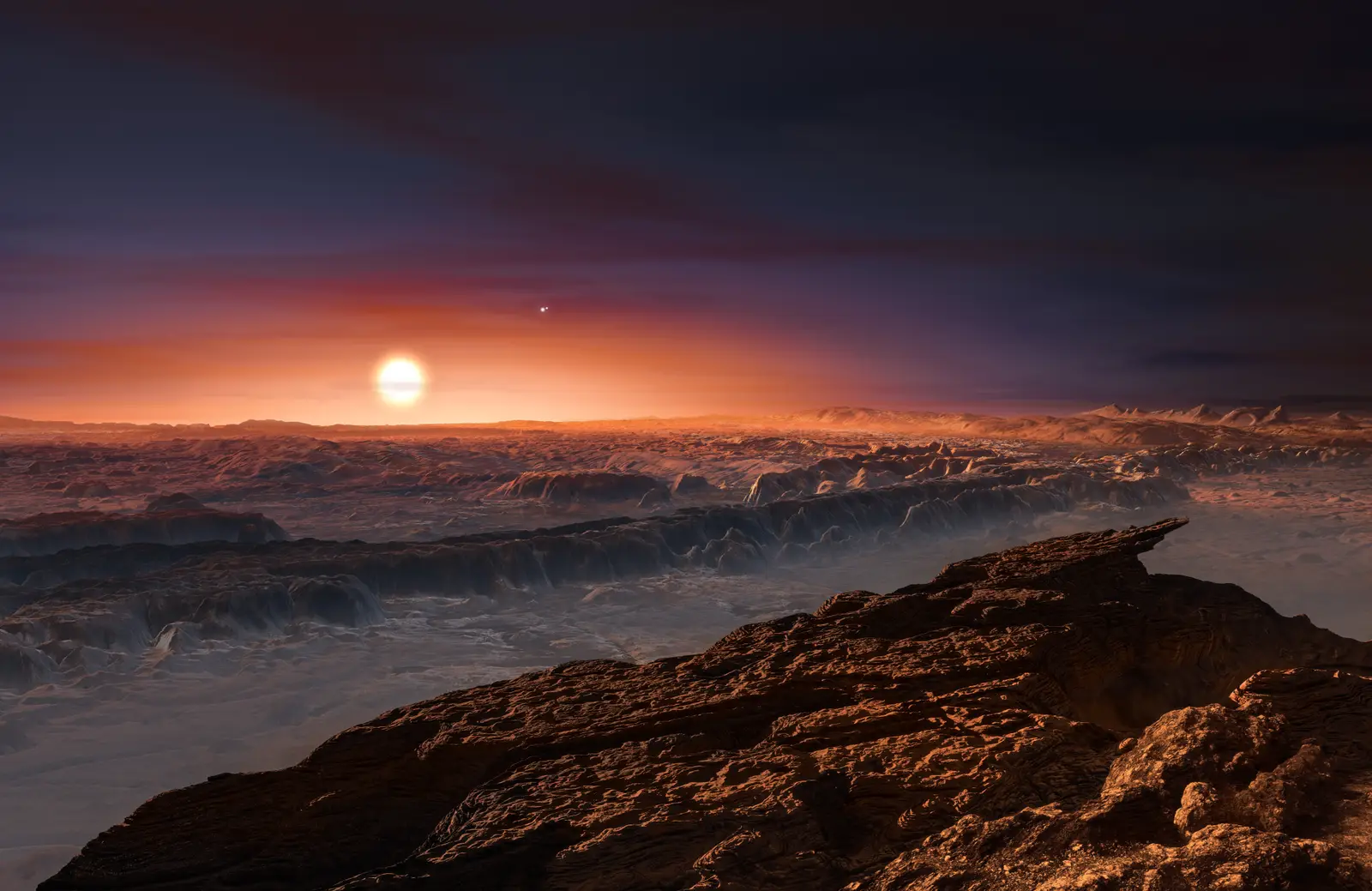
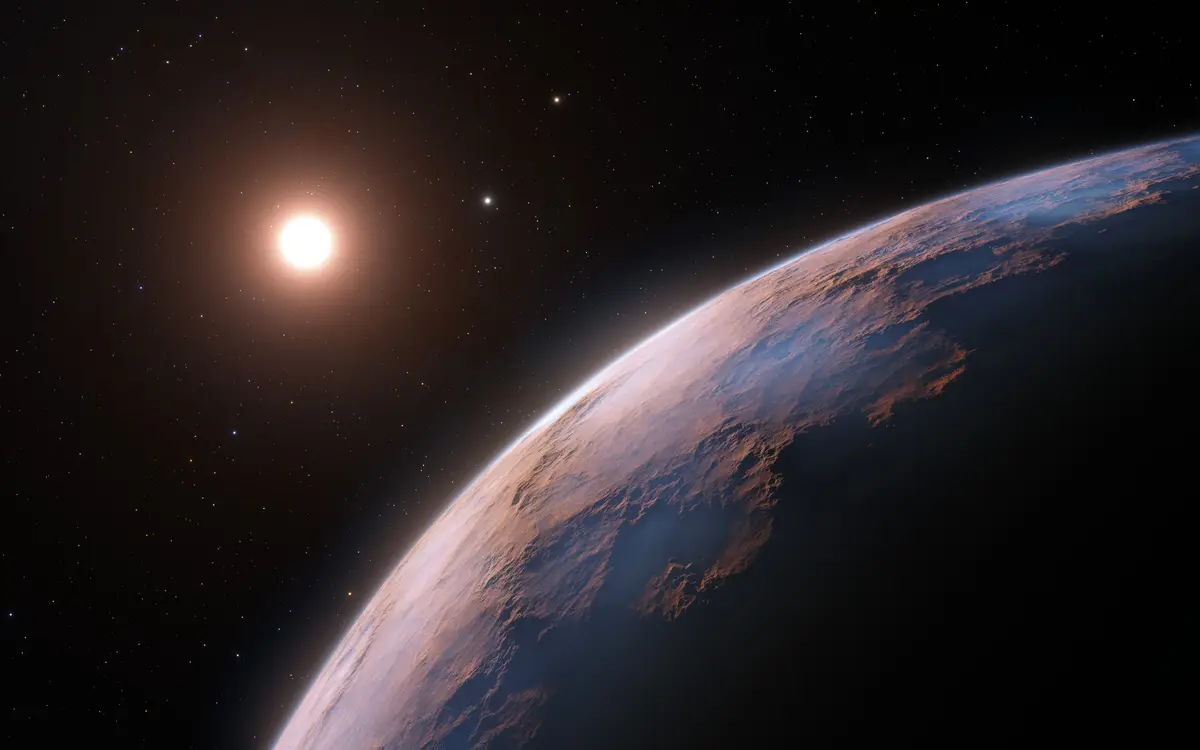
One confirmed, and two more that astronomers are still checking. The confirmed one is Proxima b, announced by ESO in August 2016 after the Pale Red Dot campaign. ESO says it orbits "every 11 days" and has a mass of "at least 1.3 times that of the Earth," about 7 million kilometers from its star, only 5 percent of the Earth-Sun distance. ESO adds that the detection was confirmed in 2020 with a newer instrument on its Very Large Telescope.
In January 2022, ESO announced a third world, Proxima d, which it calls a "candidate planet," and "the lightest yet discovered orbiting this star," at about a quarter of Earth's mass. ESO also lists a candidate, Proxima c, on a five-year orbit.
| Planet | Status | Orbit |
|---|---|---|
| Proxima b | Confirmed | About 11 days |
| Proxima c | Candidate | About 5 years |
| Proxima d | Candidate | About 5 days |
The Proxima Centauri planets, from ESO releases of August 24, 2016 and January 4, 2022 and NASA pages read November 19, 2026.
One caution on the mass of Proxima b. ESO's discovery gave a minimum of 1.3 Earths, NASA's Nearest Neighbor page says 1.27, and the NASA exoplanet catalog lists 1.07 in its text. They are close, but not identical, which is normal as measurements get refined. I would treat it as "a bit more massive than Earth" and leave it there. The method behind these discoveries is explained in how astronomers find exoplanets.
Could Proxima b support life?
Nobody knows yet, and NASA is careful about it. Proxima b orbits inside the habitable zone, the range of distances where liquid water could exist on a planet's surface. ESO says the planet's temperature is "suitable for liquid water," because the star is far fainter than the Sun even though the planet orbits much closer than Mercury does to the Sun.
The catch is the star. NASA says "Liquid water requires a suitable atmosphere, and so far none of our telescopes, in space or on the ground, has the capability to check whether Proxima b has any sign of an atmosphere at all." It adds that Proxima Centauri "frequently erupts in bursts of intense ultraviolet radiation," which might strip away an atmosphere. ESO makes a similar point: flares "far more intense than the Earth experiences from the Sun" could strongly affect surface conditions.
In my opinion, the fair summary is "right place, open question." Being in the habitable zone is a starting point for study, not a finding about life, and NASA's own wording is that its habitability "is so far unknown."
How long would it take to get to Proxima Centauri?
With today's spacecraft, tens of thousands of years. NASA's Imagine the Universe page does the math with Voyager 1's speed of 17.3 kilometers per second and says a trip to Proxima "would take over 73,000 years to arrive." Using NASA's newer figure of nearly 61,000 kilometers per hour, I get roughly 75,000 years, so the answer holds.
| Traveler | Time to arrive |
|---|---|
| A beam of light | About 4.2 years |
| Voyager 1 speed | Over 73,000 years |
Travel times to Proxima Centauri, from NASA's Imagine the Universe page and Voyager 1 light-day page.
Voyager 1 is not actually pointed at Proxima. NASA says it is heading toward the constellation Ophiuchus and will pass within 1.7 light-years of a star called AC+79 3888 in the year 40,272. The speed comparison is only a way to feel the distance. Light itself, NASA reminds readers, takes more than four years, and nothing can beat it; I explain why in why nothing can go faster than light.
Will Proxima always be the closest star?
No, because stars move. NASA's Imagine the Universe page notes that Barnard's Star is approaching the Sun so quickly that around the year 11,700 it will be 3.8 light-years away, "and thus the closest star to our own." The page quotes astronomer Phil Plait comparing it to cars on a highway: stars "continually pass each other as they orbit the Galaxy."
So the title belongs to Proxima for now, on a timescale of thousands of years. For the other stars near us and the bigger picture they sit in, browse the rest of Stars & Galaxies.
Frequently asked questions
What is the closest star to Earth after the Sun?
Proxima Centauri. NASA says it is about 4.24 light-years away, or about 24.95 trillion miles (40.15 trillion kilometers). It is a small red dwarf with about an eighth of the Sun's mass.
Is Proxima Centauri the same as Alpha Centauri?
No. Alpha Centauri is a system of three stars. Proxima Centauri is the faintest and nearest of them, and NASA says it takes more than half a million years to orbit the other two, Alpha Centauri A and B.
Can you see Proxima Centauri with the naked eye?
No. NASA and ESO both say it is too faint to see without a telescope. The much brighter pair next to it, Alpha Centauri A and B, is, NASA says, not visible from much of the northern hemisphere.
Does Proxima Centauri have planets?
Yes. Proxima b is confirmed and orbits every 11 days. ESO also lists two candidates: Proxima d, with a five-day orbit and about a quarter of Earth's mass, and Proxima c, on a five-year orbit.
Is Proxima b habitable?
NASA says this is so far unknown. The planet orbits in the habitable zone, but NASA notes that no telescope can yet check for an atmosphere and that flares from the star could strip one away.
How long would it take to travel to Proxima Centauri?
Light takes about 4.2 years. At Voyager 1's speed of 17.3 kilometers per second, NASA says the trip would take over 73,000 years, although Voyager 1 is not headed toward Proxima.
Will Proxima Centauri always be the nearest star?
No. NASA says Barnard's Star is moving toward the Sun and around the year 11,700 will be 3.8 light-years away, making it the closest star at that time.
Sources
- NASA Science, "Voyager 1: What Is a Light-Day" (accessed November 19, 2026). Used for the distance to Proxima Centauri, Voyager 1's speed and the November 18 milestone.
- NASA Science, "Our Nearest Celestial Neighbor? An Exotic 3-Star System" (page updated June 3, 2025). Used for the three-star system, Proxima b and the flares.
- NASA Imagine the Universe, "The Nearest Neighbor Star" (page dated December 8, 2020). Used for astronomical units, travel time and Barnard's Star.
- NASA Science, "Hubble's New Shot of Proxima Centauri, Our Nearest Neighbor" (November 2013). Used for visibility and mass.
- NASA Exoplanet Catalog, "Proxima Centauri b" (page updated July 29, 2025). Used for the mass and orbit figures.
- NASA Science, "Voyager: Frequently Asked Questions" (accessed November 19, 2026). Used for Voyager 1's direction and speed.
- ESO, "Pale Red Dot campaign reveals Earth-mass world in orbit around Proxima Centauri" (August 24, 2016). Used for Proxima b and habitability.
- ESO, "New planet detected around star closest to the Sun" (January 4, 2022). Used for Proxima d and candidate Proxima c.

Founder and editor, Orbit and Atom
I write Orbit and Atom to explain space and science in plain English, starting from what NASA, ESA and the mission teams publish. Every article lists its sources at the end so you can read them yourself.