Stars & Galaxies
How Old Is the Universe? How Astronomers Know
Quick answer
The universe is about 13.8 billion years old. Astronomers reach that number two ways: by reading the oldest light in the sky, the cosmic microwave background mapped by NASA's WMAP and ESA's Planck, and by measuring how fast space is expanding with Hubble and Webb. Both methods land near 13.8 billion years, but they disagree on the expansion rate itself, a puzzle called the Hubble tension.
On this page
Nobody was there to watch the universe begin, so how can astronomers say it is 13.8 billion years old? The answer is that they do not read a birth certificate. They measure two things that each carry a clock inside them, and then check whether the clocks agree.
This guide explains both methods, how close the answer is, and the open question that makes the number more interesting than it looks. I read pages from NASA and ESA for it, and the sources are listed at the end.
How old is the universe?
About 13.8 billion years. NASA's page on the history of the universe uses that figure, and so does ESA. The more precise numbers depend on the mission. NASA says its Wilkinson Microwave Anisotropy Probe, WMAP, determined the age to be 13.77 billion years, to within half a percent. ESA's Planck satellite, using data released in 2013, implied 13.82 billion years.
The two results are not in conflict. By my arithmetic, half a percent of 13.77 billion years is about 70 million years, and the two missions differ by about 50 million. Both are the same answer, given to a different decimal.
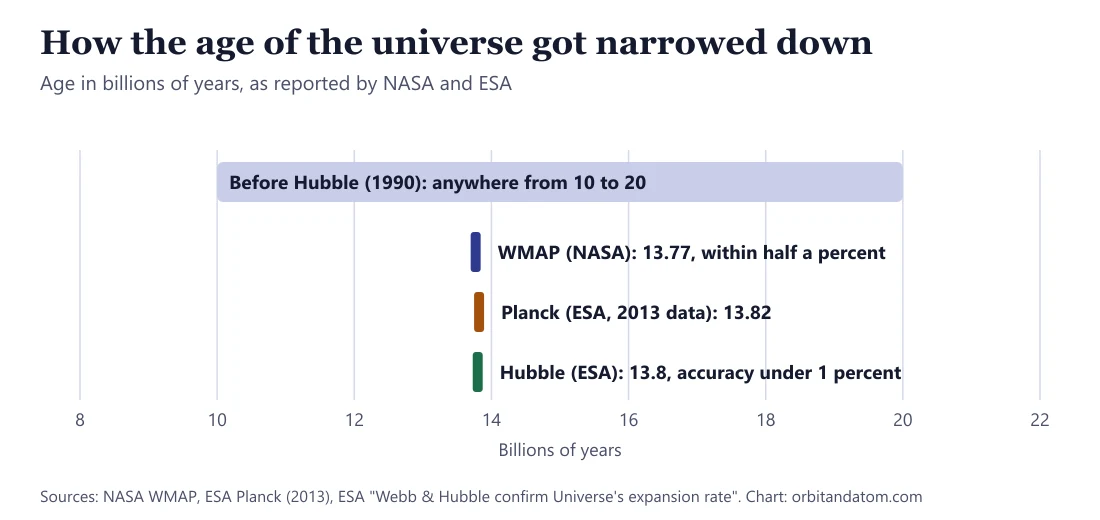
The progress is the real story. ESA notes that before Hubble launched in 1990, ground-based observations left huge uncertainties, and depending on the expansion rate you picked, the universe could be anywhere between 10 and 20 billion years old. Over the following 34 years, ESA says, Hubble shrank the uncertainty to less than one percent, splitting the difference at 13.8 billion years.
How does the oldest light give the age?
This is the first method. About 380,000 years after the big bang, NASA explains, the universe cooled enough for atomic nuclei to capture electrons. Until then free electrons scattered light like a fog. Once they were locked into atoms, the fog cleared, and light could travel freely for the first time. That glow is still detectable today, and NASA calls it the cosmic microwave background, the oldest light we can observe.
ESA adds what happened to it on the way. The young universe was filled with a hot soup at about 2,700 °C (about 4,900 °F). As space expanded, the light stretched out to microwave wavelengths, equivalent to a temperature of just 2.7 degrees above absolute zero.
The map is not smooth. It shows tiny temperature differences, which ESA says correspond to regions of slightly different density at very early times: the seeds of all later stars and galaxies. NASA's WMAP mapped them using nine years of data, and Planck mapped them with greater resolution and sensitivity than ever before.
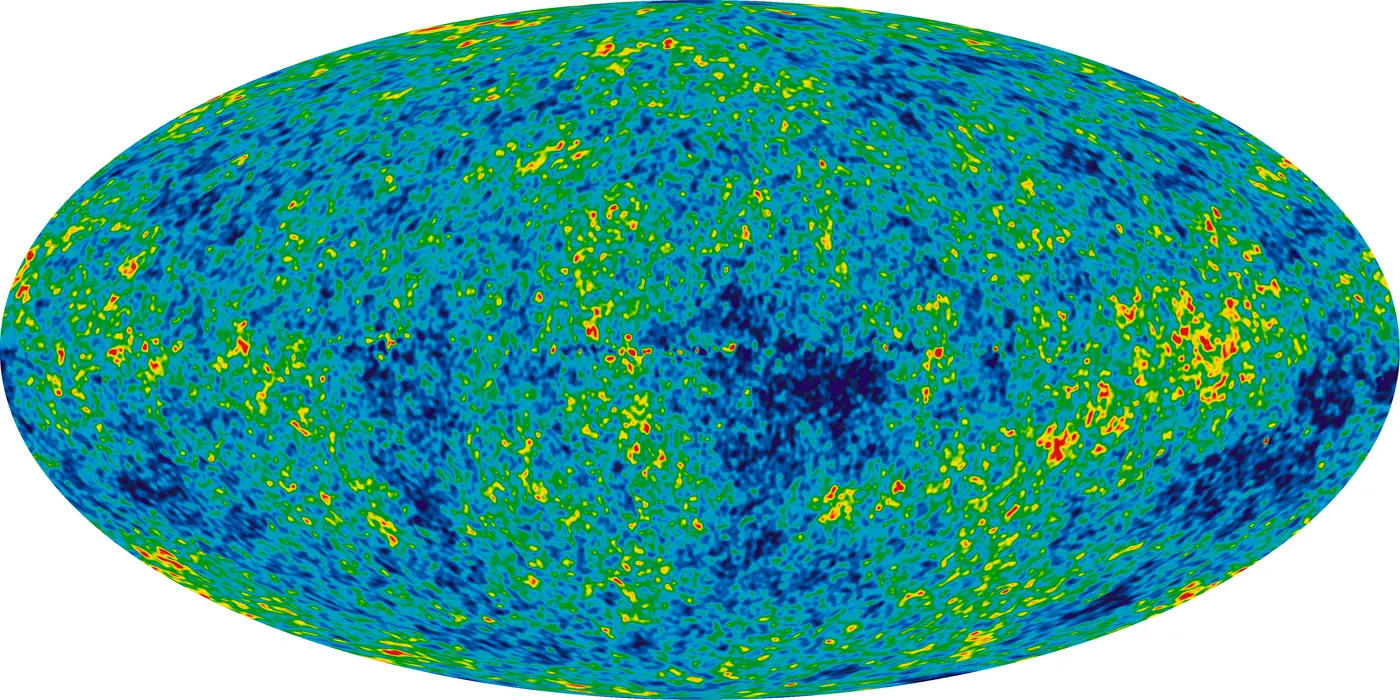
Here is where the age comes from. The size and pattern of those patches let scientists work out what the universe is made of and how it has evolved, as ESA puts it, "from its birth to the present day." Planck found that normal matter makes up 4.9 percent of the universe's mass and energy and dark matter 26.8 percent, and that the data fit what ESA calls a rather simple model of the universe very well. Feed those ingredients into the model and run it forward, and the clock reads 13.8 billion years. In my opinion, this is the part worth remembering: the age is not measured directly, it is the answer a well-tested model gives when it is fitted to the oldest picture we have.
How does the expansion of space give the age?
This is the second method, and it works from today backward. ESA describes the rate at which the universe is expanding as the Hubble constant. If you know how fast space is stretching now, you can rewind and ask how long it took to get this big.
A faster expansion rate means a younger universe, and a slower one means an older universe. That follows from the rewind: if everything is moving apart quickly, it did not take long to reach today's spacing. This is my explanation of the logic, and ESA's 10 to 20 billion year spread before Hubble shows the same link in practice, since the spread came from the uncertain expansion rate.
The hard part is measuring distances. NASA describes a cosmic distance ladder. Its first rungs are Cepheid variable stars, which NASA calls milepost markers for the expansion rate. Farther out, type Ia supernovae are so bright they are used to measure distances beyond the range of the Cepheids. The idea is simple: when you know how bright a marker really is, how dim it looks tells you how far away it is. Compare that distance to how fast the galaxy is moving away, and you have the expansion rate.
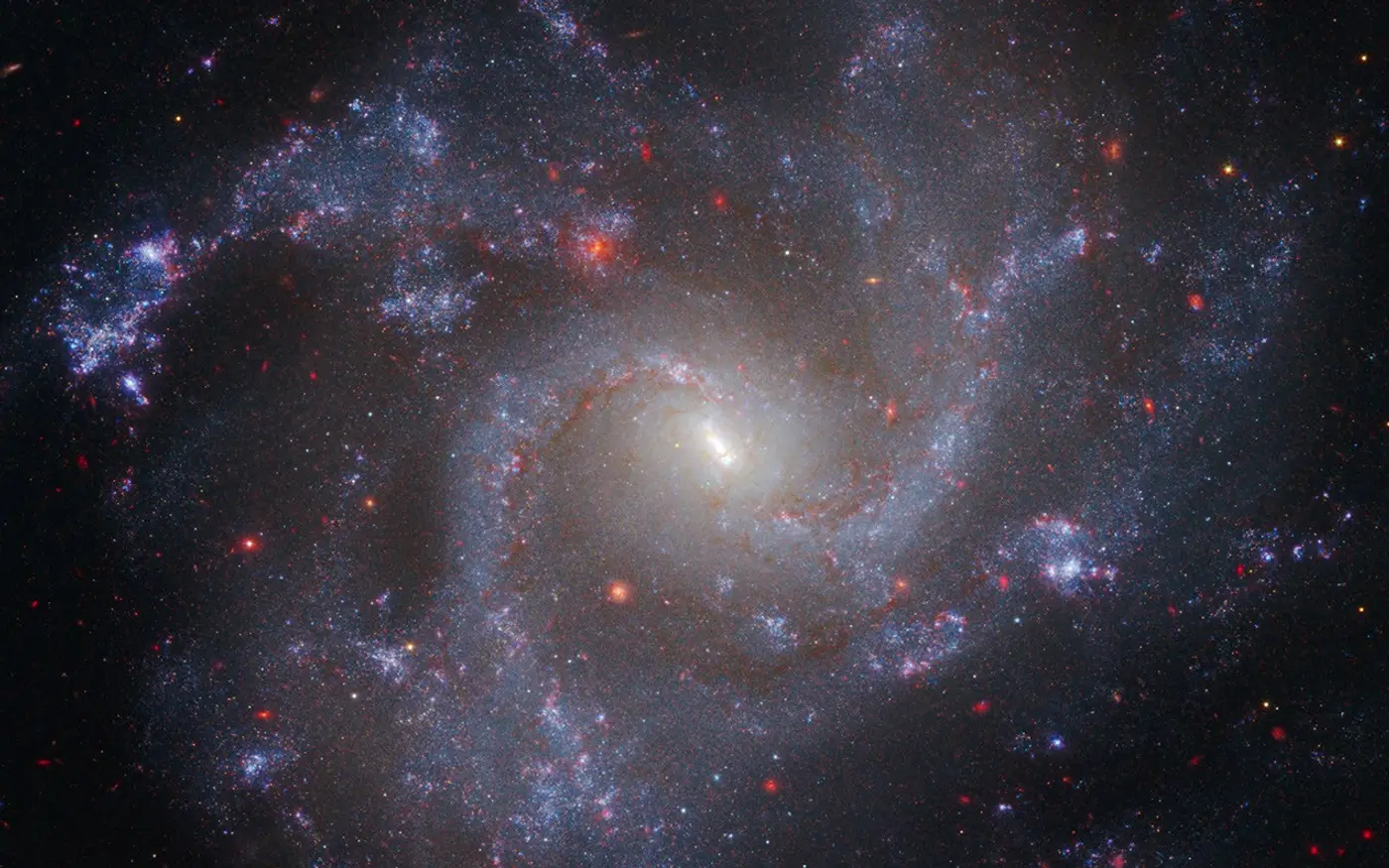
Hubble spent decades on this, and then Webb checked its work. NASA reports that the new Webb observations include five host galaxies of eight type Ia supernovae, with a total of 1,000 Cepheids, reaching out to NGC 5468, the farthest galaxy where Cepheids have been well measured, at 130 million light-years. The results were published in The Astrophysical Journal Letters on February 6, 2024. Webb sees through dust and separates the stars from their crowded neighbors in infrared light, and its numbers agreed with Hubble's.
| Method | What it measures | Telescopes |
|---|---|---|
| Oldest light | Patterns in the glow from 380,000 years after the big bang | WMAP, Planck |
| Expansion today | Distances and speeds of nearby galaxies | Hubble, Webb |
The two ways to date the universe, based on NASA and ESA pages read November 14, 2026.
Why do the two methods not fully agree?
They agree on the age, roughly, but not on the expansion rate. That mismatch is called the Hubble tension. NASA states the puzzle plainly: the current rate of expansion is faster than what astronomers expect it to be, based on the universe's initial conditions and the present understanding of how it evolved.
ESA's Planck data, from the early universe, gave a Hubble constant of 67.15 kilometers per second per megaparsec in the 2013 release. A megaparsec is about 3.3 million light-years, so the number means that a galaxy that far away is receding at about 67 kilometers per second. The nearby measurements by Hubble and other telescopes consistently come out higher, NASA says, and do not match the prediction based on Planck.
The obvious suspect was measurement error. That is what Webb tested, and it came back clean. Adam Riess, who holds a Nobel Prize for co-discovering that the expansion is accelerating, said in NASA's release: "We've now spanned the whole range of what Hubble observed, and we can rule out a measurement error as the cause of the Hubble Tension with very high confidence." What remains, he added, is "the real and exciting possibility we have misunderstood the universe."
NASA offers a neat picture. Hubble and Webb have set an anchor on one shoreline of a river, and Planck has set one on the other side. How the expansion changed over the billions of years in between has not been observed directly. In my view, that is the honest summary: the age of 13.8 billion years is solid, and what is still open is the story of how the universe got from the beginning to now.
Does the tension change the age of the universe?
Not by much, as far as these sources go. ESA's own summary is that Hubble narrowed the age to 13.8 billion years with an accuracy of less than 1 percent, while the tension is described as a "nagging puzzle" about the expansion rate, possibly something in the fabric of space that is not yet understood. NASA does not say the age is in doubt. I did not find a NASA or ESA page that gives a new age, so I am not offering one.
What could settle it? NASA says its upcoming Nancy Grace Roman Space Telescope will run wide surveys to study the influence of dark energy, and ESA's Euclid observatory, with NASA contributions, is pursuing a similar task. If you want more on the instruments, my guides to what Roman will see that Hubble can't and Webb's biggest discoveries are a good next stop.
For nearby topics, I explain how the far-away light behaves in whether the universe has an edge, how big the distances are in how far a light year is, and what holds most of the mass in what dark matter is. The pull behind it all is in what gravity is. You can also browse Stars & Galaxies.
Frequently asked questions
How old is the universe?
About 13.8 billion years. NASA's WMAP gave 13.77 billion years to within half a percent, and ESA's Planck, with 2013 data, implied 13.82 billion years.
How do astronomers know the age of the universe?
Two main ways. One reads the cosmic microwave background, the oldest light, mapped by WMAP and Planck. The other measures how fast space is expanding today, using Cepheid stars and supernovae observed by Hubble and Webb.
What is the cosmic microwave background?
NASA calls it the oldest light we can observe. It was released about 380,000 years after the big bang, when atoms formed and the cosmic fog cleared, and it has stretched to microwaves, about 2.7 degrees above absolute zero, according to ESA.
What is the Hubble tension?
A mismatch between the expansion rate measured in the nearby universe and the rate predicted from the early universe by Planck. NASA says the current rate is faster than expected from the initial conditions.
Has Webb solved the Hubble tension?
No. Webb confirmed Hubble's measurements, which rules out measurement error as the cause with very high confidence, in the words of NASA's Adam Riess. The cause of the tension is still open.
Could the universe be older or younger than 13.8 billion years?
Estimates by NASA and ESA cluster around 13.8 billion years with an accuracy of less than 1 percent for Hubble's measurement, per ESA. Before Hubble, estimates ranged from 10 to 20 billion years.
Sources
- NASA Science, "The Universe's History" (accessed November 14, 2026). Used for 13.8 billion years, the recombination about 380,000 years after the big bang and the cosmic microwave background.
- NASA, WMAP, "How Old is the Universe?" (accessed November 14, 2026). Used for 13.77 billion years to within half a percent.
- ESA, "Planck reveals an almost perfect Universe" (March 21, 2013; accessed November 14, 2026). Used for 13.82 billion years, 67.15 km/s/Mpc, 4.9 and 26.8 percent, 2,700 °C and 2.7 degrees.
- ESA, "Webb & Hubble confirm Universe's expansion rate" (March 11, 2024; accessed November 14, 2026). Used for the 10 to 20 billion year range before Hubble, 13.8 billion years and the Hubble tension.
- NASA Science, "NASA's Webb, Hubble Telescopes Affirm Universe's Expansion Rate, Puzzle Persists" (accessed November 14, 2026). Used for the Cepheids, NGC 5468, the Riess quotes and the February 6, 2024 publication date.

Founder and editor, Orbit and Atom
I write Orbit and Atom to explain space and science in plain English, starting from what NASA, ESA and the mission teams publish. Every article lists its sources at the end so you can read them yourself.