Stars & Galaxies
Is There an Edge to the Universe? How Far We Can Actually See
Quick answer
No edge has ever been found. What exists is a limit to what we can see, the observable universe, roughly 46 to 47 billion light-years out in every direction even though the universe is only 13.8 billion years old, because space kept expanding. The farthest light we can detect dates from about 380,000 years after the Big Bang. What lies beyond that limit is not known.
On this page
- Does the universe have an edge?
- What is the observable universe?
- Why is the observable universe 46 billion light-years if it is only 13.8 billion years old?
- What is the farthest thing we can see?
- Is the oldest light the edge of the universe?
- How far back can telescopes see stars and galaxies?
- Did old TV static really include the Big Bang?
- What is beyond the observable universe?
- FAQ
- Sources
Picture traveling in a straight line and never stopping. Do you eventually hit a wall? Astronomers say the honest answer is that nobody has found one, and the reason is more interesting than a simple yes or no.
What exists is a limit to what we can see. Here is how far that reaches, what the oldest light looks like and what we do and do not know about everything beyond it.
Does the universe have an edge?
Not one that anyone has found. NASA's Ask an Astrophysicist team answers it this way: if the universe includes everything, all of space, time, matter and energy, then there is nothing outside it, so there is no edge in the sense of a fence with more land on the other side. The universe is not a ball sitting inside something larger.
That does not make it infinite, and it does not make it small. UCLA cosmologist Ned Wright, in his cosmology FAQ, says observations put the radius of curvature of space at more than 70 billion light-years. The simplest model that fits is flat and infinite, he writes, but what we really know is that the universe is very big, at least 20 times the volume of the part we can observe. NASA's WMAP team measured space to be within 0.4% of flat.
In my opinion, "we can't find an edge" is the right way to say it, because it is true to the data without claiming more.
What is the observable universe?
It is the part of the universe whose light has had time to reach us. NASA says the universe appears to be about 13.8 billion years old. Light from anything farther than that travel time simply has not arrived yet, so it sits outside our view, like the part of the ocean beyond the horizon.
The limit is set by time, not by a wall. A galaxy past it still exists as far as anyone can tell. We are only blocked from seeing it, and everyone in the cosmos has their own limit, centered on where they are.
The observable universe is not empty. NASA says it holds at least 100 billion galaxies, and my Milky Way guide shows how large just one of them is.
Why is the observable universe 46 billion light-years if it is only 13.8 billion years old?
Because space stretched while the light was on its way. A common first guess is that the limit should be 13.8 billion light-years, the age of the universe times the speed of light. That would be right in a universe that never expanded. In ours, the galaxies kept moving apart as the light crossed the gap.
Wright's FAQ explains it with the distance "now". The light we see today started its trip when that source was much closer. By the time it arrives, the source has been carried farther away by the expansion, and the place it came from is now about 47 billion light-years away, by his figure. Other sources give a slightly different value, mostly between 46 and 47 billion, so I use that range here. Double it for the diameter and you get close to 93 billion light-years across (my arithmetic).
| Measure | Value |
|---|---|
| Age of the universe | About 13.8 billion years |
| Simple guess, age times light speed | 13.8 billion light-years |
| Distance to the edge of view, today | About 46 to 47 billion light-years |
| Width of the observable universe | About 93 billion light-years |
Two ways to measure the limit. The age is from NASA Science; the 47 billion light-years is from Ned Wright's UCLA cosmology FAQ; the rest is my arithmetic.
Does this break the speed limit? No. Nothing moves through space faster than light, which I cover in my guide on why nothing can go faster than light. The expansion is space itself growing, and that is allowed. For the basics of how these distances are counted, see how far a light-year is.
What is the farthest thing we can see?
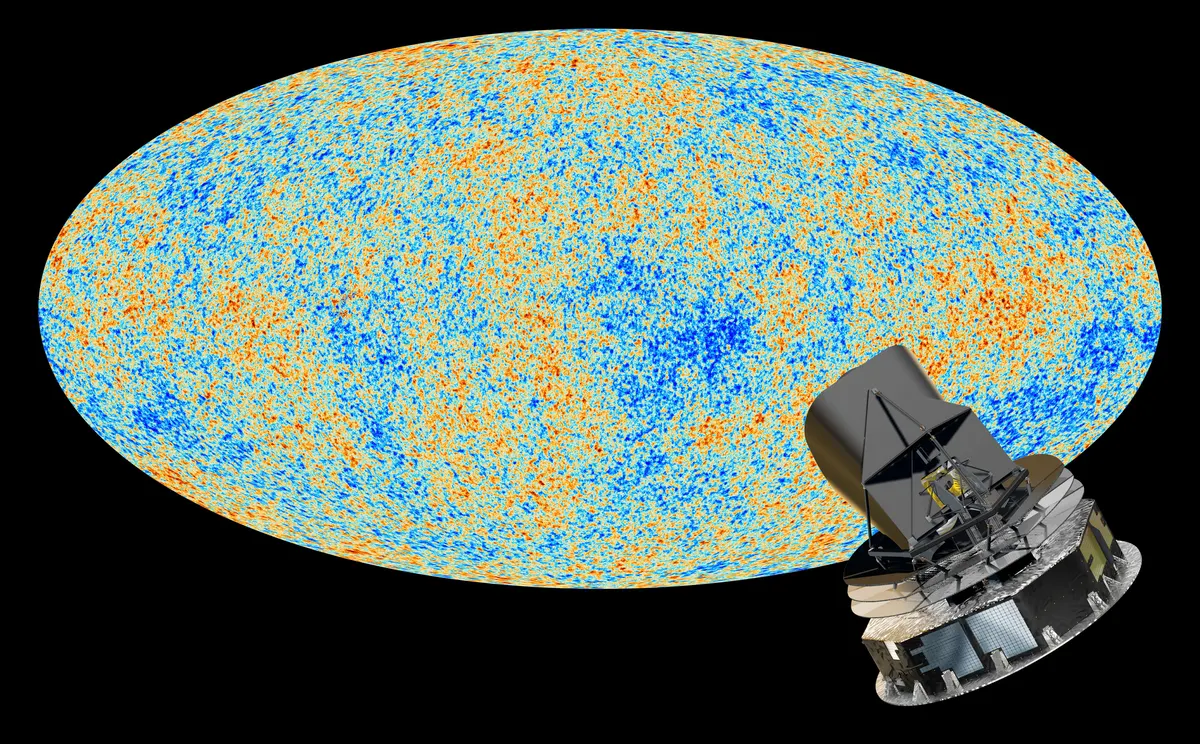
The oldest light there is: the cosmic microwave background, or CMB. ESA explains that for roughly the first 380,000 years after the Big Bang, the universe was filled with a hot plasma, and light kept bumping into free electrons, so it could not travel far. The early universe was opaque, like being in fog.
Then it cooled. At about 3000 kelvin (roughly 2700 °C, or about 4,900 °F) electrons joined protons to form hydrogen atoms, and the fog cleared. NASA calls the leftover glow from that moment the oldest light we can observe. Light has been flying freely ever since.
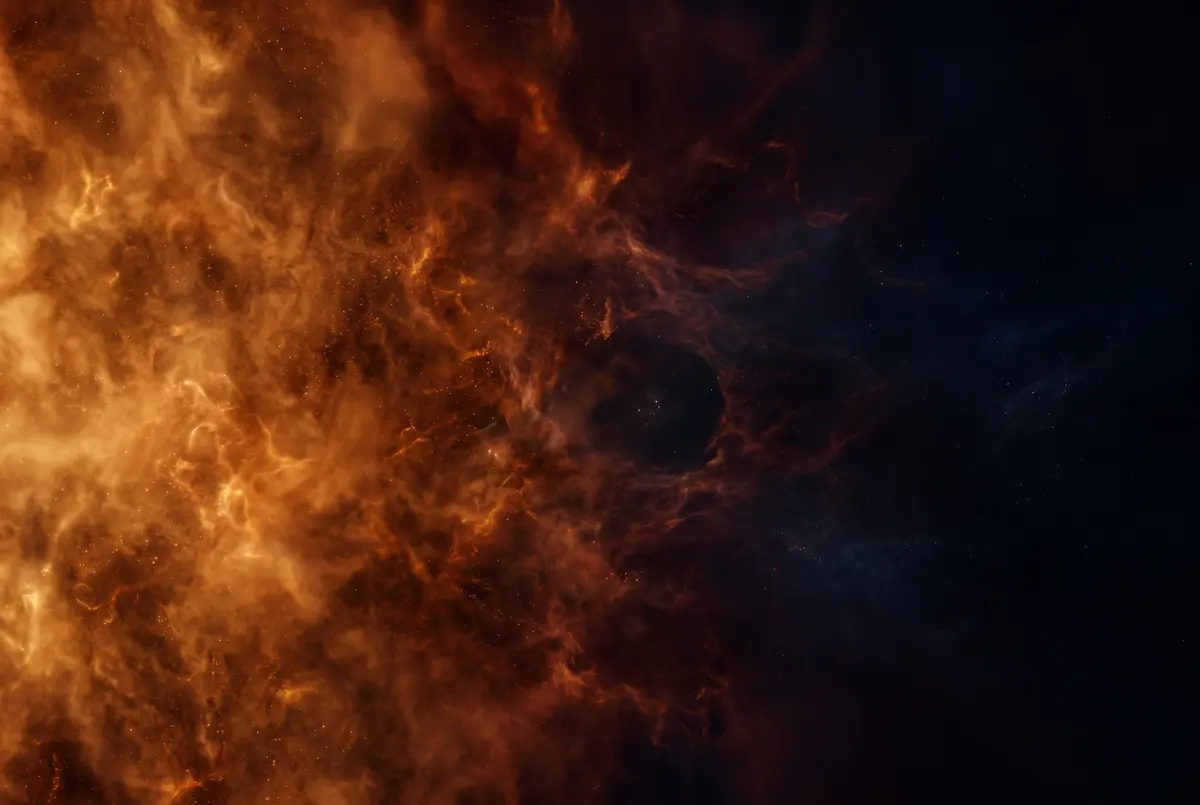
That glow has cooled with the expansion. ESA says the stretching has lengthened its waves to about a millimeter, which makes it just 2.7 kelvin today, around minus 270 °C (about minus 454 °F, my conversion). It is detected in every direction, and ESA says there are roughly 400 of these photons in every cubic centimeter of space.
Is the oldest light the edge of the universe?
No, and this is the part that surprises people. It is the edge of what light can show us. Before those 380,000 years the fog blocked light, so no telescope that collects light can see further back. ESA calls the CMB the farthest back in time we can explore using light.
The CMB is also not a shell far away in space that we are looking at from the inside of a hole. It is everywhere, including right where you are standing. The matter that was glowing when it was released is now roughly 46 to 47 billion light-years away from us, the limit described above.
It is the best baby picture the universe has. ESA says the temperature varies by about one part in 100,000 across the sky, and that these tiny differences are the seeds from which stars and galaxies later grew.
How far back can telescopes see stars and galaxies?
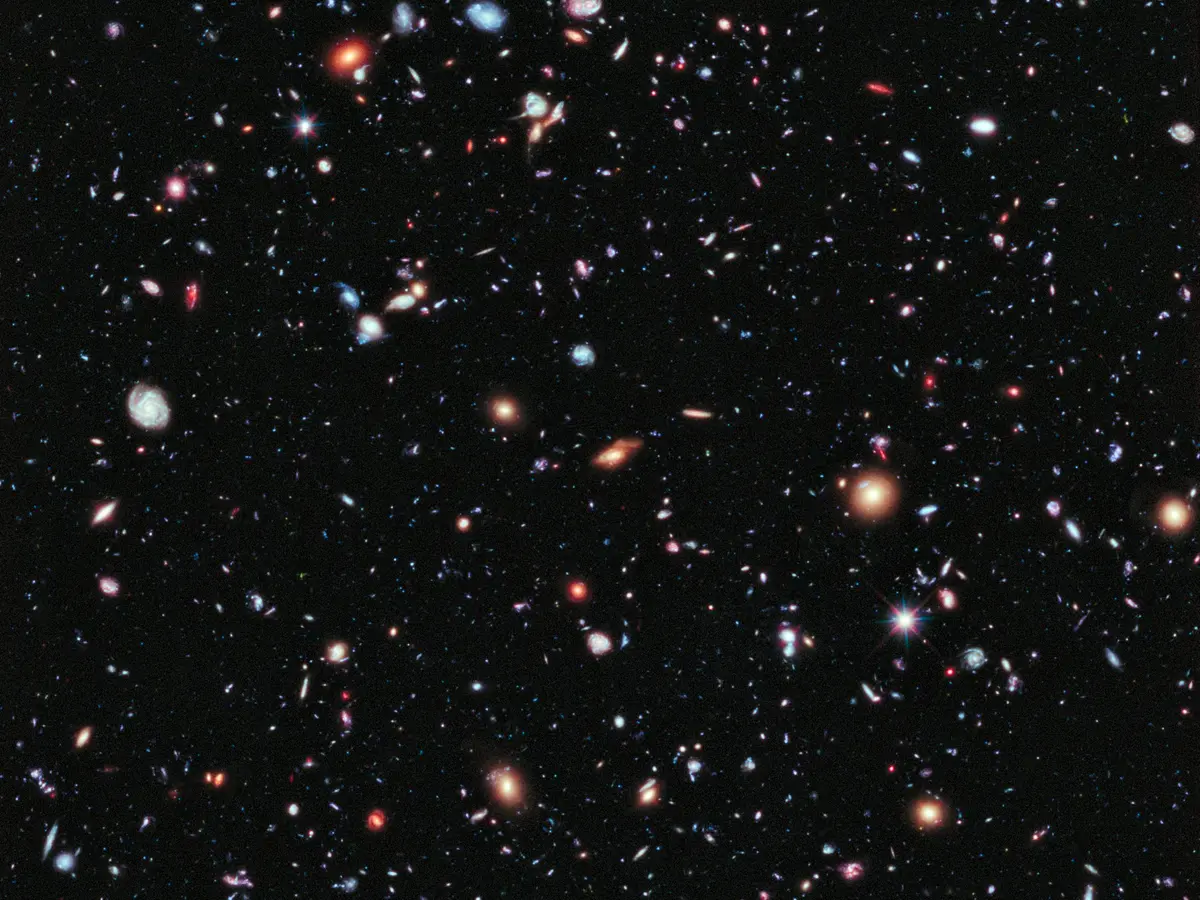
Much closer to us than the CMB. NASA says the Hubble Ultra Deep Field looks back about 13 billion years. The first stars and galaxies formed in between, after a long period NASA calls the dark ages, when no stars shone yet. For what the Webb telescope has found beyond Hubble, see my Webb discoveries guide, and for Hubble itself, my Hubble guide.
Did old TV static really include the Big Bang?
The story is real, with a twist. NASA says the cosmic microwave background was discovered by accident in 1964 by Arno Penzias and Robert Wilson of Bell Laboratories, who were trying to get rid of static in their radio experiments. They even built pigeon traps because droppings were a source of static, but a constant low-level noise stayed. It turned out to be the afterglow of the Big Bang, and they won the 1978 Nobel Prize in Physics for it, ESA notes.
You will often read that a share of the fuzz on an old analog TV between channels came from the same source. I did not find a percentage from NASA or ESA, so I would not trust one. The better-supported point is the discovery story above, which shows how a nuisance in a radio receiver became one of the biggest discoveries in cosmology.
What is beyond the observable universe?
No one knows, and the honest answer is that probably more of the same. Wright says we know the universe is at least 20 times bigger by volume than the part we see, which means the rest likely has galaxies like ours. Nothing we have measured says our patch is special.
There is a catch. NASA's Ask an Astrophysicist team notes that some parts of the universe are outside our horizon and, because the expansion is speeding up, they will never become observable to us. NASA adds that cosmologists suggest the universe will likely keep expanding forever. As expansion carries distant galaxies away, the observable universe is a limit that moves with time, not a fixed size. For the mystery behind the speeding up, my dark matter guide covers the 68% of the universe NASA ties to dark energy.
Frequently asked questions
Is there an edge to the universe?
None has been found. NASA says that if the universe includes everything, there is nothing outside it. Observations show space is very close to flat and far larger than the part we can see.
How big is the observable universe?
Roughly 46 to 47 billion light-years in every direction from us, which makes it about 93 billion light-years across. UCLA cosmologist Ned Wright gives about 47 billion light-years as the distance today.
Why is the observable universe bigger than 13.8 billion light-years?
Because space expanded while the light traveled. The sources we see have been carried farther away since their light left, so their distance today is much greater than the light-travel time.
What is the farthest thing we can see?
The cosmic microwave background, the oldest light we can observe. ESA says it was released about 380,000 years after the Big Bang, when the universe cooled enough to turn transparent.
Can we see past the cosmic microwave background?
Not with light. Before that moment the universe was opaque, like fog, so no telescope that collects light can see further back. ESA calls it the farthest back we can explore using light.
What is beyond the observable universe?
Nobody knows. The universe is at least 20 times bigger by volume than the observable part, per Ned Wright, and it likely holds more galaxies, but we cannot observe them.
Is the universe infinite?
It might be. The flat model that fits the data is infinite, but Wright points out that what we can actually say is that it is very big. Measurements cannot tell the two apart.
Sources
- NASA Science, "The Universe's History" (accessed November 12, 2026). Used for recombination, the oldest light, the dark ages and the future expansion.
- NASA Science, "What is the Universe?" (accessed November 12, 2026). Used for the 13.8-billion-year age and the 100 billion galaxies.
- ESA, "Planck and the cosmic microwave background" (March 21, 2013; accessed November 12, 2026). Used for the 380,000 years, the temperatures, the photon count and the discovery in 1964.
- NASA Imagine the Universe, "Old light, but new to us" (accessed November 12, 2026). Used for the Penzias and Wilson discovery story.
- NASA WMAP, mission overview (accessed November 12, 2026). Used for the flatness measurement.
- NASA Imagine the Universe, "Ask an Astrophysicist: Cosmology" (accessed November 12, 2026). Used for the "no edge" answer and for regions outside our horizon.
- Ned Wright, UCLA, "Cosmology FAQ" (last modified May 24, 2013; accessed November 12, 2026). Used for the distance of about 47 billion light-years, the curvature limit and the size compared with the observable part.
- NASA Imagine the Universe, "Farthest Visible Reaches of Space" (accessed November 12, 2026). Used for the Hubble Ultra Deep Field look-back time.
- ESA and the Planck Collaboration, D. Ducros, "Planck and the Cosmic Microwave Background Artist Concept" (PIA17449)

Founder and editor, Orbit and Atom
I write Orbit and Atom to explain space and science in plain English, starting from what NASA, ESA and the mission teams publish. Every article lists its sources at the end so you can read them yourself.