Stars & Galaxies
How Big Is the Milky Way? Size, Shape and Our Place in It
Quick answer
The Milky Way is a barred spiral galaxy roughly 100,000 light-years across, with hundreds of billions of stars. Our Sun is not near the middle: it sits about 26,000 light-years from the center, close to a small partial arm called the Orion Arm. From Earth we see the galaxy's disk edge-on, as the faint band of light that gave it its name.
On this page
You live inside it, so nobody has ever photographed the Milky Way from the outside. Everything astronomers know about its size and shape comes from mapping it from within, and the numbers are still being refined.
Here is how wide it is, what shape it has, how many stars it holds and where the Sun sits among them.
How big is the Milky Way?
About 100,000 light-years across. NASA Goddard puts it at roughly 100,000 light-years, or about 30 kiloparsecs, and NASA's galaxies page says its disk of stars spans more than 100,000 light-years. In kilometers that is around a quintillion, a 1 followed by 18 zeros, according to Goddard.
A light-year is the distance light covers in a year, so by my arithmetic a beam of light would need about 100,000 years to cross the galaxy from one edge to the other. For a feel for that unit, see my light-year explainer.
Astronomers do not give one fixed figure because the galaxy has no sharp edge. Stars thin out gradually, which is why NASA says "more than" for the disk.
How many stars are in the Milky Way?
Hundreds of billions. ESA's Gaia team describes the disk as the place where most of the galaxy's hundreds of billions of stars live. Nobody has counted them one by one, and ESA gives no exact number, so treat any single figure you see with some caution.
Gaia, ESA's star-mapping satellite, measures the apparent motions of millions of stars across the sky, and ESA says that lets astronomers model large-scale processes in the galaxy. Dust hides much of the galaxy from ordinary light: NASA notes the swirling core hides hundreds of thousands of stars that cannot be seen in visible light, and infrared and X-ray telescopes see through the dust to reveal them.
What shape is the Milky Way?
A barred spiral. NASA Goddard says it was debated for a long time whether our galaxy has a bar, and it has now been determined that it does: a thick bar of stars across the middle, with spiral arms winding out from its ends.
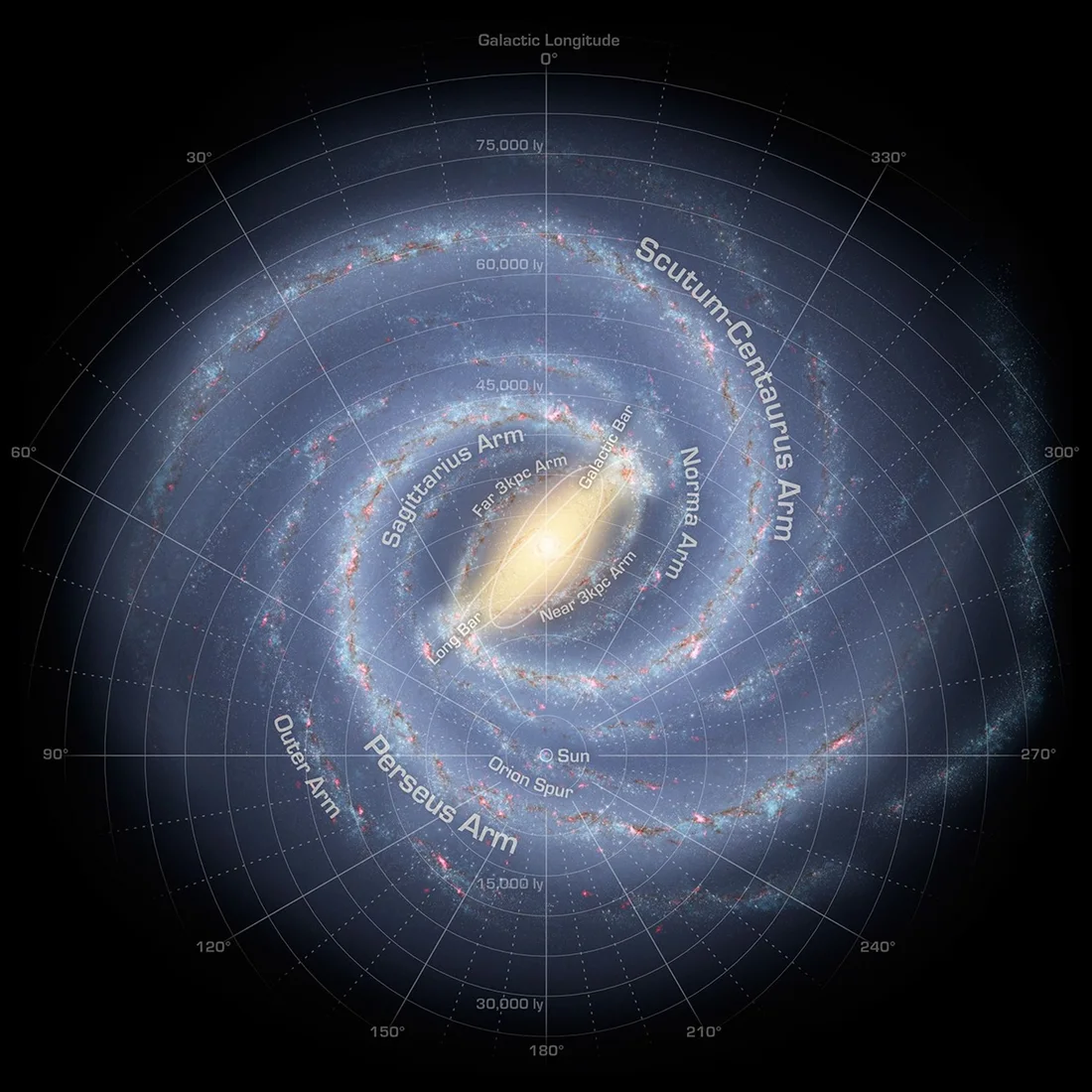
The arms are where the map changed. Using infrared images from NASA's Spitzer Space Telescope, scientists found that the spiral structure is dominated by two major arms. The galaxy was previously thought to have four. Here is how NASA's artist concept sorts them.
| Arm | Type |
|---|---|
| Scutum-Centaurus | Major |
| Perseus | Major |
| Norma | Minor |
| Sagittarius | Minor |
| Far-3 kiloparsec | Short, along the bar |
The arms of the Milky Way as drawn in NASA's Spitzer-based artist concept. Source: NASA Science, "The Milky Way Galaxy" (image dated November 8, 2017), read November 11, 2026. The Far-3 kiloparsec arm was found separately, in a radio survey of gas.
NASA says the major arms hold the highest densities of both young and old stars, while the minor arms are mostly gas and pockets of star formation. The artist concept below is an illustration, not a photo, because nobody can stand outside the galaxy to take one.
Where is the Sun in the Milky Way?
About 26,000 light-years from the center, on a small arm. ESA gives that distance, and NASA Goddard converts it to about 8 kiloparsecs. NASA's galaxies page describes Earth's location as about halfway from the center to the edge, and NASA says our Sun lies near the Orion Arm, also called the Orion Spur, between the Sagittarius and Perseus arms.
The Sun does not stay put there. NASA says our solar system takes about 240 million years to go around the Milky Way once. That is a slow lap, and the Sun's own home arm is a modest one, not one of the two big spirals.
The Sun is just one of those hundreds of billions of stars. If you are curious about the ones that explode, my supernova guide explains how they end.
What is at the center of the Milky Way?
A supermassive black hole called Sagittarius A*. NASA's Chandra Observatory describes it as having about 4 million times the mass of the Sun, and NASA puts it about 26,000 light-years from Earth, the same distance ESA gives for the Sun's distance from the center.
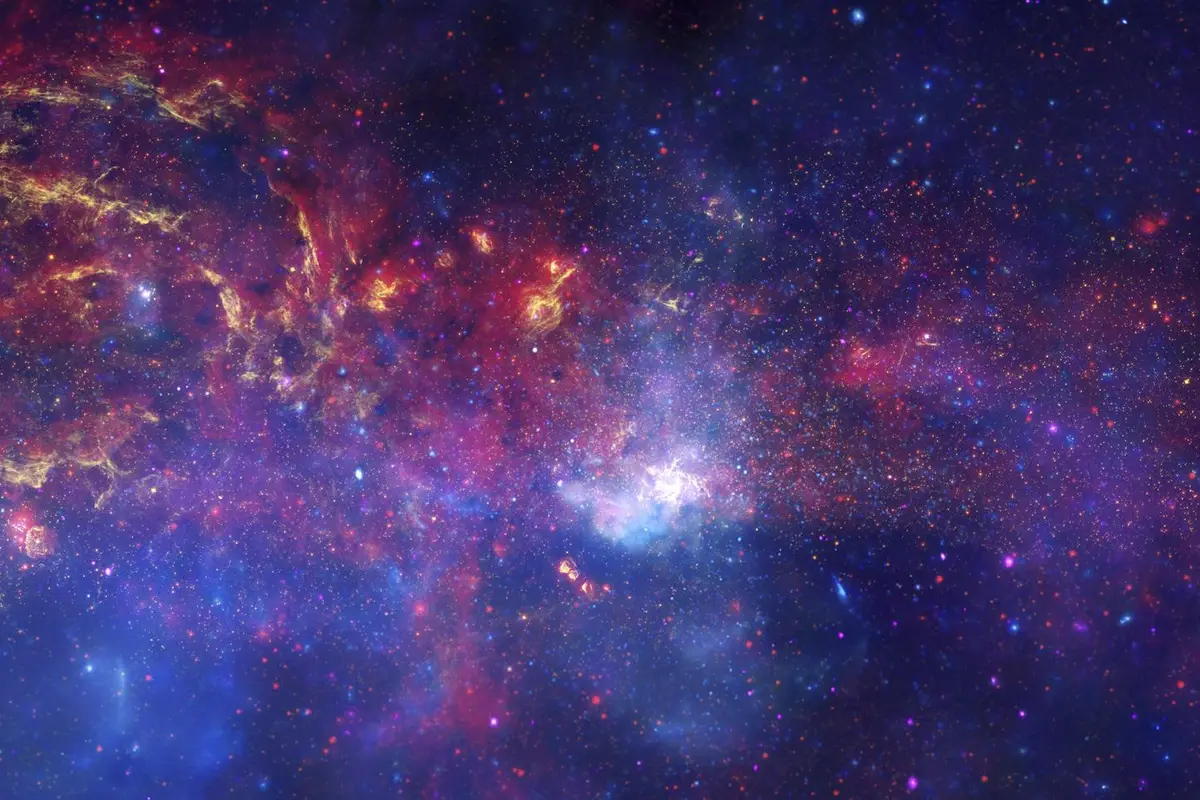
The black hole is not the whole story of the core. NASA says the galactic center is crowded and active, "like the downtown of a large city," with stellar nurseries forming new stars. For how black holes form and why they matter, see my black hole guide.
Is the Milky Way flat?
Not quite. ESA says astronomers have known since the late 1950s that the disk is somewhat curved upward on one side and downward on the other, a feature called the warp. In 2020, a team using Gaia data confirmed that the warp is not fixed but changes its orientation over time, and that it turns faster than the intergalactic magnetic field or a dark matter halo would allow.
Their best idea is a collision with a smaller galaxy that sends ripples through the disk like a rock thrown into water. ESA says the Sagittarius dwarf galaxy, which orbits the Milky Way, is one contender, but the astronomers do not yet know which galaxy is responsible. That is the researchers' suggestion, not a settled answer.
The warp is out in the galaxy's outer parts. ESA's lead author said the Sun is at a distance where the warp's amplitude is very small, and the team says it has no noticeable effect on life on Earth. Dark matter was one of the explanations the team considered, and my dark matter guide explains why astronomers think it exists at all.
How do you see the Milky Way from Earth?
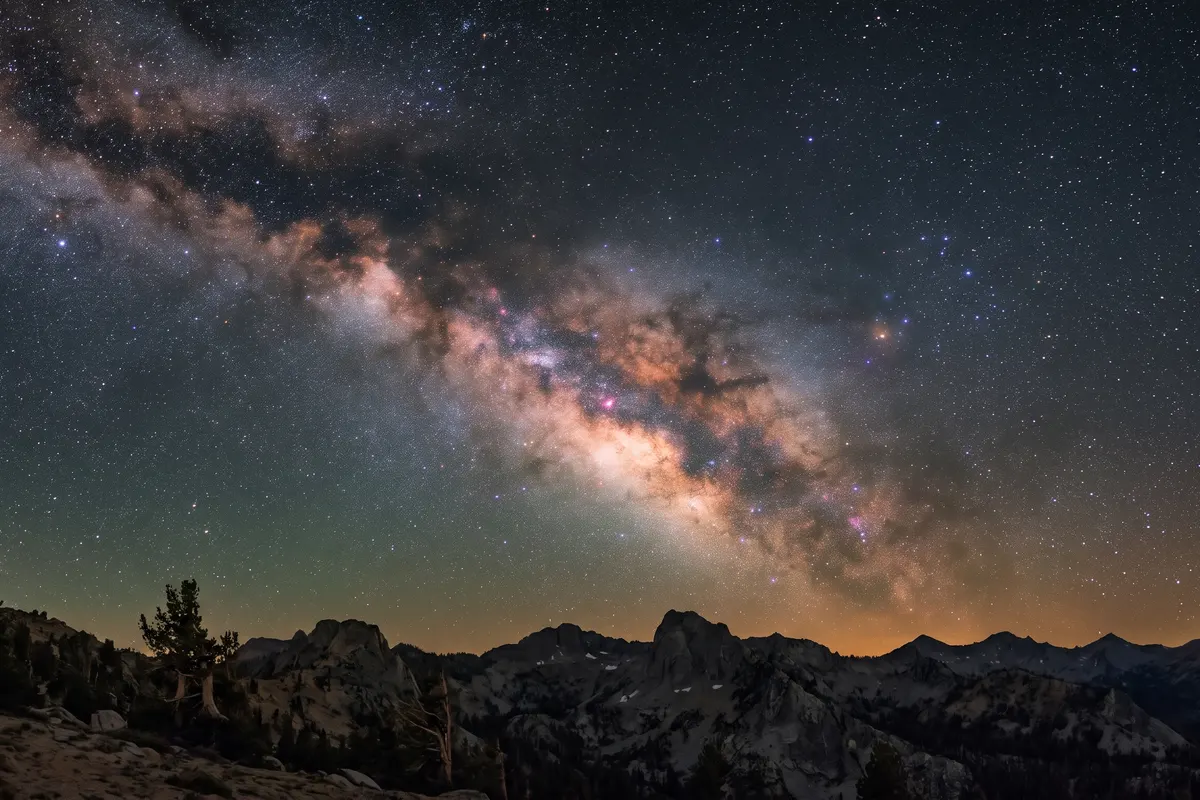
Look for a faint, milky band stretching across a dark sky. NASA says that band is the central disk of our galaxy seen edge-on from inside it, which is how the galaxy got its name.
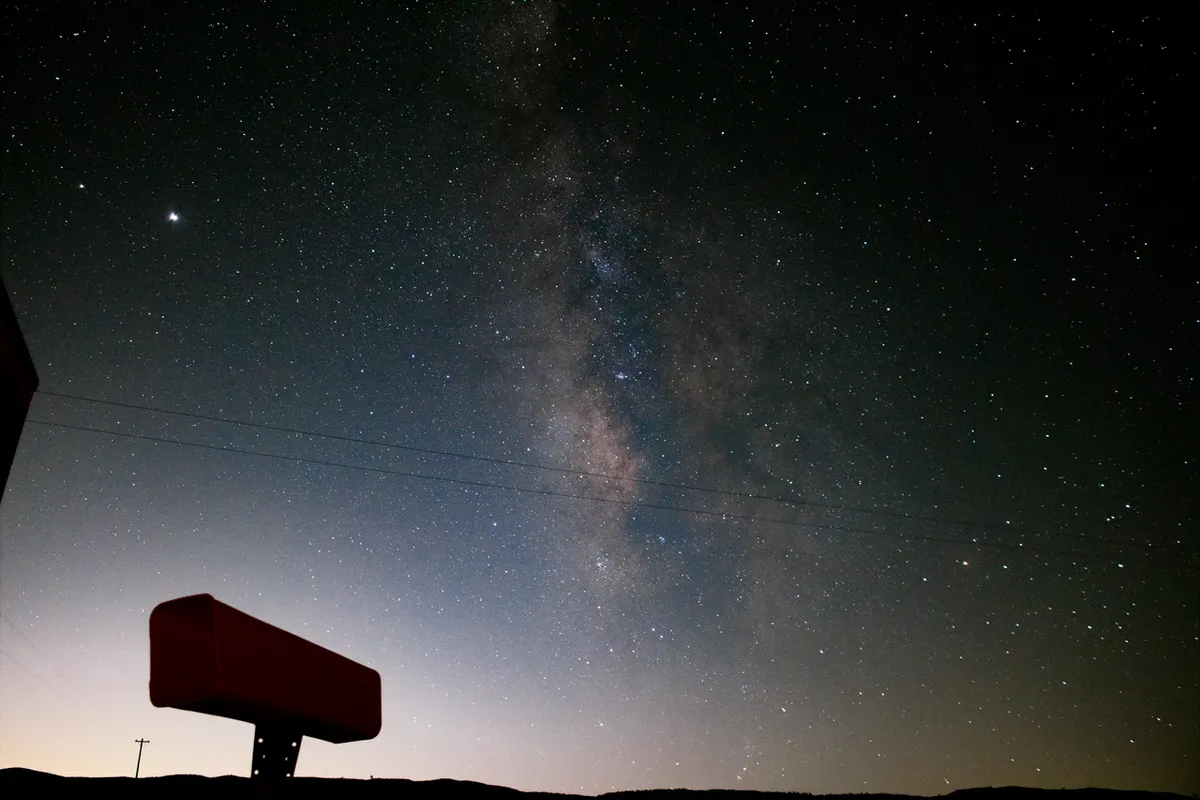
NASA's stargazing advice is simple. You need a dark sky away from city lights, and for most people a site rated Bortle class 3 or 4 is dark enough for a great evening. The photo above was taken at about class 4.5 and the Milky Way was still clearly visible to the eye. NASA suggests heading at least 20 to 30 miles (32 to 48 km) from the city limits, checking a light-pollution map and avoiding a bright Moon.
The galaxy's bright core is generally seen toward the south, NASA says, so make sure no ridge blocks that direction. Give your eyes time to adapt to the dark, too, because even a brief bright light resets some of that. In my opinion, the first clear view of the band is worth the drive.
How does the Milky Way compare with its neighbors?
It belongs to a neighborhood NASA calls the Local Group, with more than 50 galaxies. NASA says the members range from dwarf galaxies with up to a few billion stars to Andromeda, our nearest large neighbor, about 2.5 million light-years away. By my arithmetic that is roughly 25 Milky Way widths. Andromeda is also the farthest thing most people can see without a telescope, and I explain how to find it.
For how astronomers study the planets around other stars in the galaxy, see my exoplanet guide.
Frequently asked questions
How big is the Milky Way?
About 100,000 light-years across, according to NASA. The galaxy has no sharp edge, which is why NASA describes its disk as spanning more than 100,000 light-years.
How many stars are in the Milky Way?
ESA says hundreds of billions. No exact count exists, because dust hides many stars and the faintest are hard to detect.
What shape is the Milky Way?
A barred spiral. NASA says a thick bar of stars crosses the middle, with two major spiral arms, Scutum-Centaurus and Perseus, attached to its ends.
Where is the Sun in the Milky Way?
About 26,000 light-years from the center, near the small Orion Arm between the Sagittarius and Perseus arms, according to ESA and NASA.
How long does the Sun take to orbit the Milky Way?
About 240 million years for one lap, according to NASA.
What is at the center of the Milky Way?
A supermassive black hole called Sagittarius A*, with about 4 million times the mass of the Sun, about 26,000 light-years from Earth, according to NASA.
How do I see the Milky Way?
Go to a dark site away from city lights, ideally Bortle class 3 or 4, on a night without a bright Moon, and let your eyes adapt. NASA says the bright core is generally seen toward the south.
Sources
- NASA Goddard, "Imagine the Universe: The Milky Way Galaxy" (page updated May 15, 2025; accessed November 11, 2026). Used for the width, the barred spiral shape and the Sun's distance in kiloparsecs.
- NASA Science, "Galaxies" (updated August 12, 2026; accessed November 11, 2026). Used for the disk width, the 240-million-year orbit, the edge-on band and the Local Group.
- NASA Science, "The Milky Way Galaxy" (NASA/JPL-Caltech/R. Hurt, SSC/Caltech; image dated November 8, 2017; accessed November 11, 2026). Used for the arms and the Orion Arm.
- ESA, "Milky Way's warp caused by galactic collision, Gaia suggests" (2020; accessed November 11, 2026). Used for the star count, the warp and the Sun's distance from the center.
- NASA Chandra, "Supermassive Black Hole Sagittarius A*" (accessed November 11, 2026)
- NASA Science, "Andromeda Galaxy" (accessed November 11, 2026). Used for the distance to Andromeda.
- NASA Science, "How to Find Good Places to Stargaze" (accessed November 11, 2026; photo by Preston Dyches)
- NASA/JPL-Caltech/ESA/CXC/STScI, "Great Observatories Unique Views of the Milky Way" (PIA12348)

Founder and editor, Orbit and Atom
I write Orbit and Atom to explain space and science in plain English, starting from what NASA, ESA and the mission teams publish. Every article lists its sources at the end so you can read them yourself.