Stars & Galaxies
What Is Dark Matter? What Scientists Know and What They Don't
Quick answer
Dark matter is an invisible form of matter that does not absorb, reflect or emit light, yet its gravity holds galaxies and galaxy clusters together. NASA says it makes up about 27% of the universe, against 5% for ordinary matter. What it is made of, no one knows: WIMPs and axions are still only hypotheses, and ESA notes that no detection experiment has succeeded so far.
On this page
- What is dark matter?
- How much of the universe is dark matter?
- How did scientists find something they cannot see?
- What does gravitational lensing show?
- What does the Bullet Cluster show?
- What could dark matter be made of?
- Is dark matter the only explanation?
- Is dark matter the same as dark energy?
- What is Euclid doing about dark matter?
- So what do scientists know, and what don't they?
- FAQ
- Sources
Add up the stars, gas and dust in a galaxy and the total does not explain how the galaxy behaves. It spins too fast, and clusters of galaxies bend light more than their visible matter should. Something else is there, and we call it dark matter.
Astronomers first suspected it nearly a century ago. They still do not know what it is. Here is what NASA and ESA say is established, what is still only a hypothesis and how a European telescope called Euclid is mapping it now.
What is dark matter?
Matter we can only detect through its gravity. NASA calls it "the invisible glue that holds the universe together" and says it makes up most of the mass in galaxies and galaxy clusters. It does not seem to interact at all with the electromagnetic spectrum, including visible light: it does not absorb, reflect or emit it.
The name is not about color. NASA says it is called "dark" because it is invisible, which is why no telescope can photograph it directly. Astronomers find it the way you might find wind: by what it moves. ESA says astronomers coined the term "precisely because it escapes our detection."
How much of the universe is dark matter?
About 27%, according to NASA. Ordinary matter, the atoms that make up stars, planets, gas and people, is only about 5%. The other 68% is dark energy, a different thing, covered below. ESA puts it another way: dark matter and dark energy together are more than 95% of the universe.
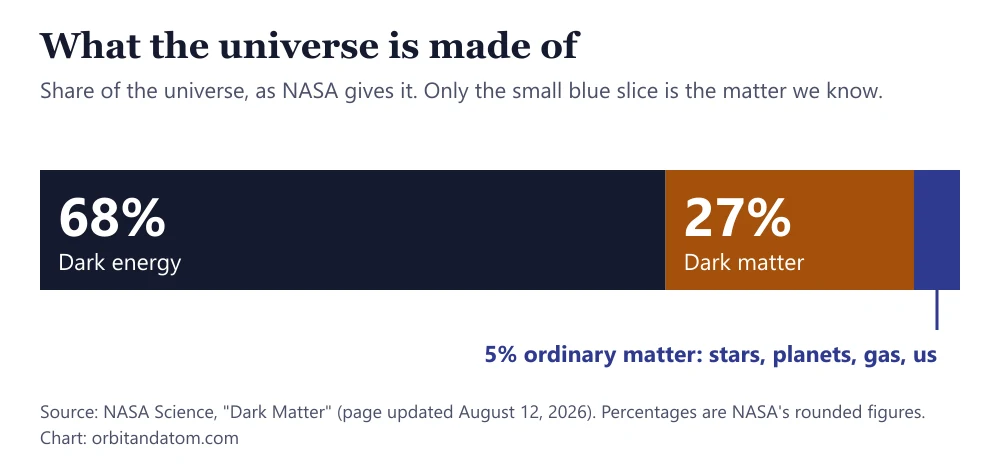
For a single galaxy, ESA says the missing mass in a typical one is about ten times the mass of its visible stars. If you want a refresher on what ordinary matter is made of, our atom guide goes from the electron cloud down to quarks.
How did scientists find something they cannot see?
By noticing that galaxies moved as if they had more mass than anyone could see. NASA dates the first clue to 1933. Fritz Zwicky studied the Coma Cluster and found its galaxies moving too fast for the gravity of its visible matter to hold them. He proposed invisible matter and called it "dunkle Materie," German for dark matter.
In the 1970s, Vera Rubin studied the outer stars of spiral galaxies. They also moved too fast to be held by visible matter alone, and she concluded those galaxies must be held together by dark matter. In our solar system, planets farther from the Sun move more slowly. Rubin found no such slowdown in the outskirts of galaxies, which is what pointed to extra mass.
What does gravitational lensing show?
Where the unseen mass is. NASA explains that dark matter's gravity bends the light of galaxies behind it, and astronomers measure that distortion to map where the dark matter sits. The same bending is what stretched galaxies into arcs in Webb's first deep field.
ESA's Euclid used it on the galaxy cluster Abell 2390, about 2.7 billion light-years away in the constellation Pegasus. ESA says the cluster has up to 10 trillion times the mass of the Sun and more than 50,000 galaxies visible in Euclid's image, and that most of that mass is dark matter, which Euclid measures indirectly through lensing. Distances like these are easier to picture with our light-year guide.
What does the Bullet Cluster show?
Dark matter and ordinary matter pulled apart. The Bullet Cluster is two galaxy clusters that collided about 3.8 billion light-years away in the constellation Carina, NASA says. The hot gas, seen in X-rays by Chandra and colored pink, was dragged out and left behind. The mass mapped by lensing, colored blue, stayed lined up with the galaxies.
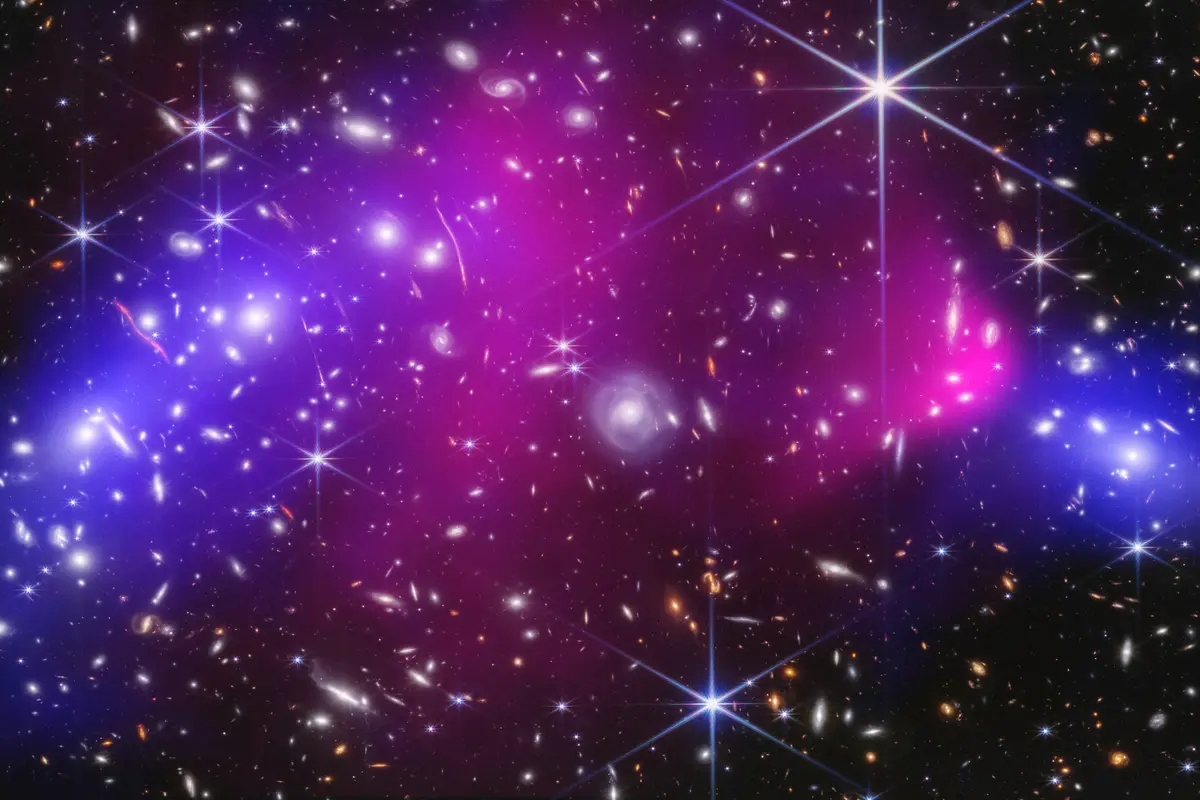
NASA describes that separation as unusual and as further evidence for dark matter. In a June 30, 2025 release, a team led by Sangjun Cha of Yonsei University used Webb to measure thousands of galaxies, in what they call the largest lensing dataset to date for this system. They found no significant sign that dark matter particles interact with each other. If they did, the dark matter would be offset from the galaxies, and it is not.
The team notes that Webb covers only part of the cluster, so complete mass estimates will need future observations, such as NASA's Nancy Grace Roman Space Telescope, which the release said was set to launch by May 2027.
What could dark matter be made of?
Nobody knows, and ESA says so plainly: "Despite decades of research we still don't know what makes up the missing mass." NASA lists the leading candidates, none of them confirmed:
- WIMPs. Hypothetical particles that are big, heavy and slow-moving. If they exist, some may annihilate and produce gamma rays, which is what NASA's Fermi data has been searched for.
- Axions. Hypothetical particles thought to be low-mass and low-energy, first theorized in 1977. Fermi, Chandra and NuSTAR observations have been used in the search.
- Primordial black holes. Hypothetical black holes that may have formed right after the birth of the universe. Stephen Hawking proposed that some could be dark matter. Our black hole guide covers the ordinary kind.
NASA says scientists currently agree that dark matter is most likely cold, or slow-moving, because simulations favor it. ESA adds that how much of it, if any, is "hot," meaning light particles moving near the speed of light, is still an open question. Neutrinos are the obvious hot candidate, and ESA says Euclid's measurements can help pin down how much of dark matter they could make up. On the particle hunt itself, ESA notes that no dark matter detection experiment has succeeded so far.
Is dark matter the only explanation?
No, though it is the leading one. NASA's Astronomy Picture of the Day on the Bullet Cluster says its lensing has been interpreted as strong evidence for the leading theory, and that a less popular alternative, modifying gravity, could explain cluster dynamics without dark matter. In NASA's words, the two hypotheses are currently competing to explain the observations.
That is worth keeping in mind when you read "scientists have proven dark matter exists." The evidence for something unseen is strong and comes from several kinds of observation. What that something is has not been settled.
Is dark matter the same as dark energy?
No. NASA defines dark energy as whatever is causing the universe's expansion to accelerate over time, and says it is spread throughout the universe rather than concentrated in galaxies. Dark matter works the opposite way: it pulls, clumping around galaxies and clusters. They share the word "dark" because both are invisible to us, and little else.
What is Euclid doing about dark matter?
Mapping it. Euclid is ESA's space telescope, launched on July 1, 2023 on a Falcon 9 from Florida, and it sits at the same second Lagrange point (L2) as Webb, 1.5 million kilometers from Earth. ESA says it observes billions of galaxies across more than a third of the sky, looking back about 10 billion years, and measures their shapes. Because dark matter distorts the light of those galaxies, the pattern of distortion shows how dark matter is distributed.
ESA's first Euclid data release came in March 2025, under the headline "26 million galaxies and counting." The next one is close. ESA's timeline says DR1-Foundation, with raw data, calibrated images, catalogues and spectra for about 1,900 square degrees of sky, is due in November 2026, with exact dates still to be announced. The higher-level products for weak lensing and galaxy clustering, the ones most tied to dark matter, follow in mid-2027, once ESA has processed and validated them.
So what do scientists know, and what don't they?
| Question | What we know | Still open |
|---|---|---|
| Does it exist? | Strong evidence from galaxy motion and lensing | Modified gravity is a less popular alternative |
| How much? | About 27% of the universe (NASA) | Euclid and Roman are refining the maps |
| What is it? | Likely cold and slow-moving | WIMPs, axions, primordial black holes: all hypotheses |
| Can we detect it? | Through its gravity, by lensing | No particle detection experiment has succeeded |
Dark matter at a glance. Sources: NASA Science and ESA, linked at the end of this article.
Frequently asked questions
What is dark matter in simple terms?
Invisible matter that does not absorb, reflect or emit light and can only be detected through its gravity. NASA says it holds galaxies and galaxy clusters together and makes up most of their mass.
How much of the universe is dark matter?
About 27%, according to NASA, compared with about 5% for ordinary matter and about 68% for dark energy. ESA says dark matter and dark energy together are more than 95% of the universe.
Has dark matter ever been seen or detected directly?
No. Astronomers detect it through its gravity, for example by how it bends light, and ESA notes that no experiment designed to detect dark matter particles has succeeded so far.
Who discovered dark matter?
NASA credits Fritz Zwicky, who in 1933 noticed that galaxies in the Coma Cluster moved too fast for their visible matter, and Vera Rubin, who in the 1970s found the same in the outer stars of spiral galaxies.
What is the Bullet Cluster and why does it matter?
Two galaxy clusters that collided about 3.8 billion light-years away. The hot gas was dragged out and left behind, while the mass mapped by lensing stayed with the galaxies, which NASA calls further evidence for dark matter.
Is dark matter the same as dark energy?
No. NASA defines dark energy as whatever is causing the universe's expansion to accelerate, spread throughout space. Dark matter clumps around galaxies and acts through gravity.
What is the Euclid telescope looking for?
Euclid maps the shapes of billions of galaxies across more than a third of the sky. Their distortion by dark matter lets scientists map how it is spread out. ESA plans a data release in November 2026 and the weak-lensing products in mid-2027.
Could dark matter not exist at all?
It is the leading explanation, but NASA notes a less popular alternative, modified gravity, that could explain cluster dynamics without it. The two hypotheses are still competing.
Sources
- NASA Science, "Dark Matter" (page updated August 12, 2026; accessed October 28, 2026). Source of the 5% / 27% / 68% shares, Zwicky and Rubin, lensing, candidates and dark energy.
- NASA Science, "NASA Webb 'Pierces' Bullet Cluster, Refines Its Mass" (June 30, 2025; accessed October 28, 2026)
- NASA Science, "Bullet Cluster (Webb and Chandra Image)": image credit and description (accessed October 28, 2026)
- NASA, Astronomy Picture of the Day, "The Matter of the Bullet Cluster" (January 15, 2017; accessed October 28, 2026). Source of the modified-gravity alternative.
- ESA, Euclid mission page (accessed October 28, 2026). Source of the launch date, L2 location and survey size.
- ESA, "Euclid explores the dark Universe" (accessed October 28, 2026)
- ESA, "Top five mysteries Euclid will help solve" (accessed October 28, 2026)
- ESA, "What are dark matter and dark energy?" (accessed October 28, 2026)
- ESA Cosmos, Euclid DR1 timeline (accessed October 28, 2026). Dates may change; exact release dates were not yet announced.
- ESA, "Euclid's new image of galaxy cluster Abell 2390" (May 23, 2024; accessed October 28, 2026)

Founder and editor, Orbit and Atom
I write Orbit and Atom to explain space and science in plain English, starting from what NASA, ESA and the mission teams publish. Every article lists its sources at the end so you can read them yourself.