Night Sky
What's the Farthest Thing You Can See With the Naked Eye?
Quick answer
The farthest thing most people can see with the naked eye is the Andromeda galaxy, about 2.5 million light-years away. NASA says it is visible from a dark site, and its light left long before modern humans existed. The Triangulum galaxy, about 3 million light-years away, is slightly farther, but NASA says only keen-eyed observers under exceptionally dark skies can spot it.
On this page
- What is the farthest thing you can see with the naked eye?
- Is the Triangulum galaxy farther than Andromeda?
- How old is the light you see from Andromeda?
- How do you find the Andromeda galaxy?
- What will you actually see?
- What else can you see, from the Moon to the Magellanic Clouds?
- What is the farthest thing ever seen with the naked eye?
- FAQ
- Sources
Almost everything you see in a dark night sky belongs to our own galaxy, the Milky Way. So where does the naked eye stop? There is a clear answer, and it is on the sky this very month.
This guide names the farthest thing you can see, explains the one object that may beat it, shows how to find it, and ends with a record that lasted only a few minutes. I read pages from NASA, and the sources are listed at the end.
What is the farthest thing you can see with the naked eye?
For most people the answer is the Andromeda galaxy, also called Messier 31 or M31. NASA's page on the galaxy puts it at about 2.5 million light-years away and says it is one of only ten galaxies that can be spotted from Earth with the naked eye. NASA's Hubble catalog adds that it is easily visible with the unaided eye from a dark site, and that its apparent magnitude of 3.1 lets you see it even in areas with moderate light pollution.
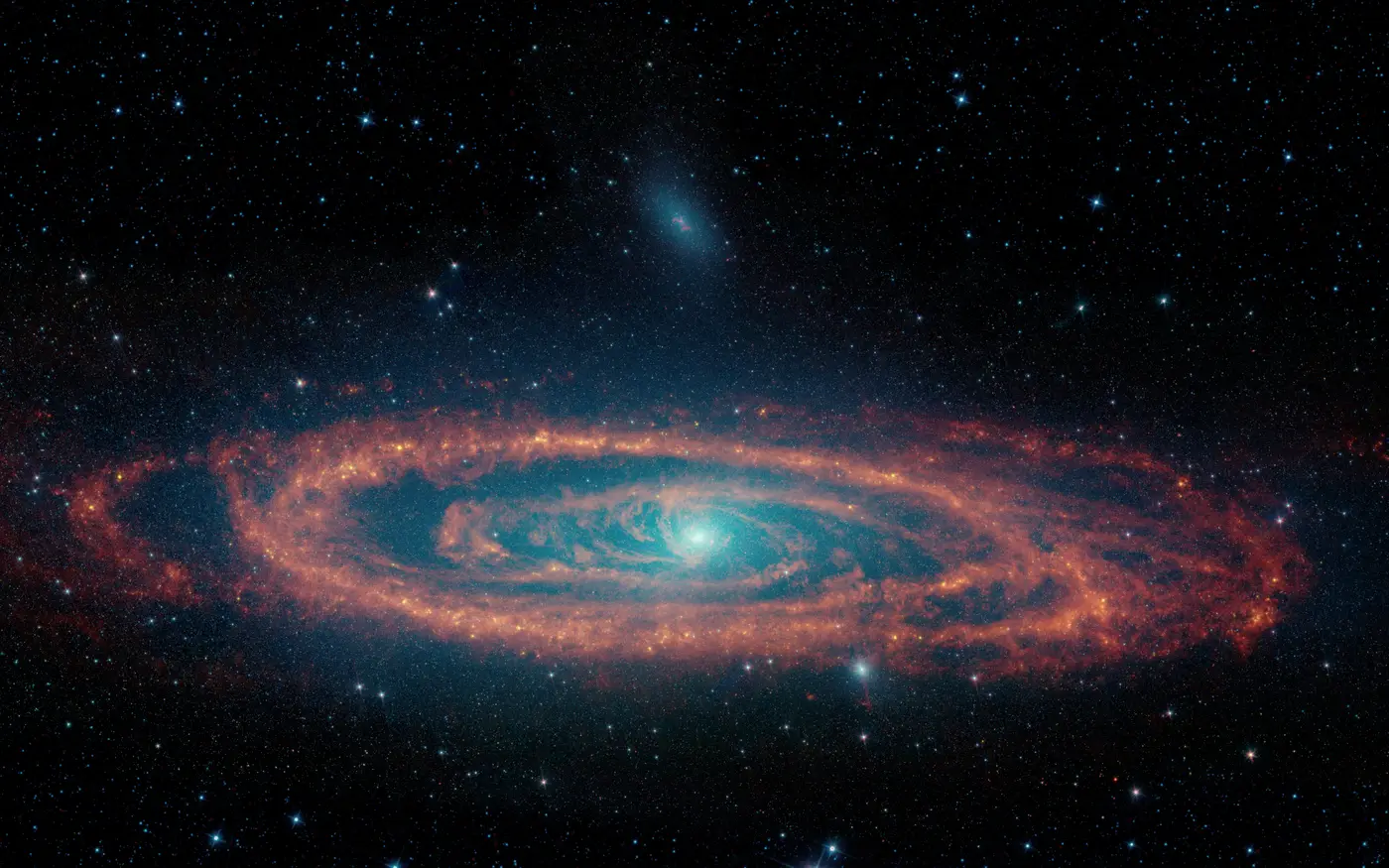
The galaxy is huge. NASA says it spans about 260,000 light-years across, more than twice the roughly 100,000 light-years of the Milky Way. Its glow covers a lot of sky too: NASA's Hubble page says that in angular size it is six times the apparent diameter of the full Moon, and a NASA infrared image puts it at nearly 3.8 degrees, close to the width of eight full Moons side by side. The two numbers come from different pictures, and both count the faint outer parts, which your eye will not catch.
The oldest written report comes from the Persian astronomer Abd al-Rahman al-Sufi in the year 964, according to NASA. Nobody knows who first saw it, because anyone with a dark sky could.
Is the Triangulum galaxy farther than Andromeda?
Yes, slightly, and that is the catch. The Triangulum galaxy, Messier 33 or M33, is about 3 million light-years away, according to NASA's Hubble page. Other sources give 2.7 or 2.9 million, so the exact figure depends on who measured it. NASA calls it one of the most distant objects that keen-eyed observers can view with the unaided eye, and only under exceptionally clear and dark skies. Its apparent magnitude is 5.7, close to the faintest stars the eye can pick out.
EarthSky is blunter: Andromeda shines eight times more brightly in our sky than Triangulum, and the Triangulum galaxy can look almost transparent, like a water spot on a window. NASA says binoculars at low magnification are the easiest way to examine it.
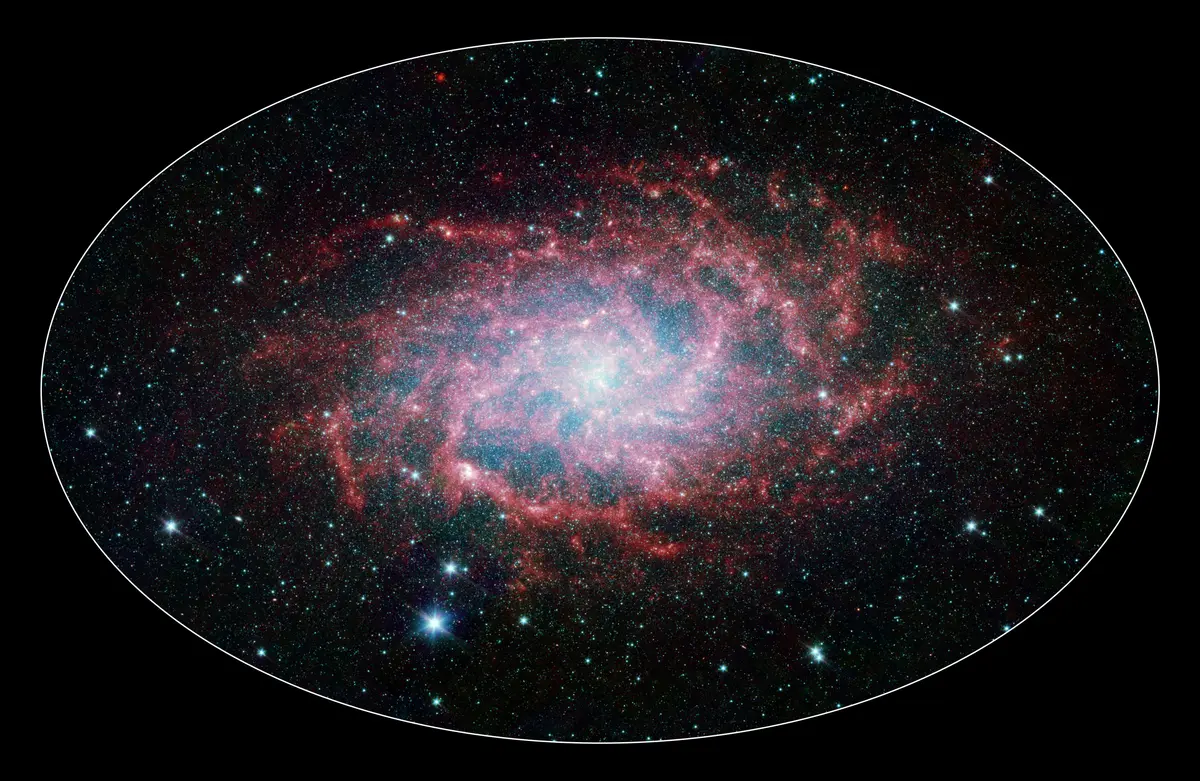
In my opinion, Andromeda is still the right answer to give. Triangulum is a real naked-eye object, but it is a test for experienced observers on a perfect night. Andromeda is something you can go out and find this week.
How old is the light you see from Andromeda?
About 2.5 million years old. Light from a galaxy 2.5 million light-years away took 2.5 million years to reach you, so you see Andromeda as it was then. The Smithsonian's Human Origins program dates our species, Homo sapiens, to about 300,000 years ago. By my arithmetic, that light started its trip more than eight times earlier than that.
If the idea of a light-year is still fuzzy, my guide to how far a light-year is walks through it step by step, and the one on how big the Milky Way is shows where Andromeda sits among our neighbors.
How do you find the Andromeda galaxy?
NASA lists M31 as best observed in November, so the timing is good. A seasonal guide from NASA's HEASARC team, written for naked eye and binoculars at about 9 p.m. in autumn, gives the route. First find the four stars of the Great Square of Pegasus, high overhead. Then look north for Cassiopeia, the bright W shape. Between the two is the constellation Andromeda. From the northeast corner of the square, find three bright stars in a long line arcing across the sky, just south of Cassiopeia. From the middle one, go north toward Cassiopeia, past one star, to a second star. The galaxy is there, and NASA's wording is that it is just barely visible to the naked eye.
EarthSky gives a second landmark: the star Mirach in Andromeda lies about midway between the Andromeda and Triangulum galaxies, so a line from the first through Mirach points toward the second. Both guides are written for the Northern Hemisphere. By my calculation for a latitude of 40 degrees north, Andromeda stands almost overhead at 8 to 10 p.m. in mid-November, so you do not need to face a low horizon.
The Moon matters more than anything else. A bright Moon washes out a faint smudge like this, so I would plan around the phases below. These times come from my own calculation for 40 degrees north and 100 degrees west, the same method I used in my November planets guide, so check your local moonrise before you go.
| Date | Moon | For Andromeda |
|---|---|---|
| Nov 17 | First quarter | Moon in the sky until near midnight |
| Nov 24 | Full | Worst night of the month |
| Nov 30 | Rises after midnight | Dark evening |
| Dec 9 | New | Best chance of the season |
Moon dates for the next weeks. My calculation for 40 °N, 100 °W; moonrise times are local standard time.
The first dark evenings after the full Moon come around November 30, when the Moon does not rise until about 12:15 a.m. at that location. The new Moon on December 9 gives the darkest sky.
What will you actually see?
Do not expect the colorful pictures. Those show infrared or long exposures. To your eye, Andromeda is a faint glow, not a spiral. The best way to see the difference is to look at what a telescope can do: NASA says Hubble is powerful enough to resolve individual stars in a 61,000-light-year stretch of the galaxy's disk, and its large mosaic captures the glow of about 200 million stars, which NASA says is still a fraction of the galaxy's stars.
As general stargazing advice, not from the NASA pages, let your eyes adjust to the dark for 15 to 20 minutes, glance slightly to one side of where the galaxy should be, and bring binoculars if you have them. The HEASARC guide itself is titled for naked eye and binoculars. I did not find a NASA page that says how small the visible part is, so I would treat the faint glow as a bonus and the star-hopping as the real fun.
What else can you see, from the Moon to the Magellanic Clouds?
The naked eye covers a huge range, and a table makes it easier to feel. NASA gives the Moon's average distance as 238,855 miles (384,400 kilometers), which light crosses in a little over a second. The rest of the table is in light-years.
| Object | Distance | What you need |
|---|---|---|
| Moon | 238,855 miles | Any sky |
| Polaris | About 320 light-years | City sky |
| Betelgeuse | About 700 light-years | City sky |
| Large Magellanic Cloud | About 163,000 light-years | Dark sky, south |
| Andromeda (M31) | About 2.5 million light-years | Dark site |
| Triangulum (M33) | About 3 million light-years | Perfect dark sky |
| Gamma-ray burst, 2008 | 7.5 billion light-years | Luck, once |
How far the naked eye reaches. Distances from NASA pages read November 15, 2026; Polaris and Betelgeuse from my earlier guides.
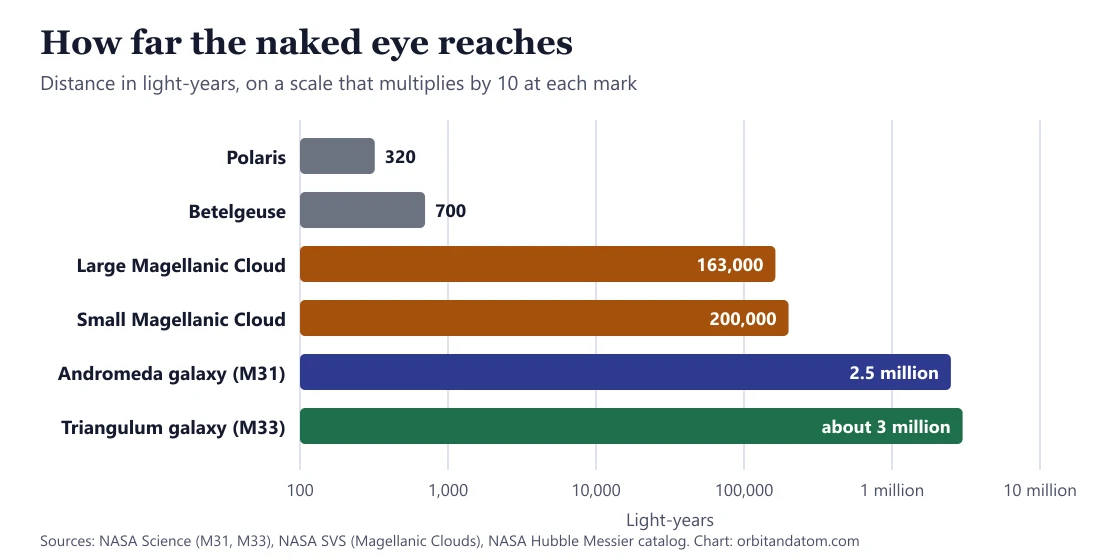
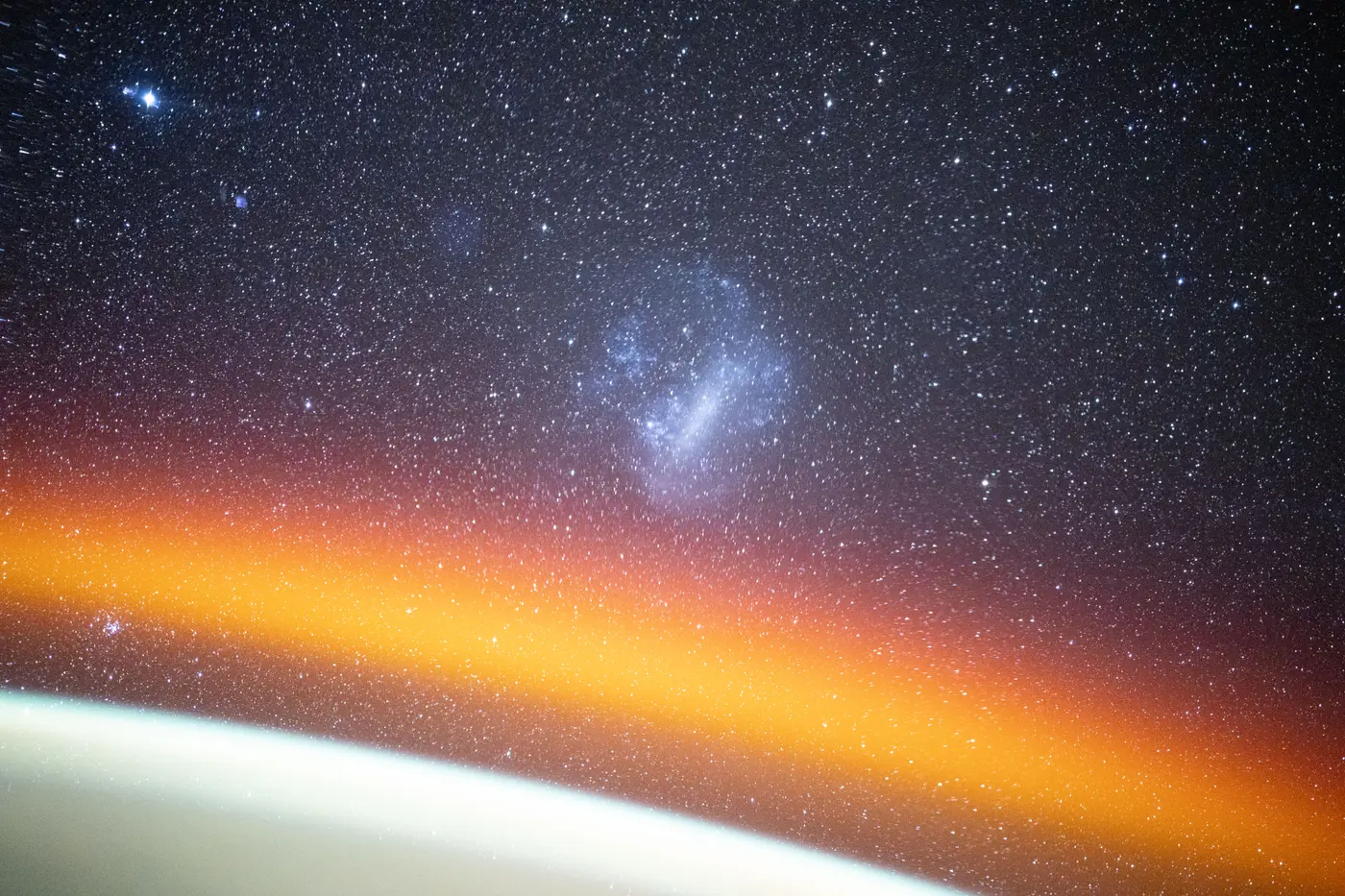
The nearest galaxies you can see are the Magellanic Clouds, but you need to be in the Southern Hemisphere. NASA's Scientific Visualization Studio places the Large and Small Magellanic Clouds at about 163,000 and 200,000 light-years, and says they are readily visible from the Southern Hemisphere as faint, glowing patches in the night sky. Another NASA page gives about 179,000 light-years for the Large Cloud, so the exact figure varies by study. Both clouds orbit our galaxy, which makes them neighbors, not outsiders.
The stars at the top of the table are close by comparison. Polaris is about 320 light-years away and Betelgeuse about 700, which I explain in my guide to when Betelgeuse might explode. Even the farthest single star on the table is thousands of times closer than Andromeda.
What is the farthest thing ever seen with the naked eye?
A star that died 7.5 billion years ago. On March 19, 2008, NASA's Swift spacecraft picked up a gamma-ray burst named GRB 080319B in the constellation Boötes. A Penn State release on the mission says ground telescopes saw its afterglow brighten to visual magnitudes between 5 and 6, which people with normal vision at a dark location could see as a dim but clearly visible point. Its redshift of 0.94 translates, the release says, into a distance of 7.5 billion light-years, so the explosion happened when the universe was less than half its present age.
The release calls it the most distant object ever visible to the naked eye. The previous record holder was the galaxy M33, at 2.9 million light-years. This is a record about a single event, not an object you can go look for. The afterglow was bright for a very short time, so it counts as a one-time record, while Andromeda stays up there every autumn. To follow how far light can reach, my guide to whether the universe has an edge picks up where this one ends.
For more to look for, my meteor shower calendar lists the next shows. Dark-sky guides and the rest of this series are in Night Sky, and the scale of the universe is in how old the universe is.
Frequently asked questions
What is the farthest thing you can see with the naked eye?
For most people it is the Andromeda galaxy, about 2.5 million light-years away. NASA says it is visible with the unaided eye from a dark site. The Triangulum galaxy, about 3 million light-years away, is a harder test.
Can you really see another galaxy with the naked eye?
Yes. NASA says Andromeda is one of only ten galaxies that can be spotted from Earth with the naked eye. It looks like a faint, elongated glow, not the spiral seen in photos.
Where is the Andromeda galaxy in the sky?
Between Cassiopeia and the Great Square of Pegasus. NASA's HEASARC guide says to follow a line of stars from the northeast corner of the Great Square toward Cassiopeia. NASA lists November as the best month.
Is Triangulum farther than Andromeda, and can you see it?
It is slightly farther, about 3 million light-years according to NASA. NASA says keen-eyed observers can see it only under exceptionally clear and dark skies, and binoculars make it easier.
Where can you see the Magellanic Clouds?
NASA says the Large and Small Magellanic Clouds are readily visible from the Southern Hemisphere as faint, glowing patches. They are about 163,000 and 200,000 light-years away.
What is the farthest object ever seen with the naked eye?
A gamma-ray burst called GRB 080319B on March 19, 2008, about 7.5 billion light-years away, according to a Penn State release on NASA's Swift mission. It faded quickly, so it was a one-time event.
Sources
- NASA Science, "Hubble Messier Catalog: Messier 31" (accessed November 15, 2026). Used for naked-eye visibility, magnitude 3.1, six times the Moon's width, November, al-Sufi in 964 and the Hubble mosaic.
- NASA Science, "Andromeda Galaxy" (accessed November 15, 2026). Used for 2.5 million light-years, 260,000 light-years across and one of ten galaxies visible to the naked eye.
- NASA Science, "Hubble Messier Catalog: Messier 33" (accessed November 15, 2026). Used for about 3 million light-years, magnitude 5.7 and the "keen-eyed observers" wording.
- NASA/JPL-Caltech, "The Infrared Face of the Andromeda Galaxy" (PIA26276). Used for the cover image and the 3.8 degree width.
- NASA Scientific Visualization Studio, "NASA Swift Provides the Best-Ever UV View of the Nearest Galaxies" (accessed November 15, 2026). Used for the Magellanic Cloud distances and visibility.
- NASA Imagine the Universe, "Nearest galaxy" (accessed November 15, 2026). Used for the 179,000 light-year figure and the southern sky wording.
- NASA HEASARC, "The Hidden Lives of Galaxies: Autumn Seasonal Guide Posts" (accessed November 15, 2026). Used for the Great Square and Cassiopeia route.
- Penn State Eberly College of Science, "Superbright Explosion is Most Distant Object Ever Visible to the Naked Eye" (2008; accessed November 15, 2026). Used for GRB 080319B.
- Smithsonian National Museum of Natural History, Human Origins, "Homo sapiens" (accessed November 15, 2026). Used for about 300,000 years ago.
- EarthSky, "Triangulum galaxy" (accessed November 15, 2026). Used for the brightness comparison with Andromeda and the Mirach landmark.
- NASA, "The Large Magellanic Cloud above Earth's atmospheric glow" (iss072e278609, Don Pettit). Used for the photo.

Founder and editor, Orbit and Atom
I write Orbit and Atom to explain space and science in plain English, starting from what NASA, ESA and the mission teams publish. Every article lists its sources at the end so you can read them yourself.