Night Sky
Mars Meets Jupiter on Nov. 16: What You Will See at Dawn
Quick answer
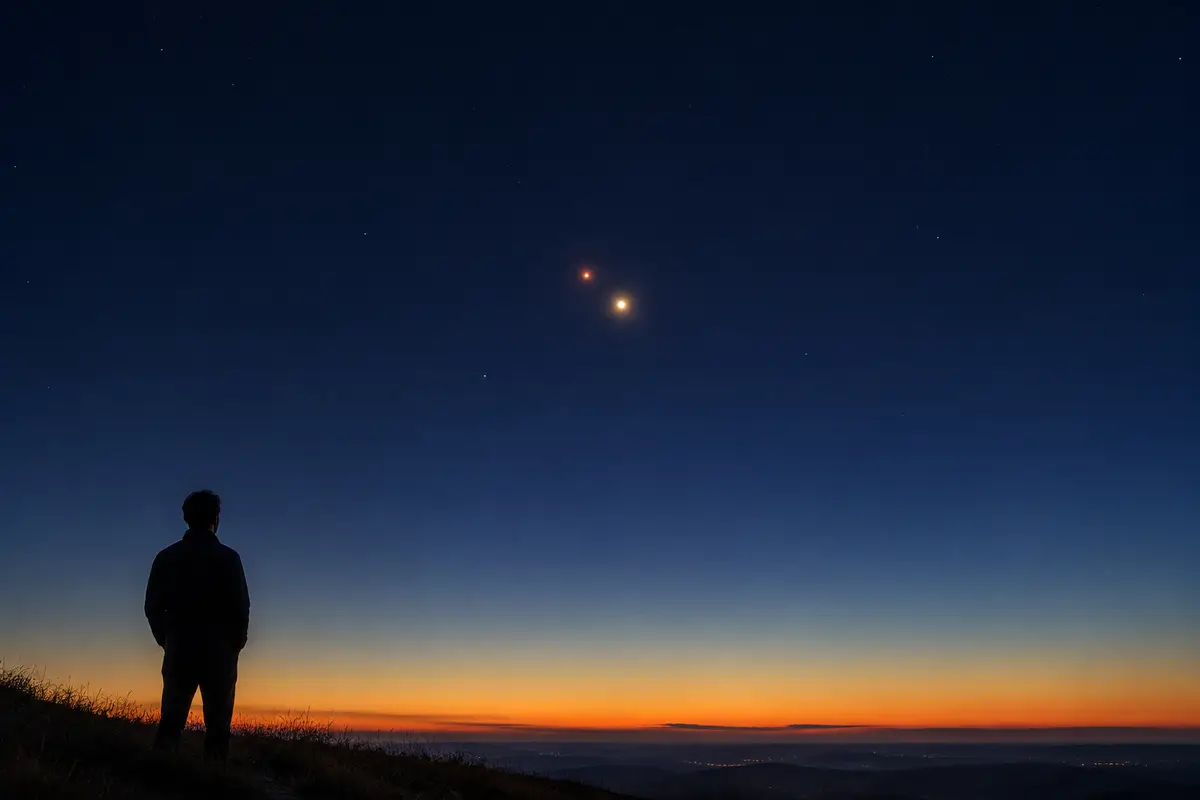
On the mornings of November 15 and 16, 2026, Mars passes about 1.2° from Jupiter, a little more than two Full Moons side by side. Look southeast before sunrise: bright Jupiter, with reddish Mars just above it. You need no telescope. The Beehive Cluster is not part of the pairing; it sits about 18° away, high in the south.
On this page
- When do Mars and Jupiter meet?
- Where do you look, and what will you see?
- Is the Beehive Cluster near Mars and Jupiter?
- How does the pair change from morning to morning?
- Are Mars and Jupiter really close together?
- Do you need binoculars?
- How do you photograph it with a phone?
- What else can you watch for after the meeting?
- FAQ
- Sources
Two of the brightest planets in the morning sky have just lined up almost on top of each other. Around November 15 and 16, Mars slid to within 1.2° of Jupiter, a gap barely wider than a little finger held at arm's length, and you can see the pair with your own eyes from your yard.
Here is when to go out, which way to face, how the pair shifts from one morning to the next, how far the Beehive Cluster really is from them, and how to get a decent phone photo.
When do Mars and Jupiter meet?
NASA's November 2026 skywatching guide puts it this way: "On the mornings of November 15th and 16th, look southeast before sunrise to see Mars and Jupiter close together." NASA says they will appear about 1.2° apart, "a little more than the width of two full Moons side by side."
Astronomers call a meeting like this a conjunction. An independent sky calendar by Jeffrey Hunt lists the conjunction on November 16 and says the gap that morning is slightly smaller than the day before. My own calculation agrees. I get about 1.2° on both mornings, with the very closest moment, about 1.19°, at roughly 8 p.m. Eastern on November 15, while the planets are still below the horizon in the Americas. So you do not need to pick one perfect morning. The two mornings look almost identical.
Where do you look, and what will you see?
Step outside about an hour before sunrise, which is what Hunt recommends. NASA's chart is set for about 5 a.m. and looks southeast. From about 40°N, my calculation puts the pair more than halfway up the sky at that hour, high enough that trees and rooftops do not get in the way. The Moon is not a problem either: Hunt's calendar shows it in the evening sky this week, near first quarter, so it has set long before dawn.
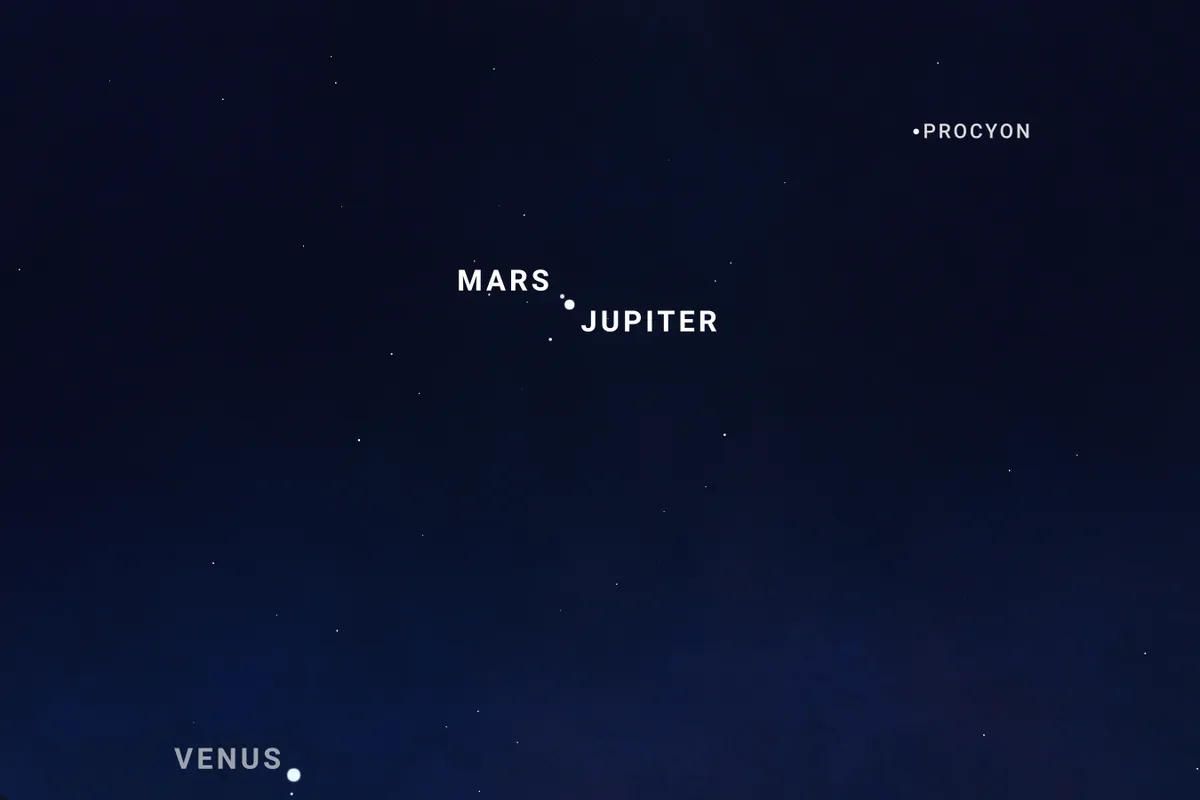
- Face southeast and look high. The brightest point of light in that part of the sky is Jupiter.
- Look just above it for a fainter, reddish dot. That is Mars. NASA describes Jupiter as the brighter point, "with reddish Mars nearby."
- Check the gap with your hand. A little finger held at arm's length covers about 1°, so the gap is a bit more than your finger's width.
- Find Regulus for a landmark. Hunt places Jupiter about 4.3° from Regulus, the brightest star of Leo, with Regulus to the lower left. Regulus makes the third bright light in the group.
- Add the bonus planets low in the east-southeast. Hunt lists Venus about 15° above the horizon near the star Spica, with Mercury lower and to the left.
What you will actually see: two clear, separate points, Jupiter bright and whitish and Mars a steady orange-red, with a gap about the width of two Full Moons. They will not merge into one dot. NASA says both planets are easy to see with the unaided eye.
Is the Beehive Cluster near Mars and Jupiter?
No. The Beehive Cluster, also called Messier 44 or Praesepe, sits in Cancer. Mars and Jupiter are in Leo. Using the cluster's catalog position, I measure about 18° from the cluster to each planet on November 16. That is roughly two fists held at arm's length, far too wide to share a view with the pair even in binoculars. Hunt says Jupiter, Mars and Regulus fit into the same binocular field; the Beehive does not.
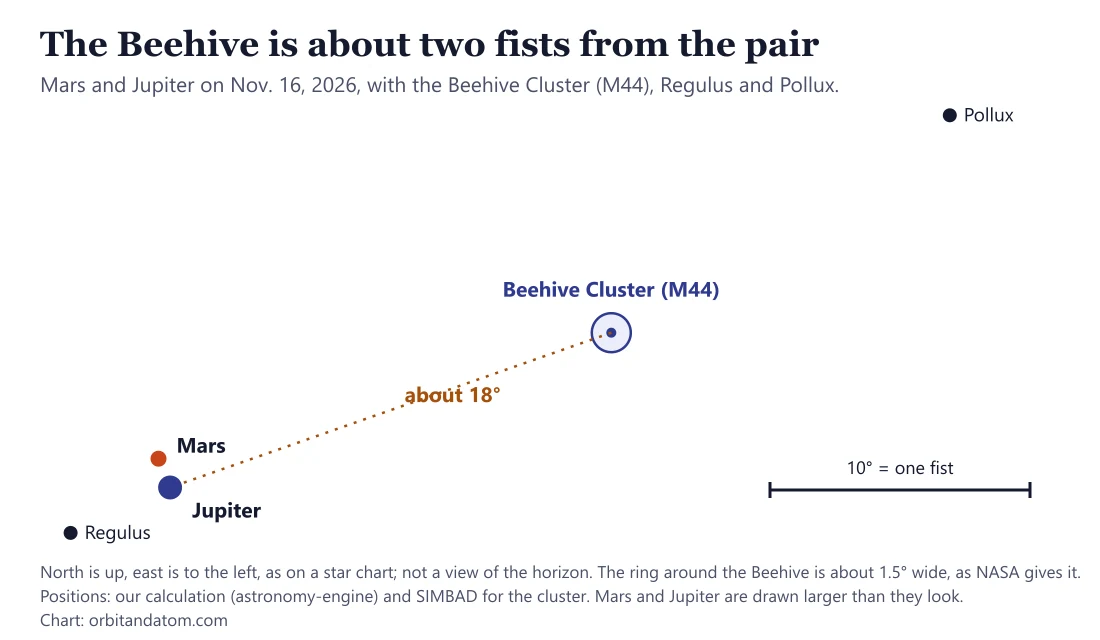
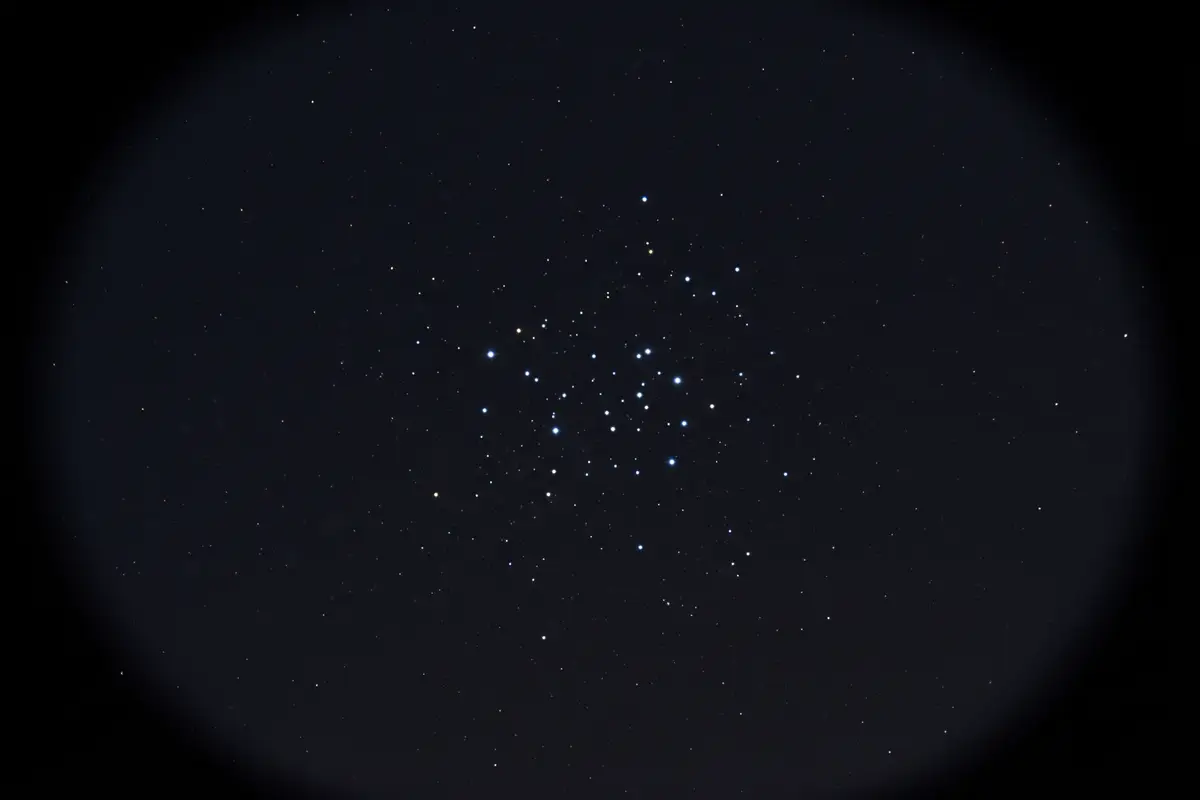
The cluster is still a good bonus target that same morning. At about 5 a.m. Eastern it is high in the south, near 70° above the horizon by my calculation, so you look up and to the right of the pair. NASA's Hubble team says the Beehive holds about 1,000 stars, lies about 600 light-years away and is roughly 600 to 700 million years old. It spans about 1.5°, or three Full Moons, and to the unaided eye it looks like a blur of light. Binoculars resolve around 20 stars, according to NASA. From a dark spot I would sweep up to it after you have enjoyed the planets, and I would expect city lights to hide it.
If you saw the two events mentioned together, the likely link is that both appear in the same pre-dawn sky this month. They are not an alignment.
How does the pair change from morning to morning?
Mars moves east against the background stars faster than Jupiter does, so it is catching up with the giant planet and then pulling away. From my calculation, Mars starts the week to the upper right of Jupiter, passes almost straight above it on November 15 and ends up to the upper left.
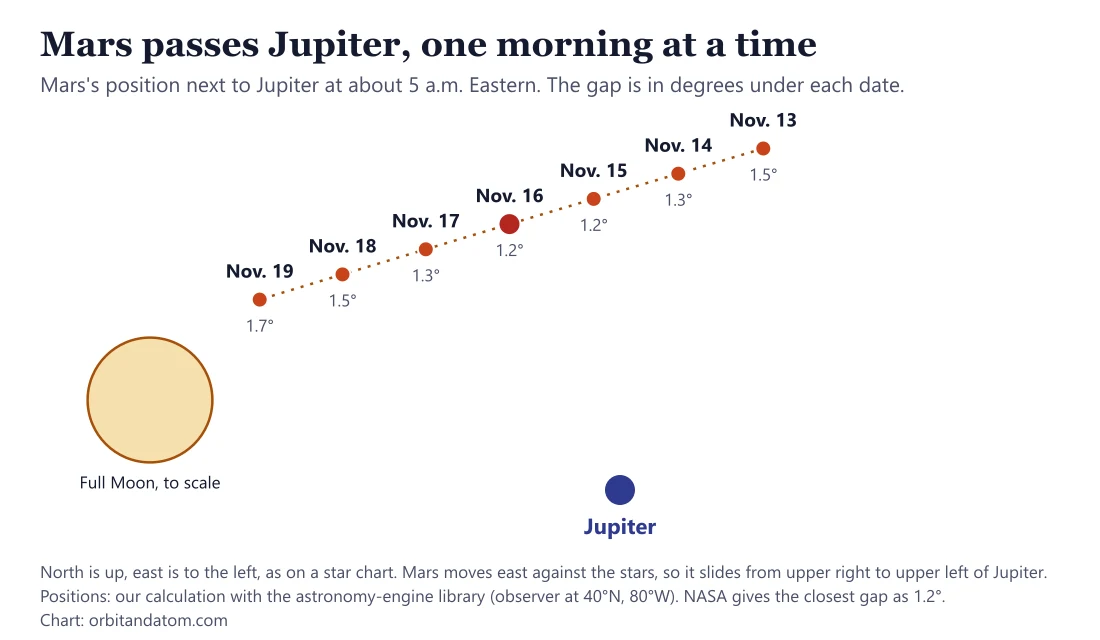
| Morning | Mars is | Gap |
|---|---|---|
| Nov. 13 | Upper right | 1.5° |
| Nov. 14 | Upper right | 1.3° |
| Nov. 15 | Nearly straight above | 1.2° |
| Nov. 16 | Upper left | 1.2° |
| Nov. 17 | Upper left | 1.3° |
| Nov. 18 | Upper left | 1.5° |
| Nov. 19 | Upper left | 1.7° |
Mars next to Jupiter at about 5 a.m. Eastern. Both columns are my calculation with the astronomy-engine library; NASA gives the closest gap as 1.2°.
The gap grows to about 2.6° by November 22, and Hunt says Mars then passes Regulus on November 26. NASA's advice is to watch over several mornings as the planets draw closer and then go their separate ways. I agree: the nightly change is the real show, and the table gives you a reason to go out on the 13th, before the main event.
Are Mars and Jupiter really close together?
Only from where you stand. NASA says the two planets are "still far apart in space, but from Earth, they appear almost side by side." Hunt puts the real gap at nearly 370 million miles. My calculation gives about 4 astronomical units between them (1 AU is the distance from Earth to the Sun): Mars is about 1.3 AU from us and Jupiter about 5.3 AU.
That changes what you are looking at. The last leg of the light's trip from Mars to your eyes takes about 11 minutes, and from Jupiter about 44 minutes (my arithmetic from those distances). For a sense of scale, my guide to how far a light-year is shows how far light goes in a year, and my guide to why Mars is red explains the orange tint you will see in the planet.
Do you need binoculars?
No. NASA says both planets are easy to see with the unaided eye. Binoculars add a different view: Hunt notes that Jupiter, Mars and Regulus all fit in one binocular field, so you can see the whole trio at once. In my opinion, they are the best single tool for this morning, because after the planets you can lift them toward the Beehive and see its stars start to separate.
How do you photograph it with a phone?
NASA's Night Sky Network gives the basics for night photos with a smartphone:
- Keep the phone still. A small tripod is ideal, and a rock or a block of wood works too.
- Use the timer. A delay of a few seconds keeps your finger from shaking the shot.
- Lock the focus. Tap a distant bright star or streetlight, then lock it.
- Set an exposure of a few seconds and take a test photo. NASA says some phones offer an astrophotography setting, though it was still rare when the page was written.
The gap is only about 1.2°, which is small for a phone's wide lens. I would expect the pair to look like one bright dot with a faint companion at normal zoom, so I would zoom in a step and keep Regulus in the frame to show the two apart.
What else can you watch for after the meeting?
- Now through November 30: the Leonid meteor shower is active. My Leonid guide has the details, and the meteor shower calendar lists the rest of the year.
- November 24: NASA lists the full supermoon. My Beaver Moon guide covers it.
- November 26: Mars passes Regulus, according to Hunt.
My guide to the planets in November 2026 has the whole month in one place, planets in order from the Sun covers the basics, and the Night Sky section has more.
Frequently asked questions
When are Mars and Jupiter closest in November 2026?
NASA points to the mornings of November 15 and 16, when the two planets appear about 1.2° apart before sunrise. An independent sky calendar lists the conjunction itself on November 16. Both mornings look almost the same.
How close do Mars and Jupiter get?
About 1.2°, according to NASA. That is a little more than the width of two Full Moons side by side. My calculation gives about 1.2° at 5 a.m. Eastern on both November 15 and 16.
What time should you look at Mars and Jupiter?
About an hour before sunrise, facing southeast. NASA's chart for November 15 is set for around 5 a.m. By then both planets are high in the sky, so you do not need a clear horizon.
Is the Beehive Cluster near Mars and Jupiter?
No. By my calculation the cluster is about 18° from each planet on November 16, roughly two fists at arm's length. It is a good bonus target that morning, high in the south, but it is not part of the pairing.
Can you see Mars and Jupiter without a telescope?
Yes. NASA says both planets are easy to see with the unaided eye. Jupiter is the brighter point of light, with reddish Mars nearby. Binoculars let you fit Jupiter, Mars and the star Regulus into one view.
How far apart are Mars and Jupiter in space?
Nearly 370 million miles, according to the sky calendar by Jeffrey Hunt. NASA says they are still far apart in space and only look side by side from Earth. My calculation gives about 4 AU between them.
How can you photograph the pair with a phone?
NASA's Night Sky Network suggests a steady phone on a small tripod or a rock, a timer to avoid shake, focus locked on a distant bright star or streetlight, and an exposure of a few seconds with a test shot first.
Sources
- Jeffrey L. Hunt, "2026, November 17: Voyager 1 Reaches One Light-Day from Earth," When the Curves Line Up (accessed November 17, 2026), planet notes
- NASA Science, "What's Up: November 2026 Skywatching Tips from NASA" (accessed November 12, 2026)
- Jeffrey L. Hunt, "2026, November 16: A Jupiter-Mars Conjunction Near Regulus as Venus Shines Near Spica," When the Curves Line Up (accessed November 12, 2026), an independent sky calendar
- Jeffrey L. Hunt, "2026, November 15: Jupiter-Mars Conjunction and Bright Planets," When the Curves Line Up (accessed November 12, 2026)
- NASA Science (Hubble), "Messier 44" (accessed November 12, 2026)
- NASA Night Sky Network, "Astrophotography With Your Smartphone" (published November 15, 2024)

Founder and editor, Orbit and Atom
I write Orbit and Atom to explain space and science in plain English, starting from what NASA, ESA and the mission teams publish. Every article lists its sources at the end so you can read them yourself.