Night Sky
What Planets Can You See in November 2026?
Quick answer
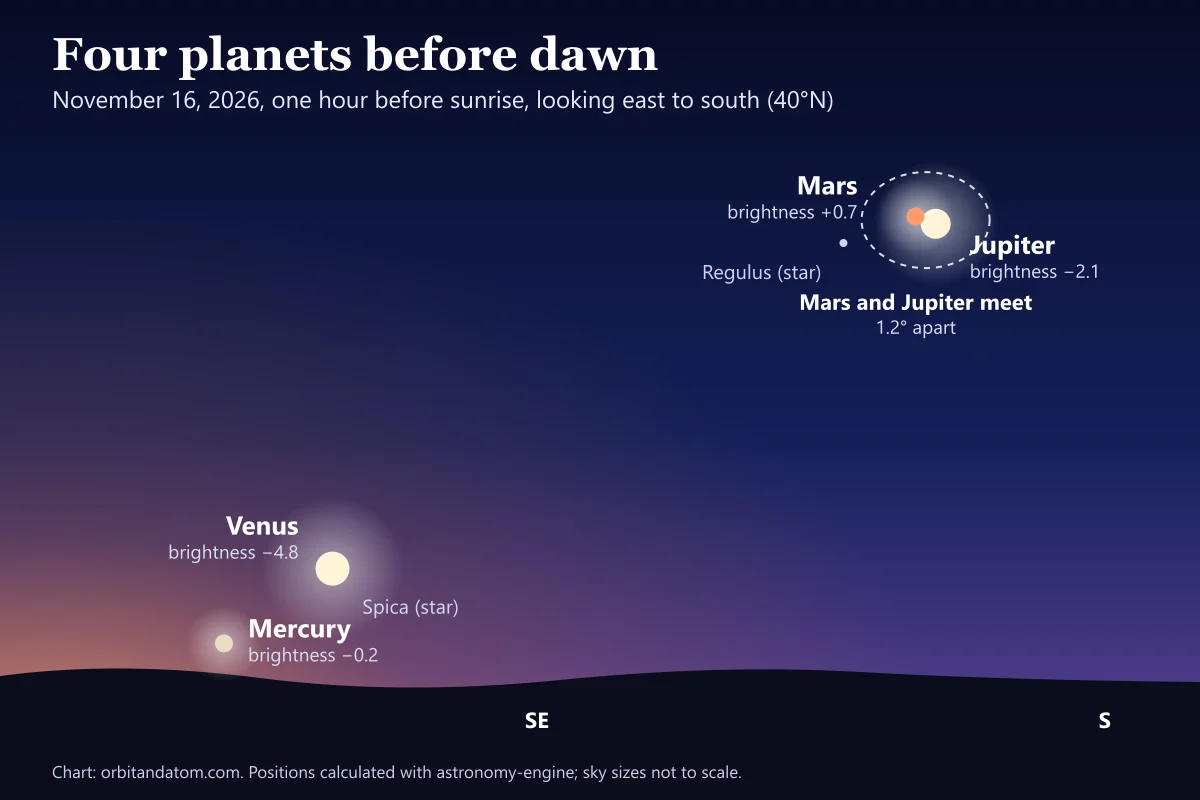
In November 2026 you can see five planets with the naked eye: Venus, Mercury, Mars and Jupiter before dawn, and Saturn in the evening. The highlight is Mars passing just 1.2° from Jupiter on November 16, high in the southern sky before sunrise. Venus climbs out of the Sun's glare as the month goes on, and Mercury is best from mid-month. Uranus is also at its best on November 25, but you need binoculars.
On this page
- Which planets can you see in November 2026?
- When is the best time to look before dawn?
- Where are Venus and Mercury?
- When do Mars and Jupiter meet?
- Where is Saturn in the evening?
- What is the Moon doing this month?
- Are there meteor showers in November?
- Can you see Uranus and Neptune?
- What does the month look like at a glance?
- Do you need binoculars or a telescope?
- FAQ
- Sources
November has a neat split. Four planets take over the hours before dawn, and one, Saturn, has the evening to itself. The best night to mark is November 16, when Mars slides just past Jupiter in the southern sky. Venus and Mercury are also coming back into view after weeks lost in the Sun's glare.
Here is what is up, where to look, and which dates are worth an alarm.
Which planets can you see in November 2026?
Five, without any equipment. A note on how I built this guide: NASA's monthly "What's Up" episode for November was not online when I wrote this on November 1, so the positions below are my own calculation with the open-source Astronomy Engine library. I checked them against NASA's Moon data and an independent skywatching calendar. Heights and times are for about 40°N, roughly the latitude of Philadelphia, Madrid or Beijing.
| Planet | When and where | Brightness | How easy |
|---|---|---|---|
| Venus | Before dawn, low in the east-southeast | -4.3, rising to -4.9 | Easy with a clear horizon |
| Mercury | Before dawn, very low in the east-southeast | -0.1 on Nov. 15, -0.6 by Nov. 30 | Harder, best Nov. 15-28 |
| Mars | Before dawn, high in the south | +0.9, brightening to +0.5 | Easy |
| Jupiter | Before dawn, high in the south | About -2.1 | The easiest of all |
| Saturn | Evening, east-southeast, then southeast | About +0.5 | Easy |
The planets in November 2026, from about 40°N. Brightness is the magnitude scale, where a lower number is brighter. All figures are my calculation with Astronomy Engine.
Magnitudes run backward: the more negative the number, the brighter the object. Venus beats everything else on this list, and Jupiter is about 13 times brighter than Mars (my arithmetic from the numbers above).
When is the best time to look before dawn?
For Venus and Mercury, about an hour before sunrise. For Mars and Jupiter, any time after about midnight. They rise around 11 p.m. in the middle of the month (for a spot in the middle of its time zone, my calculation) and are high in the south by the time the sky starts to brighten.
One practical thing: in the United States, daylight saving time ended on November 1, so sunrise comes about an hour earlier on the clock than last week. Look up your own sunrise time and plan from that.
Where are Venus and Mercury?
Venus passed between Earth and the Sun on October 24 (my calculation), so it is only now starting its run as a morning star. In the first days of November it rises just about an hour before the Sun and hugs the horizon. By mid-month it rises about two and a half hours before sunrise and is about 16° up an hour before it. By November 30 it rises about three and a half hours ahead of the Sun and sits about 25° up. Its brightness climbs from -4.3 to -4.9 along the way. While you wait for it to rise, my guide to why Venus spins backward explains why the Sun would come up in the west there.
Venus also passes close to Spica, the brightest star of Virgo. They are closest on November 9, about 1.2° apart (my calculation), and an independent sky calendar highlights the pair too. A pair of binoculars shows the star next to the planet.
Mercury is the tricky one. It reaches its widest gap from the Sun in the morning sky on November 20, about 19.6° (my calculation), which makes the second half of the month the time to try. Even then it is only 6° to 7° up an hour before sunrise, less than one fist-width of sky (a fist at arm's length spans about 10°). Look lower and to the left of Venus, and make sure a hill, a tree or a roof does not block the view. I would start on November 15 and use Venus as a pointer.
When do Mars and Jupiter meet?
On November 16, when Mars passes about 1.2° from Jupiter. That is a little more than two Moon-widths (my calculation), and an independent sky calendar gives the same date for the meeting. Face south an hour before sunrise: both planets are about two thirds of the way up the sky, so you do not need a clear horizon. Jupiter is the brighter one, and Mars sits just above it with a reddish tint.
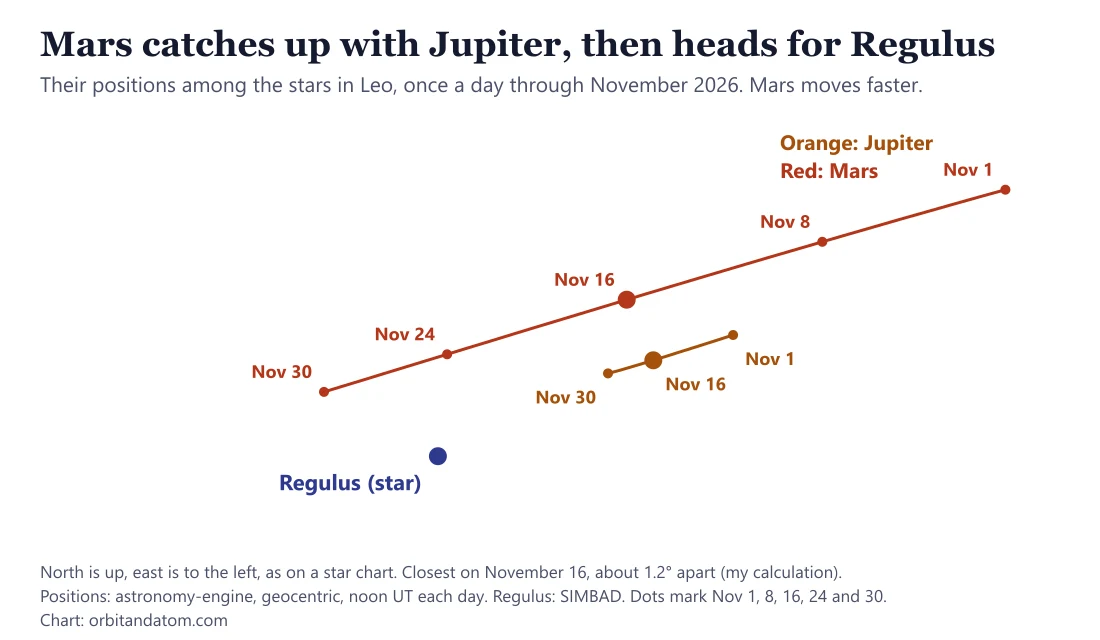
The meeting does not last. Mars moves faster against the stars, so the gap is about 2.6° by November 22 and about 4.5° by the end of the month (my calculation). Mars then passes Regulus, Leo's brightest star, at about 1.7° on November 26, which the same sky calendar also notes. I would look on several mornings, not only the 16th: the change from night to night is the real show. My Mars and Jupiter conjunction guide has a morning-by-morning table and a phone photo checklist.
Where is Saturn in the evening?
East-southeast after sunset, and it climbs higher every week. Saturn passed opposition on October 4, NASA's October guide notes, the point when it sits opposite the Sun, and it is still well placed weeks later. Around November 1 it is about 24° up an hour after sunset, and by November 30 it is about 40° up in the southeast (my calculation). It sets around 4 a.m. at the start of the month and around 2 a.m. at the end.
Saturn is not as bright as Jupiter, but no other planet is near it in the evening sky. Even a small telescope shows the rings. They are tilted only about 6° toward us right now (my calculation), so they look thin. I explain why in my guide to why Saturn's rings look so thin, and the planet's family of moons is in how many moons Saturn has.
What is the Moon doing this month?
The Moon's phases this month, from NASA's hourly data: last quarter on November 1, new Moon on November 9, first quarter on November 17, full Moon on November 24 and last quarter again on December 1. The week around the new Moon is the best for anything faint.
- Morning of November 2: the Moon, about 43% lit, sits close to Mars, with Jupiter a little farther to the left. From North America the gap to Mars is about 1.5° (my calculation). Farther east, the Moon is a bit farther from Mars by dawn.
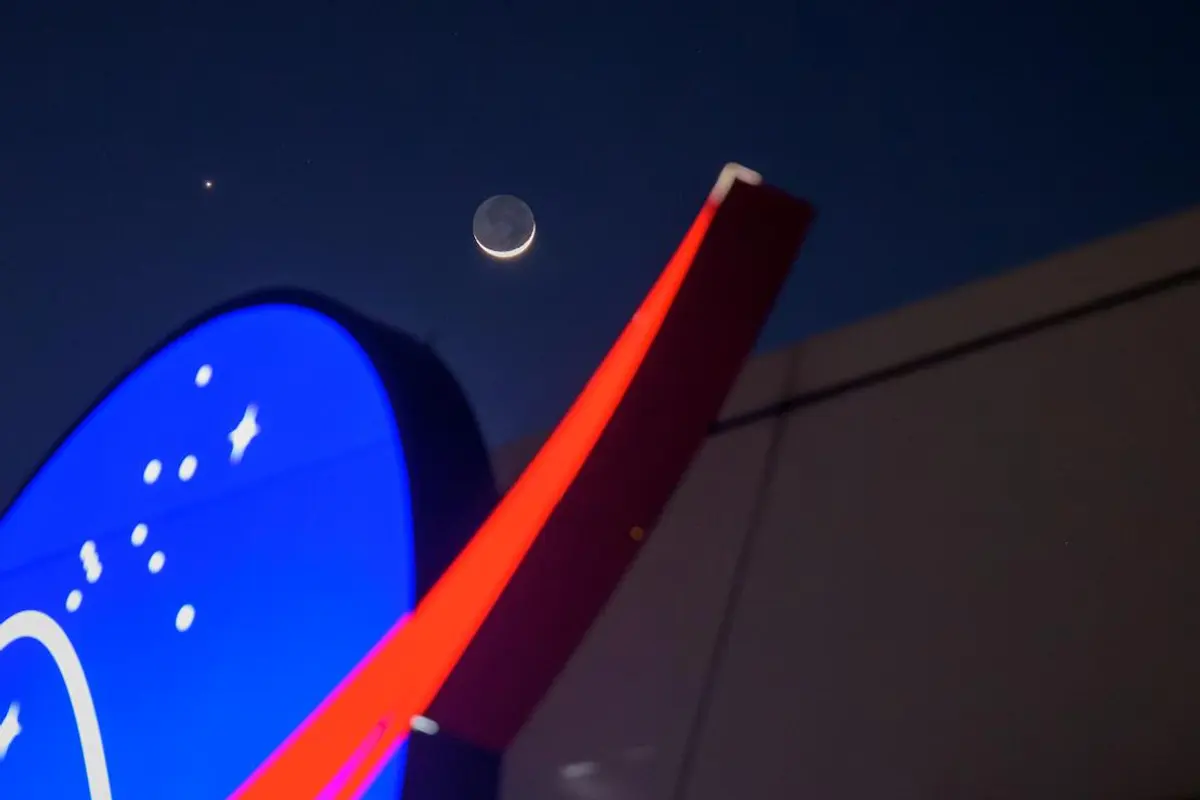
- November 6 and 7: a very thin crescent Moon visits Venus. On the 6th it is about 8% lit and well above Venus. On the 7th it is only about 3% lit and closest, about 1° below Venus (my calculation). It will be low, so you need a clear eastern horizon.
- November 24: the full Moon. NASA lists it as a supermoon, with the exact moment at 14:54 UTC. My Beaver Moon guide covers the best evenings to look.
If a very bright Moon is your question, my Hunter's Moon guide covers the last full Moon, and the Moon illusion guide explains why a low Moon looks so big.
Are there meteor showers in November?
Two, and neither is a big show. The Taurids are a slow, scattered shower known for the occasional fireball, and my Taurid guide explains why. The American Meteor Society lists the southern branch at its peak on November 4-5 and the northern branch on November 11-12, with the Moon only a thin crescent on the second night. The Leonids come next, peaking overnight from November 16 into the 17th. Expect a quiet year, with NASA's rate under 3 an hour, though each one is fast and bright. The first-quarter Moon is gone by late evening, which leaves the hours after midnight dark. My Leonid guide has the details and the meteor shower calendar has the rest of the year. A strong geomagnetic storm can also bring aurora far from the poles on a dark night; my guide to what causes the northern lights explains how far south it can reach.
Can you see Uranus and Neptune?
Uranus, yes, with help. It reaches opposition on November 25, when it is opposite the Sun and at its best for the year. Its magnitude is about 5.6 (my calculation), at the very edge of what the naked eye can pick out under a dark sky, so I would use binoculars. It sits in Taurus, about 5° from the Pleiades. The full Moon on November 24 washes it out, so the better nights are a few days later, when the Moon rises late. Neptune, at about magnitude 7.8, needs a telescope. It was at opposition on September 26 and is well up in the southeast in the evening.
What does the month look like at a glance?
| Date | What to look for | When |
|---|---|---|
| Nov. 2 | Moon, about 43% lit, near Mars | Before dawn |
| Nov. 4-5 | Southern Taurids peak (AMS) | Late evening |
| Nov. 6-7 | Thin crescent Moon near Venus | Before dawn |
| Nov. 9 | New Moon; Venus 1.2° from Spica | Before dawn |
| Nov. 11-12 | Northern Taurids peak (AMS) | Late evening |
| Nov. 16 | Mars passes 1.2° from Jupiter | Before dawn |
| Nov. 16-17 | Leonid meteor shower peaks (NASA) | After midnight |
| Nov. 20 | Mercury at its widest from the Sun, 19.6° | Before dawn |
| Nov. 24 | Full Moon, a supermoon (NASA) | All night |
| Nov. 25 | Uranus at opposition | Evening, binoculars |
| Nov. 26 | Mars about 1.7° from Regulus | Before dawn |
Dates to mark in November 2026. Dates are for the Americas; for Europe and Asia, the morning events fall on the same date but at different clock times. Positions are my calculation unless noted.
Do you need binoculars or a telescope?
Not for the five planets. Venus, Mars, Jupiter and Saturn are easy by eye, and Mercury just needs a clear horizon. Binoculars add the star next to Venus and make Uranus possible, and a small telescope turns Saturn from a steady point into a planet with rings. If I could only bring one thing, I would bring binoculars.
The planets stay in the sky between months, so to follow them past November, bookmark my Sky This Month page, which always points to the newest guide. For planet basics, see the planets in order from the Sun, and for more sky events, the Night Sky section.
Frequently asked questions
What planets can you see in November 2026?
Five with the naked eye: Venus, Mercury, Mars and Jupiter before dawn, and Saturn in the evening. Uranus is at its best on November 25 but needs binoculars, and Neptune needs a telescope. Positions are my calculation for about 40°N.
When are Mars and Jupiter closest in November 2026?
On November 16, when Mars passes about 1.2° from Jupiter in Leo (my calculation). Look south about an hour before sunrise, when both are about two thirds of the way up the sky. Mars then moves on toward the star Regulus.
What is the best time to see Venus in November 2026?
About an hour before sunrise, looking east-southeast. Venus starts the month very low, rising only about an hour before the Sun, and gets easier every morning. By the end of November it rises about three and a half hours before sunrise (my calculation).
Can you see Mercury in November 2026?
Yes, but it is low. Mercury is at its widest from the Sun on November 20, about 19.6° (my calculation), and the best days are about November 15 to 28. Look lower and to the left of Venus about an hour before sunrise, with a clear horizon.
Is Saturn visible in November 2026?
Yes. Saturn reached opposition on October 4, according to NASA, and it is up in the east-southeast after sunset, setting around 4 a.m. early in the month and around 2 a.m. by the end (my calculation). A small telescope shows its rings.
Do you need a telescope to see the planets this month?
No. Venus, Mars, Jupiter and Saturn are easy by eye, and Mercury just needs a clear horizon. Binoculars help with Uranus and with the star Spica next to Venus. Neptune is the only one that needs a telescope.
Does this guide work in the Southern Hemisphere?
The planets and the dates are the same, but the heights and directions are not. I calculated for about 40°N. From the Southern Hemisphere the planets appear in the northern half of the sky. Use a planetarium app for your own city.
Sources
- NASA Science, "What's Up: October 2026 Skywatching Tips from NASA" (Saturn at opposition on October 4; the November episode was not yet online on November 1, 2026)
- NASA Scientific Visualization Studio, "Moon Phase and Libration, 2026" (hourly Moon positions and phase, UT; used for the Moon dates)
- NASA Science, "Supermoons" (the November 24, 2026 full Moon, 14:54 UTC; accessed November 1, 2026)
- NASA Science, "Leonids" (active Nov. 6-30, peak night Nov. 16-17, fewer than 3 meteors per hour; accessed November 1, 2026)
- American Meteor Society, "2026/2027 Meteor Shower Calendar" (Taurid peaks and Moon conditions; accessed October 21, 2026)
- Jeffrey L. Hunt, "2026, November 3: Moon, Jupiter, Mars, Venus, and Saturn: Today's Highlights," When the Curves Line Up (October 25, 2026), an independent sky calendar
- Astronomy Engine (open-source library by Don Cross), used for my own planet positions, rise and set times and separations, for an observer at 40°N
- NASA Image and Video Library, "Moon Venus Conjunction" (May 18, 2026), photo NASA/Bill Ingalls

Founder and editor, Orbit and Atom
I write Orbit and Atom to explain space and science in plain English, starting from what NASA, ESA and the mission teams publish. Every article lists its sources at the end so you can read them yourself.