Atoms & Physics
What Causes the Northern Lights, and Why Are They Seen Farther South?
Quick answer
The northern lights are caused by charged particles from the Sun. The solar wind loads Earth's magnetic shield with energy, and when that energy is released, electrons rain down into the upper atmosphere and make oxygen and nitrogen glow. The lights reach farther south during strong geomagnetic storms, when the oval of light around the magnetic pole expands toward the middle latitudes.
On this page
- What causes the northern lights?
- Why are the northern lights green, red and purple?
- Why do the northern lights usually stay near the poles?
- Why are the northern lights sometimes seen farther south?
- How far did the biggest recent storms reach?
- Does the Sun's 11-year cycle decide when northern lights appear?
- How can you tell if the northern lights might be visible tonight?
- So what is the short answer?
- FAQ
- Sources
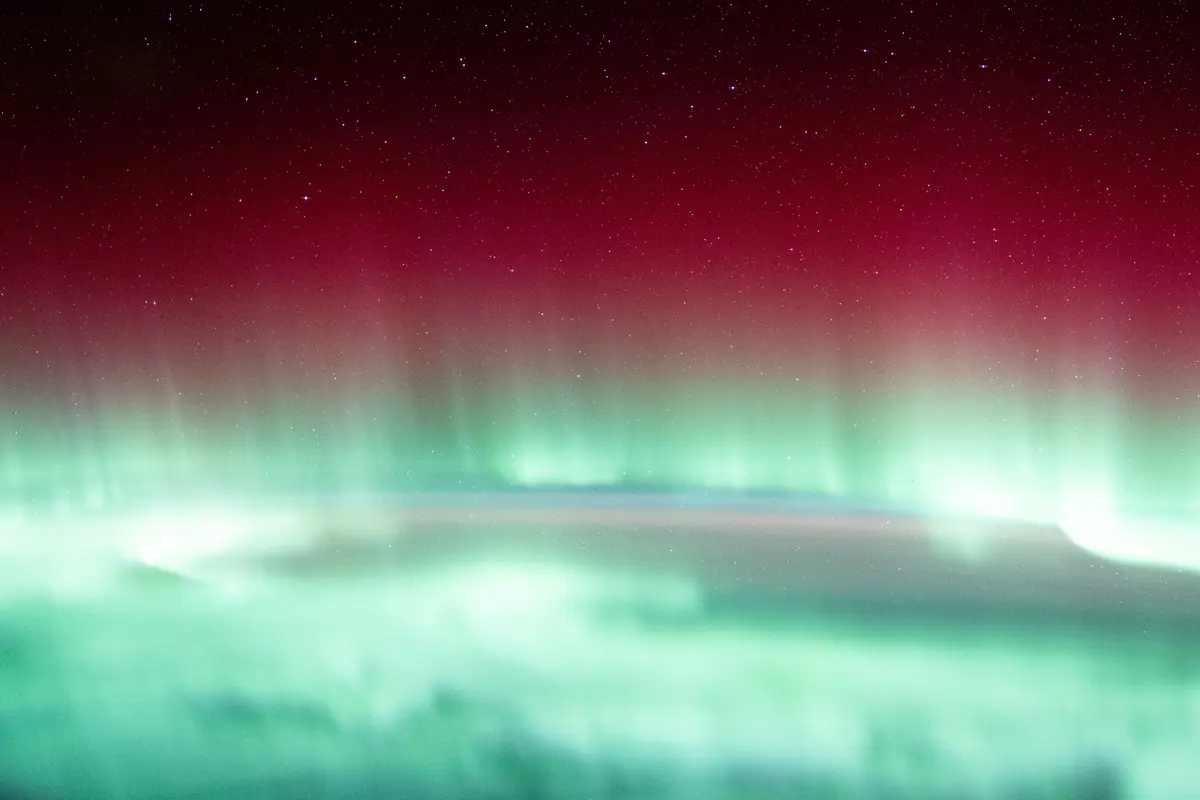
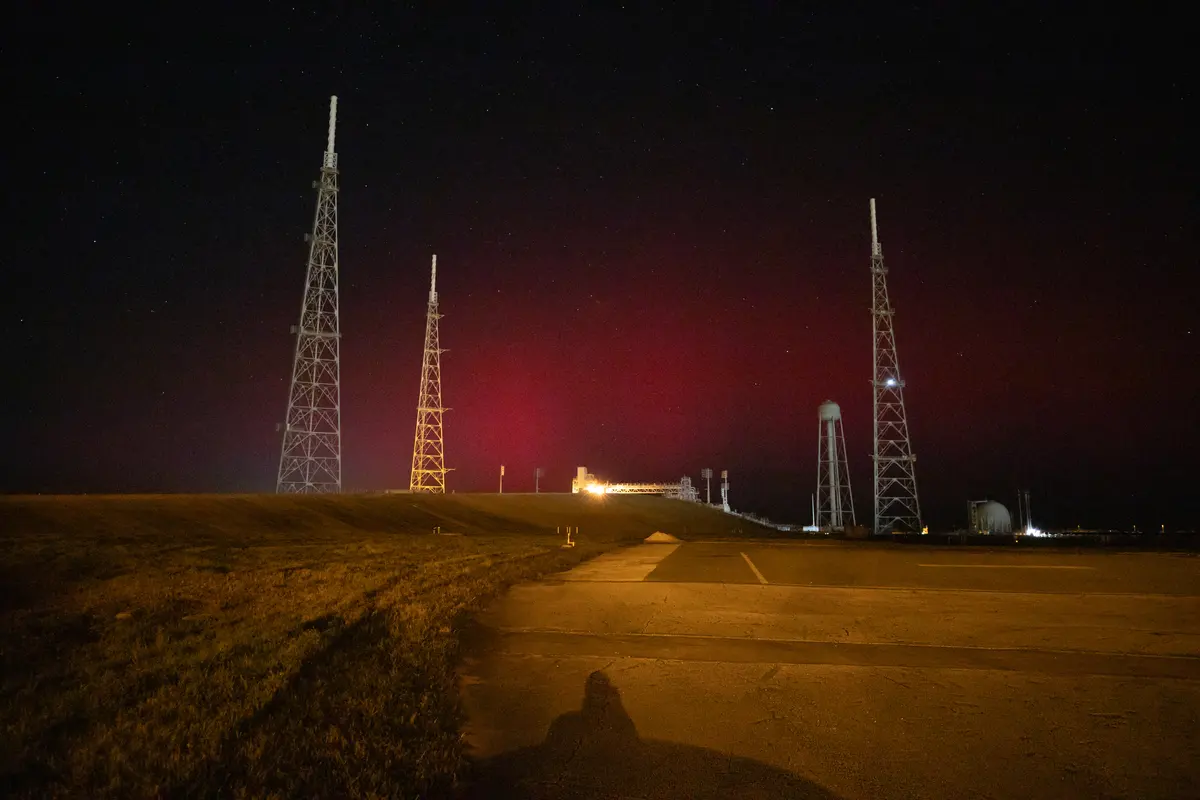
On Nov. 11, 2025, NASA photographed a faint red glow in the sky over a launch pad at Kennedy Space Center in Florida. It was an aurora, in a state better known for beaches than for northern lights.
The same light shows up on most nights in northern Canada and Alaska. On a few nights each cycle it stretches about as far from the poles as it ever goes. Here is what makes it, why it comes in different colors, and what has to happen for it to travel south.
What causes the northern lights?
The chain has four links: the Sun, the solar wind, Earth's magnetic shield and the upper atmosphere. The Sun constantly blows out charged particles, a flow NASA calls the solar wind. NOAA describes it as mostly protons and electrons in a state called plasma. In its usual slow state it moves at about 250 miles per second (400 km/s). Wind from coronal holes, darker patches on the Sun, is faster: 310 to 500 miles per second (500 to 800 km/s). The wind starts in the Sun's outer atmosphere, the corona, which is far hotter than the surface below it; I explain that puzzle in How Hot Is the Sun?
Earth is wrapped in a magnetic shield called the magnetosphere, and the solar wind pushes on it all the time. NASA says the wind can deposit and accumulate energy there. When that energy is finally released, much of it rains down on Earth's atmosphere.
The release often starts with magnetic reconnection. NASA explains that the magnetic field carried by the solar wind can point opposite to Earth's. When it does, the two fields snap together, like a magnet on a refrigerator door. The wind drags those joined field lines into a long tail on the night side until they stretch too far and snap back like a rubber band, sending energy down the field lines.
NOAA describes the last step. Electrons, accelerated in the night-side tail and at lower altitudes along auroral field lines, follow Earth's magnetic field down toward the polar regions. There they collide with oxygen and nitrogen in the upper atmosphere. The struck atoms and molecules take on energy, and when they relax they release it as light, "similar to how a neon light works," in NOAA's words. The glow forms about 50 to 300 miles (80 to 500 km) above the ground. Protons take part too, but NOAA says they make only a faint, diffuse light that is usually hard to see.
Atoms taking on energy and giving it back as light is really a story about electrons. The shells they sit in are laid out in What Is Inside an Atom?
Why are the northern lights green, red and purple?
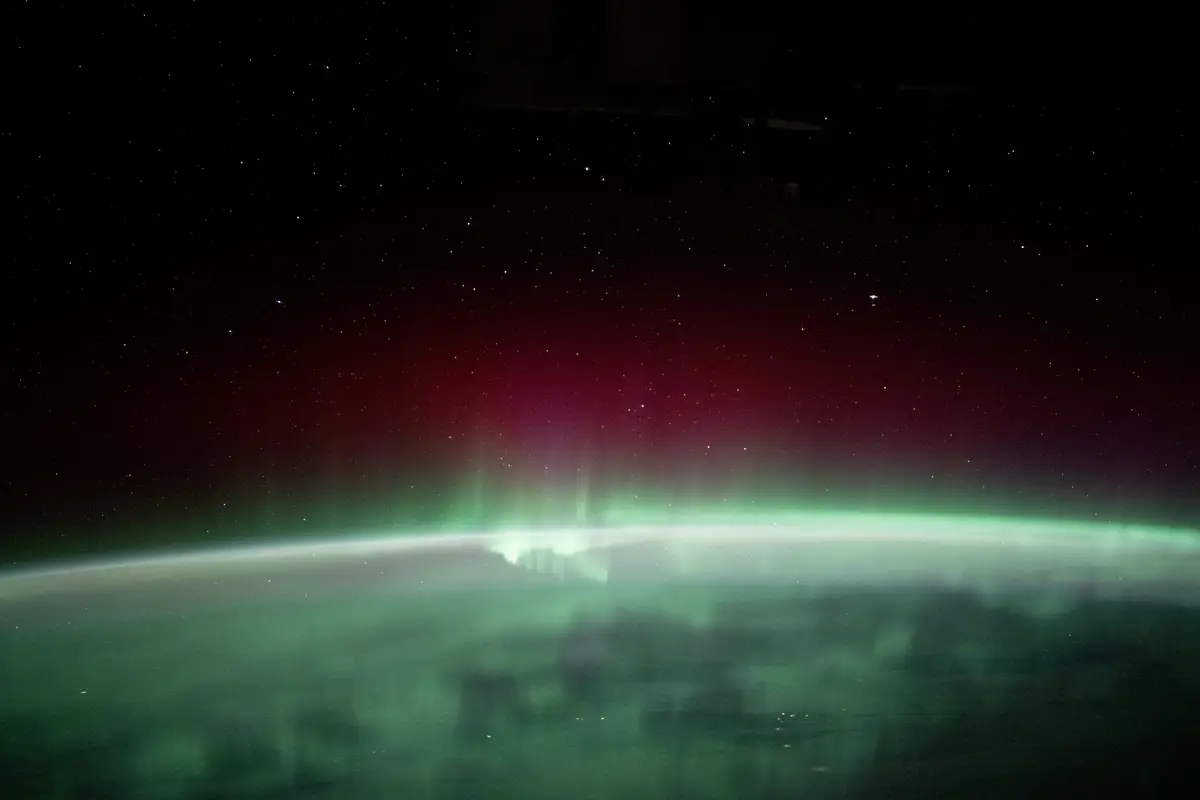
The color depends on which gas is hit and how high up it is. Green is the most common color, and it comes from oxygen. NASA's table of the main colors:
| Color | Gas | Altitude |
|---|---|---|
| Green | Oxygen | 60 to 120 miles (100 to 200 km) |
| Red | Oxygen | 120 miles (200 km) and up |
| Blue | Nitrogen | 60 to 120 miles (100 to 200 km) |
| Pink | Nitrogen | 60 miles (100 km) and below |
Aurora colors, gases and altitudes. Source: NASA Science, "Auroras."
NASA adds that the light from these gases can mix, so an aurora can also look purple, pink or even white. The altitude column explains a common sight in photos: a green band with a red glow above it, both made by oxygen at different heights.
Ordinary sky color works differently. In Why Is the Sky Blue? the air scatters the Sun's light, while in an aurora the gas makes its own.
Why do the northern lights usually stay near the poles?
Earth's magnetic field guides the electrons, so the aurora forms two rings, called ovals, roughly centered on the magnetic poles. NOAA says the best place to watch is under the oval, between about 60 and 75 degrees north or south latitude. There, it says, an aurora can be seen on more than half the nights of the year. That belt covers places such as northern Canada, Alaska and Scandinavia.
The southern lights, the aurora australis, form the same way around the south pole. Both names come from the Latin word for dawn: NASA notes that Europeans far from the Arctic usually saw the aurora as a faint red glow to the north, like the reddish glow before sunrise.
Two things can still ruin a night under the oval. The sky has to be dark and clear, and in summer at those latitudes the midnight sun keeps it too bright, NOAA notes.
Why are the northern lights sometimes seen farther south?
The cause is a geomagnetic storm. NOAA defines it as a major disturbance of the magnetosphere, when energy moves very efficiently from the solar wind into the space around Earth. Two conditions make that happen: sustained high-speed solar wind, lasting several to many hours, and, most importantly, a magnetic field in the wind that points south, opposite to Earth's field on the side facing the Sun.
The Sun has two main ways to deliver this. The biggest storms come from coronal mass ejections, or CMEs, where about a billion tons of plasma with a magnetic field arrives at Earth. NOAA says they typically take several days to get here, and as little as 18 hours for some of the most intense storms. Streams of fast wind from coronal holes cause weaker storms, but NOAA says they can deposit more energy over a longer time.
When a storm is strong, the ovals expand away from the poles. NOAA ranks storms on a G scale from G1 to G5, based on the Kp index, which it builds from magnetic disturbances measured on the ground. The scale also lists how far south the aurora has been seen at each level:
| Level | Kp | Aurora seen as low as | Per cycle |
|---|---|---|---|
| G1 Minor | 5 | Northern Michigan and Maine | 1,700 |
| G2 Moderate | 6 | New York and Idaho | 600 |
| G3 Strong | 7 | Illinois and Oregon | 200 |
| G4 Severe | 8 to 9- | Alabama and northern California | 100 |
| G5 Extreme | 9 | Florida and southern Texas | 4 |
Geomagnetic storm levels and where aurora has been seen. Source: NOAA Space Weather Prediction Center, "NOAA Space Weather Scales." Frequencies are NOAA's averages per 11-year solar cycle.
NOAA ties each level to geomagnetic latitude, about 55 degrees for G2, 50 for G3, 45 for G4 and 40 for G5. That is measured from the magnetic poles, not the geographic ones. Because the oval is centered on the magnetic pole, two places at the same ordinary latitude can see different displays.
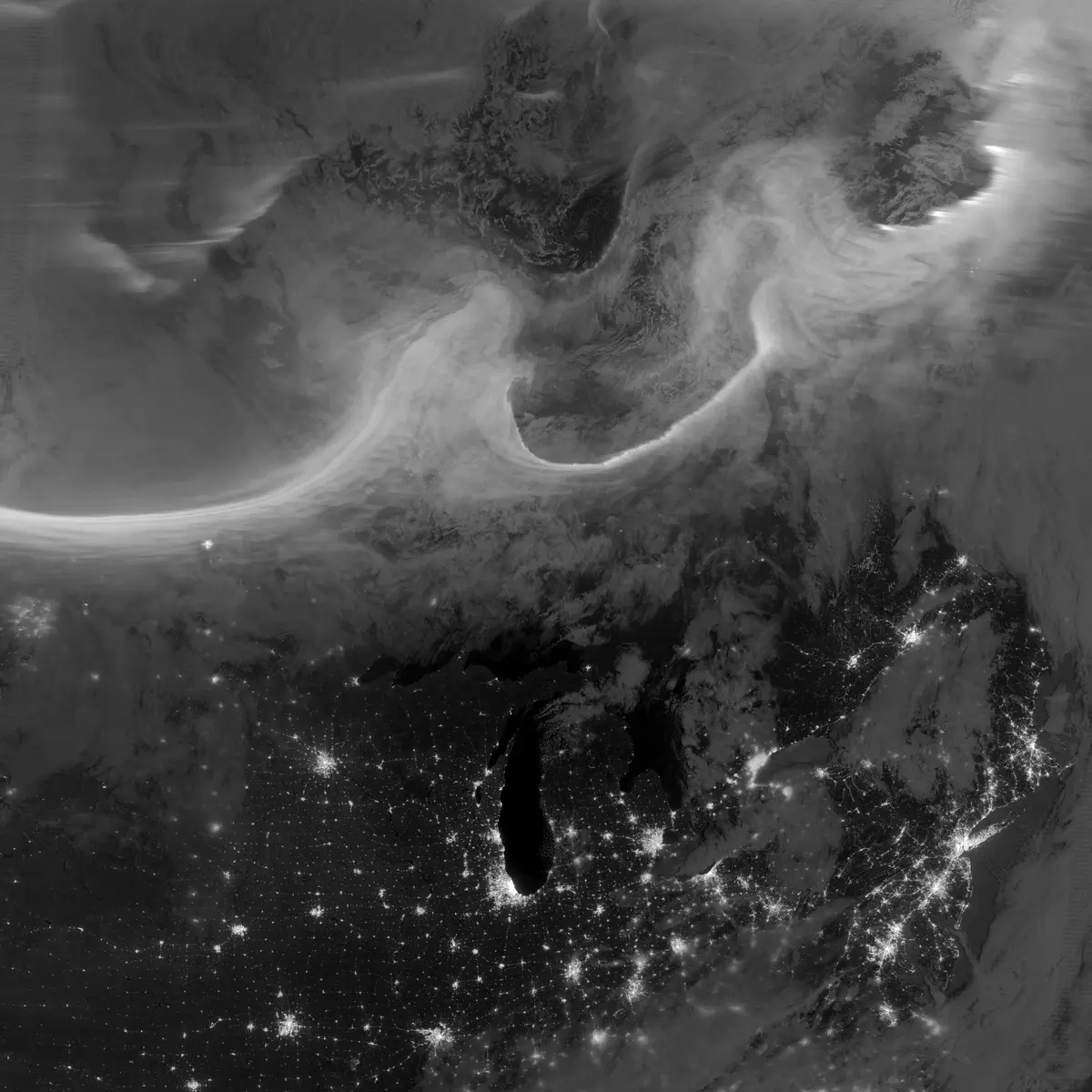
What you see that far south is not the same show. NOAA says a bright aurora can be seen from as much as 620 miles (1,000 km) away. In my opinion, from that and the NASA note about Europe, far from the poles you often get a dim red glow low in the sky instead of dancing curtains overhead, which is what the Florida photo below shows.
How far did the biggest recent storms reach?
The strongest in decades hit on May 10, 2024. NASA says it was the first G5 storm in over two decades, and it was named the Gannon storm in memory of space weather physicist Jennifer Gannon. It has been called the best-documented geomagnetic storm in history. NASA's Aurorasaurus project, where people report their sightings, received more than 6,000 reports from over 55 countries and all seven continents.
One detail shows how unusual the night was. In Japan, where red auroras are normal, people photographed magenta ones. NASA says researchers found those were around 600 miles (about 1,000 km) above the ground, about 200 miles higher than red auroras typically appear. The likely cause was a mix of red and blue light from oxygen and nitrogen lifted higher than usual as the storm heated and expanded the upper atmosphere.
A smaller storm came on Nov. 11 to 12, 2025. NOAA reported G4 levels at 0120 UTC on Nov. 12 (8:20 p.m. EST on Nov. 11). The Kennedy Space Center photo above is from that evening.
Earth is not the only world that gets this. NASA's MAVEN orbiter watched auroras engulf Mars from May 14 to 20, 2024, as particles from a solar storm struck its atmosphere.
Does the Sun's 11-year cycle decide when northern lights appear?
It sets the odds. NASA explains that, roughly every 11 years at the height of the cycle, the Sun's magnetic poles flip and it shifts from calm to stormy. Sunspots track that activity, and more of them mean more flares and CMEs. On Oct. 15, 2024, NASA and NOAA announced that the Sun had reached the solar maximum period of Solar Cycle 25. NOAA's Elsayed Talaat cautioned then that the actual peak month would not be known for months or years.
Two years of data now give an answer. In NOAA's record the smoothed sunspot number peaks at about 161 in October 2024 and has fallen to about 89 by April 2026, the latest smoothed value.
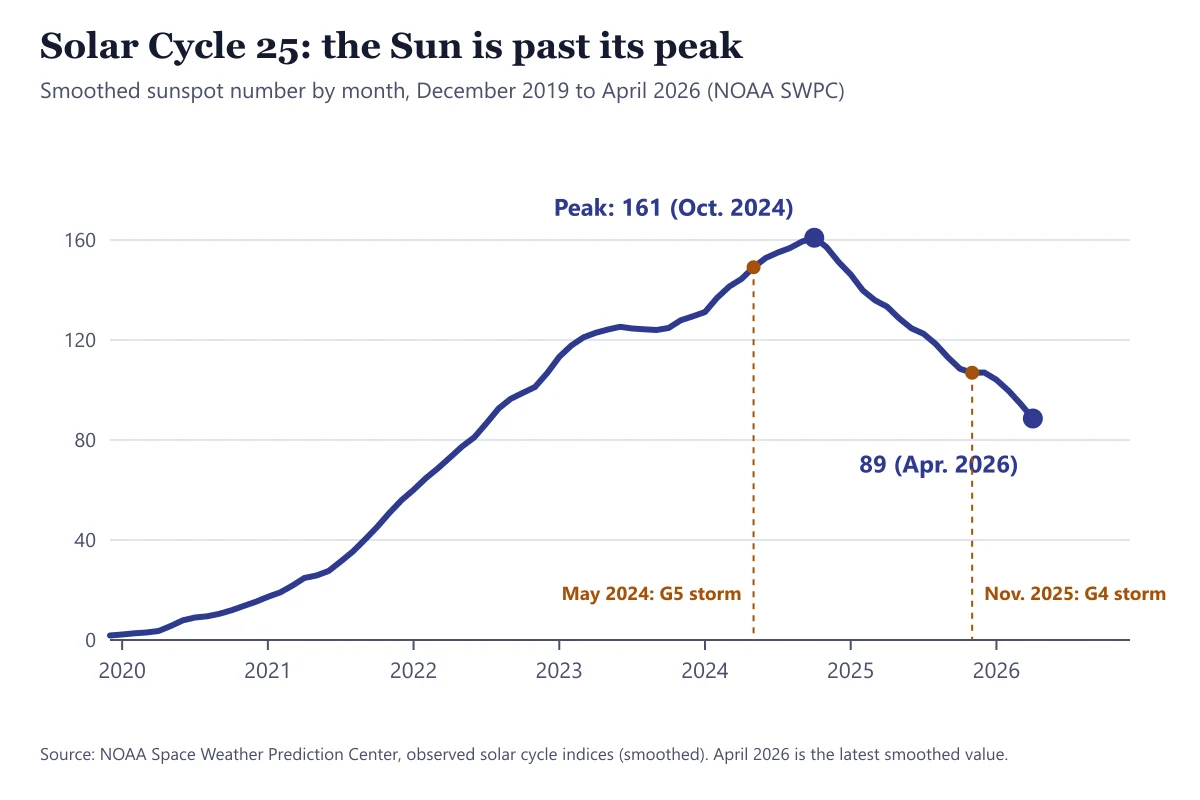
A falling count does not switch the lights off. The NASA and NOAA announcement says that, though less frequent, scientists often see fairly significant storms during the declining phase. The November 2025 G4 storm came about a year after the peak, which fits that pattern. My read: fewer chances, but any single clear night with a strong CME on the way can still deliver.
How can you tell if the northern lights might be visible tonight?
NOAA's Aurora 30 Minute Forecast shows the expected location and intensity of the aurora 30 to 90 minutes ahead. That lead time is how long the solar wind takes to travel from a monitoring point about 1 million miles (1.6 million km) upstream of Earth. The map shows a green oval that turns red where the aurora is forecast to be stronger.
The Kp index shows which row of the table above applies at the moment. NOAA posts storm watches when a CME is on the way, since a CME typically takes several days to arrive, and the 30-minute map covers the last stretch. After that, three things decide whether you see anything:
- Darkness and clear sky. The aurora cannot be seen in daylight, and cloud blocks it.
- Distance from the oval. Farther from the poles, you need a stronger storm. A bright display can still be seen from up to 620 miles (1,000 km) away.
- A camera. NASA says modern digital camera sensors can record auroras you cannot see with the naked eye, so a phone photo can confirm a faint glow.
My read: with only 30 to 90 minutes of warning for the display itself, the practical move is to find a dark spot ahead of time and check the forecast from there. If you are heading out anyway, my guide to what planets you can see in November 2026 and my meteor shower calendar give you other reasons to look up. And if you do see an aurora, you can report it to NASA's Aurorasaurus project, which uses verified sightings in its research.
So what is the short answer?
The Sun supplies the particles and the energy, Earth's magnetic field gathers and guides them, and oxygen and nitrogen turn the arriving electrons into light. The color tells you which gas and how high. The distance from the pole tells you how strong the storm was.
Frequently asked questions
What causes the northern lights?
Electrons guided by Earth's magnetic field collide with oxygen and nitrogen in the upper atmosphere. The solar wind loads the magnetic shield with energy, and when it is released, the electrons rain down toward the poles. The excited gases release the energy as light.
Why are the northern lights green?
Green comes from oxygen excited between about 60 and 120 miles (100 to 200 km) above the ground, according to NASA. It is the most common aurora color.
Can you see the northern lights from the southern United States?
Only during strong geomagnetic storms. NOAA says aurora has been seen as low as Alabama and northern California at G4 and as low as Florida and southern Texas at G5. On Nov. 11, 2025, NASA photographed a faint glow over Kennedy Space Center in Florida.
What is the Kp index?
Kp is a planetary measure of geomagnetic disturbance that NOAA builds from magnetic changes measured on the ground. It is the basis of the G scale: Kp 5 is G1, Kp 6 is G2, Kp 7 is G3, Kp 8 to 9- is G4 and Kp 9 is G5.
Are the northern lights and southern lights the same thing?
Yes. Both are caused by electrons hitting the upper atmosphere. The aurora borealis forms an oval around the north magnetic pole and the aurora australis forms one around the south magnetic pole.
Can you see the aurora during the day?
No. NOAA says the aurora cannot be seen in daylight, and in summer at auroral latitudes the midnight sun keeps the sky too bright to see it at night.
Are the northern lights dangerous?
The aurora itself is just light in the upper atmosphere. The risk comes from the geomagnetic storms behind big displays, which NOAA says can disrupt navigation systems, satellites and power grids. NASA says the May 2024 storm caused no catastrophic damage, though many trans-Atlantic flights took more southerly routes.
Sources
- NASA Science, "Auroras" (accessed November 3, 2026)
- NOAA Space Weather Prediction Center, "Aurora" (accessed November 3, 2026)
- NOAA Space Weather Prediction Center, "Solar Wind" (accessed November 3, 2026)
- NOAA Space Weather Prediction Center, "Geomagnetic Storms" (accessed November 3, 2026)
- NOAA Space Weather Prediction Center, "NOAA Space Weather Scales" (accessed November 3, 2026)
- NOAA Space Weather Prediction Center, "Aurora - 30 Minute Forecast" (accessed November 3, 2026)
- NOAA Space Weather Prediction Center, "G4 (Severe) Storm Levels Reached!" (November 12, 2025)
- NOAA Space Weather Prediction Center, observed solar cycle indices (data for the chart, accessed November 3, 2026)
- NASA Science, "NASA, NOAA: Sun Reaches Maximum Phase in 11-Year Solar Cycle" (October 15, 2024)
- NASA Science, "What NASA Is Learning from the Biggest Geomagnetic Storm in 20 Years"

Founder and editor, Orbit and Atom
I write Orbit and Atom to explain space and science in plain English, starting from what NASA, ESA and the mission teams publish. Every article lists its sources at the end so you can read them yourself.