Solar System & Missions
How Hot Is the Sun? Why Its Outer Layer Is Hotter Than the Surface
Quick answer
The Sun is about 15 million °C (27 million °F) at its core and about 5,500 °C (10,000 °F) at its visible surface. Strangely, its thin outer atmosphere, the corona, is hotter than the surface, at 1 to 2 million °C. Scientists still cannot fully explain why, and NASA's Parker Solar Probe and ESA's Solar Orbiter are now measuring it up close.
On this page
- How hot is the Sun?
- Why is the Sun's core so much hotter than its surface?
- Why is the Sun's atmosphere hotter than its surface?
- What could heat the corona?
- What has NASA's Parker Solar Probe found?
- What has ESA's Solar Orbiter added?
- Why doesn't a spacecraft melt in a corona that hot?
- Is the Sun's heating puzzle solved?
- FAQ
- Sources
In 1869, astronomers watching a total solar eclipse saw a green line of light that matched no element known on Earth. They named the mystery element "coronium." About 70 years later, a Swedish physicist showed it was ordinary iron, stripped of half its electrons. Iron only loses that many in extremely hot gas, and that gas sat above a Sun surface that is much cooler.
The puzzle is still open today. Here is how hot each part of the Sun is, why its outer layer breaks the rules, and what two spacecraft flying close to the Sun have found so far.
How hot is the Sun?
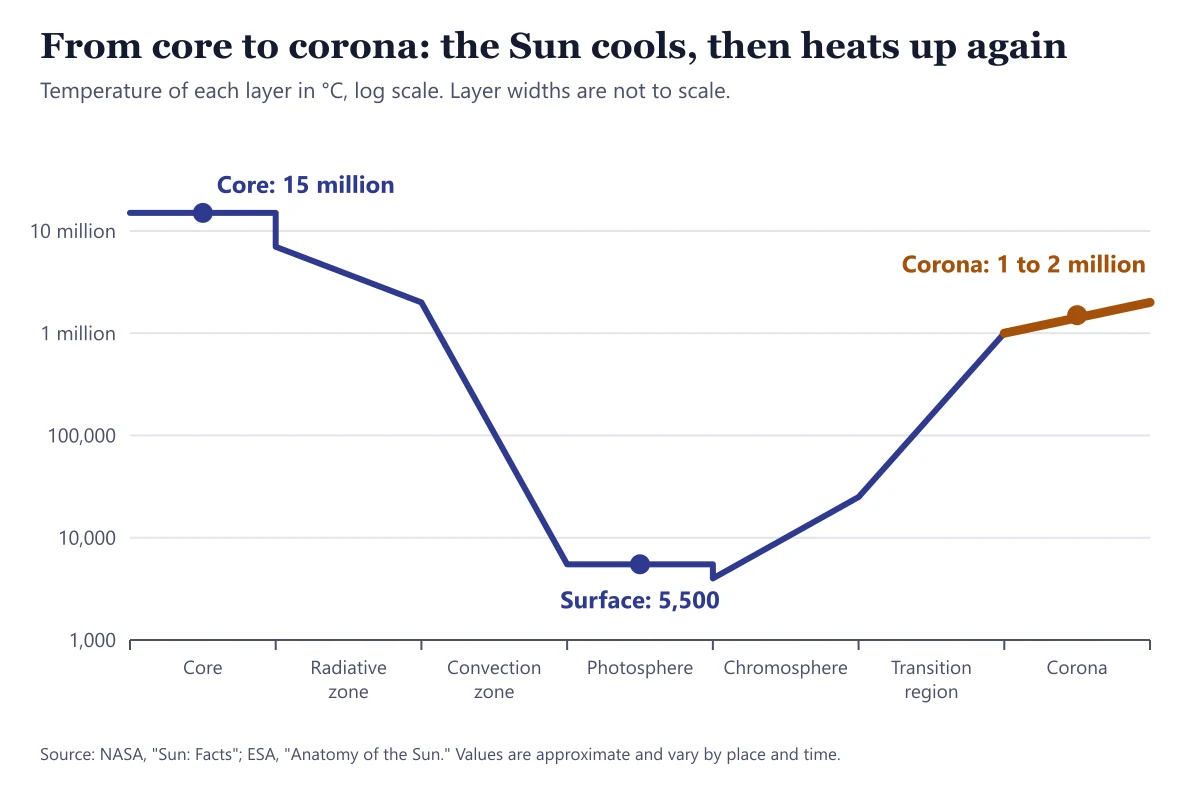
It depends on where you measure. NASA puts the temperature of the core at about 15 million °C (27 million °F), hot enough to fuse hydrogen into helium. The visible "surface" is only about 5,500 °C (10,000 °F), which NASA notes is still hot enough to make carbon boil. ESA gives a range of 4,500 to 6,000 °C (about 8,000 to 11,000 °F), because the surface temperature varies from place to place. Above the surface, the temperature climbs again:
| Layer | Temperature |
|---|---|
| Core | About 15 million °C (27 million °F) |
| Radiative zone | About 7 million °C at the base, 2 million °C at the top |
| Convection zone | About 2 million °C at the base, 4,500 to 6,000 °C at the top |
| Photosphere (the "surface") | About 5,500 °C (10,000 °F) |
| Chromosphere | About 4,000 to 25,000 °C (7,000 to 45,000 °F) |
| Transition region | Rises to nearly 1 million °C (1.8 million °F) |
| Corona | 1 to 2 million °C (about 2 to 3.5 million °F) |
Temperature by layer of the Sun. Sources: NASA Science, "Sun: Facts"; ESA, "Anatomy of the Sun." Values are approximate.
The Sun has no solid surface. NASA calls the photosphere the part seen from Earth, and it is the layer that sends out most of the Sun's visible light. How that light turns the sky blue and sunsets red is in Why Is the Sky Blue? Even the dark sunspots are not cold: ESA says they are about 1,000 degrees cooler than the area around them, which is why they look dark.
Why is the Sun's core so much hotter than its surface?
The core is where the Sun makes its energy. NASA says the heat and pressure there fuse hydrogen into helium, which creates the outward pressure that keeps the Sun from collapsing. ESA says the Sun uses up four million tonnes of hydrogen every second this way. The core is about 86,000 miles (138,000 km) thick.
The energy then has a very long way out. Both NASA and ESA put the trip through the Sun's dense inner layers at about 170,000 years, because light there bounces from atom to atom. Once it reaches the surface it escapes into space, and it needs only about eight minutes to cover the 93 million miles (150 million km) to Earth. The size of that gap is easier to feel in How Far Is a Light-Year? and the distance to each planet is in Planets in Order From the Sun.
So far the pattern makes sense: the farther from the fusion furnace, the cooler. The chart shows how it holds until the surface, and then breaks.
Why is the Sun's atmosphere hotter than its surface?
Above the surface are the chromosphere, a thin transition region and the corona. ESA says the chromosphere warms from about 4,000 to 25,000 °C, and across the transition region the temperature soars to nearly 1 million °C. The corona is above 1 million °C by ESA's figures, and NASA says it reaches up to 2 million °C (3.5 million °F). ESA calls it more than 150 times hotter than the surface.
That should not happen. ESA's reasoning is simple: the Sun's energy comes from the core, and things get cooler the farther they are from a heat source, so another way of moving energy into the corona must be at work. NASA's picture is walking away from a bonfire and getting warmer. It calls the source of the corona's heat a major unsolved puzzle in the study of the Sun.
The corona is also very thin. ESA says its density is typically about one trillionth of the photosphere's. It is extremely hot but nearly empty, a detail that matters in the last section.
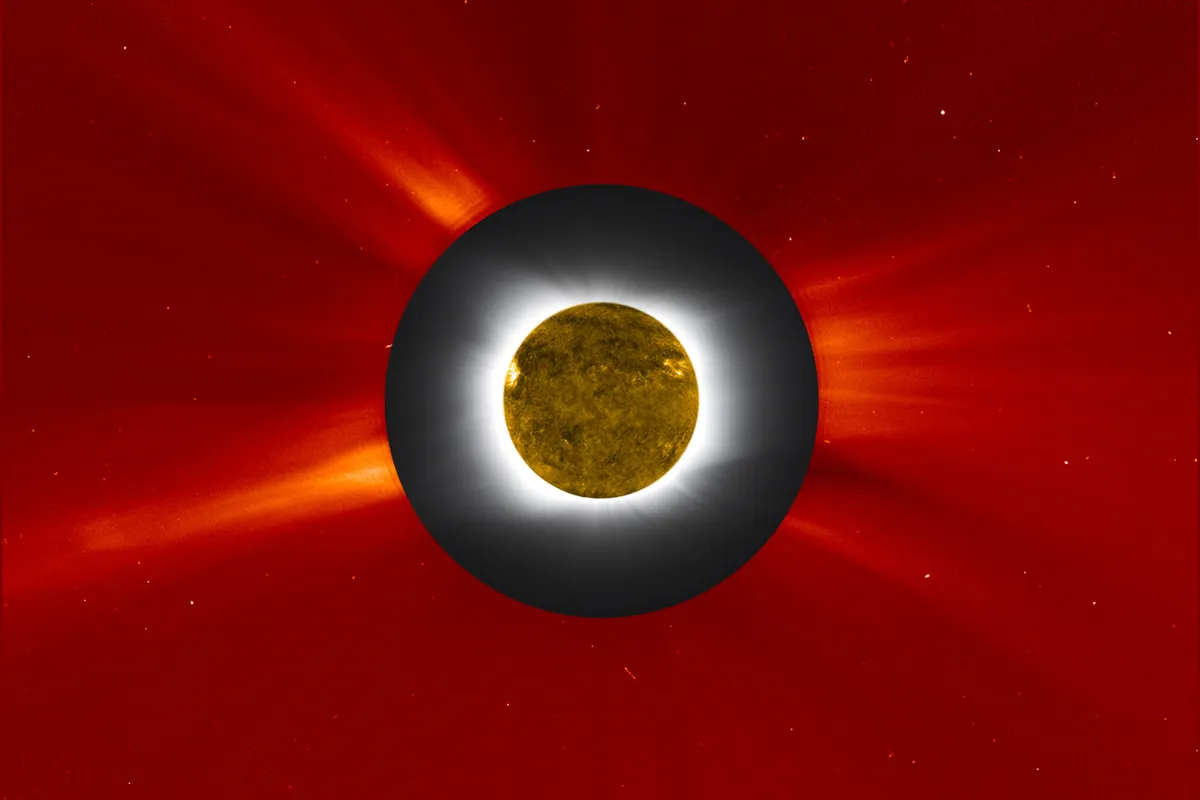
Scientists can see the corona from the ground only during a total solar eclipse, when NASA says it looks like a white crown around the dark Moon. I covered where to see the next one in my guide to the Aug. 2, 2027 total solar eclipse. The iron in that 1869 green line is a good example of what the heat does: gas that hot is plasma, with electrons torn off its atoms, and What Is Inside an Atom? shows what those electrons are.
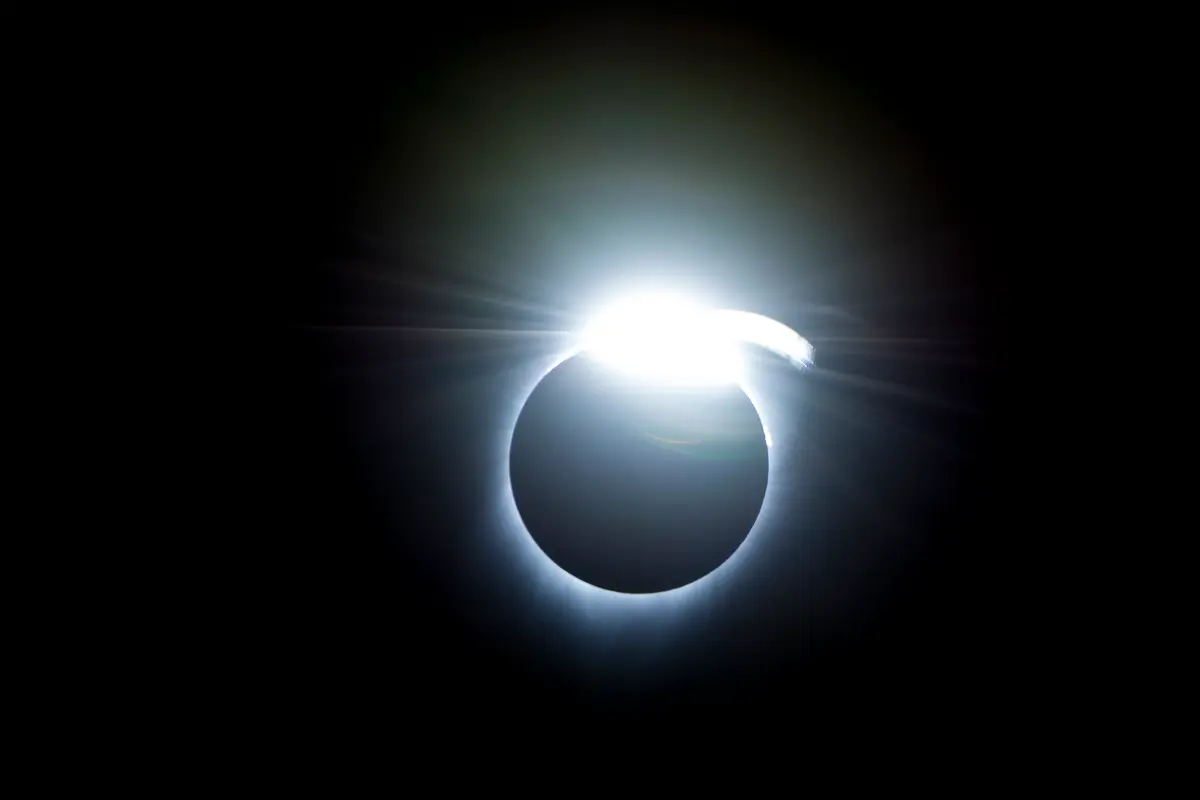
What could heat the corona?
Nobody knows for certain. NASA describes two leading ideas. Both start in the Sun's boiling outer layers, where churning plasma tangles magnetic fields, and both try to explain how that energy ends up as heat in the corona.
| Idea | What it says | What would show it |
|---|---|---|
| Waves | Magnetic waves called Alfvén waves travel up from the Sun and spin charged particles, heating the atmosphere | Wave activity in electric and magnetic field data |
| Nanoflares | Countless tiny explosions from magnetic reconnection dump heat into the atmosphere | Jets of particles shooting in opposite directions, and hot spots where fields change fast |
The two main ideas for heating the corona. Source: NASA, "NASA's Parker Solar Probe and the Curious Case of the Hot Corona" (2018).
The two ideas are not rivals. NASA says many scientists think both may be involved, and a nanoflare could even launch the waves. ESA adds turbulence, which it compares to stirring a cup of coffee: energy passes from big motions to ever smaller ones until it reaches individual particles and turns into heat. In the corona the fluid is also magnetized, so stored magnetic energy joins in.
What has NASA's Parker Solar Probe found?
Parker launched in August 2018 to fly into the corona itself. On April 28, 2021, at 18.8 solar radii (about 8.1 million miles) from the Sun, it met the magnetic and particle conditions that told scientists it had crossed the Alfvén critical surface, the boundary where the solar atmosphere ends and the solar wind begins. NASA announced on Dec. 14, 2021 that a spacecraft had touched the Sun for the first time. The boundary turned out to be wrinkled, with spikes and valleys, instead of a smooth ball.
Parker has since gone much closer. Its record is 3.8 million miles (about 6.1 million km) from the solar surface at 430,000 miles per hour, set on Dec. 24, 2024 and matched on seven flybys since, most recently its 29th close approach on Sept. 4, 2026. NASA says that flyby gathered data from inside the corona, and that the mission has been extended into 2029.
The probe is also turning up details about the Sun's magnetic explosions. In a 2022 flyby it passed between the Sun and a reconnection event in the solar wind and found that protons and heavier ions were accelerated in different ways, which the standard theories did not expect. NASA published that result in April 2026. In my view, that is progress on how magnetic energy turns into fast particles, not an answer to the heating puzzle. Neither NASA nor ESA says the puzzle is solved.
What has ESA's Solar Orbiter added?
Solar Orbiter launched in February 2020 and comes no closer than about 42 million km (about 26 million miles). That is farther than Parker, but it carries cameras and ten instruments, so it can watch the Sun and its corona while measuring particles and fields. ESA says Parker largely skips imaging the Sun itself to get closer, which makes the two spacecraft a team.
On June 1, 2022, ESA's team rolled Solar Orbiter 45 degrees so its coronagraph, Metis, could see the corona with Parker in view. Together the two spacecraft made the first estimate of the rate at which the corona is heated. ESA says the result shows turbulence is almost certainly part of the answer, though more work is needed before the problem can be called solved.
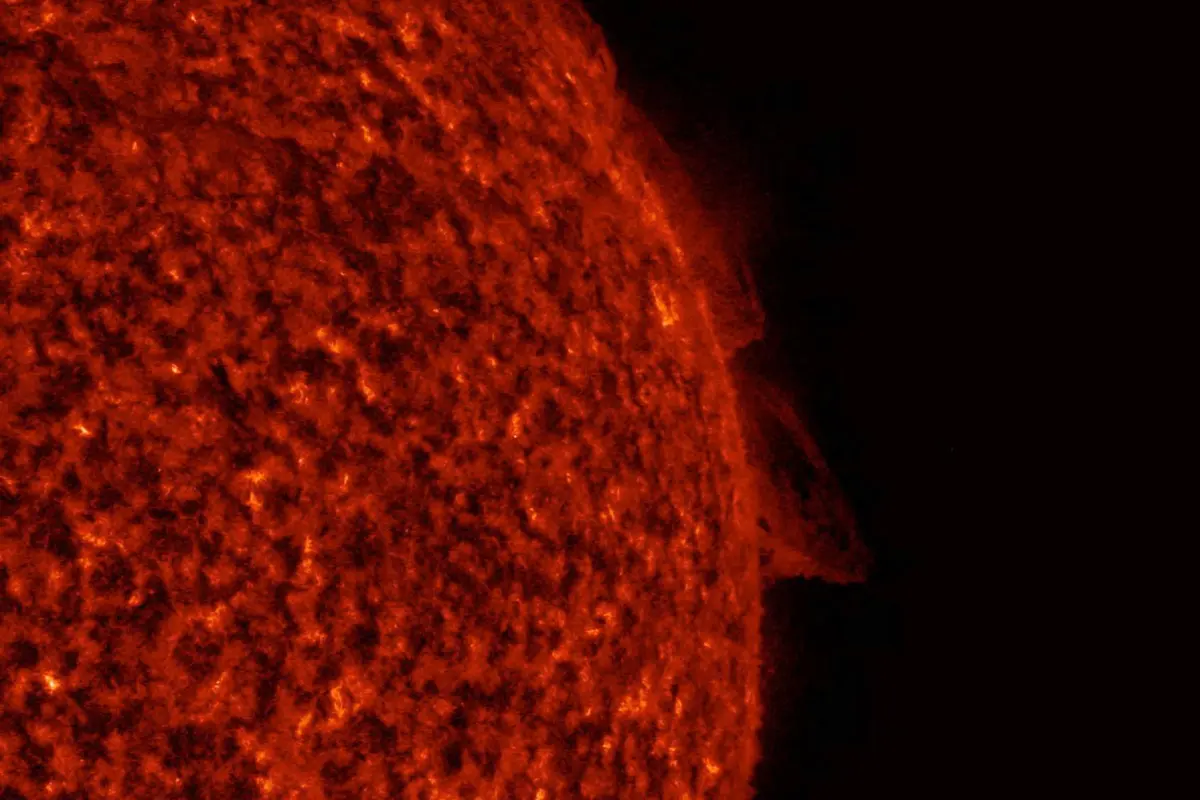
The newest result is from Oct. 8, 2026. Solar Orbiter flew through a very large "switchback," an S-shaped kink in the solar wind's magnetic field. The particles inside it carried the fingerprint of hot magnetic loops at the Sun's surface, the "smoking gun," in ESA's words, for a process called interchange reconnection. The team also saw signs of waves and turbulence, but only after the switchback had left the Sun. ESA says this fits both leading ideas into one story, and that it sheds light on how the Sun heats its atmosphere and speeds up the solar wind.
Why doesn't a spacecraft melt in a corona that hot?
Temperature and heat are different things. NASA explains that temperature measures how fast particles move, while heat is the total energy they pass on. The corona has an extremely high temperature but very low density, so few particles hit the spacecraft. NASA compares it to a hand in a hot oven versus in boiling water: a hand can stand a much hotter oven for longer than boiling water, because in the water it meets many more particles.
Parker also has a shield. Its heat shield is a carbon-composite sandwich 4.5 inches (about 11.4 cm) thick. NASA says there is no temperature sensor on the front, but models put it at about 930 °C (1,700 °F) at closest approach, about as hot as molten lava, which NASA puts at 700 to 1,200 °C. The temperature behind the shield has stayed steady on every pass, which NASA's engineers read as a sign the shield is not wearing out.
Solar Orbiter, much farther out, was tested to withstand 500 °C and gets 13 times the solar heating that satellites in Earth's orbit receive, according to ESA.
Is the Sun's heating puzzle solved?
Not yet. The Sun is hottest at its core, cools to about 5,500 °C at the surface, and then heats up again to 1 to 2 million °C in the corona. Heat from the core cannot explain the corona, so something else must carry energy up from the Sun's churning magnetic layers. Waves, nanoflares and turbulence are the main suspects, and the latest ESA and NASA results suggest more than one is involved.
This matters beyond curiosity. ESA says the solar wind starts in the corona, and NASA says understanding it helps forecast space weather. The same wind powers the displays in What Causes the Northern Lights? My read: with Parker's mission extended to 2029, this is a question that could get a firmer answer within a few years, but I would treat any "solved" headline carefully until NASA or ESA says so.
Frequently asked questions
How hot is the Sun?
About 15 million °C (27 million °F) in the core and about 5,500 °C (10,000 °F) at the visible surface, according to NASA. The Sun's outer atmosphere, the corona, reaches 1 to 2 million °C (about 2 to 3.5 million °F).
How hot is the surface of the Sun?
NASA gives about 5,500 °C (10,000 °F) for the photosphere, the layer called the surface. ESA gives a range of 4,500 to 6,000 °C because the temperature varies from place to place.
Why is the corona hotter than the surface of the Sun?
Scientists do not know for certain. The leading ideas are Alfvén waves, countless tiny magnetic explosions called nanoflares, and turbulence. NASA says many scientists think more than one is involved, and ESA and NASA spacecraft are collecting data to test them.
Has anything ever touched the Sun?
NASA's Parker Solar Probe flew through the Sun's corona for the first time on April 28, 2021, and NASA announced in December 2021 that a spacecraft had touched the Sun. It did not touch the surface: its closest approach is about 3.8 million miles (6.1 million km) above it.
Why doesn't Parker Solar Probe melt?
The corona is extremely hot but very thin, so few particles hit the spacecraft and little heat reaches it. A 4.5-inch (11.4 cm) carbon-composite heat shield does the rest, reaching about 930 °C (1,700 °F) by NASA's models.
How long does energy take to get from the Sun's core to its surface?
Both NASA and ESA put the trip through the Sun's dense inner layers at about 170,000 years. Once light leaves the surface, it reaches Earth in about eight minutes.
Can you see the Sun's corona from Earth?
With your eyes, only during a total solar eclipse, when the Moon hides the bright surface and the corona appears as a white crown. Space telescopes use a disk called a coronagraph to block the surface light and see it at any time.
Sources
- NASA Science, "Sun: Facts" (accessed November 4, 2026)
- ESA, "The Sun" (accessed November 4, 2026)
- ESA, "Anatomy of the Sun" (accessed November 4, 2026)
- NASA, "NASA's Parker Solar Probe and the Curious Case of the Hot Corona" (July 27, 2018)
- NASA, "NASA Enters the Solar Atmosphere for the First Time, Bringing New Discoveries" (December 14, 2021)
- NASA, "After Latest Swing Past Sun, NASA's Parker Solar Probe Checks in" (September 10, 2026)
- NASA, "Parker Solar Probe Makes 28th Close Pass of Sun" (June 11, 2026)
- NASA, "NASA's Parker Solar Probe Finds Surprises in an Explosion Near the Sun" (April 15, 2026)
- NASA, "Traveling to the Sun: Why Won't Parker Solar Probe Melt?" (July 19, 2018)
- ESA, "Solar Orbiter" and "Solar Orbiter factsheet" (accessed November 4, 2026)
- ESA, "Solar Orbiter closes in on the solution to a 65-year-old solar mystery" (September 14, 2023)
- ESA, "Solar Orbiter tracks origin of mysterious magnetic switchbacks" (October 8, 2026)

Founder and editor, Orbit and Atom
I write Orbit and Atom to explain space and science in plain English, starting from what NASA, ESA and the mission teams publish. Every article lists its sources at the end so you can read them yourself.