Solar System & Missions
Why Does Venus Spin Backward? What Scientists Think
Quick answer
Nobody knows for sure. Venus spins clockwise, opposite to Earth, and so slowly that one day lasts 243 Earth days, longer than its 225-day year. Scientists have three main ideas: an ancient giant impact, the Sun's tides pulling on its very thick atmosphere, or a long-gone moon. A new 2026 study backs the atmosphere. All three are still hypotheses.
On this page
- Why does Venus spin backward?
- What does it mean that Venus spins backward?
- How do we know how fast Venus turns?
- Did a giant impact flip Venus?
- Could the Sun's tides and the thick atmosphere do it?
- Did a lost moon slow Venus down?
- What did the new 2026 study find?
- Is Venus's spin even steady?
- What would settle the question?
- FAQ
- Sources
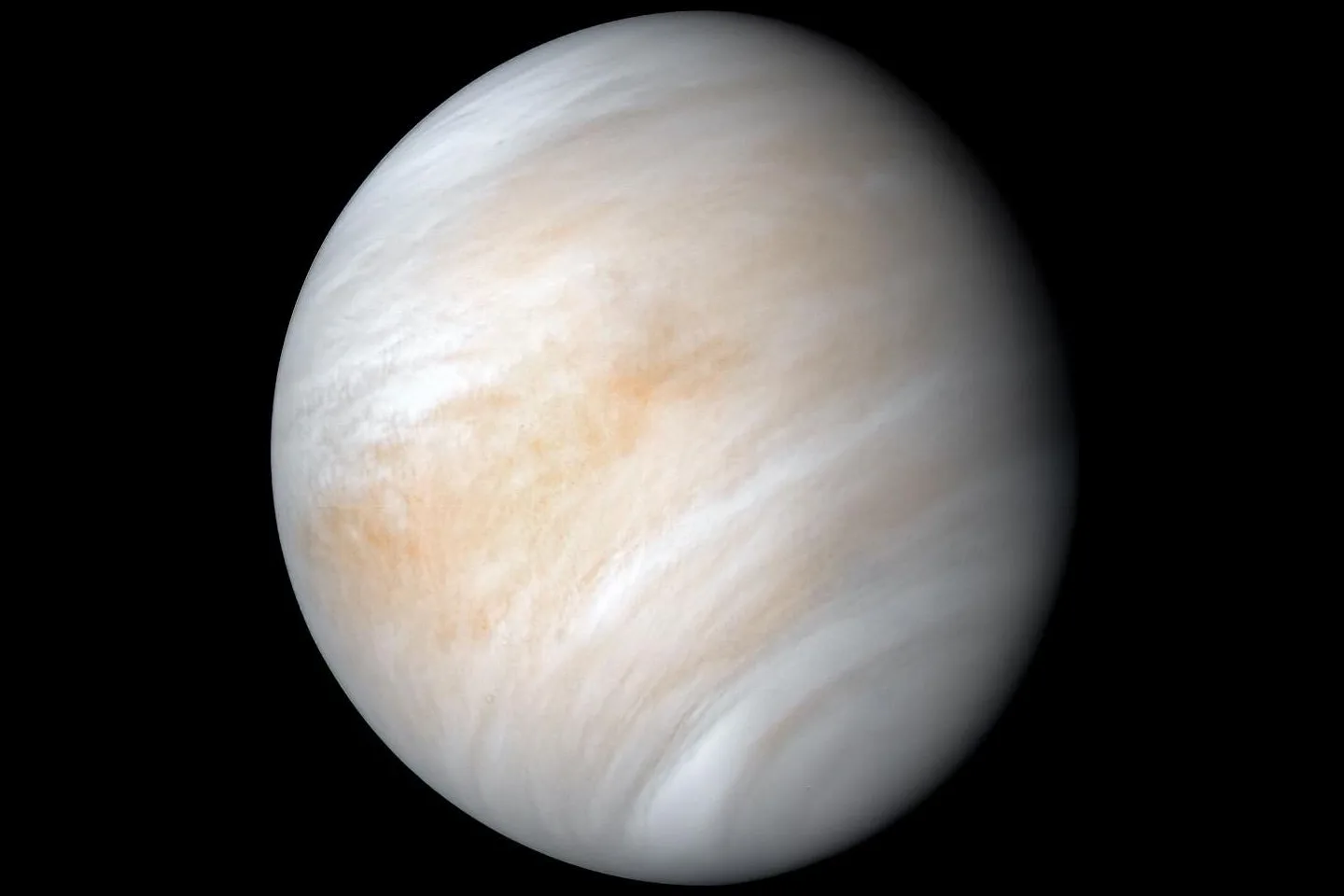
Stand on Venus, if you could, and the Sun would come up in the west. It would crawl across a sky you could not see through the clouds, and set in the east about 58 Earth days later, if my arithmetic is right. Then it would be dark for just as long.
Venus is one of only two planets in our solar system that turn the "wrong" way, and its spin is also painfully slow. Why it ended up like this is a real open question, and a new study published this year gives it a fresh twist. If you want the planet in context first, start with my guide to the planets in order from the Sun.
Why does Venus spin backward?
The honest answer has two parts. Why it spins backward today is fairly well understood: it is a balance between two pushes, the Sun's gravity tugging on the planet's body and the Sun's heat tugging on its enormous atmosphere. How it got there is where the arguments begin. Impact, tides and a vanished moon are the three explanations I found in the research, and each has a real paper behind it.
That matters for how you read any headline about this. A new model that "explains" Venus's spin shows a way it could have happened. It does not prove it did. Nobody was there, and Venus keeps its history hidden under a thick layer of clouds.
What does it mean that Venus spins backward?
Most planets turn counterclockwise when you look down from above their north pole, the same way they circle the Sun. Venus turns the other way. NASA's Venus facts page says it "spins slowly in the opposite direction from most planets," and that the Sun would rise in the west and set in the east. The Agência FAPESP report on the new study names Uranus as the other planet that turns east to west. Uranus has its own, different story.
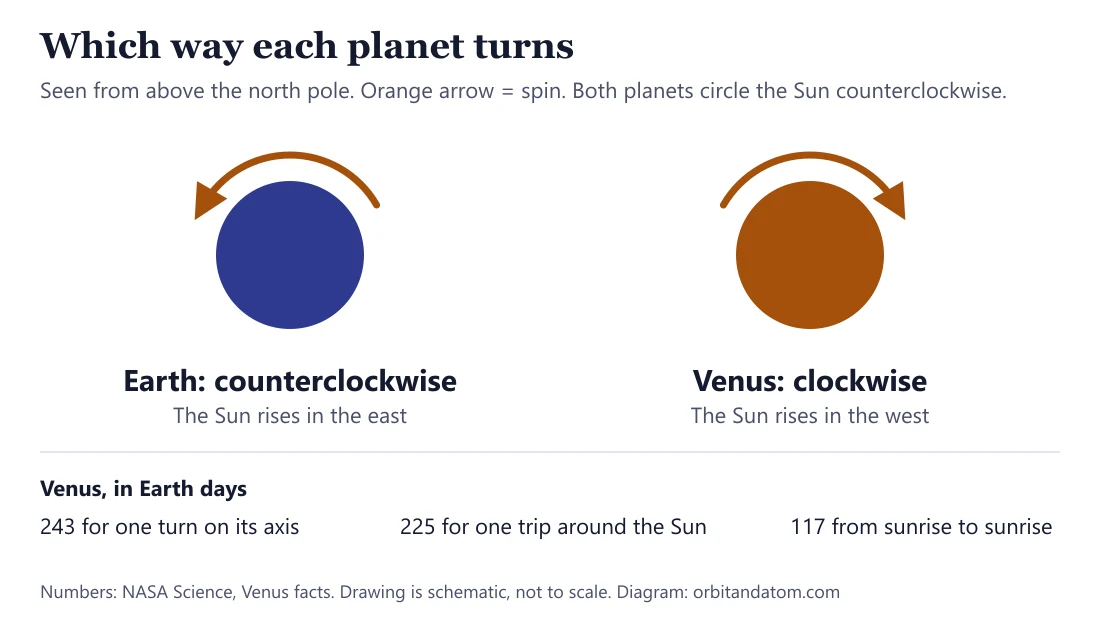
Here is the strange arithmetic, using NASA's numbers. One turn on its axis takes Venus 243 Earth days. One trip around the Sun takes only 225. So a Venus "day" in the sense of a full turn is longer than its year. Because the spin runs against the orbit, the time between one sunrise and the next is shorter than either, about 117 Earth days (NASA's figure; my check: 1 ÷ (1/243 + 1/225) is about 117).
| Thing | Venus | Earth |
|---|---|---|
| Direction of spin | Clockwise | Counterclockwise |
| One turn on its axis | 243 days | 1 day |
| One orbit of the Sun | 225 days | 365 days |
| Speed at the surface | About 4 mph | About 1,000 mph |
| Tilt of the axis | About 3 degrees | About 23 degrees |
Venus numbers from NASA Science (Venus facts and the Mariner 10 image page), read November 20, 2026. Earth values are the usual ones.
The surface speed is a nice way to feel it. NASA says the solid planet turns at about 4 miles per hour (under 2 meters per second) at the equator, against roughly 1,000 miles per hour (450 meters per second) on Earth. That is about a walking pace. Above the ground the air does the opposite: NASA says the clouds race around Venus in about four and a half days, blowing west, "because the planet itself rotates to the west."
The tilt is small, so Venus has no real seasons. You can also describe Venus as turned almost upside down, about 177 degrees, instead of spinning backward. That 177 is my own subtraction from the roughly 3 degrees NASA gives, and it is the same thing seen from another angle.
How do we know how fast Venus turns?
With radar, because Venus is wrapped in clouds that hide its surface. For centuries astronomers could not agree. The Observatoire de Paris account by Jacques Laskar describes how early observers guessed about 23 hours, and how in 1890 Giovanni Schiaparelli proposed that Venus kept one face to the Sun, turning once per orbit. The real answer came in 1962, when radar signals bounced off the surface showed a slow turn in the retrograde direction, "at the great surprise of astronomers," in Laskar's words.
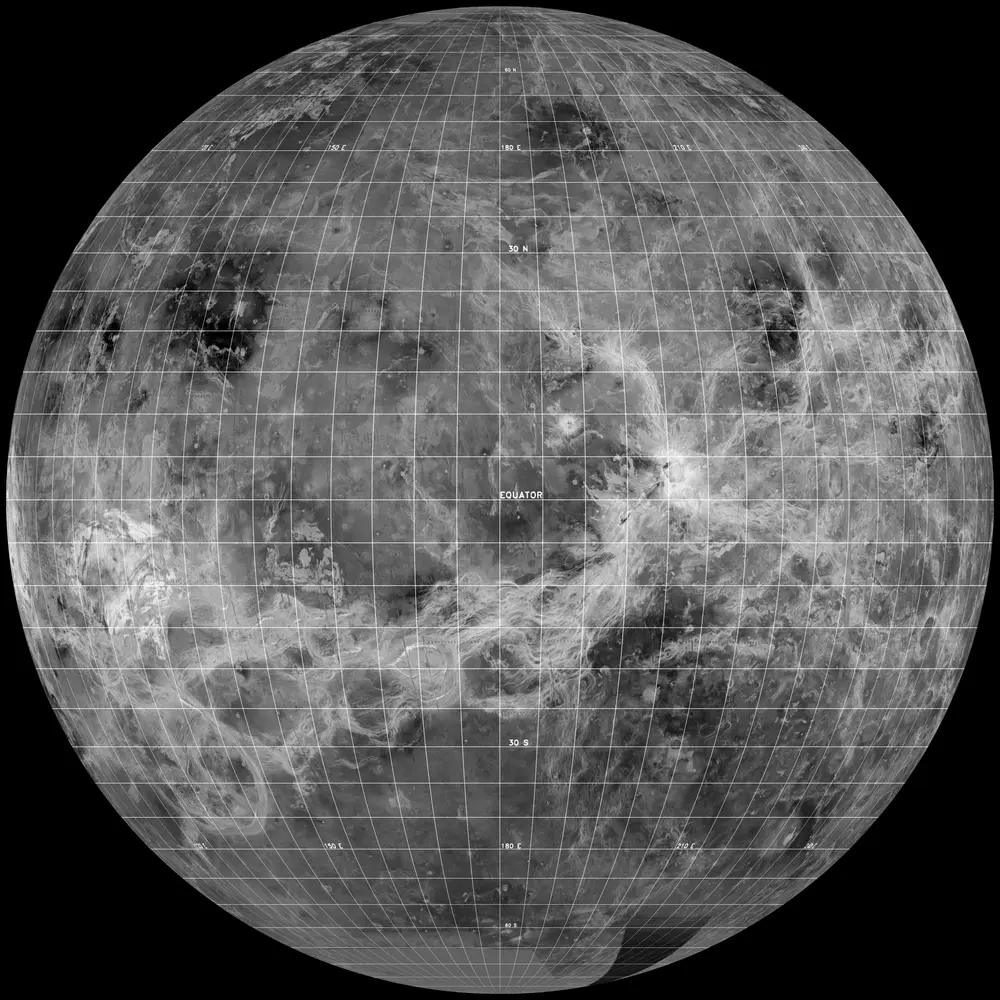
Later radar work made the number precise. NASA's Magellan orbiter watched surface features pass beneath it for four years and gave a day of 243.0185 Earth days, according to ESA. Then, from 2006 to 2020, a team led by Jean-Luc Margot of UCLA bounced radio waves off Venus from the Goldstone antenna in California 21 times and reported an average of 243.0226 days in the journal Nature Astronomy. Margot's own phrase for the method is that Venus works like "a giant disco ball."
Did a giant impact flip Venus?
It is the oldest idea, and a 2025 study kept it alive. A team led by Mirco Bussmann ran computer simulations of a last big collision on Venus, with impactors from 0.01 to 0.1 Earth masses, hitting at 10 to 15 kilometers per second. Their abstract says a wide range of impacts match Venus's slow retrograde spin today. Two examples: a head-on hit on a planet that was not spinning, or an angled hit-and-run by a Mars-sized body on one that was.
There is a bonus. Those matching impacts leave little debris orbiting Venus, so the material would likely fall back onto the planet. The team notes that this fits another oddity: Venus has no moon. I read the abstract of the paper, which is a preprint posted on arXiv in August 2025, not the full text, so treat this as one team's simulation.
The catch is the evidence. I found no scar on Venus that the sources point to as the mark of such a crash. NASA notes that, apart from Earth, Venus has by far the fewest impact craters of any rocky planet, which in my view makes an ancient scar hard to point to. An impact can explain the spin, but nobody can show the crash.
Could the Sun's tides and the thick atmosphere do it?
This is the idea with the longest paper trail. In Laskar's account, the Sun's pull on the body of Venus acts like a brake. Left alone, it would slow the planet until it kept one face to the Sun, as the Moon does with Earth. But the Sun also heats the dense atmosphere unevenly, which shifts air around and creates a second, opposing push that speeds the rotation up. Laskar credits Gold and Soter in 1969 with spotting that the unusual spin is a balance between these two effects.
In 2001, Alexandre Correia and Jacques Laskar showed in Nature that this balance can end in only four stable spin states for a planet like Venus, two forward and two backward. Scientific American's report on that paper explains the twist. The older theory said Venus flipped upside down. Correia and Laskar suggested it may never have flipped: its spin could have slowed to a standstill and then reversed. They also found Venus would be more stable in one of the two retrograde states. The magazine put it as just a question of time before Venus ended up spinning backward.
Did a lost moon slow Venus down?
A third idea sounds like science fiction, but it was published in the journal Universe in 2024. Valeri Makarov and Alexey Goldin simulated a small body that Venus captures into a backward orbit. Its tides slowly brake Venus's original forward spin, then reverse it, while the moon's orbit keeps shrinking. In the end, the authors write, it reaches the Roche radius, breaks up and probably rains most of its material onto Venus's surface. They call it "Neith," a historical name.
In their scenario the moon is destroyed, which would fit Venus having none today. The authors say the chance of such a capture from one encounter is low, but argue it becomes possible in the crowded early solar system. I read the abstract, so the details are theirs. In my opinion it is the most speculative of the three, which is fine, as long as it is labeled that way.
What did the new 2026 study find?
A team in Brazil argues that no collision is needed at all. Sylvio Ferraz Mello and colleagues at the Institute of Astronomy, Geophysics and Atmospheric Sciences of the University of São Paulo published the work in The Astronomical Journal, and Agência FAPESP reported it on September 2, 2026. I read the FAPESP report and the paper's abstract, not the full paper.
Their model combines the same two pushes: gravitational tides and the atmosphere's thermal torque. The key result is about timing. With almost no atmosphere, tides alone give one stable state, a spin locked to the orbit. As the atmosphere builds up from gases released by the planet's interior, the system reaches a tipping point and splits into two new stable states, one faster and one slower. "In the case of Venus, it followed the slower path until it reversed direction," Ferraz Mello says in the report.
They also tested what holds Venus there. FAPESP says that without its atmosphere, tides alone would send Venus back to a forward spin in less than a million years. And the same reasoning, the team says, could apply to rocky planets in the habitable zone of other stars. That is a prediction from a model, not a measurement. If you like that exoplanet angle, see my guide to how astronomers find exoplanets.
Is Venus's spin even steady?
No, and that is one of the best reasons the question is hard. In 2012 ESA reported that the Venus Express orbiter, using infrared to see through the clouds, found surface features up to 20 kilometers away from where Magellan's measurements said they should be. To line the two maps up, the Venus day had to be about 6.5 minutes longer on average than Magellan's value.
Margot's radar team found the same restlessness. The length of a Venus day changes by at least 20 minutes between measurements, and they point to the atmosphere. As it sloshes around the planet, it trades momentum with the solid ground. UCLA says the same thing happens on Earth but adds or subtracts only about a millisecond per day, whereas Venus's atmosphere is roughly 93 times as massive as ours.
The Brazilian team adds a warning of its own. Venus may sit close to a stability threshold, and current observations are not precise enough to rule out slow changes in its spin period. So Venus is not a clock. It is more like a spinning top that the weather keeps nudging.
What would settle the question?
Better data on what is inside Venus. ESA says detailed measurements of the planet's spin help scientists work out whether its core is solid or liquid, which in turn shapes how the planet reacts to the Sun's pull. Margot's team estimates the core at about 3,500 kilometers across, close to Earth's, but cannot say yet whether it is liquid.
NASA's VERITAS orbiter is designed for that kind of job. NASA says it will map the surface in far more detail than Magellan and give insight into the interior of Venus, with a gravity science investigation among its tasks. I did not find a launch date on NASA's page, so I am not giving one. Whatever flies next, precise spin measurements will make the tidal models much sharper.
You can also keep an eye on the planet itself. Venus is in the pre-dawn sky now, and my guide to what planets you can see in November 2026 says when and where to look. The slowest-turning planet is also one of the brightest things in the morning sky, and it is a good excuse to read about its neighbors in Solar System & Missions. For another case where gravity's pull shapes a world's spin, my guide to what gravity is covers the basics, and the tides that tug on the Moon are in why the Moon is drifting away.
I think the best way to hold this story is simple. Venus's backward spin is real and measured, the present balance of tides and atmosphere is well understood, and the origin is still a contest between ideas. Any one of them could be right, or a mix.
Frequently asked questions
Why does Venus spin backward?
Nobody knows for sure. Scientists have three main ideas: an ancient giant impact, the Sun's tides acting on Venus's thick atmosphere, or a long-lost moon. A 2026 study supports the atmosphere idea, but all three remain hypotheses.
Which way does Venus rotate?
Clockwise when seen from above its north pole, opposite to Earth and most planets. NASA says the Sun would rise in the west and set in the east.
How long is a day on Venus?
One turn on its axis takes about 243 Earth days, longer than its 225-day year. NASA gives about 117 Earth days for the time from one sunrise to the next, because the spin runs against the orbit.
Is Venus's rotation constant?
No. Venus Express found a day about 6.5 minutes longer than Magellan measured, and radar work led by UCLA found changes of at least 20 minutes between measurements, which the team blames on the atmosphere exchanging momentum with the planet.
Does any other planet spin backward like Venus?
Uranus also turns east to west, according to the Agência FAPESP report on the 2026 study, but Uranus lies on its side, so its story is different.
Why is the Sun rising in the west on Venus?
Because the planet turns clockwise seen from above the north pole. NASA says the clouds also blow west because the planet itself rotates to the west.
Sources
- NASA Science, "Venus Facts" (page last updated November 12, 2026; accessed November 20, 2026). Used for the spin direction, day and year, sunrise time, tilt and wind speed.
- NASA/JPL-Caltech, "Venus from Mariner 10" (PIA23791, June 2020). Used for cloud speed, surface speed and the cover photo caption.
- ESA, "Could Venus be shifting gear?" (February 10, 2012). Used for the Magellan and Venus Express rotation values.
- ESA Science & Technology, "Spinning Venus is slowing down" (Venus Express major discoveries). Used for the 20 km shift and the core question.
- UCLA Newsroom, "How long is a day on Venus? Scientists crack mysteries of our closest neighbor" (April 29, 2021). Used for the radar measurements and the atmosphere's mass.
- Margot et al., "Spin state and moment of inertia of Venus" (arXiv:2103.01504, published in Nature Astronomy, 2021). Used for 243.0226 days and the 20-minute variations.
- Jacques Laskar, Observatoire de Paris, "The retrograde rotation of Venus". Used for the radar discovery in 1962 and the tide-balance explanation.
- Scientific American, "Why Venus Spins the Wrong Way" (June 15, 2001), on Correia and Laskar's paper in Nature. A 2001 news report.
- Bussmann et al., "The possibility of a giant impact on Venus" (arXiv:2508.03239, August 2025). Preprint; I read the abstract.
- Makarov and Goldin, "Chaotic Capture of a Retrograde Moon by Venus and the Reversal of Its Spin" (Universe, 2024). I read the abstract.
- Agência FAPESP, "New physical model explains Venus's retrograde rotation as a natural result of planetary evolution" (September 2, 2026). News report on a study in The Astronomical Journal; I did not read the full paper.
- Ferraz Mello et al., "Exoplanet Synchronization in the Habitable Zone: Learning from Venus' Retrograde Rotation" (The Astronomical Journal, 2026). Abstract only.
- NASA Science, "VERITAS" (accessed November 20, 2026). Used for what the mission will map and measure.
- NASA/JPL, "Venus - Global View Centered at 180 degrees" (PIA00478), Magellan radar mosaic. Used for the globe image.

Founder and editor, Orbit and Atom
I write Orbit and Atom to explain space and science in plain English, starting from what NASA, ESA and the mission teams publish. Every article lists its sources at the end so you can read them yourself.