Solar System & Missions
How Far Away Is the Moon, and Is It Drifting Away?
Quick answer
The Moon is an average of 238,855 miles (384,400 kilometers) from Earth, and it is drifting away. NASA says it swings from about 226,000 miles at its closest to about 251,000 miles at its farthest during each 27-day orbit. Lasers aimed at reflectors left by Apollo astronauts show the Moon moving out about 1.5 inches (3.8 centimeters) a year, pushed by Earth's ocean tides.
On this page
- How far away is the Moon?
- Why does the Moon's distance keep changing?
- How do scientists measure the distance to the Moon?
- Is the Moon really moving away from Earth?
- Why is the Moon drifting away?
- How far has the Moon moved since the Apollo landings?
- Will the Moon ever leave Earth?
- How can you picture the Moon's size and distance?
- Are new Moon reflectors on the way?
- FAQ
- Sources
On a clear night the Moon looks close enough to reach. Light, the fastest thing there is, still needs more than a second to cover the gap.
The number most people want is simple, and it has a surprise attached: the gap grows a little every year.
How far away is the Moon?
NASA gives the Moon's average distance as 238,855 miles (384,400 kilometers). Its Moon Facts page adds a picture for scale: 30 Earth-sized planets would fit in the space between Earth and the Moon. The Moon itself is small by comparison, with a radius of about 1,080 miles (1,740 kilometers), less than a third of Earth's width.
Light covers that distance in about 1.3 seconds; the ladder of light-seconds, light-minutes and light-days is in my light-year guide. A radio message or a laser pulse that goes there and back takes roughly twice that, about 2.6 seconds (my arithmetic, from NASA's 1.3).
The figure is not a rough guess. A NASA Goddard page on laser ranging says the average distance between the centers of Earth and the Moon is known to better than one part in 10 billion.
Why does the Moon's distance keep changing?
The Moon's orbit is not a perfect circle. NASA says that during each 27-day trip around Earth, the Moon reaches a closest point, called perigee, about 226,000 miles (363,300 kilometers) away. Half an orbit later it reaches its farthest point, apogee, about 251,000 miles (405,500 kilometers) away.
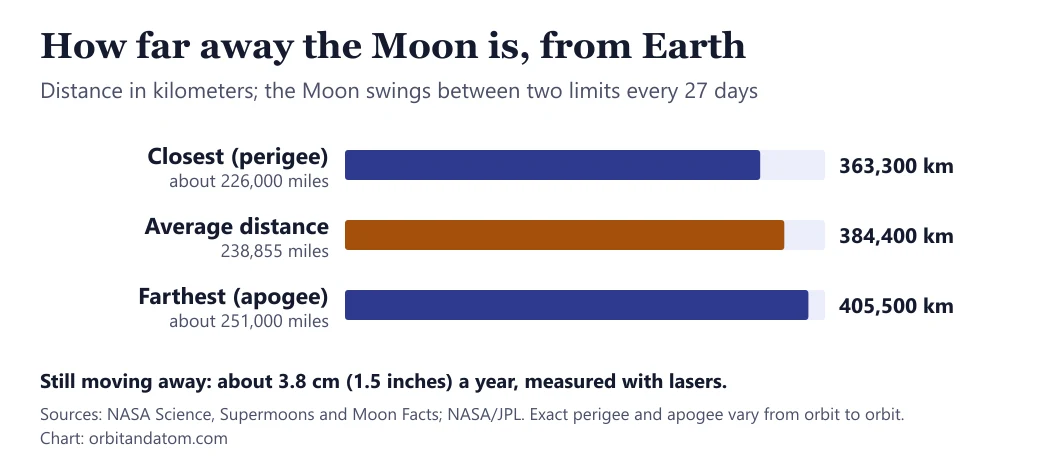
That last point matters. NASA says the orbit wobbles and depends on where the Sun and Earth are, so some close approaches are closer than others. The International Laser Ranging Service, which tracks the Moon with lasers, describes the distance it has to cope with as roughly 357,000 to 407,000 kilometers.
This is the reason for supermoons. NASA defines one as a full Moon that coincides with perigee, and says the term is usually used for a full Moon within at least 90 percent of perigee. Supermoons happen three to four times a year and always come in a row. Whether a given full Moon, such as this month's Hunter's Moon, counts as a supermoon depends on where the Moon sits in its orbit that night.
How do scientists measure the distance to the Moon?
With lasers and mirrors left on the surface. In July 1969, Apollo 11 astronauts Neil Armstrong and Buzz Aldrin set up a laser ranging retroreflector in the Sea of Tranquility, and the Apollo 14 and 15 crews placed more in 1971. The Soviet Luna 17 and Luna 21 missions carried two more, in 1970 and 1973, according to the ILRS.
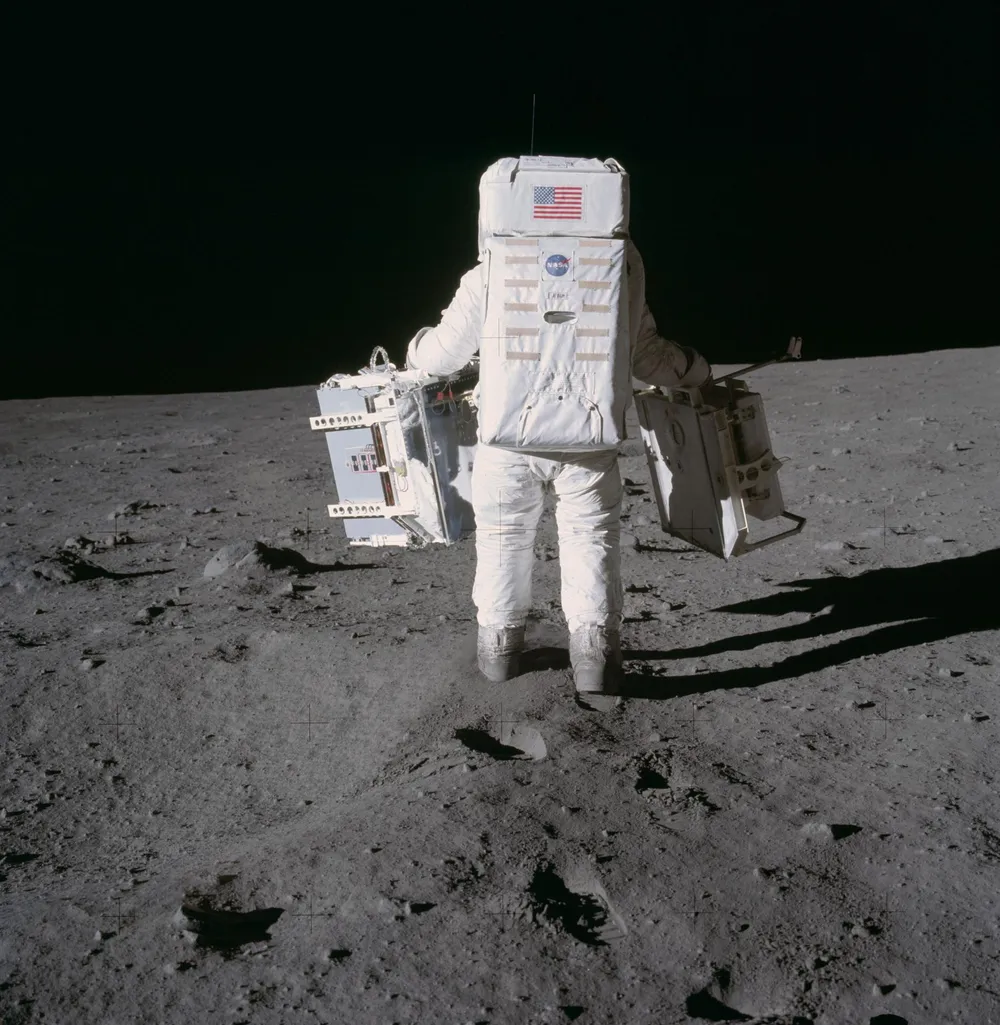
A retroreflector is an array of prisms that sends light straight back to where it came from. The Apollo 11 and 14 arrays have 100 prisms each, and the Apollo 15 array has 300. NASA's Jet Propulsion Laboratory notes that the arrays need no power, which is part of why they still work after more than half a century.
Here is the procedure. Observatories on Earth fire short laser pulses at the arrays and time how long the light takes to come back. Half the round trip, multiplied by the speed of light, gives the distance. NASA's 2019 feature says four telescopes, in New Mexico, France, Italy and Germany, do this, measuring the distance to within a few millimeters.
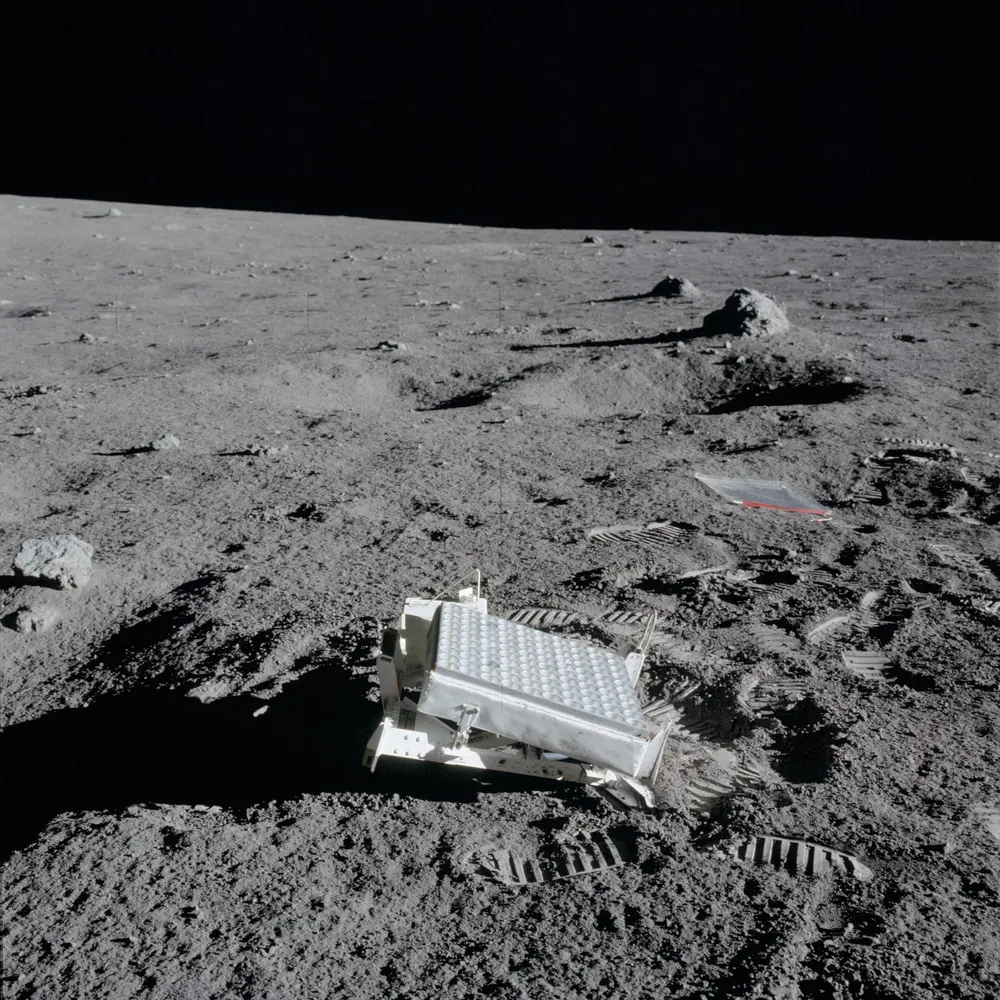
Hitting a target that small is hard. A NASA Goddard page, drawn from a 1994 science bulletin, says the beam is about four miles wide when it reaches the Moon and compares the aim to hitting a moving dime two miles away with a rifle. Only about one photon comes back every few seconds, so the observatories use extremely sensitive detectors. I find that one of the most satisfying details in the whole story: a mirror with no power supply and a handful of returning photons give us the Moon's distance.
Is the Moon really moving away from Earth?
Yes. NASA's Jet Propulsion Laboratory says lunar laser ranging has accurately shown that the distance increases by 1.5 inches (3.8 centimeters) a year. The ILRS gives the same 3.8 centimeters and calls it one of the earliest significant results of laser ranging.
NASA pages state the rate in slightly different ways. The Moon Facts page rounds it to about an inch a year, and the Tidal Locking page says about an inch and a half (4 centimeters). The laser measurement is the 3.8 centimeters; the others are rounder versions of it.
NASA also says the drift is slowing as the Moon moves out, so the rate is not locked in forever.
Why is the Moon drifting away?
The cause is the ocean tides. Earth's oceans bulge toward the Moon, but NASA explains that the bulges do not line up exactly with it. It takes time for all that water to shift and pile up, so the bulge is always a little ahead of the Moon's position.
That slightly misplaced bulge does two things:
- It slows Earth's spin. The friction of the tides drags on Earth's rotation.
- It pulls the Moon forward. The gravity of the bulge tugs the Moon along its orbit. NASA says the energy comes primarily from Earth's oceans, and the extra speed makes the Moon fall farther out. JPL puts the result at 0.1 inches (3 millimeters) each month.
The Moon also raises tides in Earth, and Earth flexes the Moon in return: JPL says the reflectors rise and fall by as much as six inches (15 centimeters) each month as the lunar rock bulges. The reflectors are part of what lets scientists tell all these effects apart.
How far has the Moon moved since the Apollo landings?
Roughly two meters. The ILRS says laser ranging has produced data for more than 57 years, since the first reflector in 1969. At about 3.8 centimeters a year, 57 years comes to around 2.2 meters, or about 7 feet. That is my own multiplication, and it assumes a steady rate, which NASA says is slowly falling, so treat it as a ballpark.
Seven feet sounds tiny next to 238,855 miles, and it is: it is about six parts in a billion of the total distance (my arithmetic again). My read is that the drift matters less as a number than as proof of how the machinery works: tides in Earth's oceans are pushing a world 239,000 miles away, and a laser can see it.
Will the Moon ever leave Earth?
NASA does not describe an escape. It describes a slow spiral outward that gradually calms down. Its Tidal Locking page runs the process far into the future: about 50 billion years from now, the page says, the Moon would be so far away, and its orbit so large, that Earth would also become tidally locked to the Moon. Only one half of the world would ever see it.
There is a catch that NASA mentions itself. That outcome only works "if the Moon and Earth could somehow avoid the eventual death of the Sun." So it is a thought experiment about the physics, not a forecast anyone should plan around.
The Moon has been through a version of this already. It is tidally locked to Earth, which is why we always see the same side, and NASA says the tidal forces that slowed the Moon's rotation long ago were also adding energy to its orbit.
How can you picture the Moon's size and distance?
NASA offers two comparisons. Set a green pea next to a U.S. nickel and you have the size of the Moon next to Earth. NASA's second comparison swaps in a coffee bean for the Moon and keeps the nickel for Earth. Put the 30 Earths from the first section in a row between them and the real gap starts to feel less empty than it sounds.
The other half of the picture is how the Moon looks. It seems large near the horizon even though it is not, which I cover in my Moon illusion guide. For the other worlds around the Sun and how far they sit, my planets in order article has the distances.
Are new Moon reflectors on the way?
Yes. The ILRS says NASA's Blue Ghost lander carried a Next Generation Lunar Retroreflector to the Moon in 2025, and that more arrays are planned, including one for NASA's Artemis program at the lunar south pole region. The old Luna 17 reflector is a good reminder of why more targets help: its position was effectively lost for nearly four decades, until images from NASA's Lunar Reconnaissance Orbiter found the rover in 2010 and let observatories range to it again.
For more on the Moon and its neighbors, see the Solar System & Missions section, or step outside with the Night Sky guides.
Frequently asked questions
How far away is the Moon in miles and kilometers?
NASA gives the Moon's average distance from Earth as 238,855 miles (384,400 kilometers). The actual distance changes during each orbit, from about 226,000 miles (363,300 kilometers) at perigee to about 251,000 miles (405,500 kilometers) at apogee.
How long does light take to travel from the Moon to Earth?
About 1.3 seconds. A laser pulse that goes to the Moon and back therefore takes about 2.6 seconds.
How fast is the Moon moving away from Earth?
About 1.5 inches (3.8 centimeters) a year, according to NASA's Jet Propulsion Laboratory and the International Laser Ranging Service. NASA says the drift is slowing over time.
Why is the Moon moving away from Earth?
Because of tides. NASA says Earth's ocean bulges pull the Moon forward along its orbit, which sends it into a larger orbit, while the same interaction slows Earth's rotation.
How do scientists know the Moon is drifting?
They fire laser pulses at reflectors left on the Moon by Apollo and Luna missions and time the return trip. Repeating this for more than 50 years shows the distance growing by about 3.8 centimeters a year.
How many Earths fit between Earth and the Moon?
NASA says 30 Earth-sized planets could fit in the space between Earth and the Moon, based on the Moon's average distance.
Will the Moon ever escape from Earth?
NASA does not describe an escape. Its Tidal Locking page describes the Moon drifting outward ever more slowly, and a distant outcome about 50 billion years away that would only happen if Earth and Moon could somehow avoid the death of the Sun.
What is the difference between perigee and apogee?
Perigee is the point in the Moon's orbit where it is closest to Earth, about 226,000 miles away according to NASA. Apogee is the farthest point, about 251,000 miles away. A supermoon is a full Moon at or near perigee.
Sources
- NASA Science, "Moon Facts" (updated February 12, 2026; accessed October 30, 2026)
- NASA Science, "Supermoons" (updated February 12, 2026; accessed October 30, 2026)
- NASA Science, "Tidal Locking" (published June 6, 2023; updated July 23, 2026; accessed October 30, 2026)
- NASA/JPL, "The Apollo Experiment That Keeps on Giving" (July 24, 2019; accessed October 30, 2026)
- NASA Goddard, Fred Espenak, "Measuring the Moon's Distance" (from the LPI Bulletin, August 1994; page dated 2005; accessed October 30, 2026)
- International Laser Ranging Service (NASA Goddard), "Lunar Science" (accessed October 30, 2026)
- International Laser Ranging Service (NASA Goddard), "Apollo and Luna Reflectors" (accessed October 30, 2026)
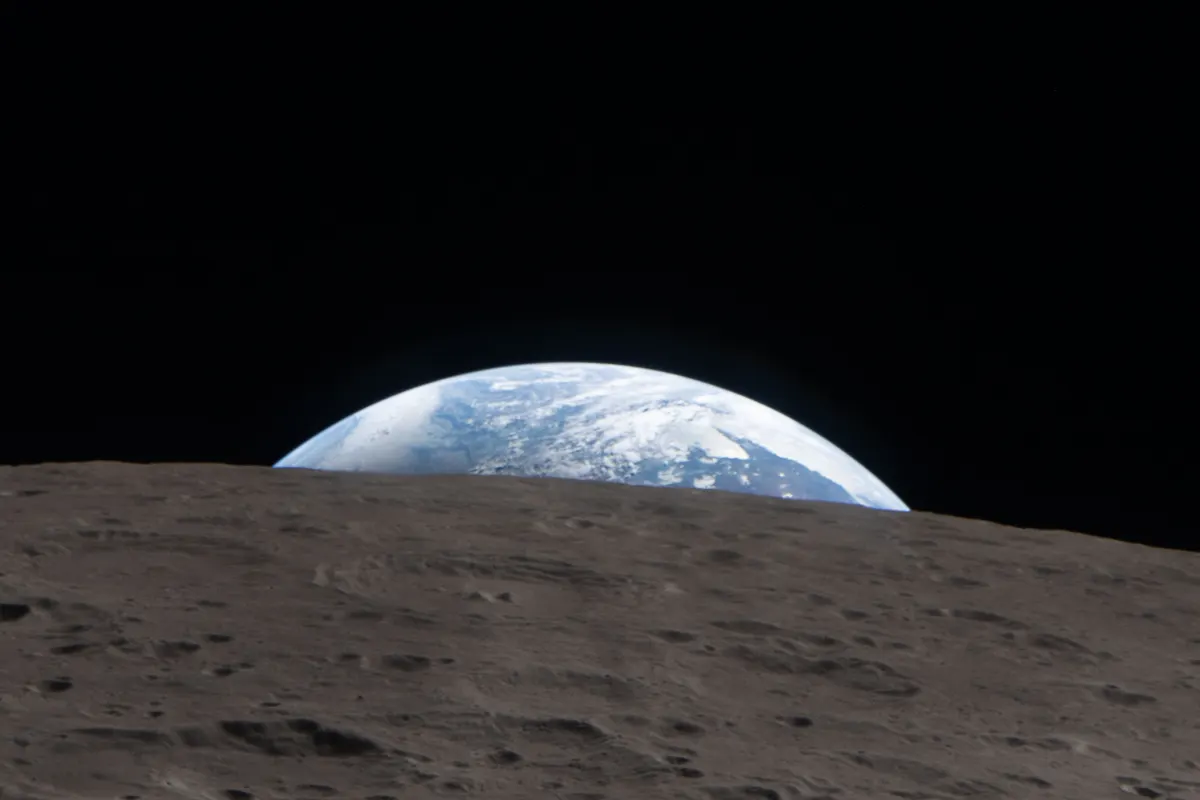
- NASA Image and Video Library, "A Breathtaking Earthset from Orion," Artemis II (April 6, 2026; accessed October 30, 2026)

Founder and editor, Orbit and Atom
I write Orbit and Atom to explain space and science in plain English, starting from what NASA, ESA and the mission teams publish. Every article lists its sources at the end so you can read them yourself.