Solar System & Missions
JUICE: ESA's Mission to Jupiter's Icy Moons, Explained
Quick answer
Juice, short for Jupiter Icy Moons Explorer, is ESA's spacecraft to the Jupiter system. It launched on April 14, 2023, used a third gravity assist at Earth on September 28, 2026 and is due at Jupiter in July 2031. It will study three moons that may hide oceans, Ganymede, Callisto and Europa, and end in orbit around Ganymede, the first time a spacecraft orbits a moon in the outer solar system.
On this page
- What is Juice, and what is it for?
- Where is Juice now?
- What happened during the Earth flyby in September 2026?
- Why does the trip to Jupiter take eight years?
- What happens when Juice reaches Jupiter?
- Why is Ganymede Juice's main target?
- What will Juice learn about Europa and Callisto?
- What instruments does Juice carry?
- How does Juice compare with NASA's Europa Clipper?
- What should you watch for next?
- FAQ
- Sources
Juice has been flying for three and a half years and still has more than four to go. Along the way it has to swing past the Moon, Venus and Earth, all to reach the system of Jupiter's big moons.
Here is where Juice is, what happened during its latest flyby of Earth, the dates still ahead and why ESA picked Ganymede as the star of the show.
What is Juice, and what is it for?
Juice is a European Space Agency mission to study Jupiter and its three large moons that are thought to hide oceans: Ganymede, Callisto and Europa. ESA says the aim is to assess these moons as planetary bodies and as possible habitats, and to study Jupiter's complex environment along the way. The name stands for Jupiter Icy Moons Explorer.
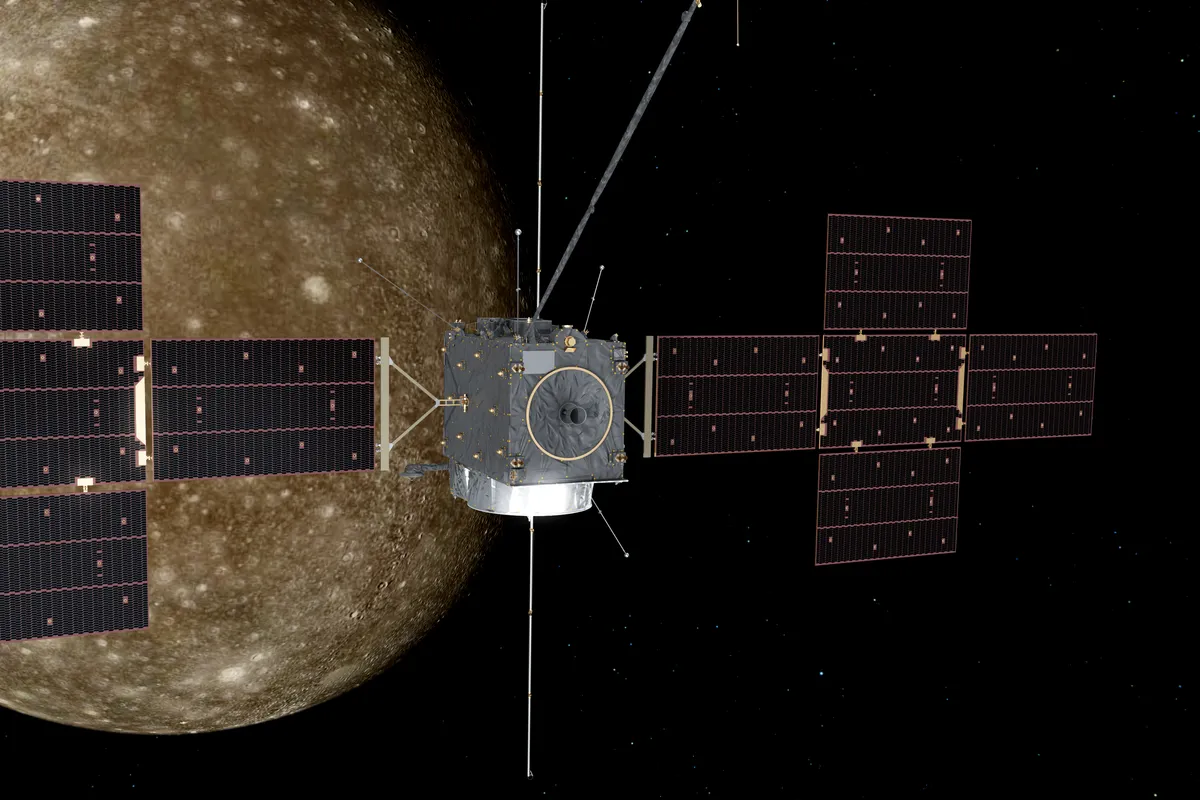
The spacecraft launched on April 14, 2023 on an Ariane 5 from Europe's Spaceport in French Guiana. ESA leads the mission, with contributions from NASA, JAXA and the Israeli Space Agency. It weighs about 6,000 kilograms with fuel (about 2,400 kilograms dry), carries solar wings with about 85 square meters of panels and a 2.5-meter high-gain antenna, and has ten science instruments.
Where is Juice now?
On its way to Jupiter, a month after its latest flyby of Earth. ESA says Juice passed Earth on September 28, 2026, its third gravity assist, and that the next and final Earth flyby is in January 2029. It is due at Jupiter in July 2031. Counting from launch, today is day 1,294 of the trip, or about three and a half years (our count). About four years and eight months remain (our count).
ESA's pages do not list a daily distance for the spacecraft. The agency offers a Where is Juice? tool for that.
| Milestone | Date | Status |
|---|---|---|
| Launch (Ariane 5, French Guiana) | April 14, 2023 | Done |
| Lunar-Earth flyby | August 2024 | Done |
| Venus flyby | August 31, 2025 | Done |
| Earth flyby, 8,640 km up | September 28, 2026 | Done, 31 days ago |
| Final Earth flyby | January 2029 | Ahead |
| Arrival at Jupiter | July 2031 | Ahead |
| Two Europa flybys | July 2032 | Ahead |
| Orbit around Ganymede begins | December 2034 | Ahead |
| End of mission | September 2035 | Ahead |
Juice's main dates. Sources: ESA Cosmos mission overview, ESA's flyby articles of September 21 and 28, 2026, and ESA's Venus article. Status as of October 29, 2026.
What happened during the Earth flyby in September 2026?
Juice came within 8,640 kilometers of Earth, over the Indian Ocean, at 13:45 CEST (11:45 UTC) on September 28. ESA says the pass deflected the spacecraft by 20 degrees compared with its path before the flyby and increased its speed by 3.5 kilometers per second.
It went smoothly. Flight controllers needed only one small trajectory correction out of six opportunities in the four weeks before the flyby, so most of the fuel set aside for it was saved. ESA's Juice spacecraft operations manager, Angela Dietz, said: "This gives us more to use at Jupiter to carry out observations of the planet's icy moons."
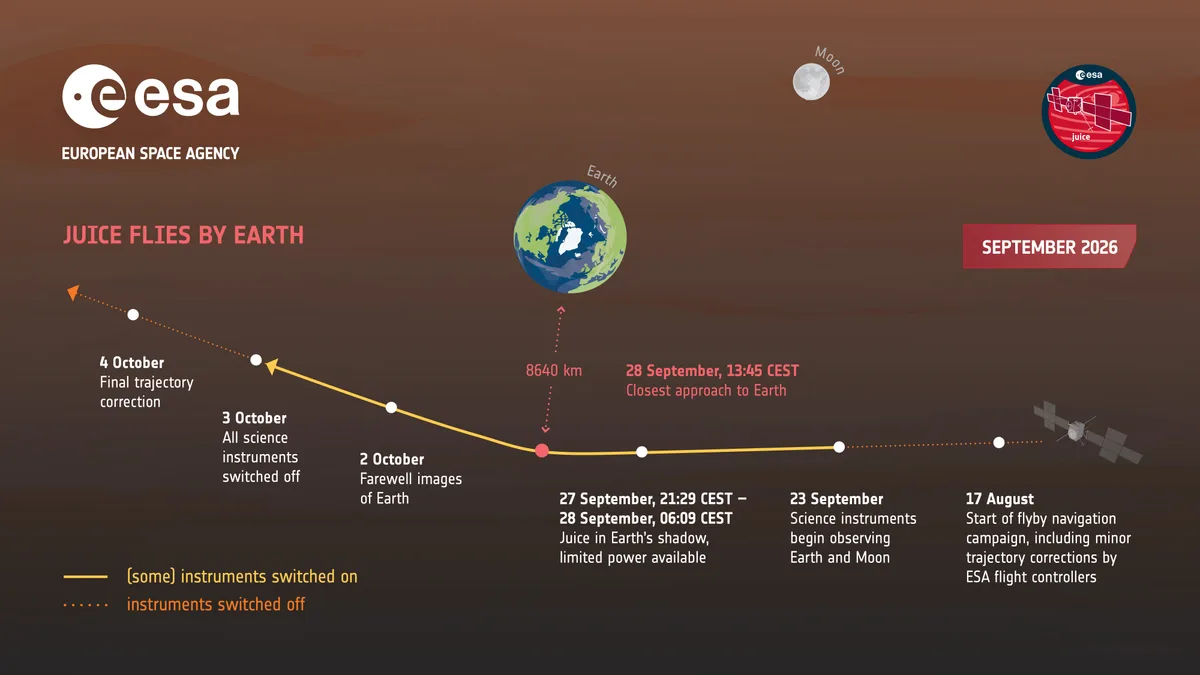
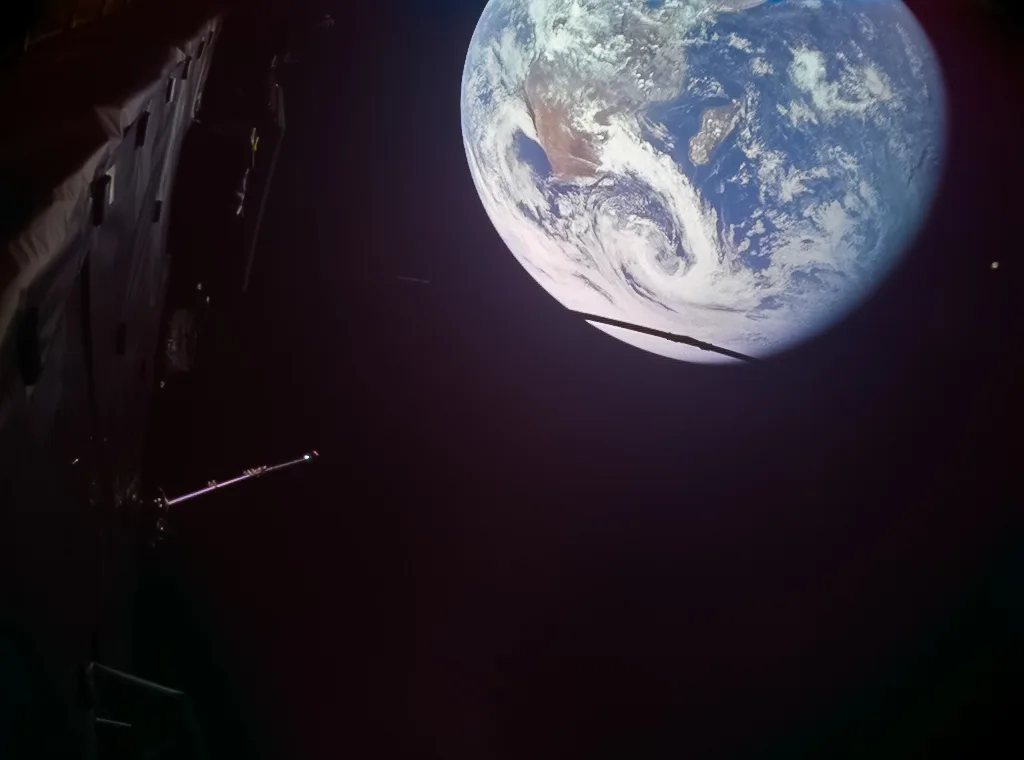
The pass was also a test run for Jupiter. ESA used it to calibrate instruments on a target it knows well, with Earth and the Moon observed from September 23 to October 3. Juice spent several days in Earth's magnetotail, the stretched magnetic tail on the night side, measuring magnetic fields and charged particles. ESA notes that the European-Chinese Smile mission was watching the same region, so the two data sets can be compared.
Why does the trip to Jupiter take eight years?
Because going straight there would take a much bigger rocket. ESA explains that a direct flight would need far more fuel, both to gain speed and to brake on arrival. Juice instead borrows energy from the planets it passes, which saves fuel at the cost of time. ESA describes it as an eight-year cruise.
Each assist did a different job. The lunar-Earth flyby in August 2024, the first of its kind, acted as a braking maneuver that put Juice on a shortcut to Jupiter via Venus. The Venus flyby on August 31, 2025 bent its orbit and added a little speed. After Venus, ESA says, Juice had enough speed relative to Earth but was not yet heading the right way, and the Earth flyby of 2026 steered it by about 20 degrees toward Jupiter. ESA counts four planned gravity assists in all: Moon-Earth, Venus, Earth in 2026 and Earth again in 2029.
The Venus leg had a scare. On July 16, 2025, ground stations could no longer receive Juice's health data. After nearly 20 hours of work, engineers got a command through that switched the signal amplifier back on. ESA traced the cause to a software timing bug and said the recovery had no lasting impact on the mission. Juice made its Venus flyby on schedule, at 07:28 CEST on August 31.
What happens when Juice reaches Jupiter?
It does not go straight to its main target. ESA's timeline starts with the Jupiter orbit insertion in July 2031, followed by an energy-reduction phase that runs to June 2032. ESA lists five Ganymede flybys in 2031 and 2032, the first Callisto flyby in June 2032 and two Europa flybys in July 2032. A phase in an inclined orbit with more Callisto flybys runs from August 2032 to August 2033.
Then Juice heads for Ganymede. The transfer phase runs from November 2033 to November 2034, and ESA lists the start of the Ganymede orbit for December 2034. The mission is set to end in September 2035 with the spacecraft striking Ganymede's surface. ESA gives the nominal science lifetime as four years.
Across the Jupiter phase, ESA counts 35 flybys of the three large moons: 2 of Europa, 12 of Ganymede and 21 of Callisto (our sum matches ESA's total).
Why is Ganymede Juice's main target?
Because it is the largest moon in the solar system, and it has features no other moon has. NASA says Ganymede is bigger than Mercury and Pluto. ESA says it is the only moon known to generate its own magnetic field, and one of only three solid bodies in the solar system to do so. That field forms a magnetic bubble inside Jupiter's, which produces auroras.
It also has an ocean. NASA reports strong evidence of a saltwater ocean under the ice that may hold more water than all of Earth's surface water. ESA adds that Ganymede's surface mixes old, cratered terrain with younger, smoother areas, a record of the Jupiter system over several billion years.
Juice will make 12 Ganymede flybys, then enter orbit and become the first spacecraft to circle a moon in the outer solar system. ESA gives a closest approach of 400 kilometers during flybys and 500 kilometers in orbit, possibly dipping to 200. Its ice-penetrating radar, RIME, is expected to make the first direct measurements below Ganymede's surface, and the team plans a kind of "tomography" of the moon, viewing it from many angles to reconstruct its interior.
What will Juice learn about Europa and Callisto?
Each of the three moons gets a different job, as ESA's graphic shows.
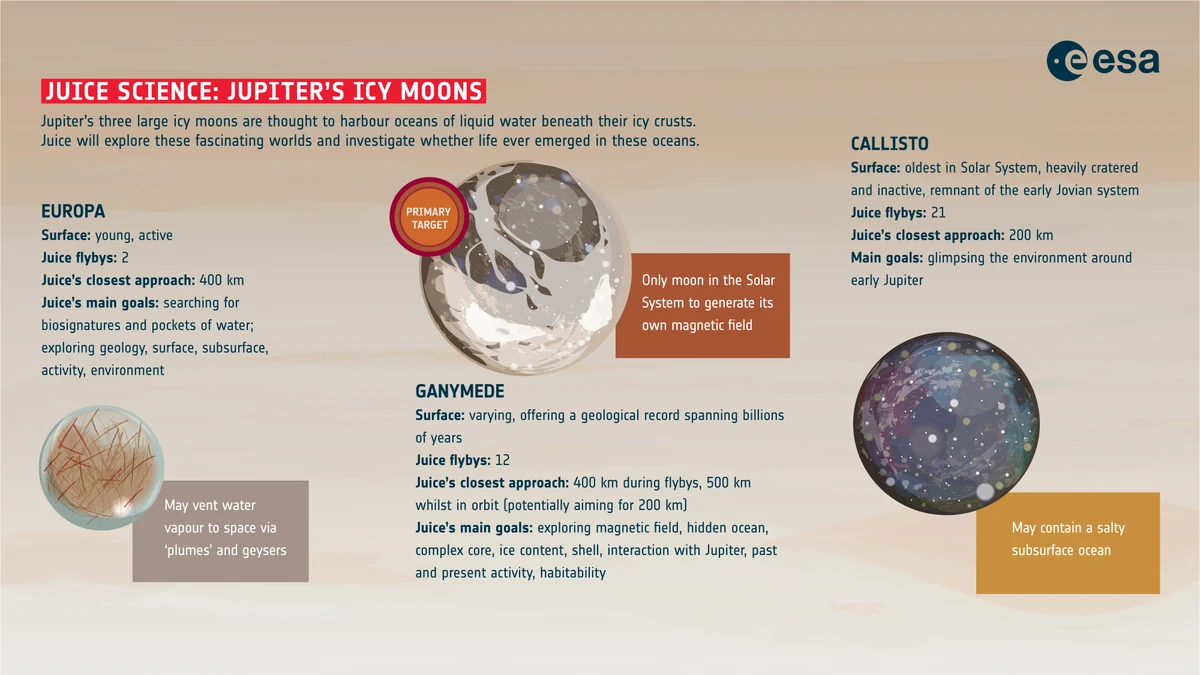
Europa has a young, active surface and may vent water vapor to space through plumes. Juice makes only two flybys, in July 2032, as close as 400 kilometers. ESA says it will look for liquid water under the most active sites and survey the depth of the ocean, and notes that Europa's crust "may be only a few km thick in places."
Callisto is the oldest-looking world of the three, heavily cratered and inactive, a remnant of the early Jupiter system. Juice flies by it 21 times between 2032 and 2034, as close as 200 kilometers. The flybys serve two purposes: exploring the moon and adjusting the spacecraft's orbit for later phases. ESA says Callisto may also have a salty subsurface ocean.
What instruments does Juice carry?
Ten science instruments, plus an experiment called PRIDE and a radiation monitor called RADEM. ESA groups the ten into three kinds: remote sensing (JANUS, MAJIS, UVS and SWI), geophysics (GALA, RIME and 3GM) and in situ measurements (PEP, J-MAG and RPWI).
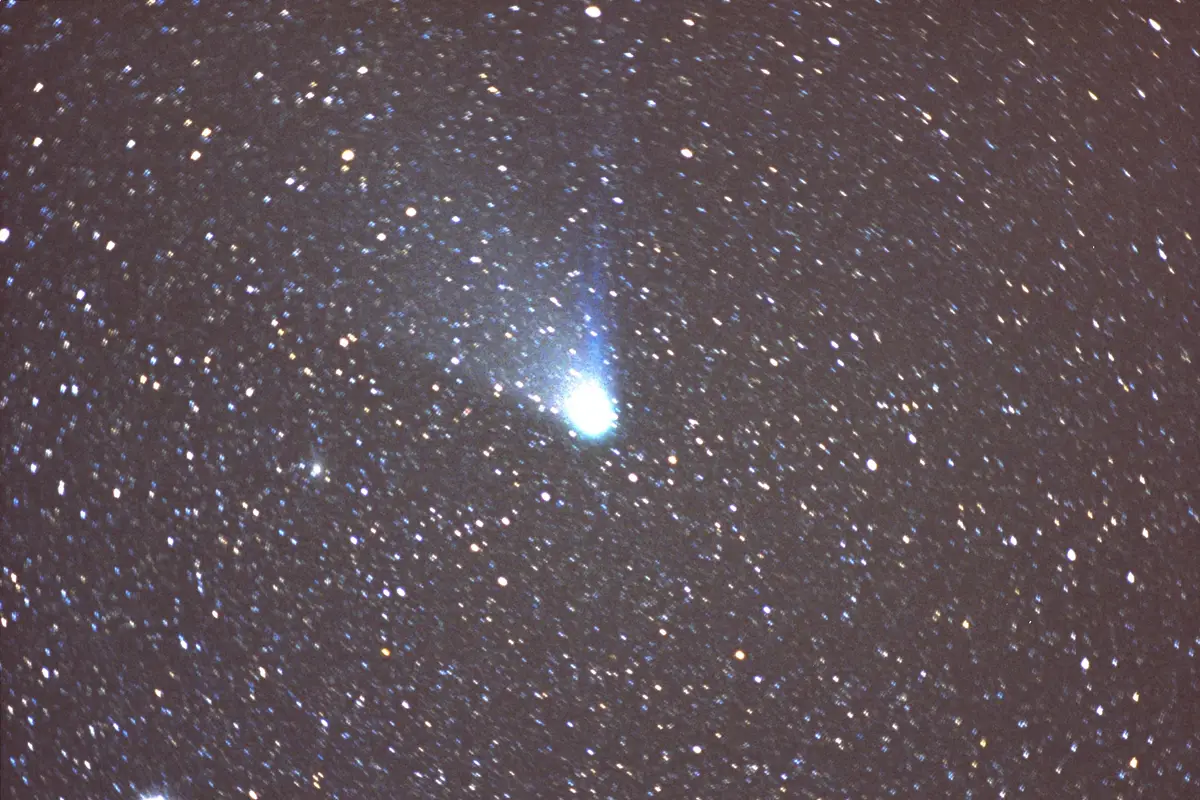
In plain terms: JANUS is the science camera, GALA is a laser altimeter that measures the shape and tides of the moons' surfaces, RIME is the ice-penetrating radar, 3GM measures Ganymede's gravity field and J-MAG is the magnetometer that looks for the magnetic signature of oceans. MAJIS and SWI are spectrometers that identify molecules in atmospheres and on surfaces. Several of them already had a workout: ESA says Juice also observed Comet 3I/ATLAS, including a first look from its science camera in February 2026.
How does Juice compare with NASA's Europa Clipper?
They are partners in curiosity, not copies. Both are sent to learn whether Jupiter's icy moons could have conditions suited to life, but they arrive at different times and aim at different moons. NASA's Europa Clipper is due at Jupiter in April 2030, about 15 months before Juice (our count), and makes nearly 50 flybys of Europa. Juice makes just two Europa flybys and puts its weight on Ganymede and Callisto.
The other big difference is the endgame. Clipper stays in orbit around Jupiter. Juice leaves Jupiter's orbit for Ganymede's. Between them, the two spacecraft will look at all three of the ocean-bearing moons.
What should you watch for next?
The next checkpoint is the final Earth flyby in January 2029, which ESA says sets up the final track to Jupiter. Before that, ESA expects to release more results from the September flyby, including high-resolution images of the Moon and Earth from the JANUS camera.
Europa Clipper has its own Earth flyby coming on December 3, 2026, so the two missions will have swung past our planet within about two months of each other. For more on Jupiter's place among the planets, see The Planets in Order From the Sun. For another icy moon with a hidden ocean, see our guide to Saturn's moons. And for a spacecraft that left all of this far behind, see Voyager 1's one-light-day milestone. More like this is in Solar System & Missions.
Frequently asked questions
What is the Juice mission?
Juice, the Jupiter Icy Moons Explorer, is an ESA spacecraft that will study Jupiter and its three large moons thought to hide oceans: Ganymede, Callisto and Europa. It carries ten science instruments and will end its mission in orbit around Ganymede.
When did Juice launch?
On April 14, 2023, aboard an Ariane 5 rocket from Europe's Spaceport in French Guiana.
When will Juice reach Jupiter?
In July 2031, according to ESA. The trip takes about eight years because the spacecraft uses gravity assists at the Moon, Venus and Earth to save fuel.
Where is Juice now?
On its cruise to Jupiter. It flew past Earth on September 28, 2026 at 8,640 kilometers, which turned its path by 20 degrees and added 3.5 kilometers per second. ESA's Where is Juice? tool shows its current position.
Why does Juice fly past Earth and Venus?
To change speed and direction without burning much fuel. ESA says flying straight to Jupiter would need a much bigger rocket, both to speed up and to brake on arrival. Juice has four planned gravity assists in all.
Why is Ganymede Juice's main target?
Ganymede is the largest moon in the solar system, the only moon known to have its own magnetic field and, according to NASA, shows strong evidence of a saltwater ocean under its ice. Juice will fly by it 12 times and then orbit it.
Will Juice land on Ganymede?
No. After its orbital science ends, ESA says the mission is set to finish in September 2035 with the spacecraft colliding with Ganymede's surface.
Is Juice the same as Europa Clipper?
No. Juice is an ESA mission aimed mainly at Ganymede, with two Europa flybys. Europa Clipper is a NASA mission that arrives in 2030 and focuses on Europa with nearly 50 flybys.
Sources
- ESA Cosmos, "Overview - JUICE" (accessed October 29, 2026). Used for the flyby schedule, the arrival date and the mission phases.
- ESA, "Successful Earth flyby improves Juice's course to Jupiter" (September 28, 2026; accessed October 29, 2026)
- ESA, "Juice to fly past Earth for third gravity assist" (September 21, 2026; accessed October 29, 2026)
- ESA, Juice factsheet (accessed October 29, 2026). Used for the spacecraft mass, solar arrays, antenna and instruments.
- ESA, "Spotlight on Ganymede, Juice's primary target" (accessed October 29, 2026)
- ESA, "The moons of Jupiter: What will Juice discover?" (accessed October 29, 2026). Used for the Europa and Callisto flyby plans.
- ESA, "The science: Juice's key objectives at Jupiter" (accessed October 29, 2026)
- ESA, "Juice team resolves anomaly on approach to Venus" (accessed October 29, 2026)
- NASA Science, "Ganymede" (page last updated April 25, 2025; accessed October 29, 2026)
- ESA, Juice mission page (news list through October 16, 2026; accessed October 29, 2026). Used for the Comet 3I/ATLAS observations.
- ESA, "Where is Juice?" tool: live position of the spacecraft (not used for numbers in this article)
- ESA/Juice/JMC, "Juice images Earth during Earth flyby" (September 28, 2026), CC BY-SA 3.0 IGO
- ESA, "Juice flies by Earth - the complete path" (September 2026), CC BY-SA 3.0 IGO
- ESA, "Jupiter's icy moons" (December 2022), CC BY-SA 3.0 IGO
- ESA (acknowledgement: ATG Medialab), "Juice flyby of Callisto (artist's impression)", CC BY-SA 3.0 IGO, via Wikimedia Commons

Founder and editor, Orbit and Atom
I write Orbit and Atom to explain space and science in plain English, starting from what NASA, ESA and the mission teams publish. Every article lists its sources at the end so you can read them yourself.