Solar System & Missions
Does Saturn's Moon Enceladus Have Life? What the Plumes Show
Quick answer
No life has been found on Enceladus, but Saturn's small icy moon is one of the best places to look. Cassini flew through its jets and found salty water, organic molecules, phosphorus and hydrogen. Those are ingredients and a possible energy source, not living things. In NASA's words, whether life could have started in that ocean is still an open question.
On this page
- Has life been found on Enceladus?
- How do we know there is an ocean under the ice?
- What did Cassini find in the plumes?
- Does hydrogen mean there is food for microbes?
- What did phosphorus and organic molecules add?
- Why couldn't Cassini settle the question?
- What did the September 2026 studies add?
- Will a spacecraft go back to Enceladus?
- FAQ
- Sources
Most places in the solar system that might hold liquid water keep it locked away. Enceladus is different. It sprays its ocean into space, and in 2005 a NASA spacecraft was close enough to notice. Cassini then flew through the spray again and again and brought the data home.
So what did it find, and how close does that bring us to life? Below is what NASA and ESA say, one clue at a time, plus the two studies from September 2026 that added something new. If you want the moon in its wider family first, start with my guide to Saturn's moons.
Has life been found on Enceladus?
No. Every source I read says the same thing. When NASA announced the discovery of phosphorus in the plumes in June 2023, planetary scientist Christopher Glein of the Southwest Research Institute made the same point. NASA's release says he stressed that life has not been found on the moon or anywhere else in the solar system beyond Earth. In his words, "having the ingredients is necessary, but they may not be sufficient," and "whether life could have originated in Enceladus' ocean remains an open question."
What Cassini did find is a list of conditions that life as we know it needs. Life on Earth needs liquid water, a source of energy and the right chemical ingredients, mainly carbon, hydrogen, nitrogen, oxygen, phosphorus and sulfur. NASA says Enceladus has "most of the chemical ingredients needed for life." That is the reason this small moon keeps coming back in the news.
How do we know there is an ocean under the ice?
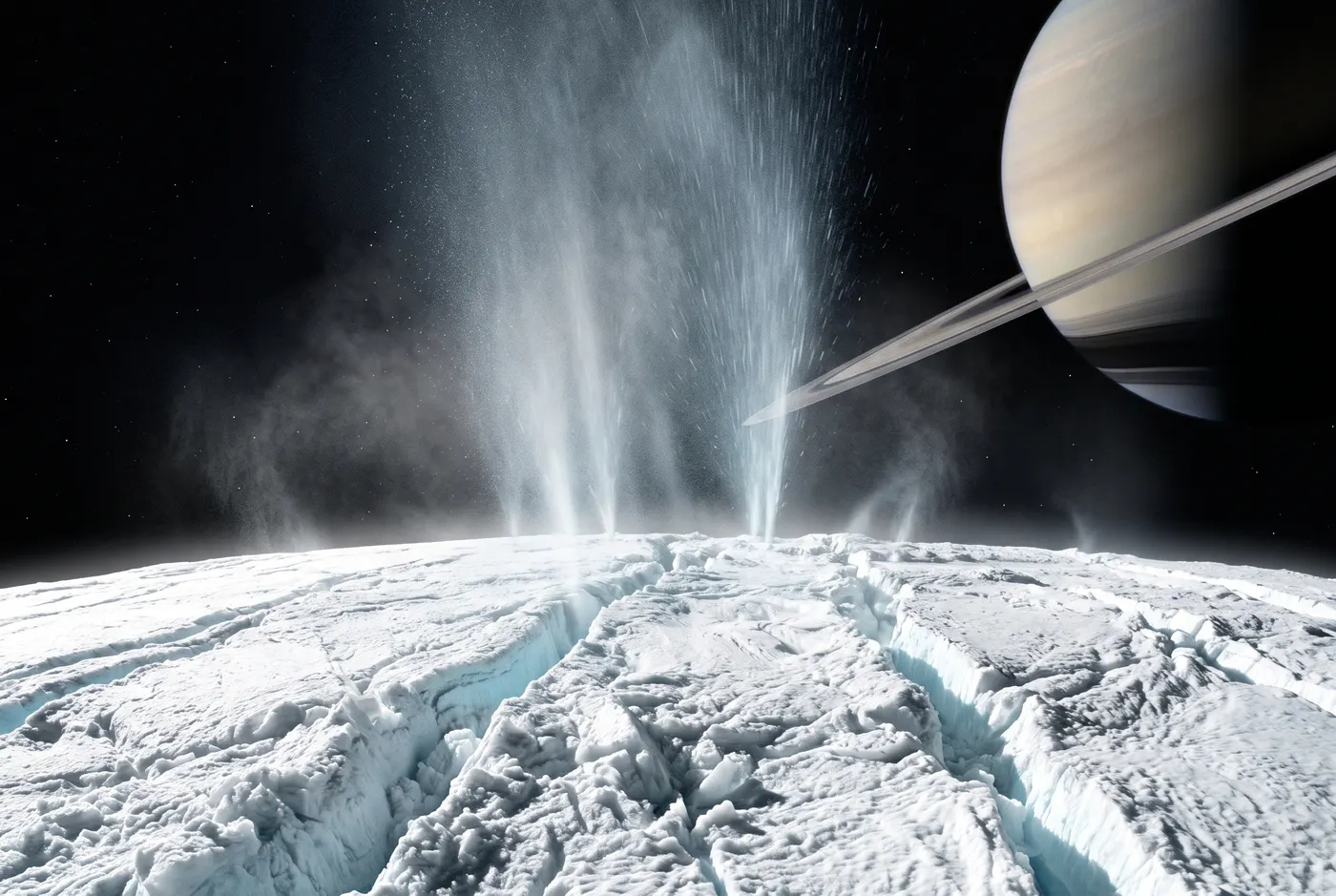
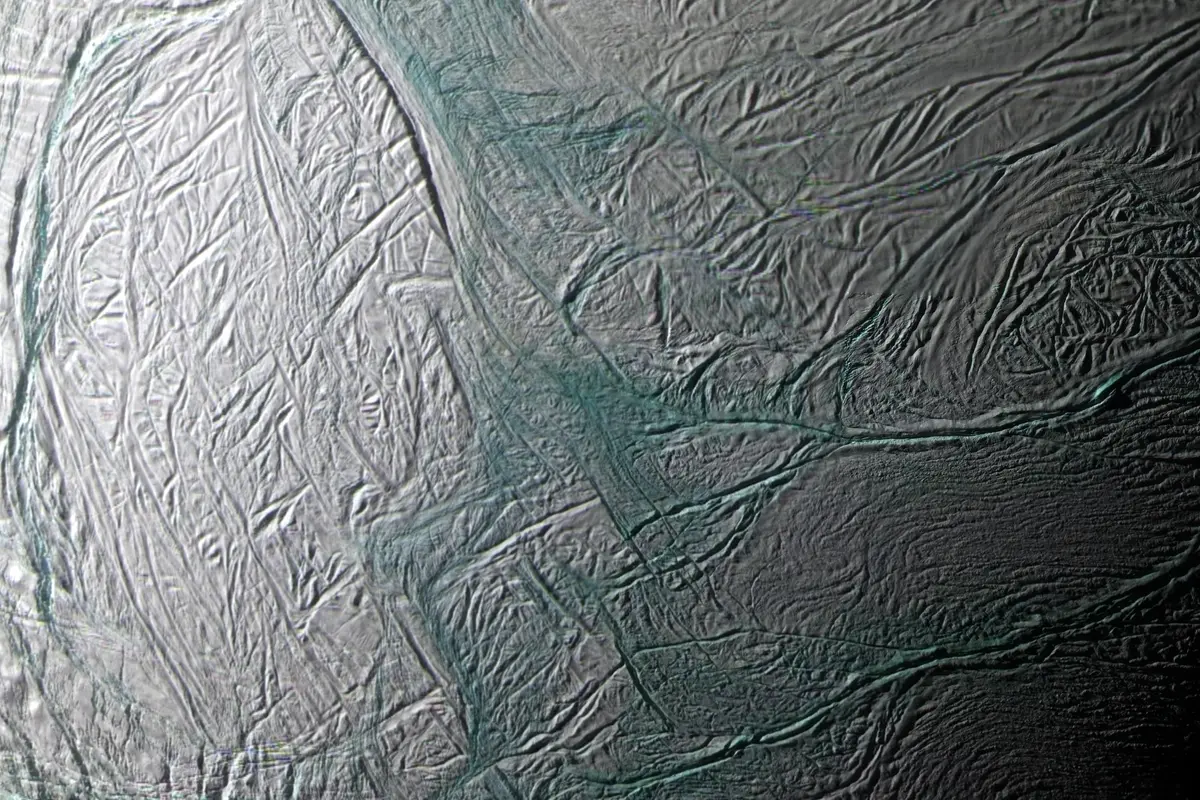
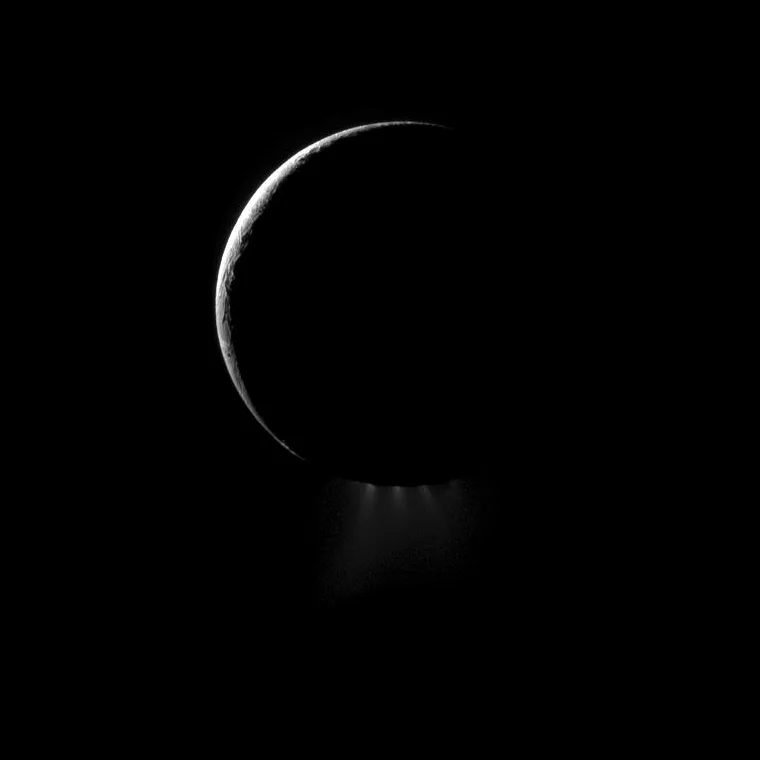
Because the ocean sprays out of the moon. NASA says Cassini discovered in 2005 that icy water particles and gas gush from Enceladus at about 400 meters per second (800 miles per hour). The jets come from long cracks near the south pole that scientists informally call "tiger stripes."
Gravity measurements added the rest. NASA says the way Enceladus wobbles as it orbits Saturn showed that a global ocean inside the moon supplies the jets. The ice shell averages about 20 to 25 kilometers (12 to 16 miles) thick, and may be as thin as 1 to 5 kilometers (half a mile to 3 miles) at the south pole. Enceladus is only about 500 kilometers (310 miles) across, and its surface sits near minus 201 °C (minus 330 °F). Under that ice is liquid water.
What did Cassini find in the plumes?
A long list, built up over more than a decade. NASA's timeline shows the evidence arriving in steps, and each one made the ocean look more interesting. The table keeps only the findings I read about on NASA and ESA pages.
| Year | Finding | Why it matters |
|---|---|---|
| 2005 | Water vapor and ice jets | A hidden source of water |
| 2008 | Organic material, 20 times denser than expected | Carbon chemistry |
| 2009 | Sodium salts in ice grains | Salty liquid water |
| 2015 to 2017 | Hydrogen gas, about 1 percent of the plume | Possible energy for microbes |
| 2023 | Phosphates in ice grains | A scarce key element |
| 2025 | Fresh organics in plume grains | Chemistry minutes old |
Plume findings from NASA and ESA pages read November 20, 2026. Years are those the sources give.
NASA also lists the gases in the plume: water vapor, carbon dioxide, methane and perhaps some ammonia, along with salts and silica. The salts matter because, as NASA's timeline puts it for the 2009 result, liquid water is "the only way to dissolve the significant amounts of minerals that would account for the levels of salt detected."
Does hydrogen mean there is food for microbes?
It means there may be an energy source, which is not the same as microbes. In April 2017 NASA reported that Cassini had detected hydrogen in the plume during its deepest dive through it, on October 28, 2015. Nearly 98 percent of the gas in the plume is water, about 1 percent is hydrogen, and the rest is a mix that includes carbon dioxide, methane and ammonia.
NASA explained why that matters. Microbes, if any exist there, could get energy by combining hydrogen with carbon dioxide dissolved in the water, a reaction that makes methane. NASA noted that this reaction "is at the root of the tree of life on Earth." The hydrogen also points to hydrothermal activity: the rock on the seafloor appears to be reacting chemically with water to make the gas.
Hunter Waite, who led the study, was careful: "Although we can't detect life, we've found that there's a food source there for it." NASA's own Enceladus page backs the hot-water idea with a second clue. The ice grains of Saturn's E ring contain tiny grains of silica that can only form where liquid water meets rock at temperatures above about 90 °C (200 °F), which points to vents on the ocean floor.
What did phosphorus and organic molecules add?
Phosphorus filled the biggest gap. In 2017, NASA said Cassini had not yet shown that phosphorus and sulfur were in the ocean. Then in June 2023, a team led by Frank Postberg of Freie Universität Berlin reported phosphates in salt-rich ice grains, using Cassini data in the journal Nature. NASA calls phosphorus "the least abundant of the essential elements necessary for biological processes" and says it is part of DNA and of the molecules that carry energy in all life on Earth. Lab work by co-authors suggested the ocean holds phosphate at concentrations of at least 100 times those in Earth's oceans.
The organics came in two rounds. In 2008, Cassini's instruments found organic material in the plume about 20 times denser than scientists expected. In a Nature Astronomy paper published on October 1, 2025, a team led by Nozair Khawaja reanalyzed grains Cassini collected in 2008, only 21 kilometers (13 miles) above the surface. NASA says it was the first time scientists saw this variety of organics in fresh particles from the ocean. As Khawaja put it, the new compounds "were just minutes old."
ESA's summary adds the useful comparison. On Earth, it says, the same kinds of molecules take part in chains of reactions that lead to molecules essential for life. That is a path, not proof, and the researchers describe it that way. In my opinion, this is the right way to hold the news: Enceladus keeps adding items to the list of things life would need, and none of them is life.
Why couldn't Cassini settle the question?
Because it was never built to look for life. NASA's 2017 release says Cassini "wasn't designed to detect signs of life in the Enceladus plume," and that scientists did not know the plume existed until after the spacecraft arrived at Saturn. The mission ran from 2004 to 2017 and ended when Cassini burned up in Saturn's atmosphere.
The data keeps paying off. Both the 2023 and 2025 discoveries came from instrument readings taken years earlier, found by teams who went back through the archive. That tells me there may still be results waiting in the Cassini data. If you like Cassini's pictures, my guide to why Saturn's rings look so thin uses several of them.
What did the September 2026 studies add?
Two papers in Science Advances, both published on September 25, 2026, with Postberg and Khawaja among the authors, according to a Freie Universität Berlin release and press coverage. I read those reports, not the papers, so I treat the details as reported.
The first study used Cassini data, long lab experiments and models to show how the plume sorts the ocean. Droplets freeze slowly inside the cracks, which separates their salts and organics, and then shatter into tiny grains in space. Postberg said the plume does "a lot of the work for us in preparing samples," because the ocean's components are separated and concentrated in individual ice particles. If microbes were present, the release says, their material might sit in only a small fraction of grains, but in high concentration.
The second study, from a team at Ludwig-Maximilians-Universität München, put a methane-making microbe from Earth's deep-sea vents, Methanothermococcus okinawensis, into a lab copy of Enceladus' ocean: very alkaline, low in oxygen and low in dissolved carbon dioxide. It grew and made methane from hydrogen. Postberg's own wording is the one to keep: "While that doesn't mean that there is life on Saturn's moon," a future spacecraft that analyzes individual plume grains "might have a good chance of finding traces."
Will a spacecraft go back to Enceladus?
Europe is studying one. ESA lists its L4 mission as the agency's fourth large-class mission and the first flagship of its Voyage 2050 plan. The aim is to sample the plumes and make measurements on the surface, searching for the ingredients that could fuel life. ESA's page lists a launch in 2042 and says two Ariane 6 rockets would be needed, with the spacecraft assembled in orbit near Earth. It is still a mission under study, not an approved launch date, so I would treat 2042 as a target.
That is a long wait, and Enceladus is not the only ocean world on the list. For the ones closer to launch, read my guides to NASA's Europa Clipper and ESA's Juice mission, both headed for the moons of Jupiter. Saturn itself is the sixth stop in the planets in order from the Sun, and more missions like these are collected under Solar System & Missions.
I think the honest summary is short. Enceladus has water, energy and the chemistry, and it hands out free samples. What it has not given us is an answer, and only a spacecraft built to look can do that.
Frequently asked questions
Is there life on Enceladus?
No life has been found. NASA scientists say Enceladus has many of the ingredients for life, but that whether life could have started in its ocean remains an open question.
What are the plumes on Enceladus made of?
NASA says the plumes carry water vapor and ice grains, plus carbon dioxide, methane, perhaps a little ammonia, salts and silica. Cassini also found organic material and, in 2017, hydrogen.
How did Cassini sample the ocean of Enceladus?
Cassini flew through the plume and through Saturn's E ring, which Enceladus feeds. Instruments such as the Cosmic Dust Analyzer and the Ion and Neutral Mass Spectrometer measured the grains and gas directly.
Why is phosphorus important?
NASA calls phosphorus the least abundant of the elements essential to life. It is part of DNA and of the molecules that carry energy in all life on Earth. Cassini data showed phosphates in Enceladus' ice grains in 2023.
Could microbes live in the ocean of Enceladus?
It is unknown. A September 2026 lab study, as reported, grew a methane-making microbe from Earth's deep-sea vents in a copy of Enceladus' ocean, but that does not show life exists there.
Is a mission planned to go back to Enceladus?
ESA is studying an orbiter and lander called L4, with a launch listed for 2042. It is a mission under study, not an approved launch.
Sources
- NASA Science, "Enceladus" (page last updated November 4, 2024; accessed November 20, 2026). Used for the jets, the ocean, the ice shell, the plume gases and the silica grains.
- NASA Science, "Cassini at Enceladus: A Decade-Plus of Discovery" (December 30, 2015). Used for the 2005 to 2009 timeline.
- NASA, "NASA Missions Provide New Insights into 'Ocean Worlds' in Our Solar System" (April 13, 2017). Used for the hydrogen result.
- NASA/JPL, "NASA Cassini Data Reveals Building Block for Life in Enceladus' Ocean" (June 14, 2023). Used for the phosphorus result.
- NASA/JPL, "NASA Cassini Study Finds Organics 'Fresh' From Ocean of Enceladus" (November 19, 2025). Used for the Nature Astronomy result on fresh organics.
- ESA, "Cassini proves complex chemistry in Enceladus ocean" (October 1, 2025)
- ESA Science Programme, "L4 to Enceladus" (accessed November 20, 2026). Used for the mission under study and the listed 2042 launch.
- Nanowerk News, "Enceladus ice plumes may concentrate biosignatures for easier detection" (September 26, 2026), a Freie Universität Berlin release. Press report on two Science Advances studies; I did not read the papers.
- EarthSky, "Life on Enceladus? Chances get big boost in 2 new studies" (October 1, 2026). News report, not an official source.
- NASA Photojournal, "Great Southern Land" (PIA11112), false-color Cassini mosaic of Enceladus, August 14, 2008. Used for the photo caption.

Founder and editor, Orbit and Atom
I write Orbit and Atom to explain space and science in plain English, starting from what NASA, ESA and the mission teams publish. Every article lists its sources at the end so you can read them yourself.