Solar System & Missions
2026 ED138: The Dwarf Planet Candidate Beyond Pluto
Quick answer
2026 ED138 is a dwarf planet candidate found in data from the Vera C. Rubin Observatory and announced on Oct. 27, 2026. It orbits about 46 AU from the Sun, farther out than Pluto's 39 AU average, and may be 600 to 1,500 km wide. It stays a candidate until infrared observations pin down its size and shape.
On this page
Far past Neptune, in a region where light from the Sun takes more than six hours to arrive, astronomers have found a world that may be big enough to count as a dwarf planet. Its name is a catalog label, 2026 ED138, and the discovery came from a new telescope, not a new spacecraft.
I read the Rubin Observatory announcement, the team's scientific paper and NASA's pages on the known dwarf planets. Here is what they say, and where the word "candidate" matters.
What is 2026 ED138?
It is a large icy body in the outer solar system, found in images from the NSF–DOE Vera C. Rubin Observatory in Chile. Rubin announced it on Oct. 27, 2026, together with the Minor Planet Center, the group that records new objects in the solar system. Matthew Holman, of the Center for Astrophysics | Harvard & Smithsonian, found it on the evening of Oct. 13 while running Rubin data through a search code he wrote with colleague Kevin Napier. Rubin quotes him: "My first reaction was one of excited disbelief."
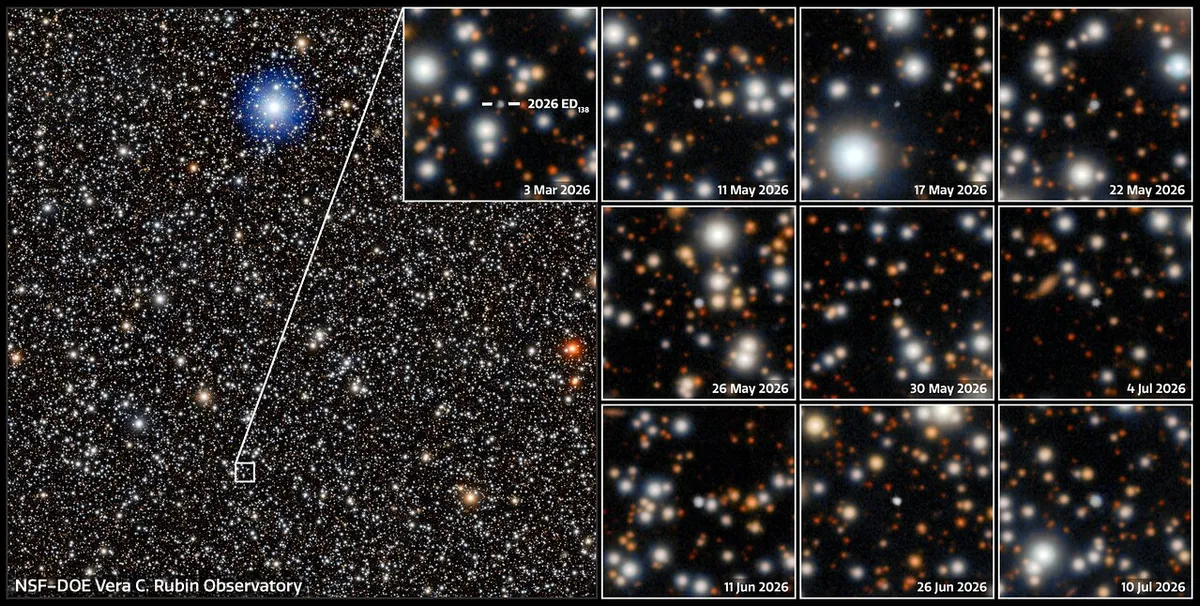
The object was already in the telescope's pictures. Rubin's main camera photographed it 30 times on 20 nights between March 4 and July 11, 2026, and nobody had noticed. Archive images from another survey camera, the Dark Energy Camera in Chile, show it as far back as 2016, which let the team follow its path for more than ten years.
Where is 2026 ED138 and how does it orbit?
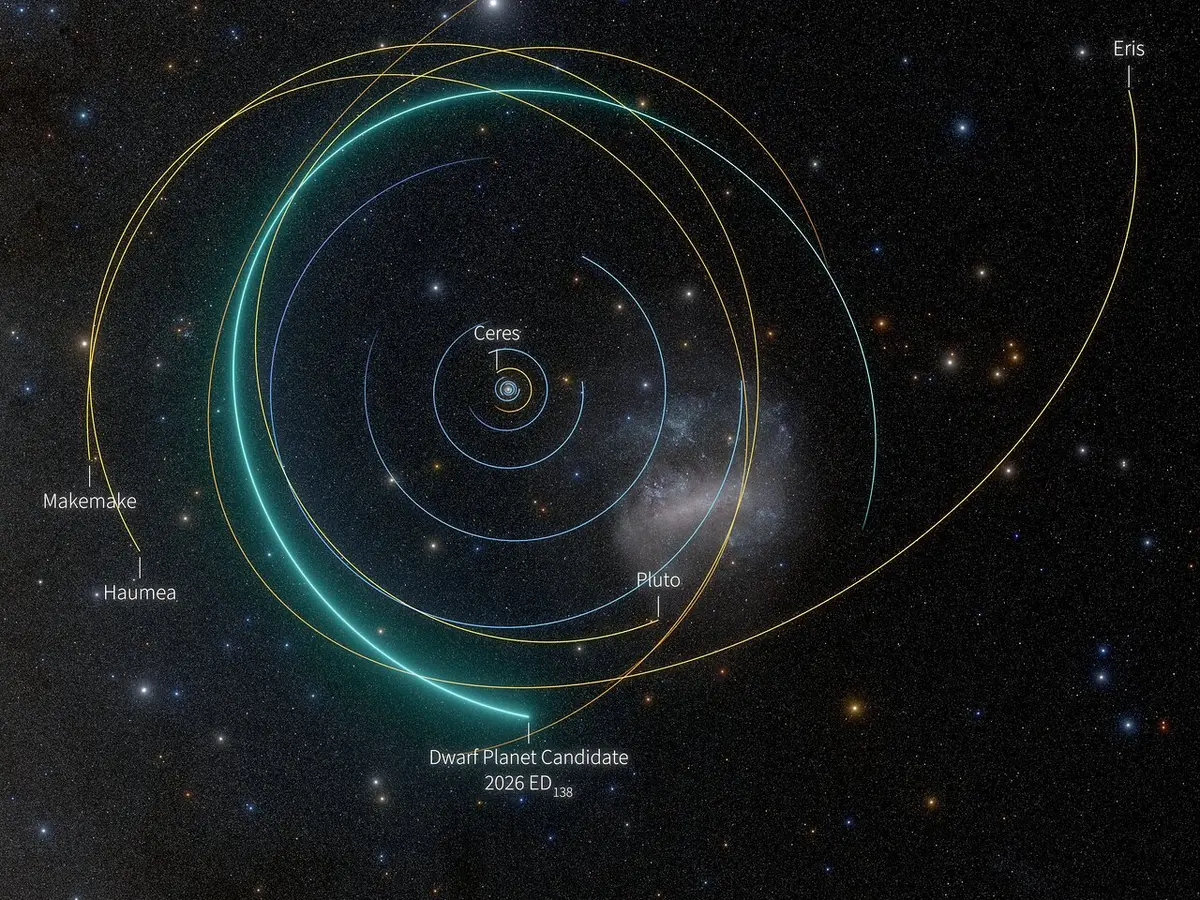
Rubin puts it at about 46 astronomical units from the Sun. One astronomical unit (AU) is the distance from Earth to the Sun, about 93 million miles. NASA gives Pluto an average distance of 39 AU, so ED138 is currently farther out than that. By my calculation, sunlight needs about 6.4 hours to reach it. NASA describes the Kuiper Belt as a doughnut-shaped region of icy bodies that starts at Neptune's orbit, about 30 AU from the Sun, and whose main part ends around 50 AU. ED138 sits inside it.
| Detail | Value |
|---|---|
| Announced | Oct. 27, 2026 |
| Distance from the Sun now | About 46 AU (light takes about 6.4 hours) |
| Average orbit size | 43.1 AU |
| Closest to the Sun | 37.1 AU |
| Time for one orbit | About 283 years |
| Tilt of the orbit | 24.4 degrees |
| Estimated diameter | 600 to 1,500 km (about 370 to 930 miles) |
| Status | Dwarf planet candidate |
2026 ED138 at a glance. Sources: Rubin Observatory release (Oct. 27, 2026); arXiv 2610.38693 (preprint, barycentric orbit); periods and light time are my calculations.
Rubin calls it a hot-classical Kuiper Belt object. That means its orbit is tilted almost 25 degrees from the flat plane where the planets travel, which suggests Neptune's gravity disturbed it long ago. The team's paper adds that its orbit sits at the edge of a 12:7 resonance with Neptune, the same kind of orbit the dwarf planet Haumea has. In plain terms, it is a slow, tilted loop that Neptune may have shaped. The paper is a preprint, so other astronomers have not yet reviewed it. For the eight planets that sit closer in, see my tour of the solar system, planet by planet.
How big could 2026 ED138 be?
Between 600 and 1,500 km across, according to Rubin. The team's paper gives 612 to 1,530 km. The range is wide because nobody has measured the object's size directly. Astronomers know how bright it looks and how far away it is, but the same brightness could come from a small, shiny world or a big, dark one. The paper uses a reflectivity (albedo) from 0.25 to 0.04 to get the two ends.
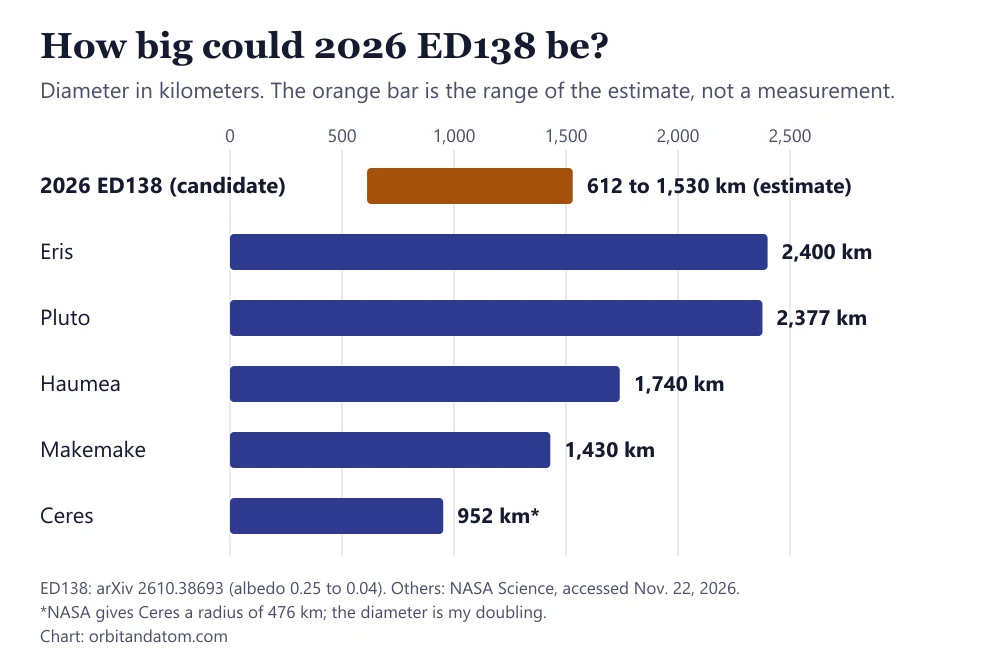
Even at the top of the range, ED138 would be smaller than Pluto, which NASA lists at about 2,377 km, and Eris at about 2,400 km. It would be close to Makemake (1,430 km) and Haumea (1,740 km). At the low end it would still be bigger than Ceres, the dwarf planet in the asteroid belt. The paper says it is one of the ten intrinsically brightest trans-Neptunian objects known, and the brightest of the 2,440 previously unknown ones its search found. EarthSky quotes Rubin's Mario Jurić calling it the largest object of its kind found in about 20 years.
Why is it only a candidate, not a dwarf planet?
Because two things are still missing. To be a dwarf planet, Rubin says an object must be massive enough for its own gravity to pull it into a round shape. Icy bodies this large are expected to be round, but that is a preliminary expectation, not a measurement. Rubin states that observations in the infrared are needed to pin down its exact size and confirm its nature.
The second piece is official. NASA says the International Astronomical Union (IAU) has so far recognized five dwarf planets: Ceres, Pluto, Haumea, Makemake and Eris. The IAU says there may be many more, perhaps more than a hundred, waiting to be found. If ED138 is confirmed, Rubin says it would join that small family. How the Pluto decision worked is in my guide on why Pluto is not a planet.
The good news is that it is bright enough to study. The paper puts its typical brightness at magnitude 19.4 in Rubin's i band and calls it bright enough for ground-based spectroscopy and light curves, and for detailed study with the Hubble and James Webb space telescopes. My list of the biggest James Webb discoveries shows what that telescope does with faint, cold targets.
Why was it not found earlier?
The sources I read do not give one single reason. The paper says the object lies about 12 degrees south of the middle of the Milky Way's plane, where the star fields are crowded and a faint moving dot is easy to miss. Rubin photographs the whole southern sky again and again, and once a candidate appeared the team could search back through months, and sometimes decades, of earlier images.
Holman says "Rubin will image the whole southern sky again and again for ten years, so any others hiding in the places earlier surveys skipped are now within reach." The paper is more specific: about three more objects as bright as this one probably remain undiscovered away from the Milky Way's plane, and probably more lie close to it, where no search has gone this deep.
Can you see 2026 ED138 from Earth?
No, not on your own. At magnitude 19.4 it is far too faint for binoculars and for most backyard telescopes. It is a target for large professional telescopes. That is part of what makes it interesting: it is a big world that stayed hidden even though it is in the pictures.
In my opinion, the most useful thing to remember is the size of the uncertainty. A diameter anywhere from 600 to 1,500 km separates a small icy body from one that rivals Makemake, and one infrared measurement could narrow that a lot. For scale, a light-year is about 63,000 AU, so even this far-off world is only a tiny fraction of one. For a spacecraft that has gone much farther, see Voyager 1 and its one light-day milestone.
So is there a new dwarf planet?
Not officially, and not yet. There is a large, bright object 46 AU from the Sun with a well-measured orbit, and a team of astronomers that calls it a dwarf planet candidate. What it lacks is a measured size and shape, and an IAU decision. Watch for infrared follow-up results, which are what would turn "candidate" into something firmer.
Frequently asked questions
What is 2026 ED138?
It is a large icy object in the Kuiper Belt, about 46 AU from the Sun, found in Vera C. Rubin Observatory data and announced on Oct. 27, 2026. Astronomers call it a dwarf planet candidate.
Is 2026 ED138 a dwarf planet?
Not yet. Rubin says infrared observations are needed to pin down its exact size and confirm its nature, and the IAU, which recognizes dwarf planets, has so far listed five.
How big is 2026 ED138?
Rubin estimates 600 to 1,500 km across, about 370 to 930 miles. The range is wide because its reflectivity is unknown. The team's paper gives 612 to 1,530 km.
How far away is 2026 ED138?
About 46 AU from the Sun, according to Rubin, which is farther than Pluto's average distance of 39 AU. Sunlight takes about 6.4 hours to reach it, by my calculation.
Who discovered 2026 ED138?
Matthew Holman, of the Center for Astrophysics | Harvard & Smithsonian, found it on Oct. 13, 2026, in Rubin images taken earlier that year. The Minor Planet Center announced it on Oct. 27.
Can I see 2026 ED138 with a telescope?
Almost certainly not. Its typical brightness is magnitude 19.4, far too faint for binoculars and most backyard telescopes. It needs large professional telescopes.
Will more objects like it be found?
Likely. The team's paper estimates that about three more objects this bright remain undiscovered away from the Milky Way's plane, and probably more lie closer to it.
Sources
- Rubin Observatory, "NSF–DOE Vera C. Rubin Observatory Reveals Its First Dwarf Planet Candidate in Our Solar System" (Oct. 27, 2026; accessed Nov. 22, 2026)
- arXiv 2610.38693, "2026 ED138: A Large Trans-Neptunian Object in Early Rubin Observatory Data, and How Many More May Remain" (preprint; accessed Nov. 22, 2026)
- Minor Planet Center, MPEC 2026-U85 (2026 ED138)
- NASA Science, "Dwarf Planets" (accessed Nov. 22, 2026)
- NASA Science, "Pluto: Facts" (accessed Nov. 22, 2026)
- NASA Science, "Kuiper Belt: Facts" (accessed Nov. 22, 2026)
- NOIRLab, image usage policy (CC BY 4.0) and image pages noirlab2626a, noirlab2626f, noirlab2626h
- EarthSky, "New dwarf planet discovered by Rubin?" (Oct. 30, 2026)

Founder and editor, Orbit and Atom
I write Orbit and Atom to explain space and science in plain English, starting from what NASA, ESA and the mission teams publish. Every article lists its sources at the end so you can read them yourself.