Solar System & Missions
Why Isn't Pluto a Planet Anymore?
Quick answer
Pluto is not a planet anymore because, in August 2006, the International Astronomical Union defined a planet with three tests, and Pluto fails the third: it has not cleared other objects from the neighborhood around its orbit. It is now a dwarf planet, still round and still orbiting the Sun. NASA's 2015 New Horizons flyby then showed a surprisingly active world, which keeps the debate alive.
On this page
For 76 years, people learned that the solar system had nine planets. Pluto, found in 1930, was the ninth. Then in 2006 it was not. The world itself did not change at all: same ice, same orbit, same five moons. What changed was the meaning of one word.
Here is what astronomers decided, why they did it when they did, and why a NASA spacecraft visiting Pluto in 2015 gave the argument new life.
What did astronomers decide about Pluto in 2006?
In August 2006, at its General Assembly in Prague, the International Astronomical Union (IAU), the world organization of astronomers, voted on two resolutions. Resolution B5 defined the word "planet" for the first time. Resolution B6 then applied it: "Pluto is a 'dwarf planet' by the above definition and is recognized as the prototype of a new category of Trans-Neptunian Objects."
That cut the planet count from nine to eight. The timing was odd: NASA's New Horizons spacecraft had launched on Jan. 19, 2006, about seven months earlier, on its way to what was still the ninth planet. By the time it arrived, Pluto had a new label.
What are the three tests for a planet?
Under Resolution B5, a planet is a body that orbits the Sun, has enough mass for its own gravity to pull it into a nearly round shape, and "has cleared the neighbourhood around its orbit." NASA puts the last test this way: the planet's gravity has cleared away other objects of similar size near its orbit. Here is how Earth and Pluto score:
| Test | Earth | Pluto |
|---|---|---|
| 1. Orbits the Sun | Yes | Yes |
| 2. Nearly round, shaped by its own gravity | Yes | Yes |
| 3. Has cleared its orbital neighborhood | Yes | No |
| Result | Planet | Dwarf planet |
The IAU's three tests for a planet (Resolution B5, 2006), with NASA's plain-language wording. Sources: IAU; NASA Science, "Dwarf Planets."
Pluto passes two tests out of three. NASA says it fails the third because it sits in the Trans-Neptunian region, beyond Neptune, "where other objects might cross Pluto's orbital path." Its orbit is also unusual: oval and tilted, taking it from 30 AU to 49.3 AU from the Sun over 248 years. From 1979 to 1999, Pluto was actually closer to the Sun than Neptune. My guide to the planets in order from the Sun shows the eight that pass all three tests.
Why did astronomers change the rules?
Mostly because of Eris. NASA says it was discovered on Jan. 5, 2005, in data from a Palomar Observatory survey, by Mike Brown of Caltech, Chad Trujillo and David Rabinowitz. Three days later, the team announced a Pluto-sized world billions of miles beyond Neptune. NASA says the discovery "reignites a debate about the definition of a planet."
The problem was easy to see. Eris is about the same size as Pluto, but three times farther from the Sun. If Pluto was a planet, so was Eris. And NASA says the Kuiper Belt holds thousands of miniature icy worlds, so more discoveries were coming. The IAU chose to write a rule instead of keep adding planets.
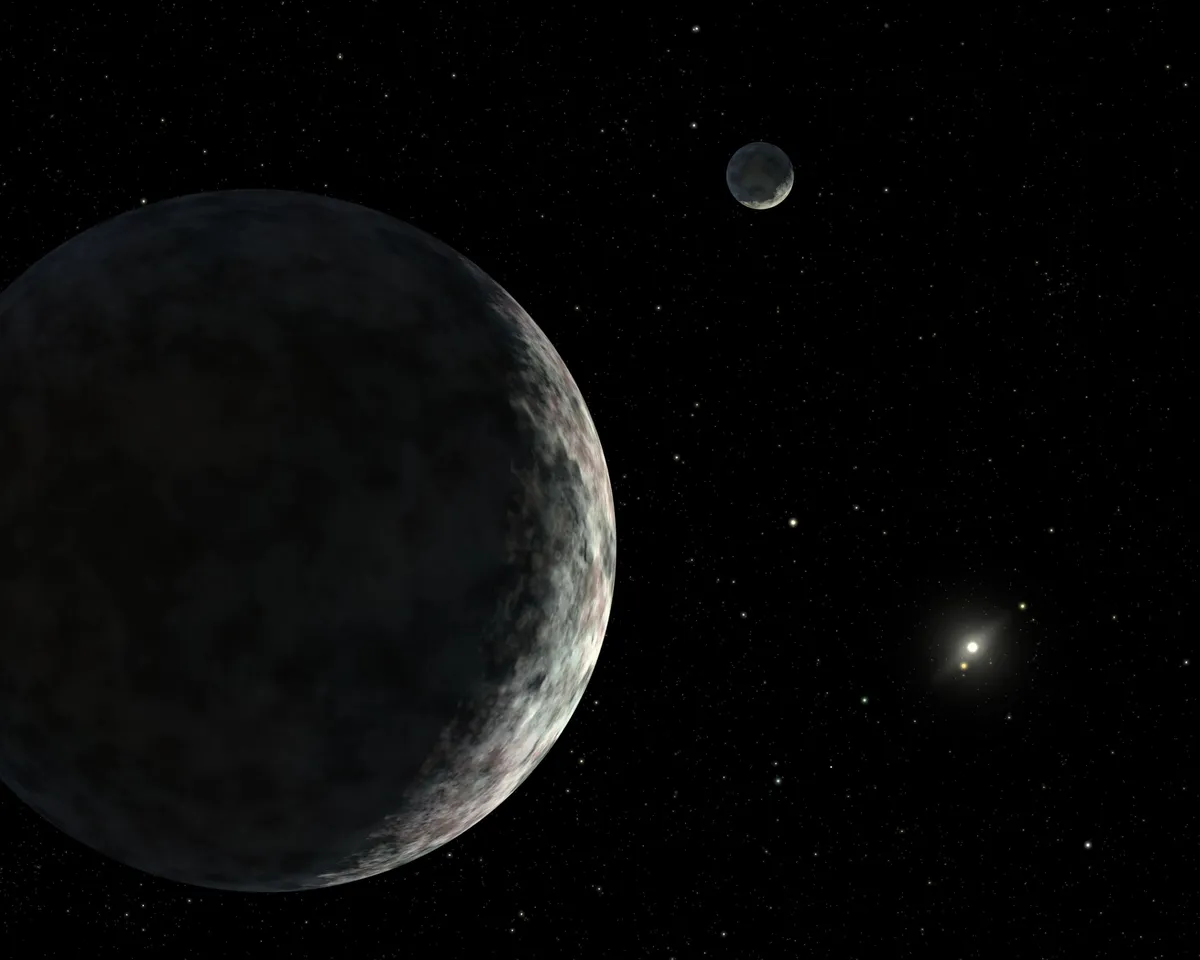
Pluto is not alone in its new category. So far the IAU has recognized five dwarf planets, and NASA lists them by distance: Ceres, Pluto, Haumea, Makemake and Eris. Ceres, in the asteroid belt, was once classified as a planet too. The IAU says there may be many more dwarf planets waiting to be found, perhaps more than a hundred.
Is Pluto smaller than the Moon?
Yes. NASA gives Pluto an equatorial diameter of about 1,477 miles (2,377 km), about one-fifth the width of Earth and about two-thirds the diameter of Earth's Moon. Its mass is about one-sixth that of the Moon. Sunlight takes about 5.5 hours to reach it. A light-year is a much bigger yardstick than anything in this story, but it helps to see how far out Pluto sits.
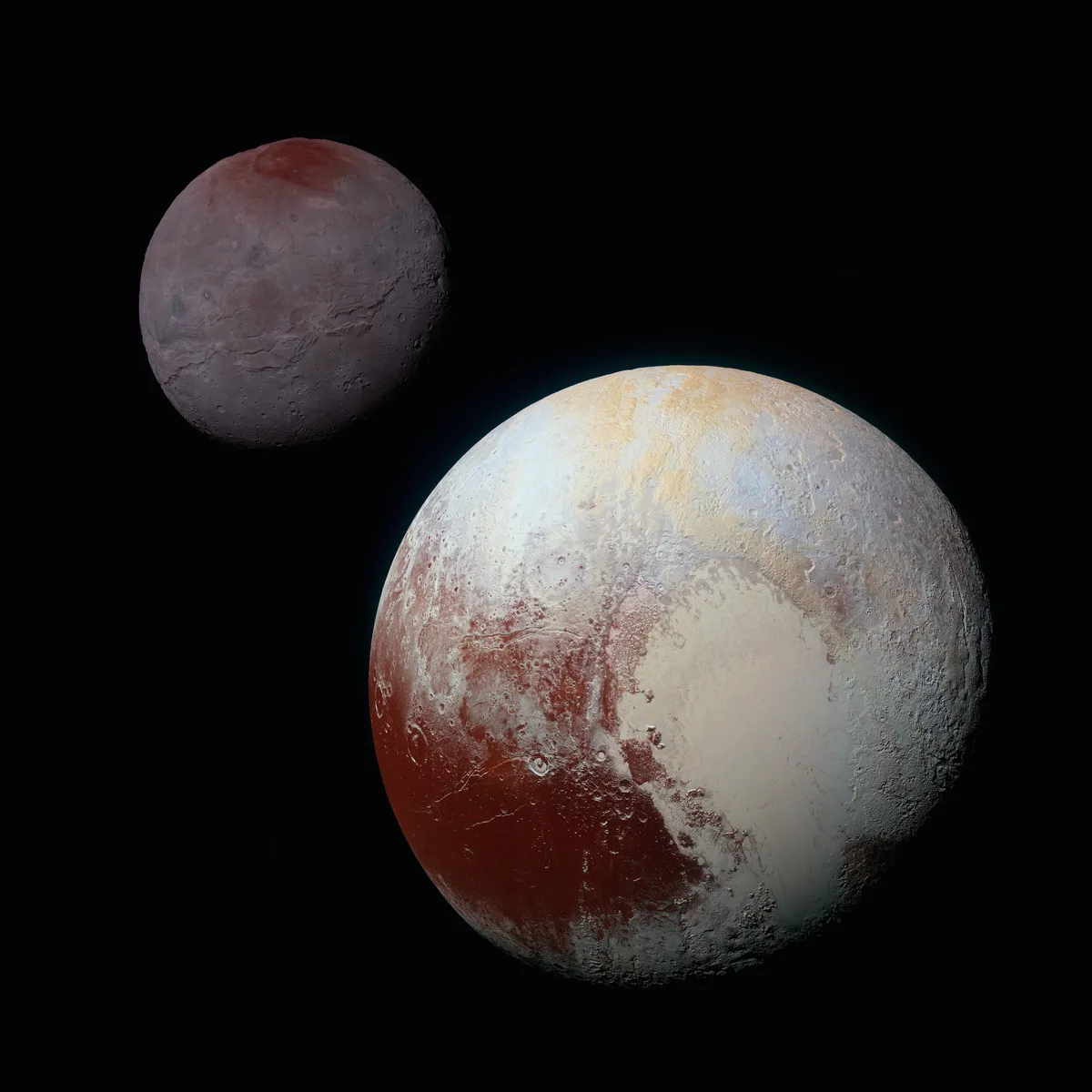
Pluto has five known moons. The largest, Charon, is about half Pluto's size, the largest moon relative to its planet in the solar system. NASA says the pair are often called a "double planet."
What did New Horizons find on Pluto?
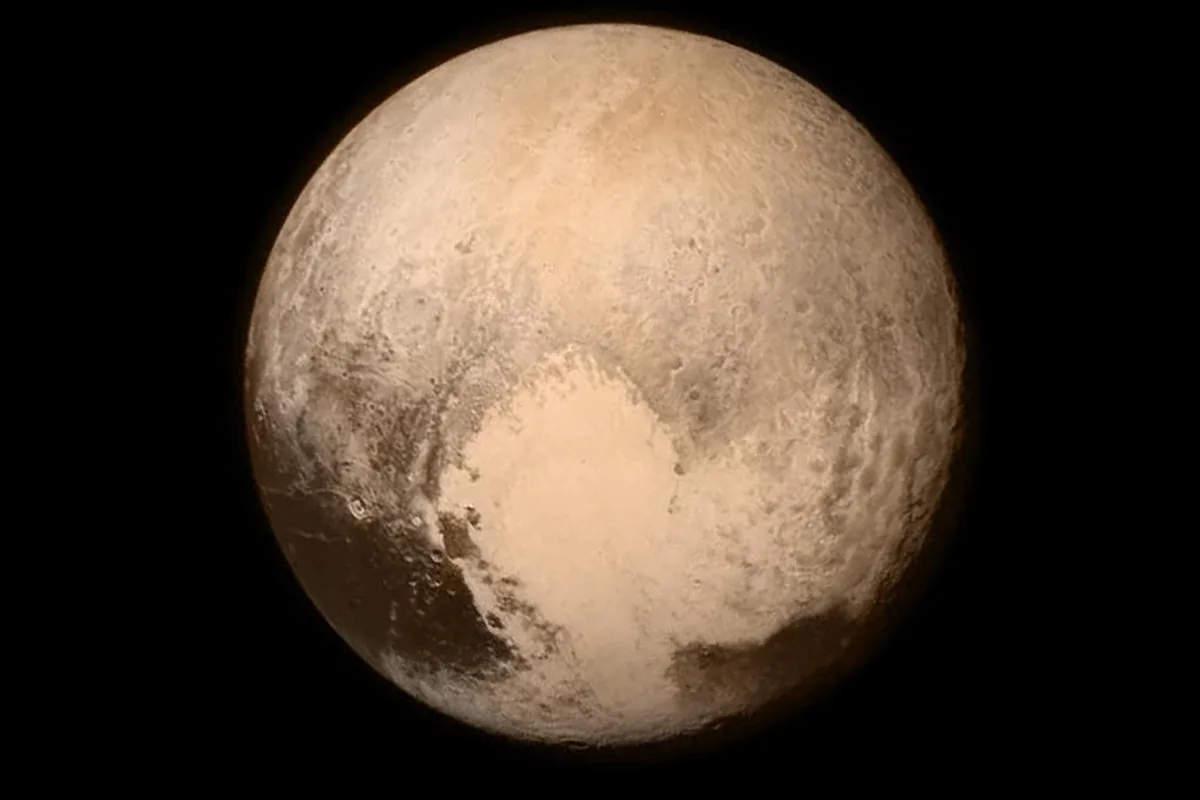
A world far more active than anyone predicted. New Horizons flew past Pluto on July 14, 2015, after a journey of more than nine years. It remains the only spacecraft to have explored Pluto up close. NASA says the data showed a system "far more complex than imagined," and that scientists were "particularly surprised by the degree of current activity" on its surface.
- A heart-shaped glacier. Sputnik Planitia, the bright "heart," is a nitrogen-ice glacier about 600 miles (1,000 km) wide. NASA calls it the largest known glacier in the solar system.
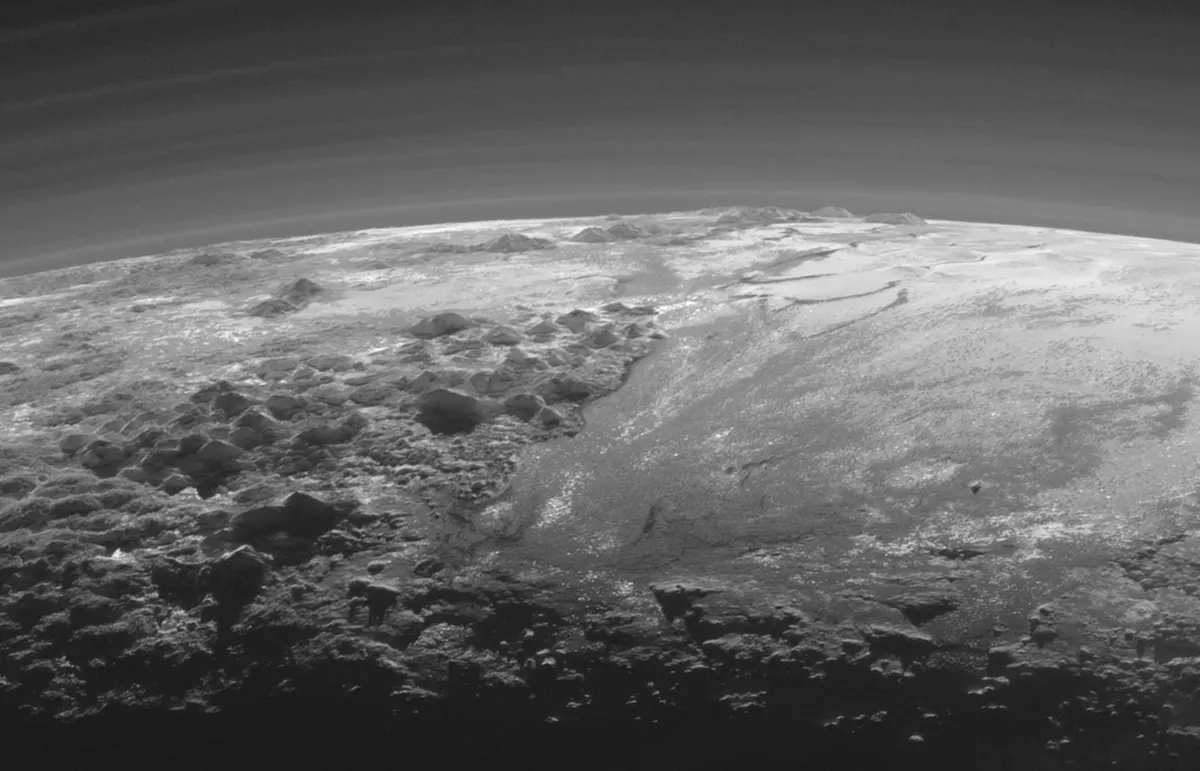
- Real mountains. The photo below shows peaks up to 11,000 feet (3,500 meters) high at the edge of the plain, with layers of haze above them.
- Possible ocean. NASA says there are hints of an internal water-ice ocean today. That would put Pluto in the same company as Europa and Enceladus, the moons that missions like Europa Clipper and ESA's JUICE are built to study.
It is still producing news. In August 2026, NASA reported a new analysis of the 2015 images that suggests liquid nitrogen is rising to the surface through cracks at the northern edge of Sputnik Planitia. NASA calls it the first evidence of recently flowing liquid on Pluto. The study was published July 31 in the Planetary Science Journal, and New Horizons principal investigator Alan Stern said, "Pluto never stops surprising us."
New Horizons did not stop there. In 2019 it flew past Arrokoth, the most distant object ever explored up close. For the farthest spacecraft of all, see Voyager 1 and its one light-day milestone.
Do scientists still disagree about Pluto?
Some do, and the loudest voice is Stern himself. At a public debate in April 2019, reported by Space.com, he argued for a geophysical definition: a planet is any body massive enough to be nearly round but not massive enough for nuclear fusion. He also said no planet fully clears its orbit, and that the rule gets harder to meet farther from the Sun. In his example, even Earth would fail the test if it orbited 100 times farther out.
Ron Ekers, a former IAU president, defended the 2006 decision. He said the asteroids and comets seen near the planets are in resonance with them, and that the IAU vote was "not a vote about science" but an agreement on how to name things. Space.com also reported that 424 voting members took part in Prague, out of about 9,000 members in total, and that a separate proposal to call dwarf planets planets failed by a large margin.
After the 2019 debate, an informal online poll open to anyone came out 130 to 30 in favor of making Pluto a planet. That poll had no official standing. The IAU definition has not changed, and NASA's current pages still call Pluto a dwarf planet.
In my opinion, both sides have a fair point. The "cleared its neighborhood" test gave astronomers a clean way to sort new discoveries, which is what it was built for. But a label that depends on how far a world sits from the Sun feels odd, and I would not be surprised to see the argument return whenever a new mission reaches the outer solar system.
So is Pluto a planet or not?
By the official definition, no. By what it is, it is one of the most interesting worlds humans have ever visited. NASA describes Pluto as "a complex and mysterious world with mountains, valleys, plains, craters, and glaciers." The label tells you how astronomers sort worlds. It does not tell you which ones deserve a spacecraft.
Frequently asked questions
Why is Pluto not a planet?
Because it fails one of the IAU's three tests. It orbits the Sun and is nearly round, but it has not cleared the neighborhood around its orbit. The IAU called it a dwarf planet in August 2006.
How many planets are there now?
Eight, from Mercury out to Neptune. Pluto is not one of them. It belongs to a separate group of five dwarf planets that also includes Ceres, Haumea, Makemake and Eris.
When did Pluto stop being a planet?
In August 2006, when the IAU voted on Resolutions B5 and B6 at its General Assembly in Prague. Pluto had been counted as the ninth planet since its discovery in 1930.
Is Pluto smaller than the Moon?
Yes. NASA says Pluto is about two-thirds the diameter of Earth's Moon and has about one-sixth of the Moon's mass.
Could Pluto become a planet again?
Only if the IAU changes its definition. Some scientists, including New Horizons principal investigator Alan Stern, argue it should. As of NASA's current Pluto pages, it is still officially a dwarf planet.
Did New Horizons visit Pluto after it was demoted?
Yes. The spacecraft launched on Jan. 19, 2006, before the IAU vote, and flew past Pluto on July 14, 2015. It remains the only spacecraft to explore Pluto up close.
Who named Pluto?
An 11-year-old girl, Venetia Burney of Oxford, England, according to NASA. She suggested the name to her grandfather in March 1930, and it was selected by the Lowell Observatory.
Sources
- International Astronomical Union, Resolutions B5 and B6 (26th General Assembly, 2006), PDF copy
- NASA Science, "Pluto: Facts" (accessed November 2, 2026)
- NASA Science, "Dwarf Planets" (accessed November 2, 2026)
- NASA Science, "Eris" (accessed November 2, 2026)
- NASA Science, "New Horizons" (accessed November 2, 2026)
- NASA, "Five Years after New Horizons' Historic Flyby, Here Are 10 Cool Things We Learned About Pluto"
- NASA Science, "NASA's New Horizons Finds Evidence of Recent Liquid on Pluto's Surface" (August 5, 2026)
- NASA/JHUAPL/SwRI, "Closer Look: Majestic Mountains and Frozen Plains" (PIA19947)
- Space.com, "Should Pluto Be a Planet Again? Informal Vote Offers Support After Experts Debate" (April 2019)

Founder and editor, Orbit and Atom
I write Orbit and Atom to explain space and science in plain English, starting from what NASA, ESA and the mission teams publish. Every article lists its sources at the end so you can read them yourself.