Solar System & Missions
Voyager 2: Where Is It Now, and What Has It Found?
Quick answer
On November 16, 2026, Voyager 2 is about 13.5 billion miles (21.7 billion kilometers) from Earth, and a radio signal needs roughly 20 hours to reach it. It has flown in interstellar space since November 2018 and is the only spacecraft that has ever visited Uranus and Neptune. Three of its instruments are still sending data.
On this page
Voyager 2 left Earth on August 20, 1977, sixteen days before its twin, Voyager 1. It was built to study Jupiter and Saturn over about five years. It went on to fly past two more planets after Jupiter and Saturn, and it is still reporting from beyond the Sun's bubble of influence.
Voyager 1 is getting the headlines this week because of its one-light-day milestone. Voyager 2 has a story of its own, so here is where it is today and what it has done.
Where is Voyager 2 right now?
About 13.5 billion miles (21.7 billion kilometers) from Earth on November 16, 2026. That is roughly 144 times the distance between Earth and the Sun, and light needs about 20 hours to cover it. NASA does not publish a daily number in text, so I took these figures from the JPL Horizons system that NASA's navigators use, and the table marks them as my reading.
| Measure | Value |
|---|---|
| Distance from Earth | About 13.5 billion miles (21.7 billion km) |
| Distance from the Sun | About 144 AU |
| Signal time, one way | About 20 hours |
| Speed leaving the solar system | About 3.1 AU per year |
| Direction | South of the planets' plane, toward Sagittarius and Pavo |
| Time since launch | 49 years |
Voyager 2 on November 16, 2026. Distance and signal time: my reading of NASA/JPL Horizons. Speed and direction: NASA Voyager FAQ.
An AU, or astronomical unit, is the Earth-Sun distance, about 93 million miles. For the same idea in light terms, I explain the light-year separately. Voyager 2 is not the farthest probe: NASA says Voyager 1 passed one light-day, 16.1 billion miles, on November 18. Voyager 2 took a longer route past two more planets, and NASA expects it to reach one light-day in November 2035. For that milestone, read my guide to Voyager 1 and the light-day.
What did Voyager 2 find at each planet?
Voyager 2 is the only spacecraft to have studied all four giant planets up close, and you can see where they sit in my guide to the planets in order from the Sun. NASA's mission history lists the flybys and the main results:
| Planet and flyby | Main results |
|---|---|
| Jupiter, July 1979 | Great Red Spot changes |
| Saturn, Aug. 1981 | Ring spokes, thin A ring |
| Uranus, Jan. 1986 | 10 new moons, 2 new rings |
| Neptune, Aug. 1989 | Great Dark Spot, Triton |
Voyager 2 planetary flybys. Source: NASA Science, Voyager 2 mission page.
The first two flybys were the job Voyager 2 was built for. A ring only about 300 meters thick is also why Saturn's rings seem to vanish when Earth lines up with their edge. The last two came from a decision made along the way. NASA says its Jupiter encounter was optimized in part so that later flybys would stay possible, and that mission planners chose to send it on to Uranus after Saturn. In my opinion, that choice is why this probe is remembered as a planetary explorer and not only as a long-distance traveler.
What did Voyager 2 find at Uranus?
On January 24, 1986, Voyager 2 became the first spacecraft to fly past Uranus, passing about 50,640 miles (81,500 kilometers) from the planet. It had only about 5.5 hours of close study.
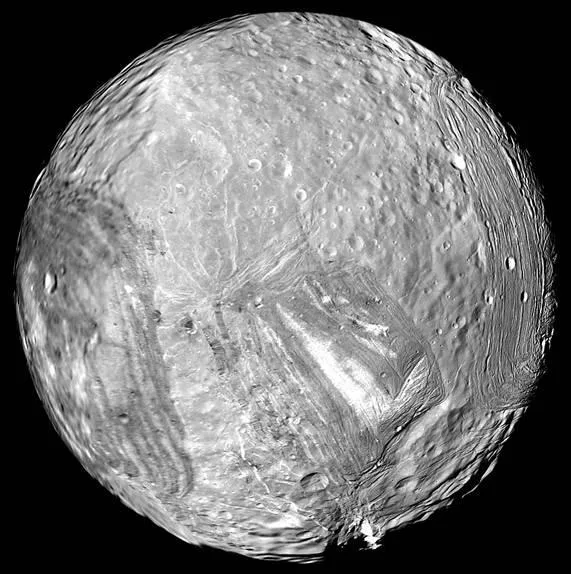
In that short window it found 10 new moons and two new rings, in addition to the nine already known. It also found a magnetic field tilted 55 degrees, and winds in the atmosphere as high as 450 miles per hour (724 kilometers per hour). Its closest pass to any object in the whole mission was the moon Miranda, at only 17,560 miles (28,260 kilometers).
Nobody has been back since. If you want to know what may be inside these ice giants, my piece on diamond rain on Neptune and Uranus starts from what Voyager 2 measured.
What did Voyager 2 find at Neptune?
On August 25, 1989, after a 4.3 billion-mile (7 billion-kilometer) journey, Voyager 2 passed about 2,980 miles (4,800 kilometers) above Neptune's cloud tops, the closest of its four planetary flybys. It was the first spacecraft to reach the planet, and all 10 of its instruments were still working.
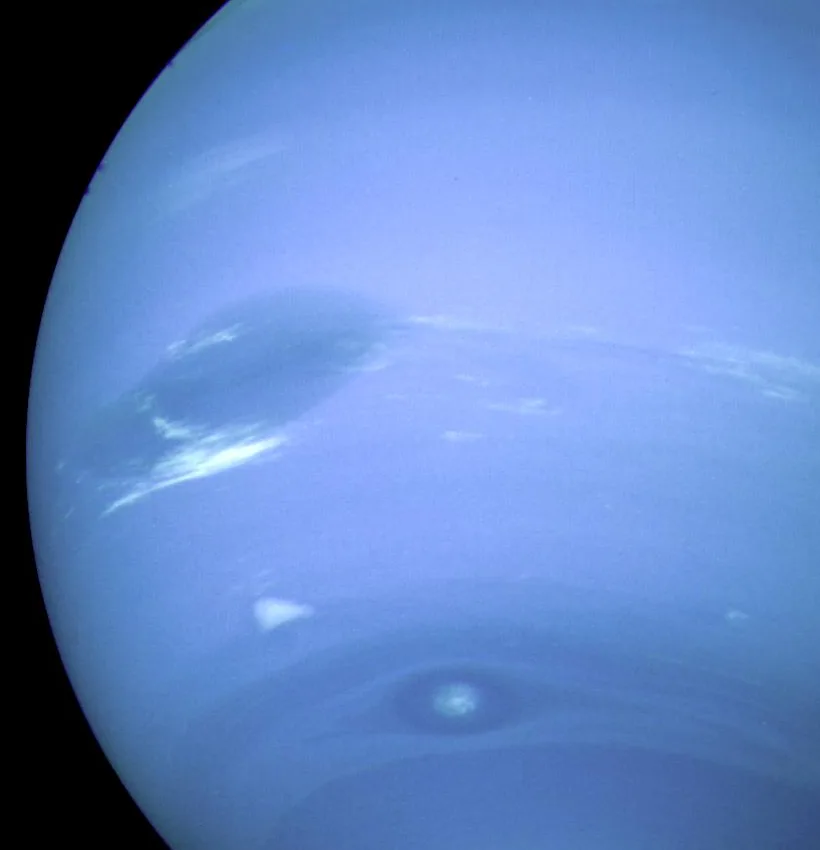
Neptune turned out to be more active than expected, with winds of 680 miles per hour (1,100 kilometers per hour). Voyager 2 found four new rings and new moons, and it imaged three major cloud features: the Great Dark Spot, the Lesser Dark Spot and a bright cloud called Scooter. Methane in the atmosphere gives the planet its blue color.
The probe also photographed about two-thirds of Triton, Neptune's largest moon. NASA's account says it revealed the coldest known planetary body in the solar system at the time, with a nitrogen ice "volcano" on its surface and a pitted, cantaloupe-like terrain in the south.
When did Voyager 2 reach interstellar space?
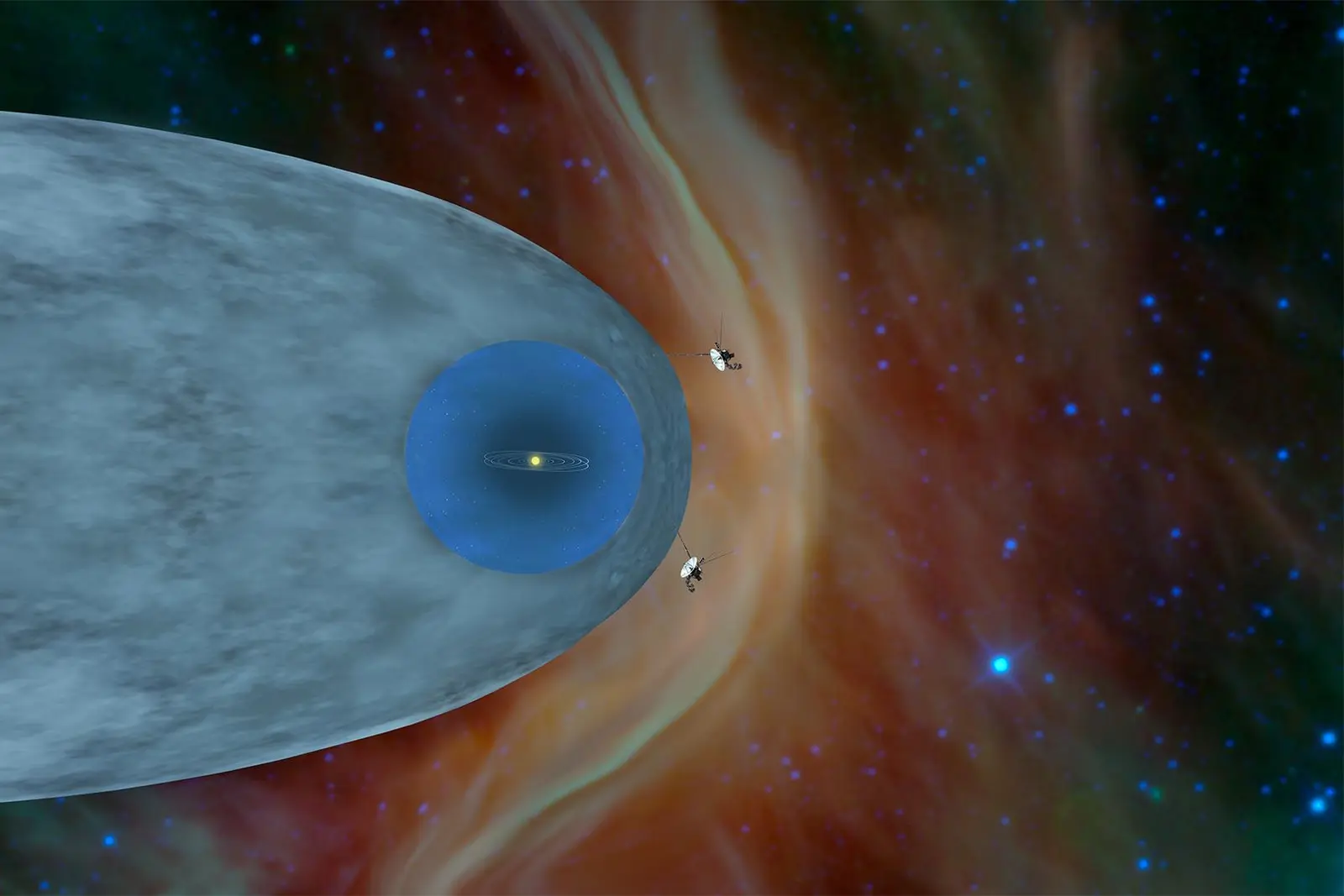
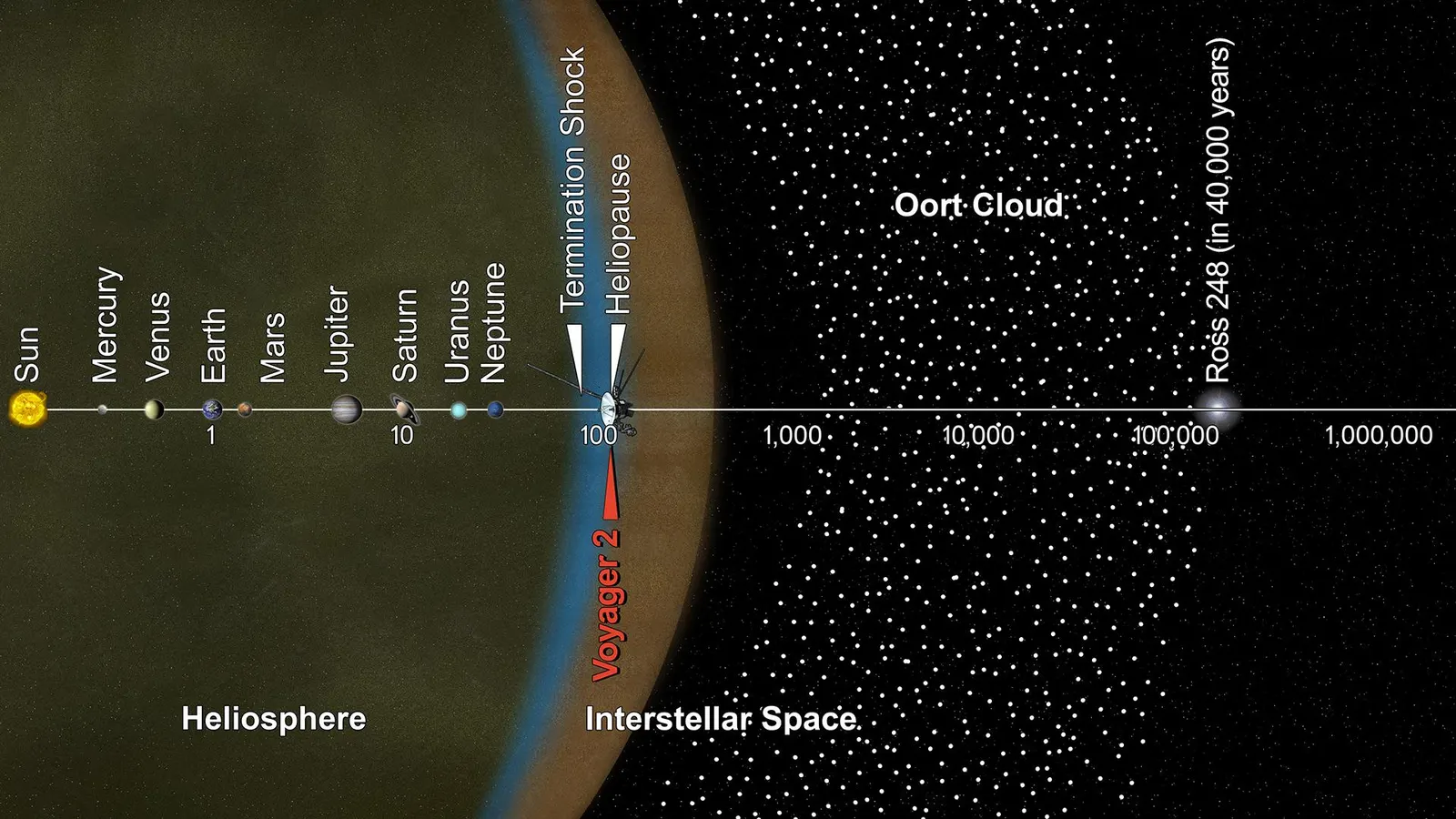
NASA places the crossing on November 5, 2018, when the probe passed the heliopause, the boundary where the Sun's thin, hot solar wind meets the colder, denser gas between the stars. It had passed an earlier boundary, the termination shock, on August 30, 2007. NASA announced the exit on December 10, 2018, when Voyager 2 was slightly more than 11 billion miles (18 billion kilometers) from Earth and its signals took about 16.5 hours to arrive.
The strongest evidence came from its plasma instrument, which saw the speed of solar wind particles fall steeply on that date and then record no solar wind at all. Voyager 1 had left in 2012, but its own plasma instrument had stopped working decades before, so Voyager 2 gave scientists first-of-its-kind observations of this boundary. Three other instruments gave readings consistent with the crossing.
Leaving the heliosphere is not leaving the solar system. NASA says the solar system extends out through the Oort Cloud, and that it will take about 300 years for Voyager 2 to reach the inner edge of that cloud and possibly 30,000 years to fly beyond it.
Is Voyager 2 still working?
Yes, with three science instruments. NASA's April 2026 status table lists the cosmic ray subsystem, the magnetometer and the plasma wave subsystem as on. The plasma instrument that proved the 2018 crossing was switched off on September 26, 2024 to save power, and the low-energy charged particle instrument followed on March 24, 2025. The cameras were turned off in 1989.
The cause is the power supply. Voyager 2 runs on a generator that turns the heat of decaying plutonium into electricity, and NASA says it loses about 4 watts a year. Without a fix, the team would have had to shut down another instrument before the end of 2026.
On August 4, 2026, NASA announced that engineers at JPL had freed up power with a procedure nicknamed the "Big Bang." They switched off certain powered devices and substituted lower-power alternatives, while keeping the spacecraft warm enough to operate. That should keep the three instruments running for at least another year. I think it is a good sign that, after 49 years, the team is still finding new ways to save watts. NASA plans the same swap on Voyager 1.
The Voyager FAQ adds that radio contact with both probes could last until roughly 2036, if enough power remains to transmit.
Where is Voyager 2 going next?
Away from the planets, 48 degrees below their orbital plane, toward the constellations Sagittarius and Pavo. NASA's FAQ says that in about 40,000 years, Voyager 2 will pass within roughly 1.7 light-years of Ross 248, a small star in the constellation Andromeda.
It carries a Golden Record, like its twin, with sounds and images from Earth. Jupiter's icy moons, which it photographed in 1979, are now the target of the Europa Clipper mission. The spacecraft will keep flying long after its last instrument goes quiet.
Frequently asked questions
How far away is Voyager 2?
About 13.5 billion miles (21.7 billion kilometers) from Earth on November 16, 2026, or roughly 144 times the Earth-Sun distance. These figures come from NASA/JPL Horizons.
Is Voyager 2 farther away than Voyager 1?
No. Voyager 1 is farther: NASA calculated that it was 16.1 billion miles (25.9 billion kilometers) from Earth on November 18, 2026. NASA expects Voyager 2 to reach that one-light-day distance in November 2035.
How long does a signal take to reach Voyager 2?
About 20 hours one way on November 16, 2026, so a command and the answer make a round trip of about 40 hours.
Did Voyager 2 leave the solar system?
It left the heliosphere, the Sun's bubble of particles and magnetic fields, on November 5, 2018. NASA says it has not left the solar system, which reaches out through the Oort Cloud. Reaching the inner edge of that cloud will take about 300 years.
Which planets did Voyager 2 visit?
Jupiter in 1979, Saturn in 1981, Uranus in 1986 and Neptune in 1989. It is the only spacecraft to have visited Uranus and Neptune.
Is Voyager 2 still sending data?
Yes. As of NASA's April 2026 status table, three science instruments were on: the cosmic ray subsystem, the magnetometer and the plasma wave subsystem. A power-saving procedure announced on August 4, 2026 should keep them running for at least another year.
When will Voyager 2 stop working?
NASA has not set a date. The spacecraft loses about 4 watts of power a year, and NASA says contact with the two Voyagers could last until about 2036.
Sources
- NASA Science, "Voyager 2" mission page (accessed November 16, 2026)
- NASA Science, "Where Are Voyager 1 and Voyager 2 Now?" (instrument status, updated April 17, 2026)
- NASA Science, "NASA Engineers Help Prolong Voyager 2's Science Mission" (August 4, 2026)
- NASA Science, "Voyager: Frequently Asked Questions"
- NASA, "NASA's Voyager 2 Probe Enters Interstellar Space" (December 10, 2018)
- NASA Science, "Voyager 1: What Is a Light-Day"
- NASA/JPL Horizons system, Voyager 2 (-32) ephemeris for November 16, 2026

Founder and editor, Orbit and Atom
I write Orbit and Atom to explain space and science in plain English, starting from what NASA, ESA and the mission teams publish. Every article lists its sources at the end so you can read them yourself.