Solar System & Missions
ESA's Hera Reaches the Asteroid NASA Hit: What It Will Find
Quick answer
ESA's Hera spacecraft has reached the asteroid pair Didymos and Dimorphos, where NASA's DART probe crashed in 2022. Hera will check whether the impact left a crater or reshaped Dimorphos, measure its mass and structure, and help explain why its orbit changed more than models predicted. ESA says detailed images of both asteroids will be unveiled on November 25.
On this page
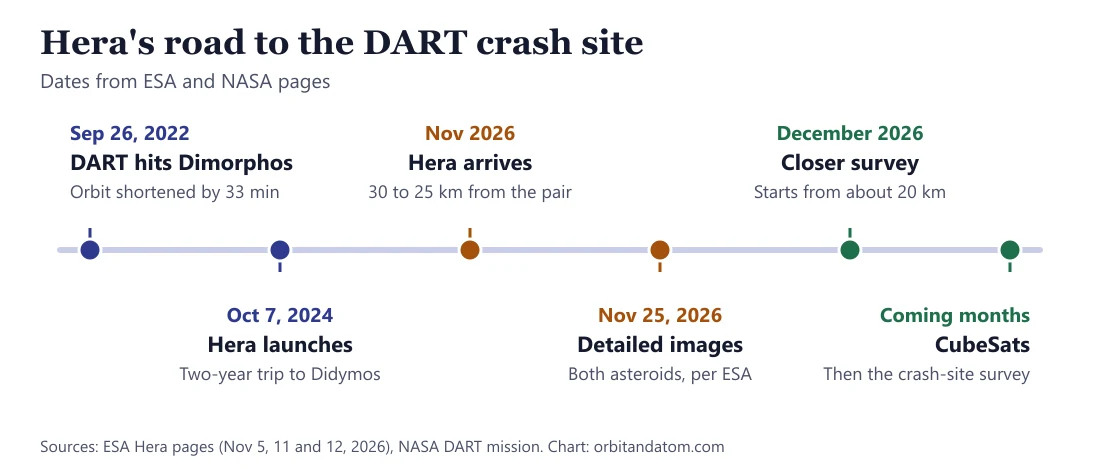
In September 2022, NASA flew a spacecraft into a small asteroid on purpose. Four years later, a European spacecraft has arrived to see what was left. ESA says its Hera mission now sits 30 to 25 kilometers (about 19 to 16 miles) from the pair, and has started its first survey.
This guide covers what Hera has already shown, what it is built to find at the crash site, and why anyone would crash a probe into an asteroid and then send a second one to check. Every fact comes from ESA and NASA pages I read on November 14, 2026, listed at the end.
What is Hera and where has it arrived?
Hera is ESA's first planetary defence mission. ESA says it launched on October 7, 2024, and describes the spacecraft as small-car-sized. Its target is a double asteroid: Didymos, a 780-meter body (about half a mile), and its moonlet Dimorphos, 151 meters across, which ESA compares to the Great Pyramid of Giza. ESA reports the pair is currently 196.8 million kilometers (about 122 million miles) from Earth.
One note on sizes. NASA's own pages give Dimorphos as 160 to 170 meters, older estimates than ESA's 151. I use ESA's figure because it comes with the Hera mission.
ESA's update of November 11 says Hera has arrived and has begun what it calls the early characterisation phase. Mission scientist Michael Kueppers says the aim right now is to gather the big-picture findings that matter for planetary defence.
What did NASA's DART do to Dimorphos?
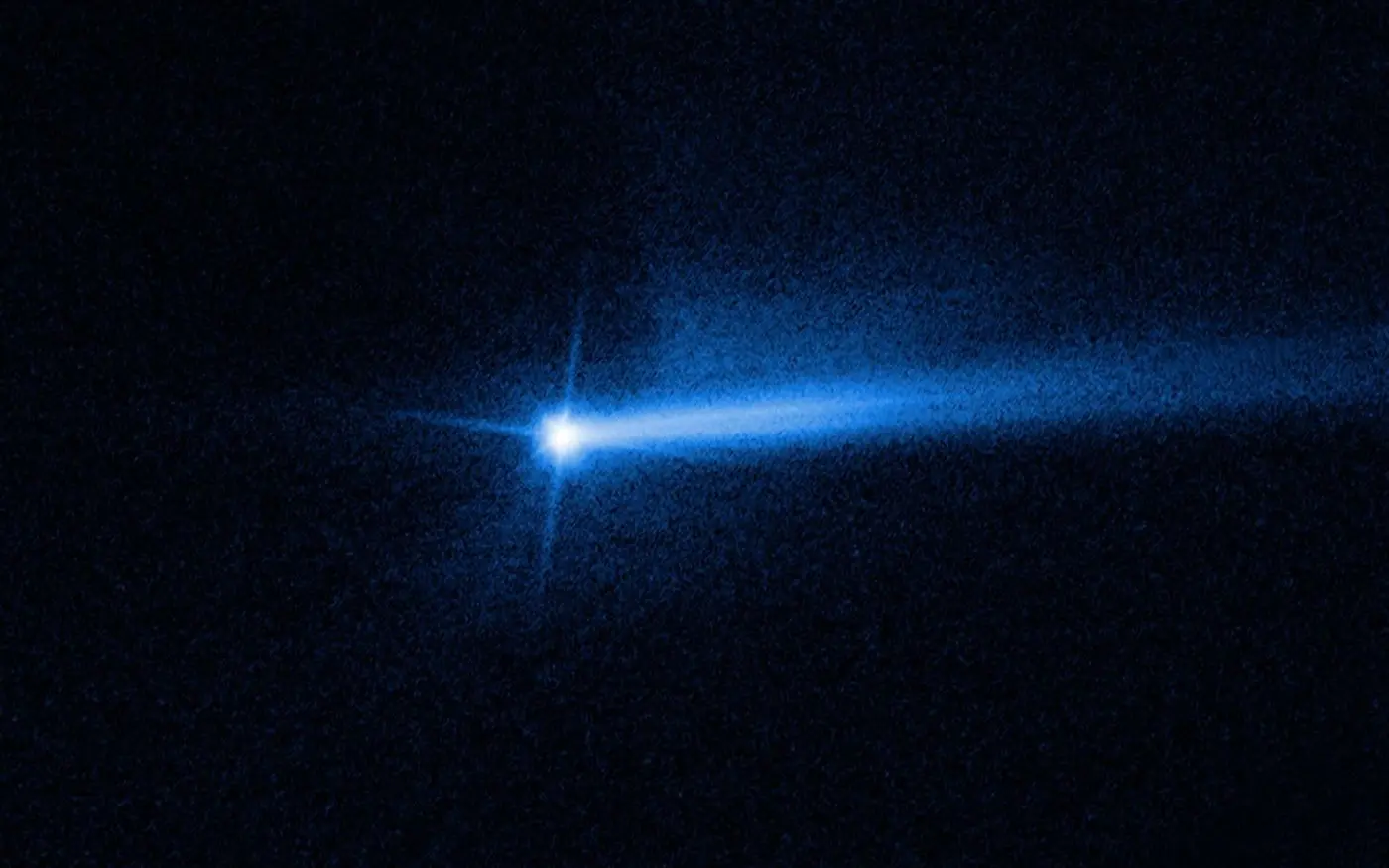
On September 26, 2022, NASA's 580-kilogram DART spacecraft hit Dimorphos at about 6.1 kilometers per second (about 13,600 miles per hour, by my conversion). ESA says the crash sent a plume of debris across 10,000 kilometers of space and shortened Dimorphos's orbit around Didymos by about 33 minutes, give or take a minute. That was much more than anyone had predicted.
Why so much? NASA's answer is the debris. A 2025 study of images from the Italian LICIACube cubesat, which flew past right after the impact, estimates that about 16 million kilograms (35.3 million pounds) of dust and rock were thrown out. That is less than 0.5 percent of Dimorphos's mass, yet 30,000 times the mass of the spacecraft. NASA says the flying rubble acted like a short rocket burst.
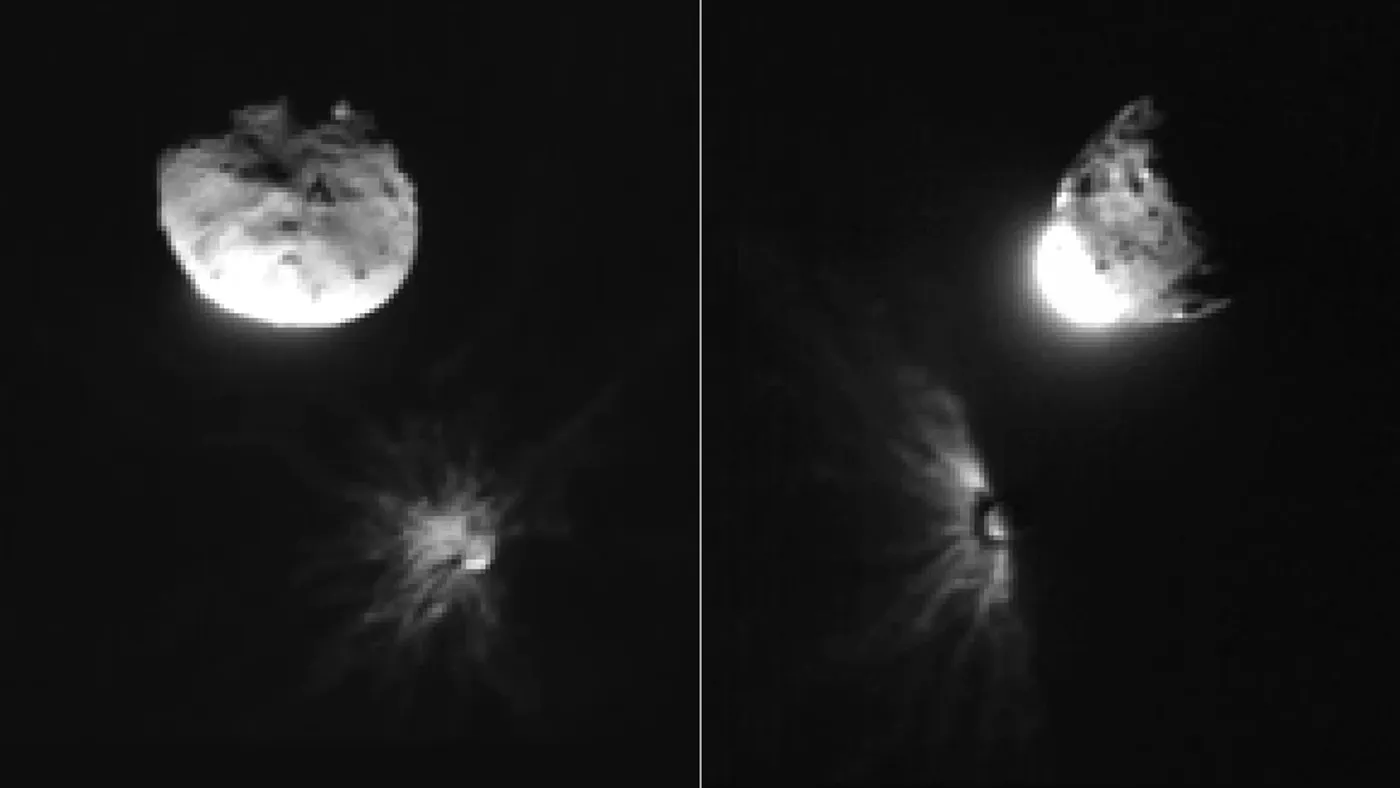
NASA has since added two more results. A March 2026 study found the impact also changed the pair's 770-day orbit around the Sun by 0.15 seconds, the first time a human-made object has measurably altered the path of a celestial body around the Sun. The same study puts the boost from the debris at a factor of about two, meaning the debris doubled the punch of the spacecraft alone. That does not match the 2025 wording, which said the debris pushed Dimorphos several times harder than the spacecraft did.
In my opinion, that mismatch is the best reason to go back. The numbers depend on how heavy Dimorphos is and how it is built, and ESA lists the mass and structure of Dimorphos as open questions.
What has Hera already seen?
Two pictures so far, both from Hera's black-and-white Asteroid Framing Camera, and both mostly of the bigger asteroid. The first, released on November 5, was taken from 60 kilometers away. Most of Dimorphos is hidden in shadow, but Didymos is clear. Hera's principal investigator, Patrick Michel, said: "The first thing we said was wow!" He explained that this is the other side of Didymos from the one DART's camera showed before impact, so it feels like looking at a whole new world.
That side has the same central ridge along its equator, but otherwise looks different, with multiple boulders, craters and what look like patterns of grooves or ridges. Kueppers adds that a lot of impact-ejected material must have crossed the roughly one kilometer of space from Dimorphos to Didymos, so some of those features may come from that transport.
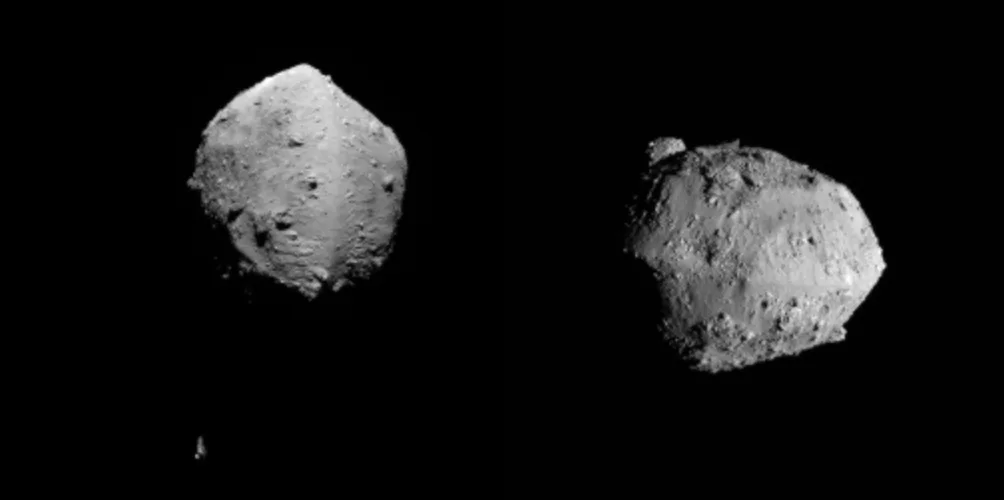
The second picture, released on November 12, was taken from 56 kilometers and shows large boulders, smoother regions and a surprisingly sharp equatorial ridge. A small part of Dimorphos peeks out near the top of Didymos. ESA's explanation for the ridge: Didymos spins once every 2.2 hours, fast enough that it is close to coming apart, and models of fast-spinning asteroids suggest material flows down from higher latitudes to the equator. Some material might even be shed, which could account for Dimorphos itself.
That last idea matches NASA's earlier DART results, where the team inferred that Dimorphos likely spun off from Didymos in a large mass-shedding event.
What will Hera look for at Dimorphos?
ESA frames it as a crash-site investigation. Its list of unknowns is short and clear: what did the impact do to the asteroid itself, did it leave a crater or reshape the whole body, what are Dimorphos's makeup, structure and mass, and which of those properties explain a deflection so much bigger than simulations predicted.
Kueppers says previous impact models suggested many different ways the moonlet might react, and that Hera will reveal which forecast was the correct one, "if any!" He adds that the early images will show for the first time what a small asteroid looks like globally after a hypervelocity impact.
| Tool | What it tells scientists |
|---|---|
| Framing cameras | Visible-light pictures of the surface |
| Thermal imager | Surface temperature, which hints at roughness and porosity |
| HyperScout H | 25 colors, to prospect the mineral makeup |
| Laser rangefinder | Distance to the surface, accurate to better than 1 m |
Hera's main tools, as described by ESA. Hera also carries two shoebox-sized CubeSats, Milani and Juventas.
The CubeSats carry extra instruments, including a radar to probe the inside of Dimorphos and spectrometers to read the composition of both asteroids. ESA says Hera will deploy the pair for a still closer survey, eventually progressing to landing. For a rubble pile held together weakly by gravity, as NASA describes Dimorphos, the radar is the part I would watch most: it is the instrument built to look inside.
How does Hera fly around two asteroids?
Very slowly. ESA says Didymos has gravity about 40,000 times weaker than Earth's, and Dimorphos about 200,000 times weaker. A normal circular orbit does not work in that little gravity, so Hera moves around the common center of the two bodies at about 12 centimeters per second, which ESA compares to a rapidly crawling insect (about 0.3 miles per hour, by my conversion).
The path is nearly straight lines. Every three days, then four days, Hera fires its thrusters to turn its course by 90 degrees, and the result is a series of "rectangular orbits" that hold it near 25 to 30 kilometers away. ESA says the layout comes from the Rosetta comet mission and is safe by design: if a firing fails, the spacecraft simply drifts away instead of heading toward the asteroids.
In December the mission moves to what ESA calls its detailed characterisation phase, flying bowtie-shaped arcs that start from around 20 kilometers out. The team at ESA's control center in Darmstadt, Germany, talks to Hera about eight hours a day across about 196.5 million kilometers.
Why does this matter for planetary defence?
Because DART was a single test. ESA says Hera's discoveries will help turn the kinetic impact method of asteroid deflection from a one-off experiment into a well-understood and potentially repeatable technique, if Earth ever comes under threat.
NASA is clear that Dimorphos poses no threat to Earth, and that Didymos was not on an impact trajectory and DART could not have put it on one. The point is the method. Planetary scientist Dave Glenar, of the University of Maryland, Baltimore County, who took part in NASA's debris study, notes that many near-Earth asteroids probably share Dimorphos's rubble-pile structure, so the extra push from the debris plume is critical to consider when designing future deflection missions.
In my view, the split between the two missions is the useful way to see it. DART asked whether a spacecraft can move an asteroid, and the answer was yes. Hera is meant to answer how well anyone understands why it moved that much. NASA adds that the harder part of any real case is finding a dangerous object early enough, which is why NASA is building its NEO Surveyor space telescope.
When will we see more of Dimorphos?
ESA says detailed images of both asteroids will be unveiled on November 25. ESA's releases of November 5 and November 12 both give that date, so I treat it as the next real milestone. I will update this guide once ESA publishes them.
If you want more on the missions and physics around this story, my guides cover what gravity is, how rockets work in space, and where Europa Clipper is now. For another look at the pieces left behind by small bodies, see why November brings the brightest fireballs, and for the telescope that photographed the debris tail, how much longer Hubble will last. You can also browse Solar System & Missions.
Frequently asked questions
What is ESA's Hera mission?
Hera is ESA's first planetary defence mission. It launched on October 7, 2024, and has arrived at the Didymos binary asteroid system to survey the aftermath of NASA's DART impact.
Has Hera reached Didymos and Dimorphos?
Yes. ESA says Hera has arrived and is flying about 30 to 25 kilometers from the pair, in what it calls the early characterisation phase.
What happened when DART hit Dimorphos?
On September 26, 2022, the 580-kilogram spacecraft hit at about 6.1 kilometers per second. ESA says Dimorphos's orbit around Didymos got shorter by about 33 minutes, much more than predicted.
What will Hera find at Dimorphos?
ESA wants to know whether the impact left a crater or reshaped the moonlet, and what Dimorphos is made of, how it is built inside and how much it weighs. Nobody has seen the answer yet.
When will ESA release detailed Hera images?
ESA says detailed images of both asteroids will be unveiled on November 25, 2026.
Is Dimorphos a danger to Earth?
No. NASA says Dimorphos poses no threat to Earth, and that Didymos was not on an impact trajectory and DART could not have put it on one.
How does Hera orbit an asteroid with so little gravity?
It does not orbit in circles. Hera flies in nearly straight lines at about 12 centimeters per second and turns 90 degrees with thruster firings, tracing "rectangular orbits" around the pair, according to ESA.
Sources
- ESA, "Hera's first close-up view of Didymos asteroids" (November 5, 2026; accessed November 14, 2026). Used for the first image, the sizes, the DART numbers, the quotes and the November 25 release.
- ESA, "Hera spacecraft in 'rectangular orbit' around target asteroids" (November 11, 2026; accessed November 14, 2026). Used for the arrival, the gravity figures, the rectangular orbits, the December phase and the open questions.
- ESA, "Hera spies a half-hidden asteroid moonlet" (November 12, 2026; accessed November 14, 2026). Used for the second image, the equatorial ridge and the 2.2-hour spin.
- ESA, "Hera's asteroid deck and instruments" (accessed November 14, 2026). Used for the instruments, the CubeSats and the launch date.
- NASA Science, "Double Asteroid Redirection Test (DART)" (accessed November 14, 2026). Used for the mission goal and the impact date.
- NASA Science, "Close-Up Views of NASA's DART Impact to Inform Planetary Defense" (August 21, 2025; accessed November 14, 2026). Used for the debris estimate, the rubble-pile structure and the Hubble image.
- NASA Science, "NASA's DART Mission Sheds New Light on Target Binary Asteroid System" (July 30, 2024; accessed November 14, 2026). Used for the idea that Dimorphos spun off from Didymos.
- NASA, "NASA's DART Mission Changed Orbit of Asteroid Didymos Around Sun" (March 6, 2026; accessed November 14, 2026). Used for the change in the orbit around the Sun, the boost factor and NEO Surveyor.

Founder and editor, Orbit and Atom
I write Orbit and Atom to explain space and science in plain English, starting from what NASA, ESA and the mission teams publish. Every article lists its sources at the end so you can read them yourself.