Atoms & Physics
How Do Rockets Work in Space With Nothing to Push Against?
Quick answer
A rocket does not push against air. It throws its own hot exhaust gas out the back, and by Newton's third law the gas pushes the rocket forward with an equal force. That works in the vacuum of space because the rocket carries everything it needs, fuel and oxidizer, and uses its exhaust instead of the atmosphere. NASA Glenn says that is why a rocket works in space but a propeller does not.
On this page
It sounds like it should not work. On Earth, a car pushes on the road, a boat pushes on water and a plane pushes on air. In space there is none of that. Yet spacecraft speed up, slow down and change course, sometimes years after launch.
The answer is a rule of physics you can feel with a balloon. Below: how a rocket gets its push, why the vacuum is not a problem, and how the quiet ion engines that crossed the asteroid belt do the same thing in a gentler way.
What does a rocket actually push against?
Itself, in a sense. A rocket pushes against the gas it throws out. NASA's Glenn Research Center says that "all thrust is generated through some application of Newton's third law of motion," the law that says for every action there is an equal and opposite reaction.
Think of letting go of an inflated balloon. The air rushes out one way and the balloon shoots the other. The balloon is not pushing on the room. It is pushing on the air it is throwing away, and that air pushes back.
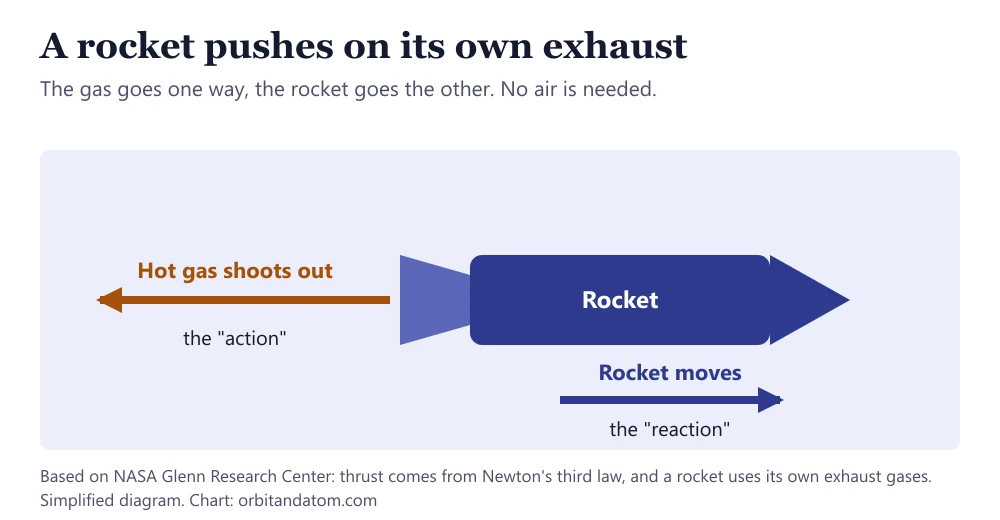
NASA Glenn's thrust page adds the two things that decide how hard the push is: how much gas leaves the engine each second, and how fast it leaves. More gas or faster gas means more thrust.
Why does a rocket work in a vacuum?
Because it does not need the air. NASA Glenn explains the difference with engines you know: "Turbine engines and propellers use air from the atmosphere as the working fluid, but rockets use the combustion exhaust gases." And then: "In outer space there is no atmosphere so turbines and propellers can not work there. This explains why a rocket works in space but a turbine engine or a propeller does not work."
A jet engine pulls in air and needs the oxygen in it to burn fuel. A rocket carries both. NASA says that in a rocket engine "fuel and a source of oxygen, called an oxidizer, are mixed and exploded in a combustion chamber." In a liquid rocket, the two are stored separately as liquids and pumped into the combustion chamber, where they burn. The propellants are loaded just before launch, which is why a rocket on the pad is mostly fuel tanks.
In my reading, the vacuum is not even the enemy people picture. Nothing in the push depends on the air, and once the rocket is high up there is almost no air left to slow it down.
What does this look like at launch?
Loud, bright and very fast. NASA's Space Launch System rocket carrying the Orion spacecraft lifted off on the Artemis I flight test on Wednesday, November 16, 2022, at 1:47 a.m. EST from Launch Complex 39B at Kennedy Space Center in Florida. In the long-exposure photo below, the glow at the bottom is the engines and the pale line is the exhaust the rocket left behind as it climbed.
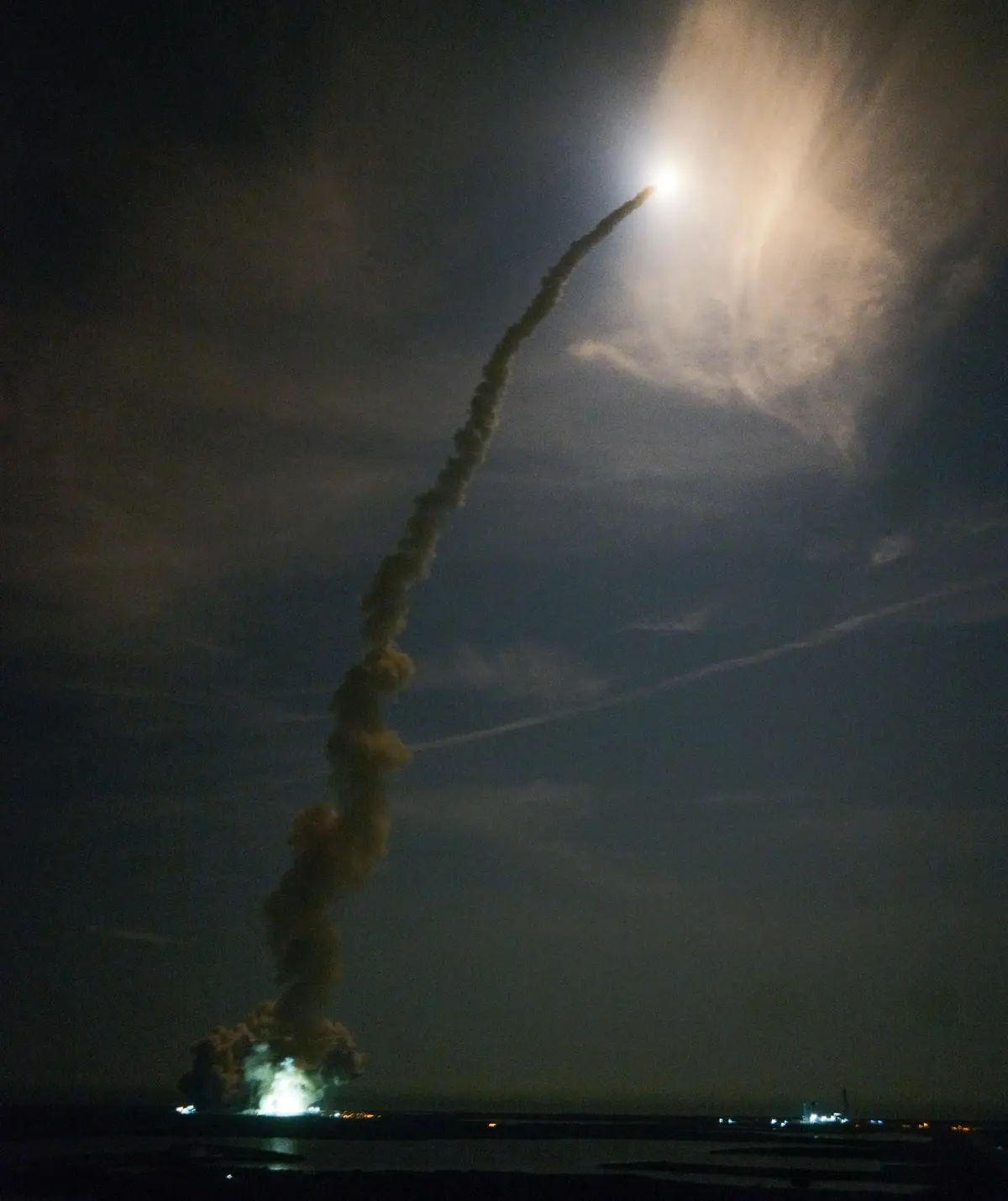
That trail is the "action" in the diagram, made visible. Every bit of that smoke was pushed backward so that the rocket could be pushed up. I cover where this rocket is headed next in what comes after Artemis II.
How do ion engines work with no flame at all?
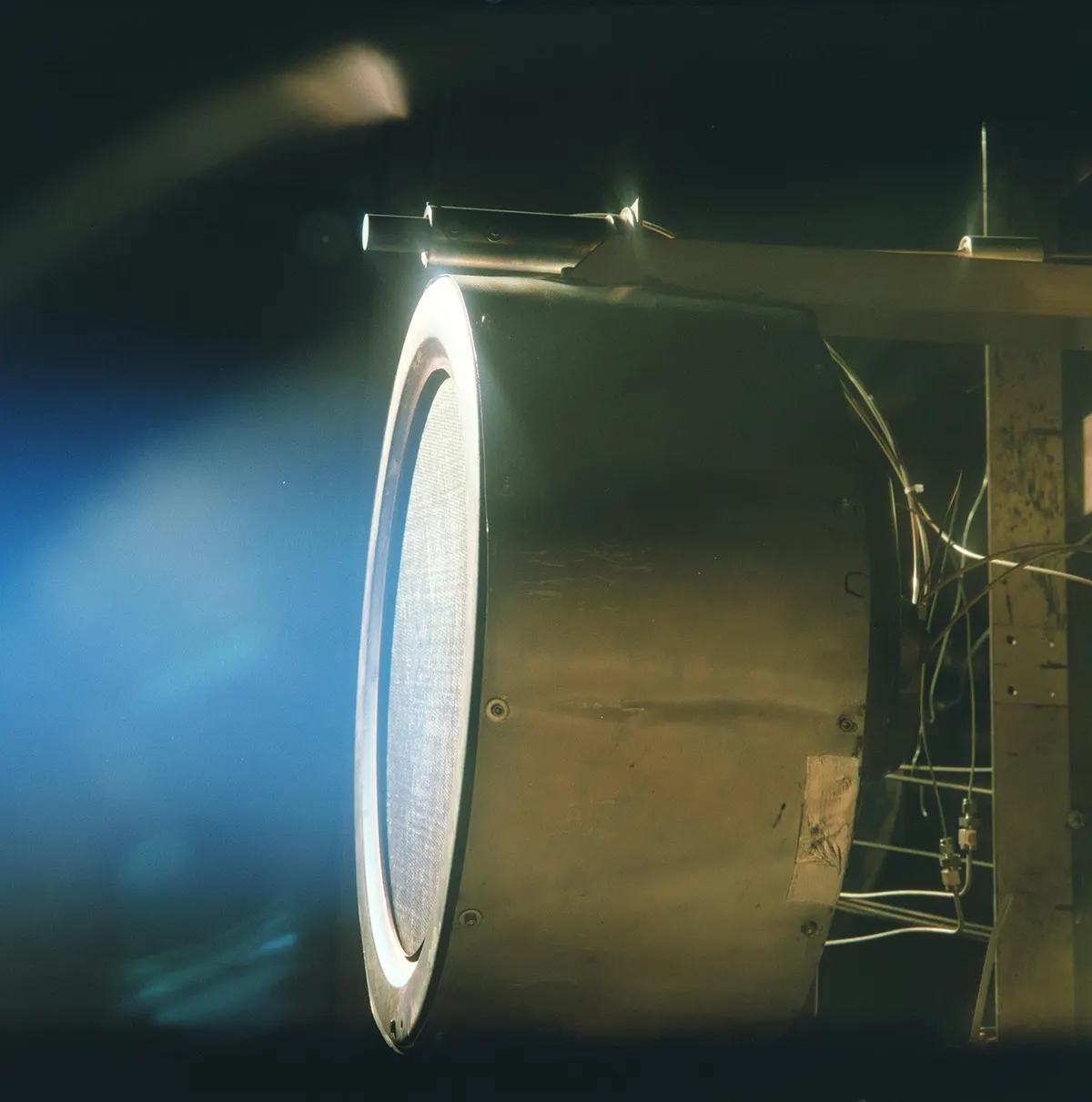
They use the same law with a much smaller push. NASA's Dawn mission page says its thrusters "work by using an electrical charge to accelerate ions from xenon fuel to a speed 7-10 times that of chemical engines." Xenon is a gas, and the engine charges its atoms and fires them out the back.
NASA JPL's description of a similar test engine says the xenon ions leave at more than 110,000 kilometers (68,000 miles) per hour, but their mass is so low that the engine produces a gentle thrust of only 90 millinewtons. In the photo at the top of this page, the faint blue glow is those ions leaving the engine.
| Measure | What NASA says |
|---|---|
| Thrust at maximum | 91 millinewtons, about the force of holding one sheet of notebook paper |
| Fuel use | About 3.25 milligrams of xenon per second |
| Fuel at launch | 425 kg (937 lb) of xenon |
| 0 to 60 mph | Four days at maximum throttle |
| Thrust time | More than 2,000 days over the mission |
Dawn's ion thrusters, from NASA's Dawn ion propulsion page. Read November 10, 2026.
It is a slow way to speed up, but it never stops. NASA says the total change in speed from Dawn's ion engines over its mission is comparable to the push from the Delta II rocket that carried it into space. The difference is that the chemical rocket spent its push in minutes, and the ion engine spent it over years.
Dawn was not the first. A NASA photo caption says the ion engine on Deep Space 1 was the first non-chemical propulsion used as the primary means of propelling a spacecraft, and Dawn's page notes that Deep Space 1 ran its ion engine for 678 days.
Why use chemical rockets and ion engines?
Because they do different jobs. A chemical rocket has a big, quick push, which is what you need to leave the ground against gravity. An ion engine has a tiny push that lasts, which is what you need to keep changing speed once you are in space. NASA's own comparison for Dawn is a person on a freeway: "You would not want to use ion propulsion to get on a freeway," it says, because it would take four days to go from 0 to 60 mph.
The ion engine also sips its fuel. At about 3.25 milligrams of xenon per second, NASA says that is about 10 ounces over 24 hours. In my opinion, that is the neat part of this story: the same third law drives both a rocket on the pad and a thruster you could hold in your hands, and the only difference is how much gas goes out and how fast.
If you want to see what long, patient pushes make possible, my guide to Europa Clipper and my piece on Voyager 1 nearing one light day from Earth both cover spacecraft that left the planet far behind.
Is it true that a rocket needs air to push against?
No, and it is an old mix-up. The pages I read do not use the phrase "push against air," but they say the working fluid of a rocket is its own exhaust, not the atmosphere. The reason a rocket could look like it needs air is that every other vehicle we see does.
A good way to keep it straight: a rocket is like standing on a skateboard and throwing a heavy ball. You roll the other way. The ball does not need to hit anything for that to happen, and neither does the exhaust.
Want to see how the rest of the physics fits together? Start with what is inside an atom, then try why nothing can go faster than light. More in Atoms & Physics.
Frequently asked questions
How do rockets work in space with no air?
They push on their own exhaust. The engine throws hot gas out the back and, by Newton's third law, the gas pushes the rocket forward. NASA Glenn says rockets use their combustion exhaust gases instead of air.
Do rockets need air to push against?
No. NASA Glenn says propellers and turbine engines need the atmosphere and so do not work in space, while a rocket does work, because it uses its own exhaust gases.
How does a rocket burn fuel in space with no oxygen?
It carries its own oxygen source, called an oxidizer. NASA says fuel and oxidizer are mixed and burned in the combustion chamber. In a liquid rocket they are stored separately and pumped in.
What is Newton's third law in simple words?
For every action there is an equal and opposite reaction. NASA Glenn words it as: when one object pushes on a second, the second pushes back on the first with an equal and opposite force.
How do ion engines work?
They use electricity to charge xenon atoms and fire them out at very high speed. NASA says Dawn's ions leave at a speed 7 to 10 times that of chemical engines, but the thrust is tiny: 91 millinewtons at most.
Why are ion engines so weak?
The ions are fast but have very little mass, so the push is small. NASA compares Dawn's full thrust to the force of holding one sheet of paper. It makes up for it by running for years.
Sources
- NASA Glenn Research Center, "Rocket Propulsion" (accessed November 10, 2026). Used for thrust, Newton's third law, fuel and oxidizer, and why rockets work in space.
- NASA Glenn Research Center, "Propulsion System" (accessed November 10, 2026). Used for liquid propellants and loading before launch.
- NASA Glenn Research Center, "Newton's Laws of Motion" (accessed November 10, 2026). Used for the wording of the third law.
- NASA Science, "Dawn: Ion Propulsion" (accessed November 10, 2026). Used for thrust, xenon use, 0 to 60 mph, thrust time and Deep Space 1.
- NASA/JPL, "Xenon Ion Engine Prototype" (PIA04238). Used for the ion speed, thrust and the photo.
- NASA/KSC, "Deep Space 1 Ion Engine" (PIA04232). Used for the first non-chemical primary propulsion.
- NASA/Joel Kowsky, "Artemis I Launch" (NHQ202211160019)

Founder and editor, Orbit and Atom
I write Orbit and Atom to explain space and science in plain English, starting from what NASA, ESA and the mission teams publish. Every article lists its sources at the end so you can read them yourself.