Atoms & Physics
Why Can Nothing Go Faster Than Light?
Quick answer
Because reaching it would take an infinite amount of energy. NASA explains that the energy of an object grows without limit as its speed approaches light speed, 186,000 miles per second (300,000 km/s), so anything with mass can get closer and closer but never arrive. Light itself travels at that speed, and the limit is the reason distances in space are measured in light-years.
On this page
Sunlight reaches Earth in about eight minutes. A spacecraft takes months to reach Mars. Faster rockets could cut that time, so it is natural to ask why we could not keep building faster ones until we pass light itself.
The short answer is that the universe has a speed limit, and it is not a rule about engines. It comes from how energy and motion work. Here is the idea without any equations.
How fast is the speed of light?
About 186,000 miles (300,000 kilometers) per second, according to NASA's Space Place. The exact figure is 299,792,458 meters per second in a vacuum, which NASA's spaceflight tutorial lists as the constant c. NIST says that number is now fixed by definition: since 1983, the meter itself is defined as the distance light travels in 1/299,792,458 of a second.
That speed is for empty space. NASA adds that light moves slightly slower through air and other materials. In a vacuum, it is the same for everyone who measures it, and that odd fact is where the whole story begins.
To feel the size of the number: at that speed, light covers the 93 million miles from the Sun to Earth in about 8.3 minutes, according to Space Place. In the time it takes you to blink, light could circle Earth several times. If you want the full distance ladder, from light-seconds to light-years, I laid it out in my guide to how far a light-year really is.
Why can't anything with mass reach the speed of light?
Because the closer you get, the more energy each extra bit of speed costs. NASA Goddard's astrophysics Q&A explains it in two steps. First, the total energy of an object increases as its speed increases, and it approaches infinity as the speed approaches that of light. Second, as the same page puts it, "this means that it would take an infinite amount of energy to accelerate an object to the speed of light."
No power plant, rocket or star holds an infinite amount of energy, so the finish line can never be crossed. NASA's answer for the matter in your body, a spacecraft or an atom is blunt: according to Einstein's equations, it is impossible for anything with mass to reach the speed of light.
Think of it like a road where every extra mile per hour needs a bigger and bigger tank of fuel. You can keep getting closer to the limit, but the fuel bill grows faster than your speed, and it never stops growing. In my opinion, that is the cleanest way to picture it, and it is also why "just build a stronger engine" does not solve the problem.
So why can light itself travel at that speed?
Light is not a lump of matter that needs to be pushed. NASA describes electromagnetic radiation as moving through empty space at the speed of light without needing a medium to carry it. The limit applies to things you would have to accelerate, and light never goes through that acceleration: it simply travels at c from the moment it exists.
It also means the limit is not a speed record waiting to be broken. It is built into how space and time are connected, which is why physicists call it a constant of nature and not an engineering target.
What does the speed limit do to time?
It makes clocks tick differently. NASA Goddard's page says that to an observer, distances appear to contract and clocks tick more slowly for something moving very fast. One test it describes: atomic clocks flown around the Earth on planes in opposite directions ended up with a time difference consistent with what the theory predicts. Muons, tiny particles that move close to the speed of light, live longer as seen from Earth's surface.
This effect is called time dilation, and it is small at everyday speeds. For astronauts on the International Space Station, ESA's figure is about 0.007 seconds over six months, and GPS satellite clocks need a daily correction of tens of microseconds. I covered both in my guide to time dilation, GPS and Interstellar.
The key point for this article is the link: the same rules that cap the speed also decide how time behaves near it. That is why the limit is a property of the universe and not just of our technology.
What does the speed limit mean for reaching other stars?
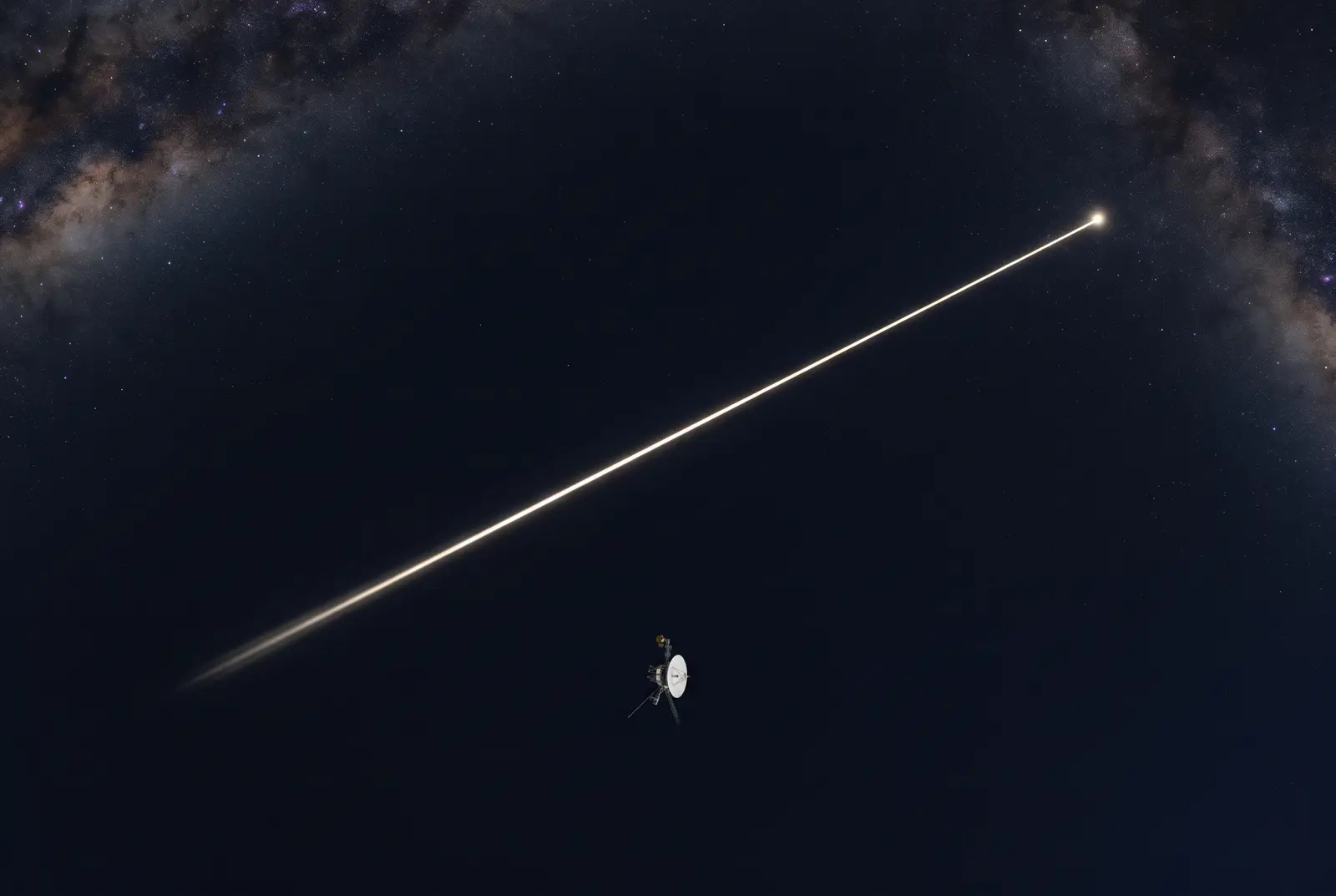
It means the distances stay huge. Proxima Centauri, the nearest star, is 4.24 light-years away, so even light needs 4.24 years to get there. Voyager 1, leaving the solar system at about 3.5 astronomical units a year, would need roughly 18,000 years to cover a single light-year (my arithmetic from NASA's figures). On November 18, 2026, Voyager 1 reached one light-day from Earth, after 49 years of flight. Light covers that same distance in a day.
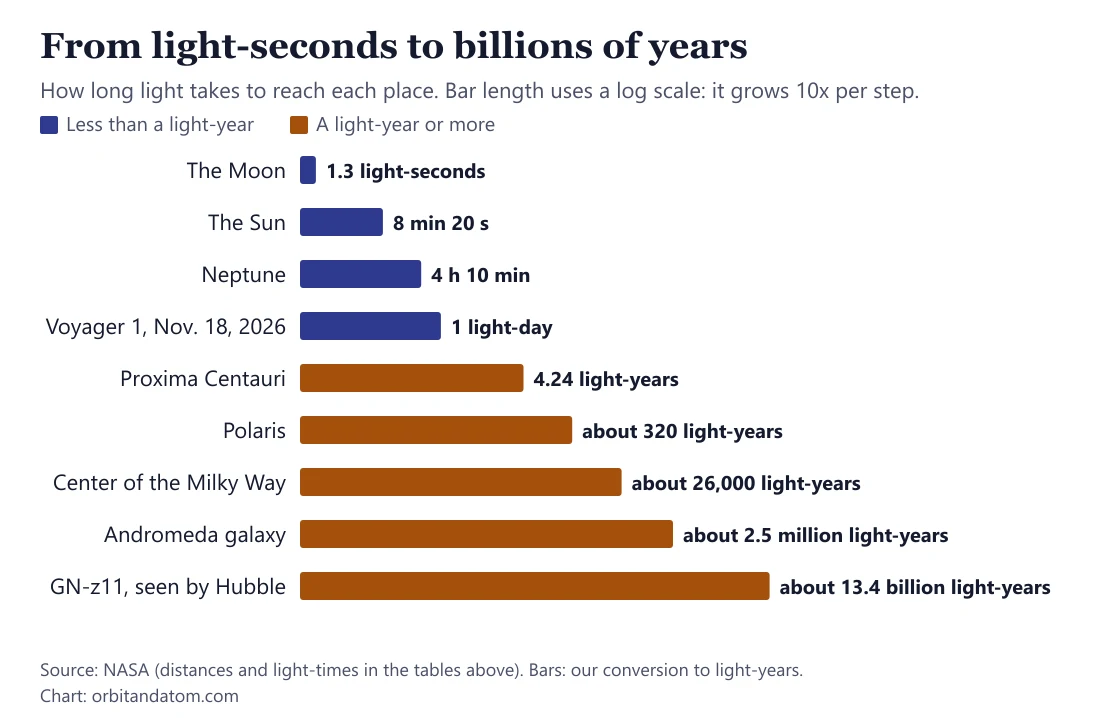
Because light is also the fastest messenger there is, the sky works like a time machine. A star's light left it years ago, and a galaxy's light left it millions of years ago. Space telescopes such as Hubble use this to study the early universe: its light is still arriving, at the speed limit.
The limit even shapes the strangest objects we know. NASA describes black holes as concentrations of matter with gravity so powerful that not even light can escape. Light is the fastest thing there is, and a black hole is where even that is not enough to get out.
Does the limit also matter for things as small as atoms?
Yes. NASA Goddard's answer applies to anything with mass, from a spacecraft to a single particle, and the same equations tie mass and energy together. If you want the building blocks themselves, my guide to what is inside an atom is the place to start.
Frequently asked questions
What is the speed of light?
About 186,000 miles (300,000 kilometers) per second in a vacuum. The exact value is 299,792,458 meters per second, which is now fixed by definition, according to NIST.
Why can nothing go faster than light?
Because the energy needed grows without limit as an object with mass speeds up toward light speed. NASA Goddard says it would take an infinite amount of energy to reach it.
Why can light travel at the speed of light?
Light is not matter that has to be accelerated. It travels through empty space at that speed on its own, and NASA says it needs no medium to do so.
Does time slow down near the speed of light?
Yes. For a very fast traveler, clocks tick more slowly as seen by an observer. Experiments with atomic clocks on planes matched the prediction, and the effect is tiny at everyday speeds.
How long does sunlight take to reach Earth?
About 8.3 minutes, since the Sun is roughly 93 million miles away, according to NASA Space Place.
How long would a trip to the nearest star take?
Light needs 4.24 years to reach Proxima Centauri. At the speed Voyager 1 is leaving the solar system, the trip would take about 77,000 years (my arithmetic from NASA figures).
Sources
- NASA Space Place, "What Is a Light-Year?" (accessed November 10, 2026)
- NASA Science, "Basics of Spaceflight: Units of Measure" (updated November 4, 2024)
- NASA Science, "Basics of Spaceflight, Chapter 6: Electromagnetics" (updated November 4, 2024)
- NASA Goddard, "Ask an Astrophysicist: Relativity" (archive, accessed November 10, 2026)
- NIST, "Meter" (updated May 28, 2026)
- NIST, "SI Units – Length" (updated September 19, 2025)

Founder and editor, Orbit and Atom
I write Orbit and Atom to explain space and science in plain English, starting from what NASA, ESA and the mission teams publish. Every article lists its sources at the end so you can read them yourself.