Atoms & Physics
What Is Gravity? Newton, Einstein and What We Still Don't Know
Quick answer
Gravity is the pull between anything that has mass: more mass pulls harder, and the pull weakens with distance. Newton described it as a force, and his math still works well in daily life. Einstein described it as mass curving spacetime, which explains black holes and bent starlight. What physics cannot yet do is fit gravity together with quantum theory, or say what dark matter and dark energy are.
On this page
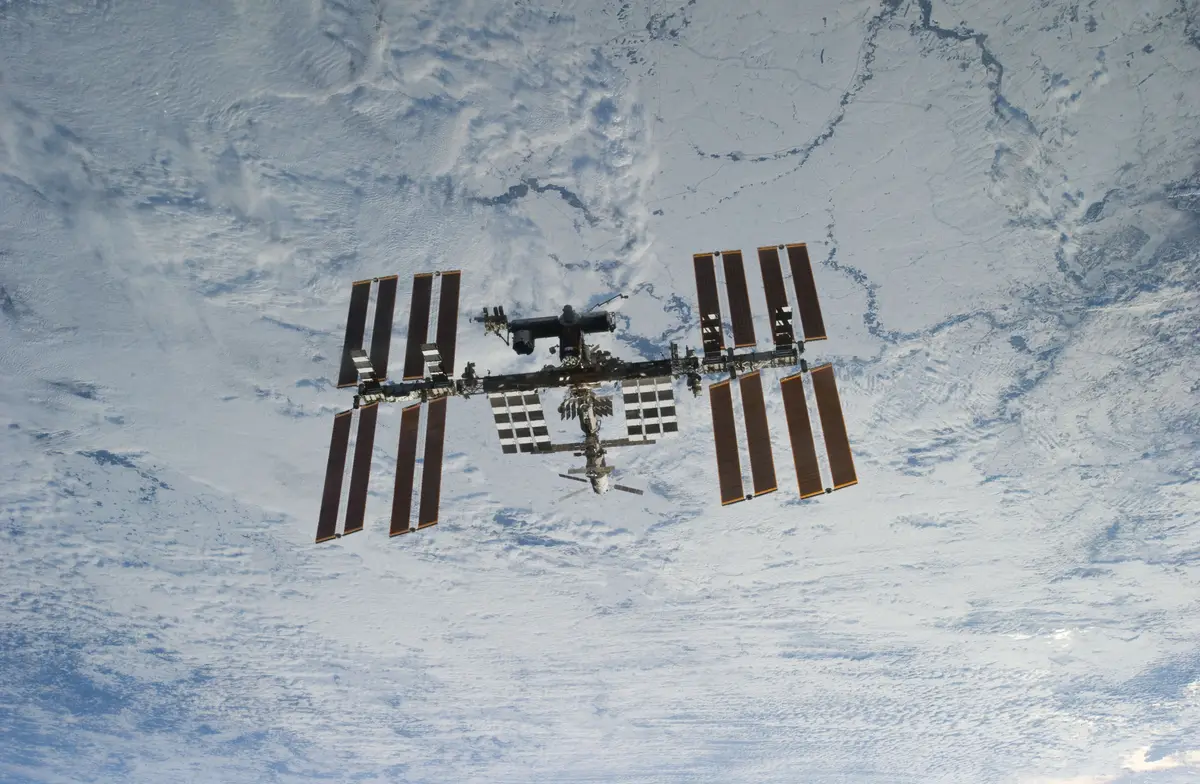
An astronaut on the International Space Station floats, but gravity has not gone anywhere. NASA says Earth's gravity at about 250 miles (400 kilometers) up is still 88.8 percent of its strength at the surface. So why does it feel like nothing is pulling? The answer is the quickest way into what gravity really is.
This guide starts with the everyday version, then goes through Newton, then Einstein, then the questions that physics has not answered. I read pages from NASA, ESA and Stanford University for it, and the sources are listed at the end.
What is gravity, in simple terms?
NASA's Space Place calls it "an invisible force that pulls objects toward each other." Anything that has mass also has gravity, and objects with more mass have more of it. Gravity also gets weaker with distance, so the closer two objects are, the stronger the pull between them.
That is why you have weight. All of Earth's mass pulls on all the mass in your body. On a planet with less mass than Earth, NASA notes, you would weigh less. You pull on Earth just as hard as it pulls on you, but Earth is so much heavier that you never notice your side of the deal.
The same pull does much bigger jobs. NASA lists the Moon's pull on the seas, which causes the ocean tides, the orbits of the planets around the Sun, and the way gravity gathers material to build stars and planets. It also holds down the atmosphere we breathe.
How did Newton explain gravity?
NASA's Glenn Research Center says Newton first described the nature of gravity more than 300 years ago: it is the attraction between any two masses, most obvious when one of them is huge, like Earth. ESA adds the rule. The pull is proportional to the product of the two masses and inversely proportional to the square of the distance between them.
The second half is easier than it sounds. By my arithmetic from that rule, doubling the distance between two objects cuts the pull to one quarter. Newton's law tied the fall of an object on Earth to the motion of bodies in the Solar System, which ESA describes as a single unified description of both.
ESA is clear that his theory "is still a great approximation to address gravity in a variety of situations, especially in our daily life." At the turn of the 20th century, only one problem was left: a tiny shift in the orbit of Mercury that Newton's gravity could not fully account for. Some astronomers even guessed that an unseen planet sat inside Mercury's orbit.
How is Einstein's picture of gravity different?
Einstein changed what gravity is. In 1905 he showed that space and time are intertwined in a four-dimensional spacetime. He then spent years trying to fit gravity into it, and in November 1915 he presented general relativity in four papers to the Prussian Academy of Sciences in Berlin, on the 4th, 11th, 18th and 25th of the month.
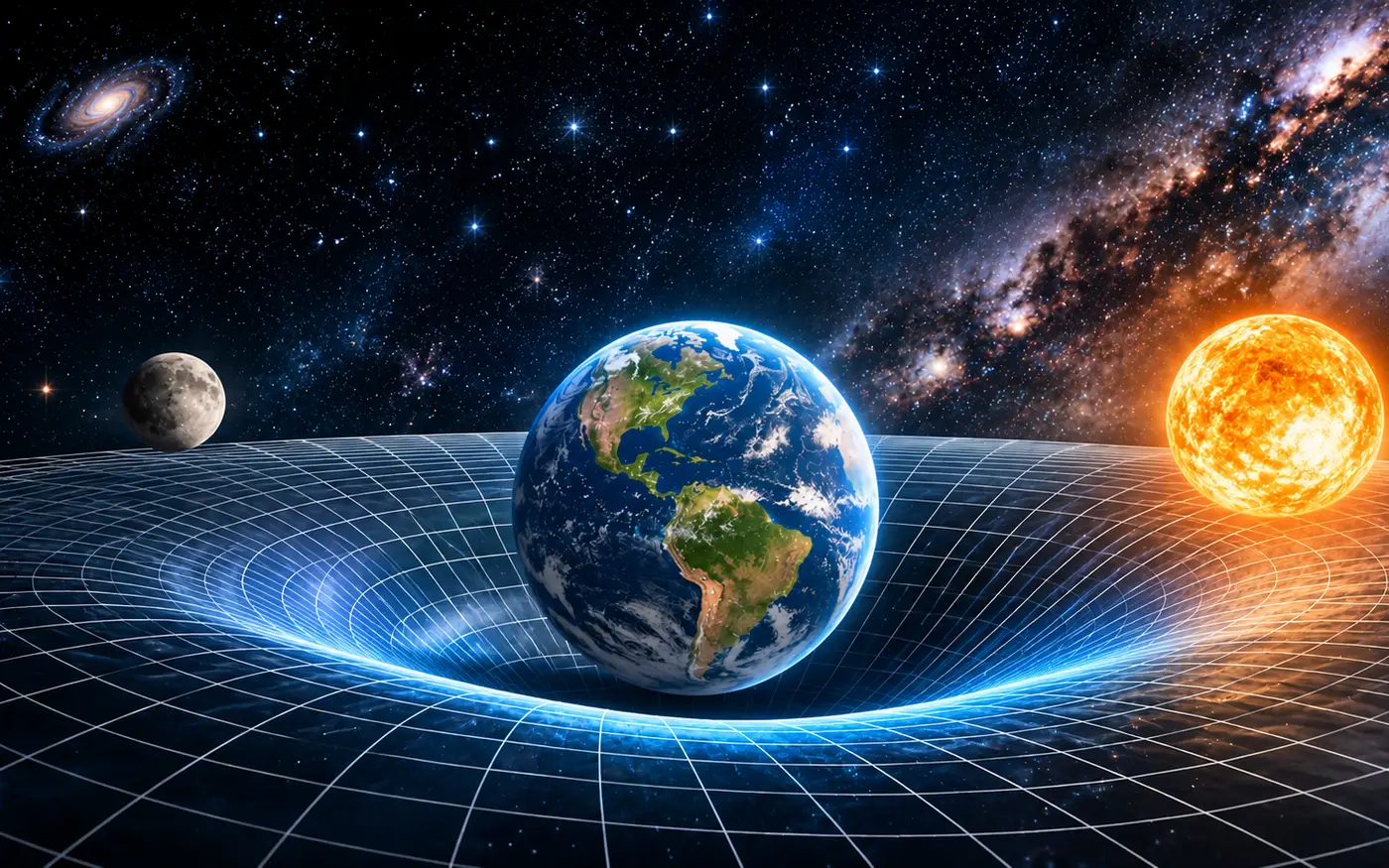
ESA's summary is short: gravity is no longer a force acting on massive bodies. Instead, general relativity links gravity to the geometry of spacetime, in particular its curvature. Massive bodies curve spacetime, and when they move, the curvature changes. Freely falling objects then follow geodesics, the equivalent of straight lines in curved geometry.
The familiar picture is a stretched sheet with heavy balls sinking into it. ESA itself calls that a simplified two-dimensional drawing, so I treat it as a way in, not as the real thing. In my opinion, the useful part to keep is the idea that a planet is not being tugged along its path. It is following the shape of the space around the Sun.
| Question | Newton | Einstein |
|---|---|---|
| What is gravity? | A force between masses | The curvature of spacetime |
| How does light react? | Bends a little | Bends twice as much |
| Mercury's orbit | Cannot fully explain it | Explains it |
| Best used for | Daily life, a great approximation | Extreme cases and the universe |
Two descriptions of one force, based on ESA's pages "Spacetime curvature" and "100 years of General Relativity", read November 13, 2026.
Why do astronauts float if gravity is still there?
Because they are falling, and so is everything around them. NASA's Glenn center says many people mistakenly think gravity does not exist in space. Typical orbits of human spacecraft are 120 to 360 miles up, which is only about 1.8 percent of the distance to the Moon, so the pull is still strong. Gravity is what keeps the station in orbit.
NASA explains the float with an apple. If an astronaut on the station drops one, it falls, but it does not look like it. The apple, the astronaut and the station are all falling together, and they are falling around the Earth, not toward it. Since everything falls at the same rate, objects inside appear to float. That state is called microgravity, and it comes about whenever something is in free fall.
Newton had a picture for this. Put a cannon on a very tall mountain. Fire it, and the ball falls to Earth, landing farther away the faster it goes. NASA says that with the proper speed the cannonball would fall continuously around the planet, which is called an orbit. For the station, that speed is 17,500 miles per hour (28,000 kilometers per hour).
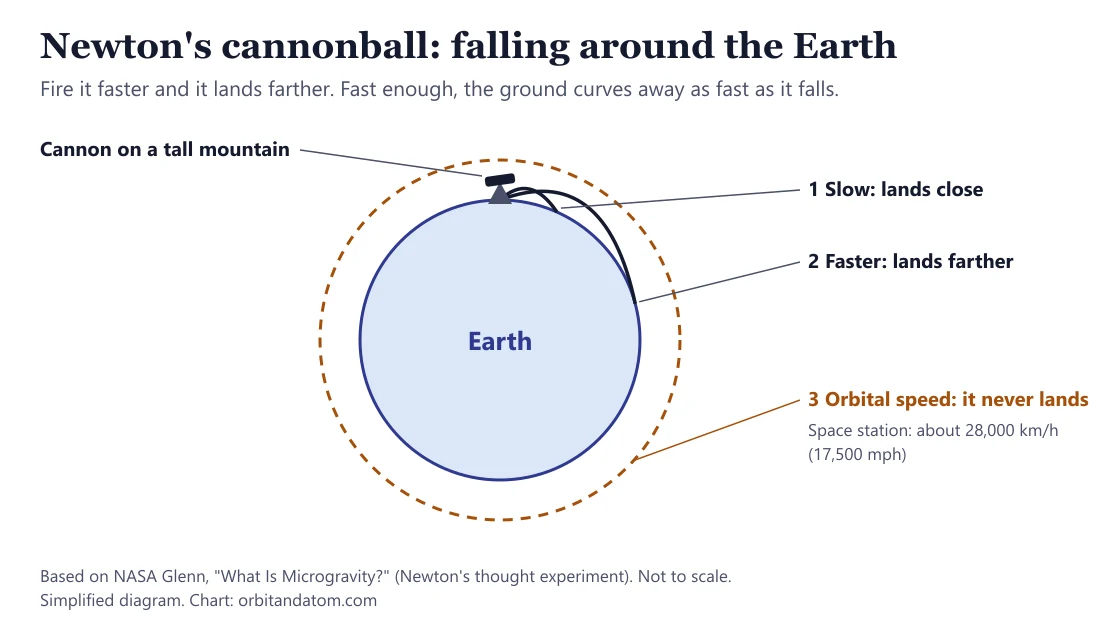
In my opinion, this is the best single picture in the whole subject. It removes the idea that orbiting is a different thing from falling. The photo below shows an object that has been falling for years and keeps missing the ground.
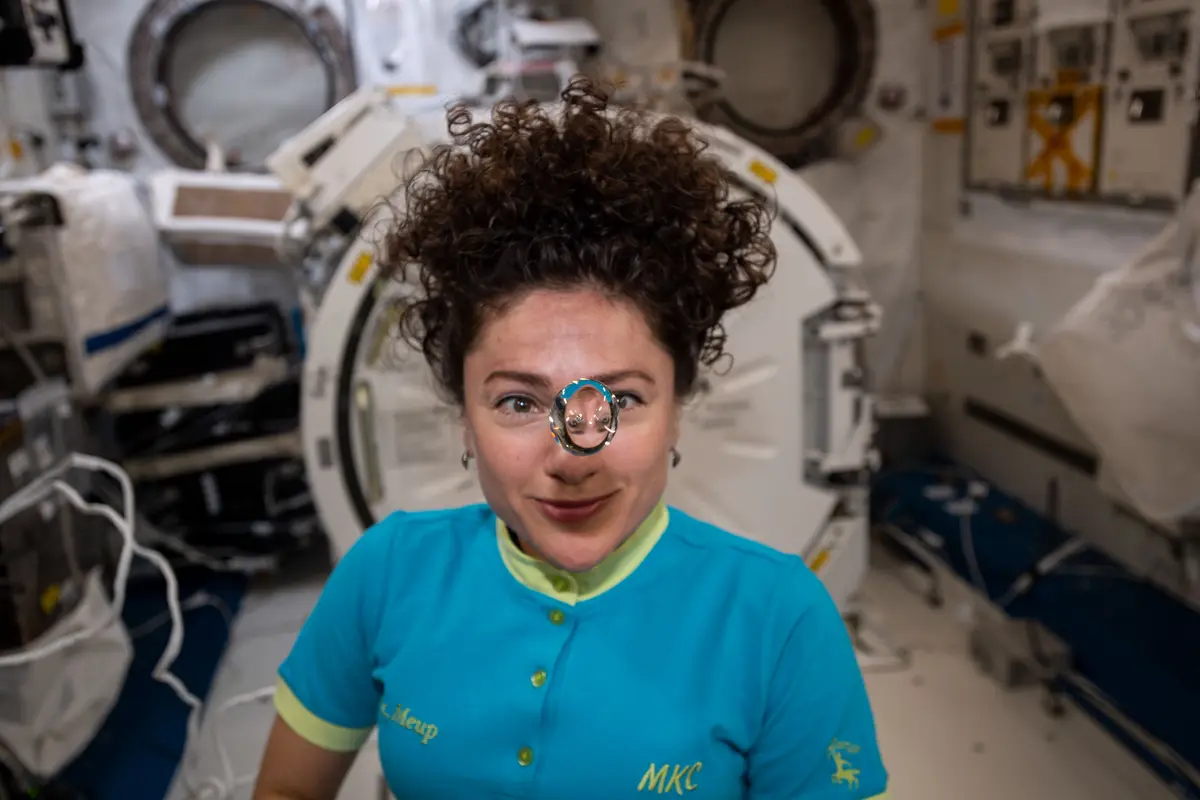
Floating inside it looks like this. NASA astronaut Jessica Meir observed a sphere of water hanging in the air of the station's Kibo laboratory in February 2020. NASA's note on weightlessness is a useful one: an object's mass stays the same, but on a scale it would register zero.
You have felt a short version yourself. NASA points out that free-fall rides, the rolling hills of a roller coaster and even a trampoline give brief moments of weightlessness. If you want to see what this does to the clocks on a spacecraft, my guide to whether astronauts age slower goes further.
How do we know Einstein's version holds up?
Because it has been tested in very different ways. The table gives the four I think are easiest to follow.
| Test | What it showed |
|---|---|
| Mercury's orbit | Explained the shift Newton could not |
| Eclipse of 1919 | Starlight bent as Einstein predicted |
| Gravity Probe B | Gyroscopes in orbit matched both predictions |
| LIGO, 2015 | Gravitational waves from merging black holes |
Four tests of general relativity, from ESA, NASA and Stanford pages read November 13, 2026.
The starlight test is a good story. Several teams tried to measure how much the Sun bends the light of background stars during an eclipse, and only in 1919 did it work. ESA says an expedition led by Arthur Eddington to Príncipe, off the west coast of Africa, and another led by Andrew Crommelin to Sobral, in north-east Brazil, measured stars near the eclipsed Sun on May 29, 1919. They appeared shifted by the amount Einstein had predicted, which ESA calls the first experimental proof of the theory.
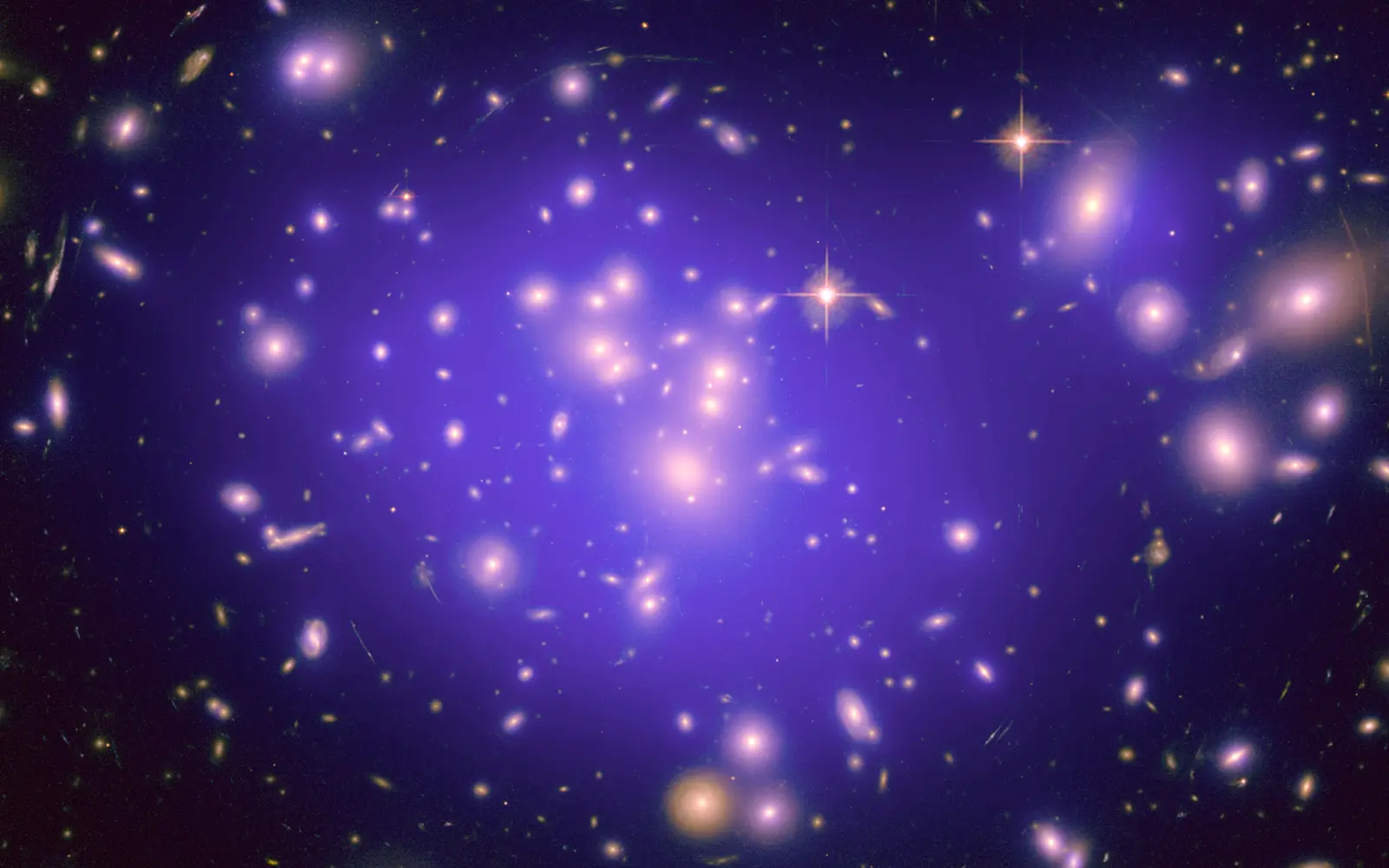
That bending is now a working tool called gravitational lensing. The cluster in the picture below, Abell 1689, is a lens: its mass distorts the galaxies behind it, and astronomers use those distortions to map how much mass the cluster holds. NASA says the same method lets them map the dark matter in a cluster.
Gravity Probe B went to orbit instead. It launched on April 20, 2004, carrying four near-perfect gyroscopes, and flew in a polar orbit about 400 miles above Earth, watching how the gyroscopes' directions slowly turned against a distant star. Stanford's final results say the data ran from August 28, 2004, to August 14, 2005. The first effect, called geodetic, is how Earth's mass curves spacetime around it: the team measured 6,601.8 milliarcseconds a year (give or take 18.3) against a predicted 6,606.1. The second, frame-dragging, came out at 37.2 (give or take 7.2) against a predicted 39.2.
In plain words, the measurements and Einstein's numbers agree within the margin of error. The second effect, the drag a spinning Earth puts on spacetime, is far smaller and was measured with less precision. A milliarcsecond is a tiny angle, about 2.8 ten-millionths of a degree, according to the same Stanford page.
Then came the ripples. NASA says LIGO, with two observatories in Louisiana and Washington and arms more than 2 miles (4 kilometers) long, detected gravitational waves for the first time on September 14, 2015. They came from two black holes that collided 1.3 billion years earlier. Einstein had predicted such waves a century before. In 2017 the Nobel Prize in Physics went to Kip Thorne, Barry Barish and Rainer Weiss for their decisive contributions to the detector and the observation. If you want to follow where this leads, I cover the objects that make these waves in what a black hole is and what a neutron star is.
Is gravity the same everywhere on Earth?
Almost, but not exactly. NASA says gravity is slightly stronger over places with more mass underground than over places with less. Near the surface, the acceleration from gravity alone is called 1g, which NASA gives as 9.8 meters per second squared (32.2 feet per second squared).
Two NASA spacecraft, part of the GRACE mission, measure these small differences and turn them into maps. NASA says the maps help scientists follow changes in sea level and detect changes in Earth's crust after earthquakes.
What don't we know about gravity?
Quite a lot, and in my view this is the most interesting part. Three gaps stand out.
Gravity and quantum physics do not fit together yet. The Stanford Encyclopedia of Philosophy describes quantum gravity as a theory still "under construction" after more than 100 years. It would have to describe spacetime at the Planck scale, which is so far beyond what experiments can reach that testing it by standard methods is described as near-impossible, although the entry notes some recent developments that suggest the outlook might be more optimistic. The entry also points out that all existing physical theories rely on a classical, non-quantum spacetime background, which makes this a deep challenge, not just a technical one.
Most of the universe is dark. NASA says ordinary matter makes up only about 5 percent of the universe, dark matter about 27 percent and dark energy about 68 percent. Dark matter interacts with ordinary matter through gravity but does not absorb, reflect or emit light. The evidence began with Fritz Zwicky in 1933 and Vera Rubin in the 1970s, and it includes lensing and the Bullet Cluster observed in 2006. NASA also says that not all astronomers agree on what dark matter might be. NASA's Hubble team has framed the question this way: how do we know that dark matter isn't just normal matter exhibiting strange gravity? My guide to what dark matter is goes into the evidence.
Dark energy has no explanation. ESA says observations of exploding stars in the 1990s suggested the universe is not just expanding but accelerating, and that no one knows what dark energy might be. It adds that Einstein had once put a cosmological constant into his equations to keep the universe still. An expanding universe did not need it, and dark energy brings back something like it in a slightly altered form.
If you want the next piece of the puzzle, I explain why the speed of light is the limit in why nothing can go faster than light, and what the distances look like in how far a light year is. You can also browse the rest of Atoms & Physics.
Frequently asked questions
What is gravity in one sentence?
Gravity is the pull between objects that have mass. NASA says more massive objects pull harder and that the pull weakens as the distance grows.
Who discovered gravity?
Nobody discovered it, because it was always there. NASA says Newton first described its nature more than 300 years ago, and Einstein presented a new description, general relativity, to the Prussian Academy of Sciences in November 1915.
Is there gravity in space?
Yes. NASA says Earth's gravity about 250 miles up, where the space station orbits, is 88.8 percent of its strength at the surface. Gravity is what keeps the station in orbit.
Why do astronauts float, then?
They are in free fall. NASA says the astronaut, the station and everything inside are falling around the Earth together, so nothing presses on anything else and objects appear to float.
Is gravity a force?
In Newton's theory, yes. In Einstein's, ESA says gravity is linked to the curvature of spacetime instead of acting as a force on bodies. Both descriptions are used, depending on the situation.
What are gravitational waves?
NASA describes them as invisible ripples in space that travel at the speed of light and squeeze and stretch anything in their path. LIGO detected them for the first time on September 14, 2015.
What do scientists still not know about gravity?
How to combine it with quantum theory, and what dark matter and dark energy are. NASA estimates that dark matter is about 27 percent of the universe and dark energy about 68 percent.
Sources
- NASA Space Place, "What Is Gravity?" (article updated December 17, 2020; accessed November 13, 2026). Used for mass, distance, weight, tides and the GRACE gravity maps.
- NASA Glenn Research Center, "What Is Microgravity?" (page updated July 25, 2023; accessed November 13, 2026). Used for Newton, 1g, gravity at station altitude, free fall, the cannonball and the weightless examples.
- ESA Science & Technology, "100 years of General Relativity" (accessed November 13, 2026). Used for Newton's law, Mercury, Einstein's 1915 papers, geodesics, lensing and the 1919 eclipse.
- ESA Science & Technology, "Spacetime curvature" (accessed November 13, 2026). Used for gravity as the geometry of spacetime.
- Stanford University, Gravity Probe B, "GP-B Status Update, May 4, 2011" (accessed November 13, 2026). Used for the final results, the data dates and the milliarcsecond.
- NASA Science, "Gravity Probe B" (page updated October 23, 2026; accessed November 13, 2026). Used for the launch date, the gyroscopes and the orbit.
- NASA Space Place, "What Is a Gravitational Wave?" (accessed November 13, 2026)
- NASA/JPL, "Gravitational Waves Detected for the First Time" (updated October 11, 2024; accessed November 13, 2026). Used for the 2015 detection and the 2017 Nobel Prize.
- NASA Science, "Dark Matter" (page updated August 12, 2026; accessed November 13, 2026). Used for the 5, 27 and 68 percent shares, Zwicky, Rubin, lensing and the Bullet Cluster.
- NASA Science, Hubble, "Dark Matter" (page updated April 17, 2023; accessed November 13, 2026). Used for the question about "strange gravity".
- ESA, "What are dark matter and dark energy?" (accessed November 13, 2026). Used for dark energy and the accelerating expansion.
- Stanford Encyclopedia of Philosophy, "Quantum Gravity" (substantive revision of February 26, 2024; accessed November 13, 2026). Reference work, not a space agency.
- NASA Image and Video Library, "Galaxy Cluster Abell 1689" (image release of August 19, 2010). Image credit.

Founder and editor, Orbit and Atom
I write Orbit and Atom to explain space and science in plain English, starting from what NASA, ESA and the mission teams publish. Every article lists its sources at the end so you can read them yourself.