Stars & Galaxies
What Is a Neutron Star? A Teaspoon Weighs Billions of Tons
Quick answer
A neutron star is the collapsed core of a massive star that exploded as a supernova, squeezed into a ball about 12 miles (20 kilometers) across with more mass than the Sun. NASA says one teaspoon of its material would weigh roughly a billion tons on Earth. Some spin and flash like lighthouses, called pulsars, and others, called magnetars, have far stronger magnetic fields.
On this page
Take a star more massive than the Sun, crush it until it fits inside a city, and you have a neutron star. It is the densest object astronomers can see directly, and its numbers sound made up even after you check them.
Here is where neutron stars come from, how heavy they really are, and why some of them blink like lighthouses and others blast out some of the biggest flares known.
What is a neutron star?
It is what a massive star leaves behind when it dies. NASA Goddard explains that when such a star runs out of fuel, its core collapses and every proton and electron is crushed together into a neutron. If that core holds between about 1 and 3 times the Sun's mass, the new neutrons can stop the collapse, and a neutron star is left.
The result, in NASA's words, is the most dense object known: the mass of a Sun squished down to the size of a city. Goddard puts the width at about 20 kilometers (12.5 miles), and a NASA feature on the NICER mission describes a sphere about as wide as New York City's Manhattan Island is long.
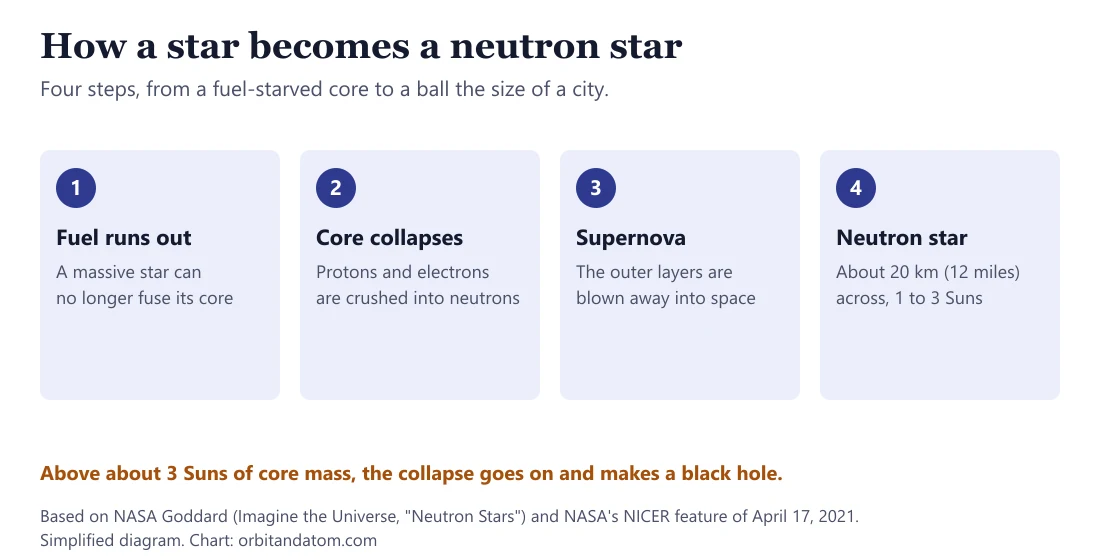
The explosion in the middle of that story is a supernova. If you want the full picture of how a star blows up, my supernova guide covers both ways it can happen. The size threshold matters too: NASA says stars with a higher-mass core keep collapsing into a black hole, which I explain in my black hole guide.
How much does a teaspoon of a neutron star weigh?
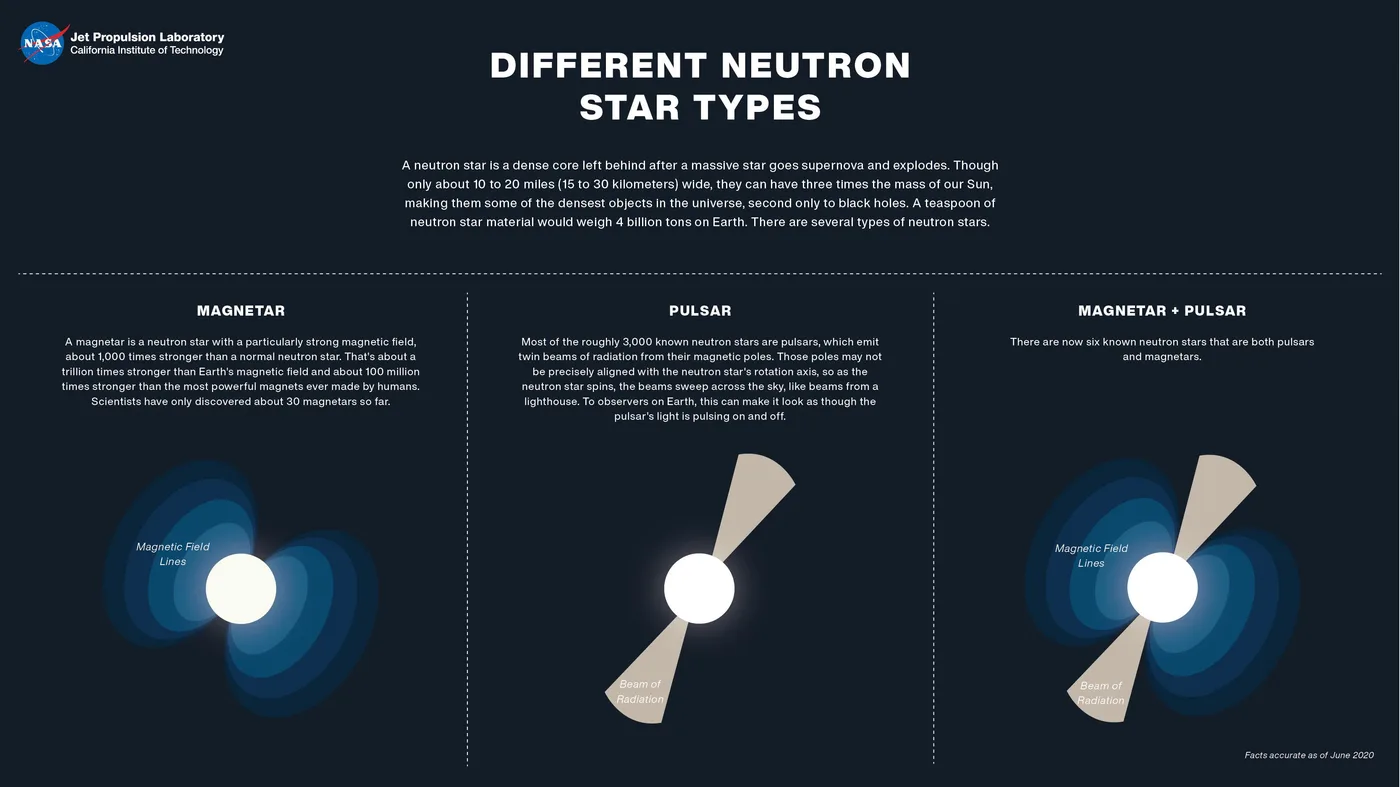
Billions of tons, according to NASA. Several NASA pages say one teaspoon of neutron star material would weigh about a billion tons on Earth, which Keith Gendreau, the NICER principal investigator, compared to squeezing Mount Everest into something like a sugar cube. A NASA/JPL infographic from 2020 gives a higher figure, 4 billion tons.
The numbers differ because neutron stars are not all the same. They vary in mass and size, and NASA's round figures are estimates for a typical one. What does not change is the idea: the material is packed so tightly that the atoms themselves are gone. NASA says that when a neutron star forms, its atoms are crushed together and merge, so the bulk of it is neutrons plus some protons and electrons.
For a closer look at those particles, the neutron is one of three in my atom explainer. In my opinion, the teaspoon comparison works best when you remember what it is built from: an atom is mostly empty space, and a neutron star squeezes that space out.
How big is a neutron star, really?
Bigger than the round number suggests, at least for the ones NASA has measured. The 20-kilometer figure is the typical value NASA quotes. NICER, an X-ray telescope on the International Space Station, measured actual pulsars and found them wider.
| Pulsar | Mass | Width |
|---|---|---|
| J0030+0451 | About 1.4 Suns | 16 miles (26 km) |
| J0740+6620 | About 2.1 Suns | 15.4 to 17 miles (24.8 to 27.4 km) |
Two pulsars measured by NASA's NICER. Source: NASA Science, "NICER Probes the Squeezability of Neutron Stars," April 17, 2021, read November 11, 2026. J0740 has two estimates from two teams that overlap within their uncertainties.
The surprise was that J0740, almost 50% more massive, came out essentially the same size, as Anna Watts of the University of Amsterdam put it in NASA's feature. That matters because the size tells physicists how matter behaves under the greatest squeeze we can measure. A NASA/JPL graphic gives the general range as 15 to 30 kilometers wide.
J0740 sits more than 3,600 light-years away, according to NASA. To get a feel for a distance counted in light-years, see my light-year explainer.
What is inside a neutron star?
Layers, as far as scientists can tell. NASA describes a thin atmosphere of hydrogen or helium on top of a solid crust of heavier atoms. Deeper in, the pressure splits the nuclei into neutrons and protons, and the neutrons end up packed at up to twice the density of an atomic nucleus.
The center is the open question. NASA says nobody yet knows whether the inner core is neutrons all the way down or whether the neutrons break into smaller pieces called quarks. Physicists have been asking since Walter Baade and Fritz Zwicky proposed neutron stars in 1934, and measuring sizes and masses is how they hope to find out. I find that a good reminder that the object I am describing is still not fully understood.
What is a pulsar?
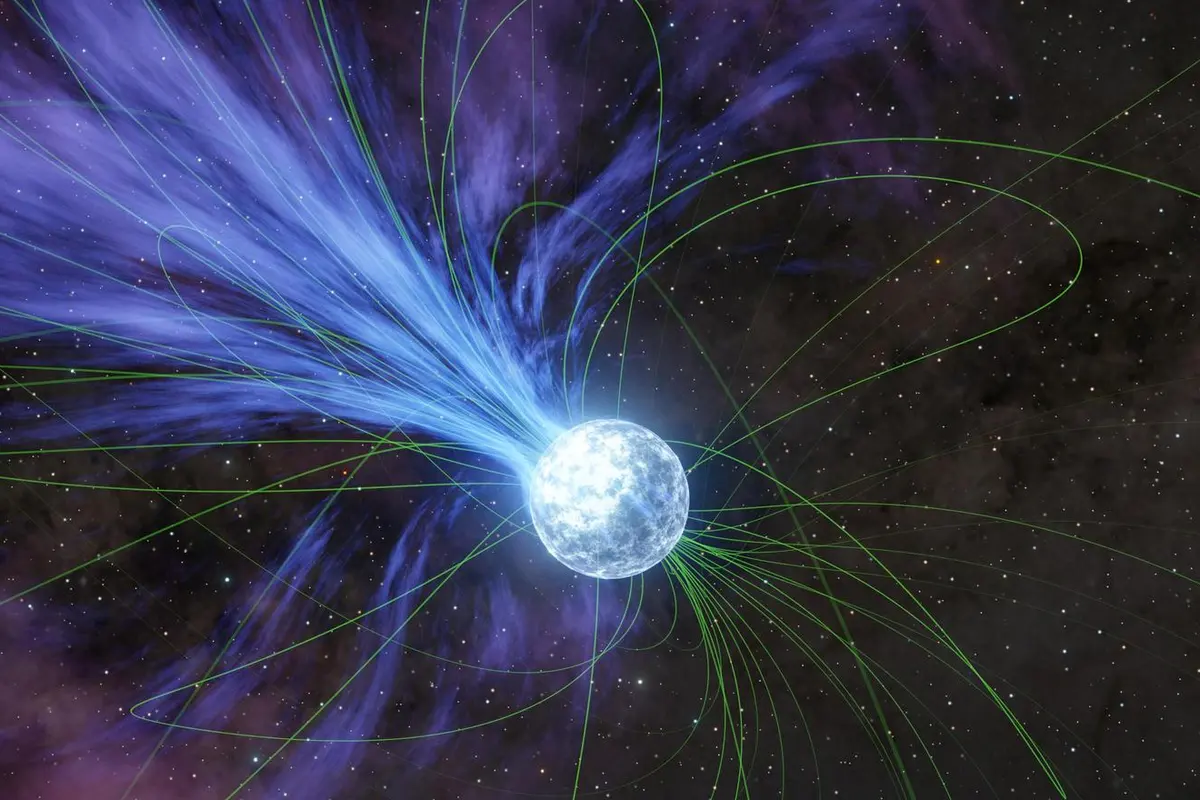
A neutron star that appears to blink. NASA Goddard says most known neutron stars are pulsars, which give off pulses of radiation at very regular intervals, from milliseconds to seconds. Strong magnetic fields funnel jets of particles out of the two magnetic poles, and those make beams of light.
The beams do not line up with the spin axis, so they sweep around as the star rotates. NASA's favorite comparison is a lighthouse: the light is always on, but you only see it when the beam points your way.
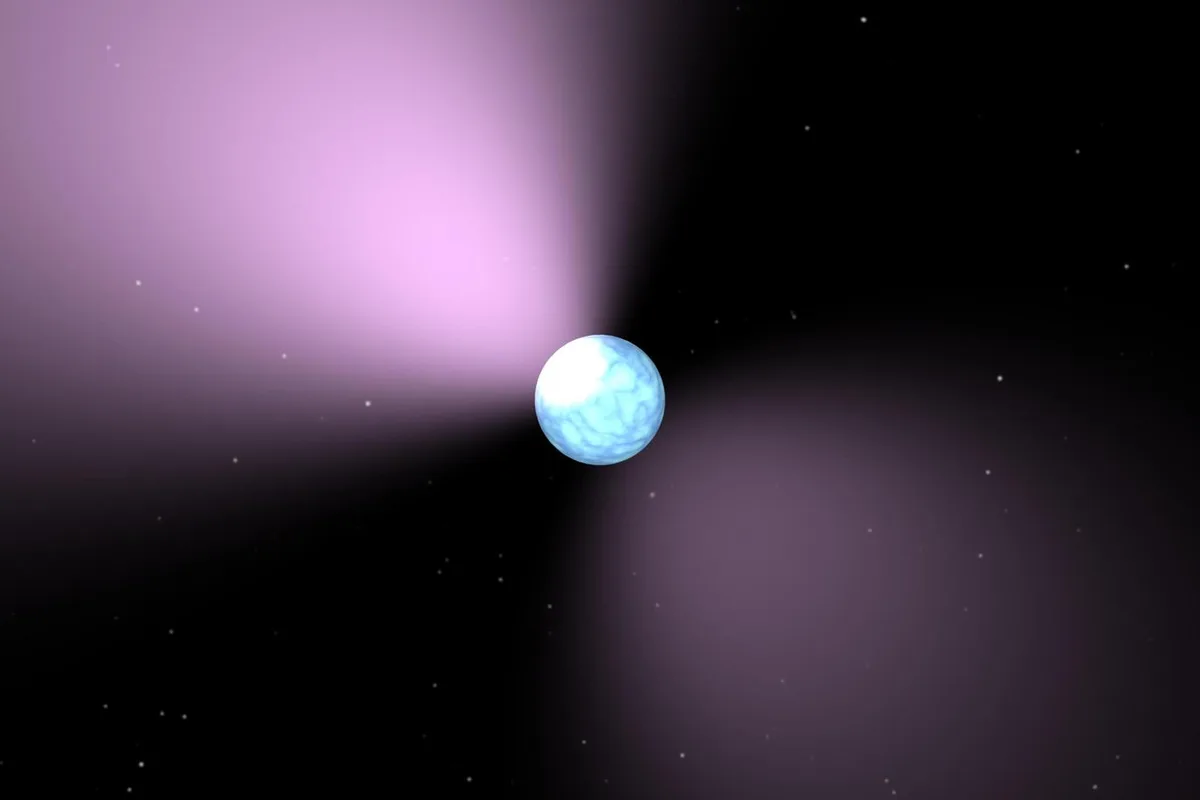
They spin fast. NASA says pulsars can rotate hundreds of times per second, faster than the blades of a household blender, and a NASA Swift page says a neutron star can spin as fast as 43,000 times per minute. J0740, from the table above, turns 346 times every second. Jocelyn Bell Burnell discovered the first pulsars in 1967, according to NASA.
What is a magnetar?
A neutron star with an extreme magnetic field. Goddard says that in a typical neutron star the field is trillions of times Earth's, and in a magnetar it is another 1,000 times stronger. A NASA/JPL graphic says that is about 100 million times stronger than the most powerful magnets people have built.
The crust of a neutron star is locked to its magnetic field, so a small movement of the crust can ripple through the whole thing. In a magnetar, NASA says, that releases a vast amount of energy as radiation. One magnetar, SGR 1806-20, had a burst that in one-tenth of a second released more energy than the Sun has emitted in the last 100,000 years.
What happens when two neutron stars collide?
Space itself ripples, and heavy elements are made. On August 17, 2017, LIGO and Virgo detected gravitational waves from two neutron stars spiraling together. The waves were detectable for about 100 seconds, and a flash of gamma rays reached Earth about two seconds after they did, the LIGO team reports. It was the first event seen in both gravitational waves and light.
The aftermath answered an old question. Telescopes including Hubble saw signs of freshly made material such as gold and platinum, which LIGO says solved a decades-long mystery about where about half of the elements heavier than iron are produced. Gravitational waves are ripples in space-time, and my black hole guide lists them among the signs astronomers use to find these objects.
Not all of the gold comes from collisions. A 2025 study using NASA and ESA data suggests that giant flares from magnetars could contribute up to 10% of the elements heavier than iron in our galaxy, NASA says. That is a theory based on old data, not a settled answer.
Will our Sun become a neutron star?
No. A neutron star comes from a star that is much heavier than the Sun. The Sun is a low-mass star that ends as a white dwarf, which is far below what a core collapse needs, as I explained in my supernova guide.
Frequently asked questions
What is a neutron star in simple terms?
It is the crushed core of a massive star that ran out of fuel and exploded as a supernova. NASA says it holds about the mass of the Sun or more in a ball about 12 miles (20 kilometers) across.
How much does a teaspoon of neutron star weigh?
NASA says about a billion tons on Earth. A 2020 NASA/JPL graphic gives 4 billion tons. The figures differ because neutron stars vary.
How big is a neutron star?
NASA quotes about 12 miles (20 kilometers) across, and a NASA/JPL graphic gives a range of 15 to 30 kilometers. NICER measured two pulsars at 16 miles (26 km) and about 15 to 17 miles (25 to 27 km).
What is the difference between a pulsar and a magnetar?
A pulsar is a spinning neutron star whose beams of light sweep past Earth like a lighthouse. A magnetar is a neutron star with a magnetic field about 1,000 times stronger than a typical one, and it can release huge bursts of radiation.
What happens when two neutron stars collide?
They send out gravitational waves and a flash of gamma rays, and they make heavy elements such as gold and platinum. LIGO and Virgo detected the first such collision, GW170817, on August 17, 2017.
Can a neutron star turn into a black hole?
The core that remains after a supernova becomes a neutron star if it holds about 1 to 3 times the Sun's mass, according to NASA Goddard. A higher-mass core keeps collapsing into a black hole.
Will the Sun become a neutron star?
No. The Sun is too light. It will end as a white dwarf, well under the mass a collapsing core needs to become a neutron star.
Sources
- NASA Goddard, "Imagine the Universe: Neutron Stars" (text updated 2017, page updated September 23, 2021; accessed November 11, 2026). Used for formation, the 1 to 3 Sun range, size, pulsars and magnetars.
- NASA, "New NASA Mission to Study Mysterious Neutron Stars" (May 26, 2017; accessed November 11, 2026). Used for the teaspoon figure, the Everest quote and spin rates.
- NASA Swift, "NASA's Swift Reveals New Phenomenon in a Neutron Star" (May 29, 2013; accessed November 11, 2026). Used for the 43,000 rotations per minute.
- NASA Science, "NASA's NICER Probes the Squeezability of Neutron Stars" (April 17, 2021; accessed November 11, 2026). Used for the measured sizes and masses, the layers and the open question about the core.
- NASA/JPL-Caltech, "Different Types of Neutron Stars" (PIA23863; facts accurate as of June 2020)
- NASA Science, "Where Does Gold Come From? NASA Data Has Clues" (April 29, 2025; accessed November 11, 2026)
- LIGO Lab, Caltech, "GW170817 Press Release" (accessed November 11, 2026)
- NASA/JPL-Caltech, "A Magnetar Loses Mass (Artist's Concept)" (PIA26274); "Pulsar Artist Concept" (PIA21085)

Founder and editor, Orbit and Atom
I write Orbit and Atom to explain space and science in plain English, starting from what NASA, ESA and the mission teams publish. Every article lists its sources at the end so you can read them yourself.