Stars & Galaxies
What Is a Supernova? The Two Ways a Star Explodes
Quick answer
A supernova is the explosion that ends a star's life, shining billions of times brighter than the Sun, NASA says. It happens in two ways: a star heavier than eight Suns runs out of fuel and its core collapses, or a white dwarf that gains too much matter detonates. The blast leaves a neutron star, a black hole or nothing, and scatters new elements into space.
On this page
Most stars die quietly. A few go out with the biggest explosions in the universe, and astronomers call that a supernova.
The word sounds like one thing, but NASA describes two very different ways to blow up a star. Here is how each one works, what is left afterward and when one last appeared in our own galaxy.
What exactly is a supernova?
A supernova is the end-of-life explosion of a star. NASA describes it as a one-time event that destroys the star and shines billions of times as bright as the Sun. The blast flings material into space, and that material forms new elements along the way.
The glow does not last. Chandra says the intense light fades over several months to a few years. By cosmic standards they are also uncommon: in a galaxy like ours, NASA's Roman mission team says, a collapsing-star supernova happens about once every 50 years, and the other kind about once every 500 years.
| Question | Core collapse | Type Ia |
|---|---|---|
| What explodes | A star over 8 Suns | A white dwarf |
| What triggers it | Core runs out of fuel | Passes 1.4 Suns |
| What is left | Neutron star or black hole | Nothing of the star |
| How often here | About every 50 years | About every 500 years |
The two kinds of supernova. Sources: NASA Science (Hubble, "Stellar Explosions"), NASA Science (Roman, "Type Ia Supernovae") and Chandra's Field Guide, read November 8, 2026. Rates are for the Milky Way.
How does a massive star explode?
By running out of fuel. NASA explains that a star stays puffed up because fusion in its core pushes outward. When the core's fuel is gone, that push stops. If the star weighs in at over eight Suns, gravity wins and the core falls inward.
Chandra describes what happens next as fast. In less than a second the core becomes a neutron star, or a black hole if the star is extremely massive. Forming it releases an enormous burst of neutrinos and heat that reverses the collapse, and everything except the central remnant is blown away at more than 50 million kilometers per hour (my conversion: over 30 million miles per hour).
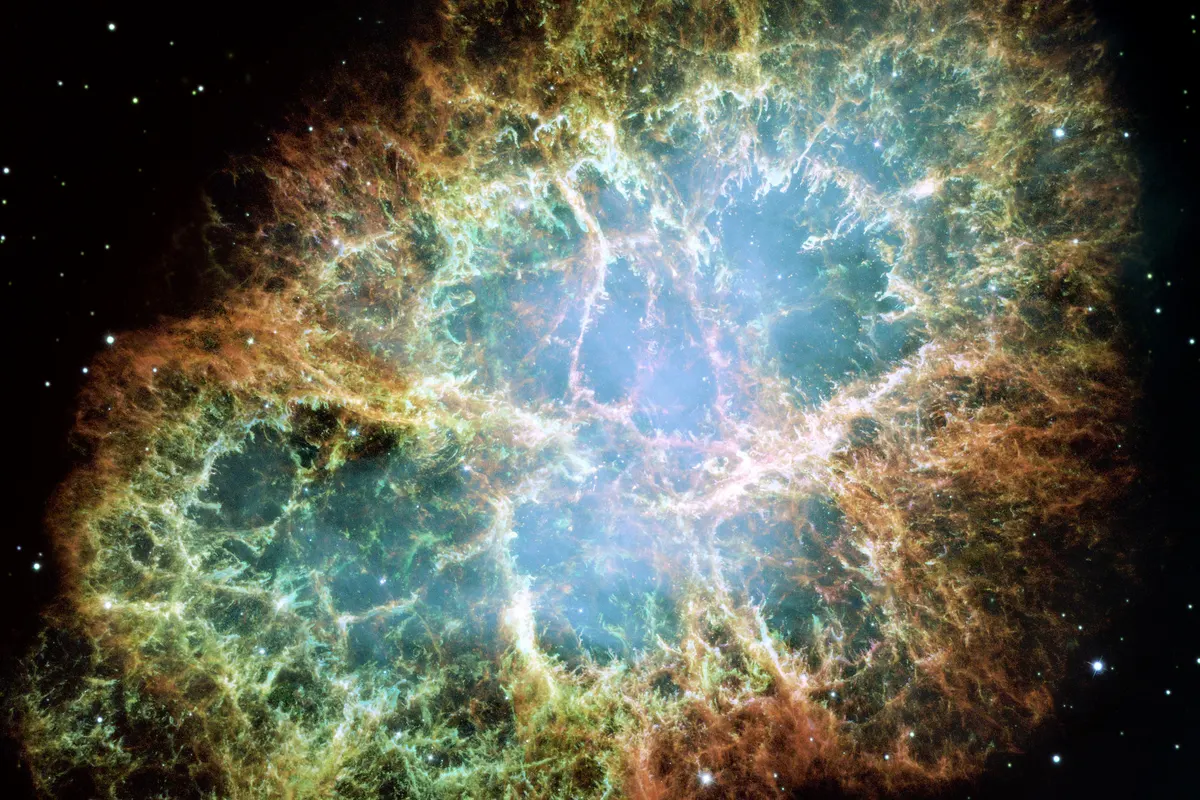
These explosions get three names, Type II, Ib and Ic, depending on which elements show up in the debris. Chandra notes that Types Ib and Ic differ because the star lost its outer layer of hydrogen before it blew up. The mechanism is the same collapse.
If you want to know where the core ends up, my black hole guide covers it. NASA says a black hole forms when the core left behind is more than three times the mass of the Sun. Below that, the core can settle as a neutron star.
What is a Type Ia supernova?
The explosion of a white dwarf, the dense Earth-sized core left over from a Sun-like star. NASA says a white dwarf sitting beside a companion star can pull gas from it. Once the white dwarf grows past 1.4 times the Sun's mass, a value called the Chandrasekhar limit, it heats up enough to restart fusion and explodes. Two white dwarfs drawn together can do the same.
Chandra says the whole star is torn apart in about ten seconds, leaving no remnant behind, and the debris glows for many weeks as radioactive nickel decays into cobalt and then iron.
Because every Type Ia blows up at about the same mass, it releases about the same amount of light. NASA calls them "standard candles": if one looks dimmer, it must be farther away, and astronomers can calculate how much. Chandra adds that this method revealed the universe's expansion is speeding up, a discovery tied to dark energy.
What is left after a supernova?
Three things can remain. The star's core may survive as a neutron star or a black hole, or, in a Type Ia, nothing of the star remains. Around it, the debris keeps going.
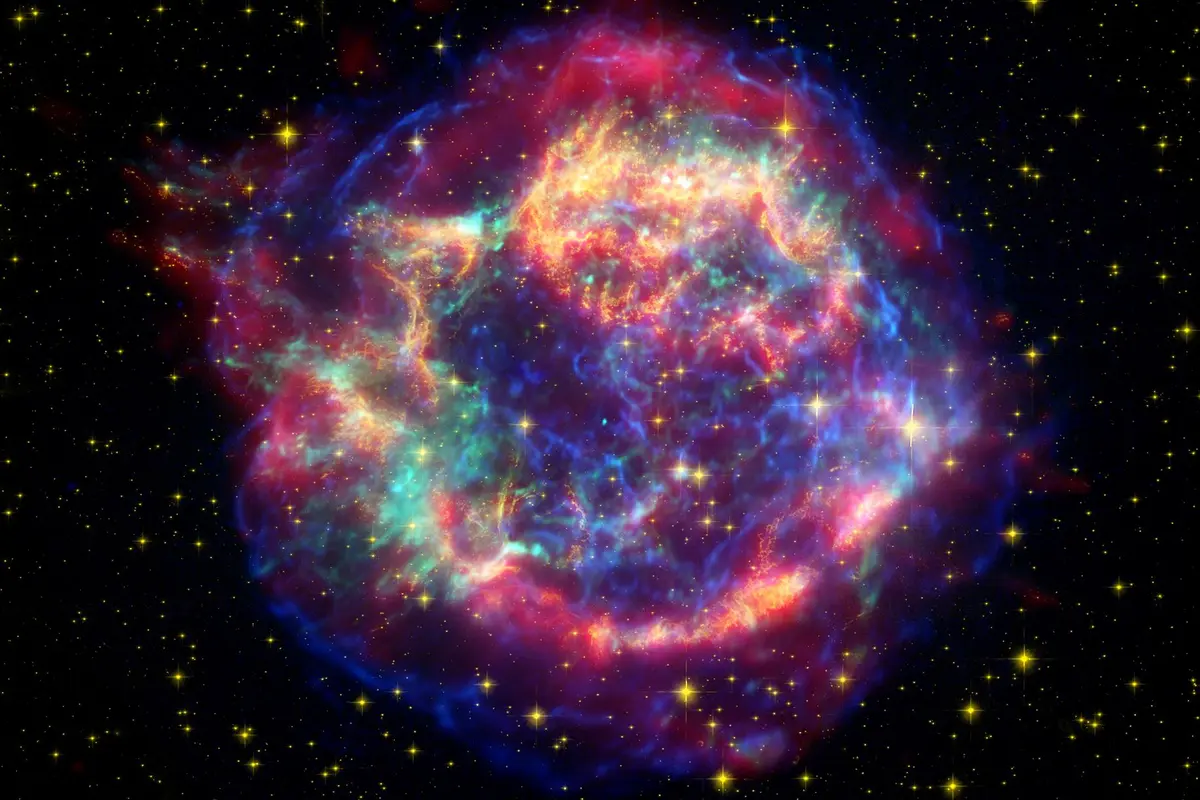
Chandra explains that the blast wave crashes into gas the star shed earlier, which creates a supernova remnant that glows in radio, infrared and X-rays for thousands of years. The cover image shows one, Cassiopeia A, about 10,000 light-years away according to NASA, and Chandra says its explosion happened about 340 years ago from Earth's point of view. A 2024 Chandra and Webb study of Cas A traced an odd green structure to that blast wave hitting gas the star had thrown off before it exploded. I cover more of what that telescope has found in my Webb discoveries guide.
Why do supernovae matter for us?
They are how space gets its heavier elements. Chandra says supernovae are the primary means of seeding the galaxy with carbon, nitrogen, oxygen, silicon and iron, the elements planets and life need. NASA adds that the material flung out is recycled as building blocks for new stars.
That is why a distant explosion matters at home: without stars blasting their contents into space, there would be no raw material for planets or for us. For a look at what those elements are made of, see my guide to the atom.
When was the last supernova in our galaxy?
The last one people are known to have recorded in the Milky Way was Kepler's, in 1604. Chandra says a new star appeared that was much brighter than Jupiter and dimmed over several weeks, and Johannes Kepler was among the sky watchers who followed it. Astronomers now know it was a Type Ia. That was about 422 years ago (my arithmetic: 2026 minus 1604), and its remnant sits about 17,000 light-years away.
Others have gone off since without being seen. NASA says the youngest known remnant in our galaxy, G1.9+0.3, exploded about 140 years before Chandra's 2008 announcement, which puts it around the 1860s by my math. Nobody saw it because it is close to the galaxy's center, behind so much dust that the explosion was about a trillion times fainter in visible light than it would have been unobscured. X-rays and radio waves passed through the dust, which is how it was found.
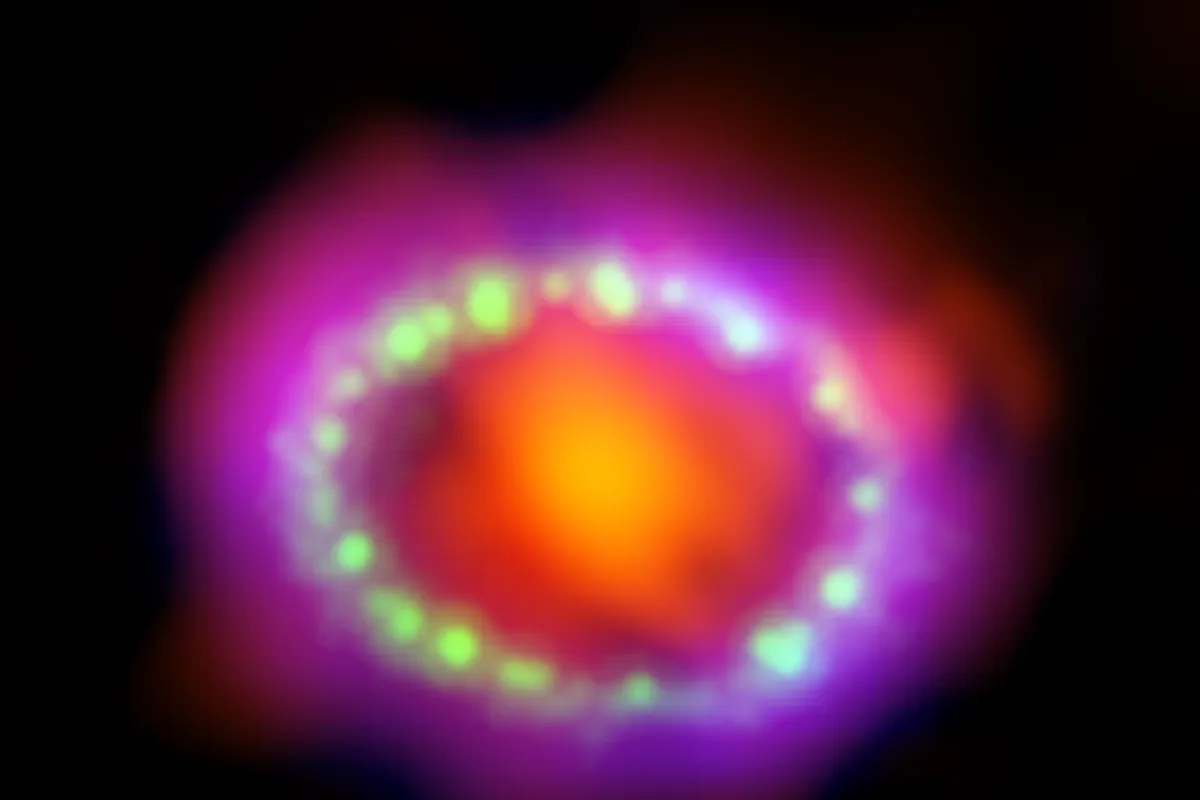
The closest recent one was outside our galaxy. In the Southern Hemisphere, astronomers watched a star explode on February 23, 1987, in the Large Magellanic Cloud, a nearby galaxy about 170,000 light-years away. Its light had been traveling for about 170,000 years, which is the "looking back in time" idea from my light-year guide.
Is a nova the same as a supernova?
No. NASA describes a nova as a relatively mild explosion on the surface of a white dwarf, which throws off some material without destroying the star. It can happen again, because the white dwarf keeps pulling gas from its companion. A kilonova, which NASA says is roughly a thousand times brighter than a nova, comes from two neutron stars, or a neutron star and a black hole, merging. A supernova is the one that ends the star for good.
Will the Sun become a supernova?
No. NASA says the Sun is a low-mass star: in several billion years it will swell into a giant, shed its outer layers as a planetary nebula and leave a white dwarf. That is far below the eight-Sun threshold for a collapse. A Type Ia needs a white dwarf pulling matter from a companion, and the Sun has none, which is my own inference rather than a NASA statement. For today's Sun, see how hot the Sun is.
The star everyone asks about is Betelgeuse. It is massive enough to explode someday, though NASA puts that about 100,000 years away. I cover what it would look like in my Betelgeuse guide. In my opinion, the best news about supernovae is how far away the next one probably is: you can learn the physics without ever having to worry about it.
Frequently asked questions
What is a supernova in simple terms?
It is the explosion that ends a star's life. NASA says it shines billions of times as bright as the Sun, happens once and destroys the star, flinging new elements into space.
What causes a supernova?
Two things. A star heavier than eight Suns runs out of core fuel and its core collapses, or a white dwarf gains enough matter to pass 1.4 times the Sun's mass and detonates.
What is left after a supernova?
A core-collapse supernova leaves a neutron star or a black hole, plus an expanding cloud of debris. A Type Ia leaves no remnant of the star itself, only the debris, which glows for thousands of years.
How often does a supernova happen in the Milky Way?
NASA says a core-collapse supernova happens about once every 50 years in our galaxy and a Type Ia about once every 500 years. Dust can hide them: G1.9+0.3 went unseen about 140 years ago.
When was the last supernova seen in our galaxy?
Kepler's supernova of 1604 is the last one people are known to have recorded in the Milky Way. In 1987 astronomers saw one in the nearby Large Magellanic Cloud, about 170,000 light-years away.
Will the Sun go supernova?
No. NASA says the Sun will swell into a giant in several billion years, shed its outer layers and become a white dwarf. That is far below the eight-Sun mass a core collapse needs.
What is the difference between a nova and a supernova?
A nova is a milder explosion on a white dwarf's surface that does not destroy the star and can repeat. A supernova destroys the star, or its core collapses, and cannot happen to the same star again.
Sources
- NASA Science (Hubble), "Stellar Explosions" (accessed November 8, 2026). Used for the definition, the two types, the 8-Sun and 1.4-Sun thresholds, novae and kilonovae, and the Crab Nebula.
- NASA Science (Roman Space Telescope), "Type Ia Supernovae" (accessed November 8, 2026). Used for how often each type happens in the Milky Way and for standard candles.
- NASA Science, "Stars" (accessed November 8, 2026). Used for the Sun's fate and the life cycle of stars.
- Chandra X-ray Observatory, "Field Guide to X-ray Sources: Supernovas & Supernova Remnants" (revised April 14, 2026; accessed November 8, 2026). Used for the collapse, the Type Ia explosion, remnants and the elements supernovae make.
- Chandra, "Kepler's Supernova Remnant" (2012; accessed November 8, 2026), and Chandra's January 6, 2026 release for the 17,000 light-year distance
- Chandra, "G1.9+0.3: Discovery of Most Recent Supernova in Our Galaxy" (2008; accessed November 8, 2026)
- Chandra, "Cassiopeia A" with Webb data (2024; accessed November 8, 2026)
- ESA/Hubble, "SN 1987a in the Large Magellanic Cloud" (opo9904e; accessed November 8, 2026)
- NASA/JPL-Caltech/STScI/CXC/SAO, "Cassiopeia A: Death Becomes Her" (PIA03519)
- NASA, ESA, J. Hester and A. Loll (Arizona State University), "Most Detailed Image of the Crab Nebula" (PIA03606)
- NASA, ESA and A. Angelich (NRAO/AUI/NSF), "The Dawn of a New Era for Supernova 1987A"

Founder and editor, Orbit and Atom
I write Orbit and Atom to explain space and science in plain English, starting from what NASA, ESA and the mission teams publish. Every article lists its sources at the end so you can read them yourself.