Stars & Galaxies
Why Is the Night Sky Dark if There Are Billions of Stars?
Quick answer
The night sky is dark because the universe has a finite age and is expanding. Light from most of the cosmos has not had time to reach us, and the oldest light that has arrived was stretched into invisible microwaves. Stars and galaxies cover only small specks of the sky, so between them our eyes see black. This puzzle is known as Olbers' paradox.
On this page
Step outside on a clear night and most of the sky looks empty. NASA says our Milky Way alone holds at least 100 billion stars, and the observable universe holds at least 100 billion galaxies. So why does the sky between the stars stay black?
The question is old, it has a name, and the answer has two parts. Here is the puzzle, the answer and a recent NASA measurement that checked how dark space really is.
What is Olbers' paradox?
It is the argument that a dark night sky should not exist in a universe that is endless, unchanging and full of stars. Penn State's astronomy course puts it like this: if every line of sight from Earth ends on a bright object, the sky has to be bright. Think of standing in the middle of a large forest. In every direction you look, your gaze ends on a tree.
Distance does not rescue the argument. A star twice as far away looks four times fainter, but a shell of space twice as far out holds four times as many stars. Penn State explains that each shell adds the same amount of light, so the sky would fill up to the brightness of a star's surface, as bright as the daytime sky.
The puzzle is named for Heinrich Wilhelm Olbers, a German amateur astronomer who described it in 1823. Historian Edward Harrison points out that Olbers was far from the first. Johannes Kepler had posed the problem in 1610, according to Harrison's account.
Could dust or distance hide the light?
No, and this is the first idea most people try. Dust between the stars does block some light, but Penn State notes that in an endless universe the dust would soak up that light, heat up and glow. The sky would still be bright, just in another way.
The puzzle is not about stars alone, either. The same logic holds for galaxies, so counting galaxies instead of stars changes nothing. I find it helpful to see this as a test of the assumptions, not of the stars: something about "endless, unchanging and full of light" has to be wrong.
So why is the night sky dark?
Because the universe has not existed forever. NASA puts its age at roughly 13.8 billion years, and light travels at a fixed speed. Light from sources beyond a certain distance has simply not arrived yet. My guide to how astronomers know the universe's age explains where that number comes from.
Edgar Allan Poe saw the outline of this in his 1848 essay Eureka. He wrote that the only way to explain the empty spaces between stars would be "by supposing the distance of the invisible background so immense that no ray from it has yet been able to reach us at all." Penn State credits Poe with the first published solution, while Wikipedia, citing Harrison, notes that Johann Heinrich von Mädler published the idea in scientific literature in 1858 and that Lord Kelvin gave the first satisfactory mathematical version in 1901. Kelvin did not know about the earlier work.
| Idea | Does it work? |
|---|---|
| Dust blocks the light | No. The dust would heat up and glow |
| The universe has a finite age | Yes. Distant light has not arrived |
| Expansion stretches the light | Yes. The oldest light became microwaves |
Three ideas for the dark sky. The verdicts follow Penn State's astronomy notes and the Wikipedia entry on Olbers' paradox, and the microwave details are from ESA.
This does not mean distant galaxies are missing. Beyond the limit of what we can see, they likely exist, and I cover that edge in my guide to the observable universe. For how far light actually travels in a year, see how far a light-year is.
What does the expansion of the universe change?
It turns the leftover glow into something our eyes cannot see. Wikipedia explains that in an expanding universe, a line of sight does not end on a star. It ends at the surface where light from the early universe first escaped, and that light has been stretched from the energy of a star's surface down to 2.73 K. A full answer, it adds, needs both the finite age and the redshift.
ESA gives the numbers. For roughly the first 380,000 years the universe was an opaque fog of hot plasma. When it cooled, light was free to travel. Since then, the stretching of space has grown the waves of that light to about 1 millimeter, which means a temperature of just 2.7 kelvin, around minus 270 °C (about minus 454 °F, my conversion).
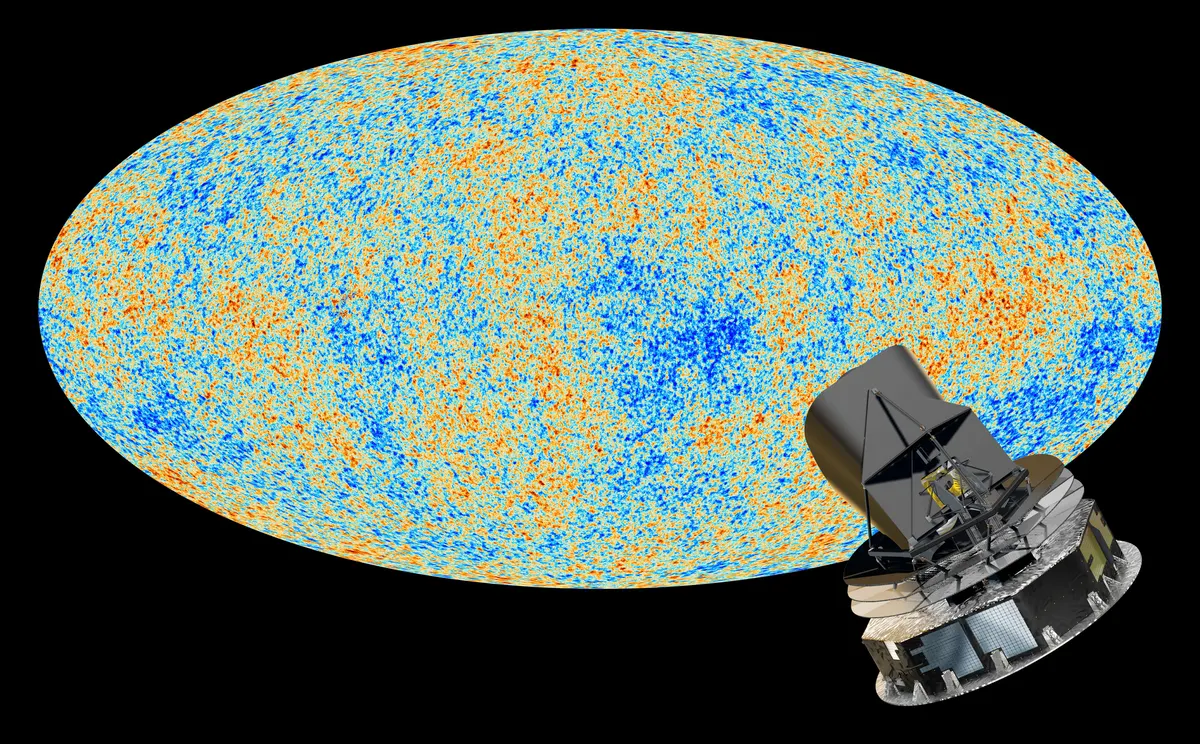
Put that way, the title hides a small trick: the sky is not dark everywhere. ESA says there are roughly 400 of these photons in every cubic centimeter of space, and far-infrared and radio telescopes detect the glow from every direction. We call the sky dark because our eyes stop short of that range. In my opinion, that makes an ordinary dark night one of the quietest clues to the Big Bang, even though it looks like nothing.
None of this breaks the cosmic speed limit. The expansion is space itself growing, and my light-speed guide explains why that is allowed.
How many galaxies hide in the dark gaps?
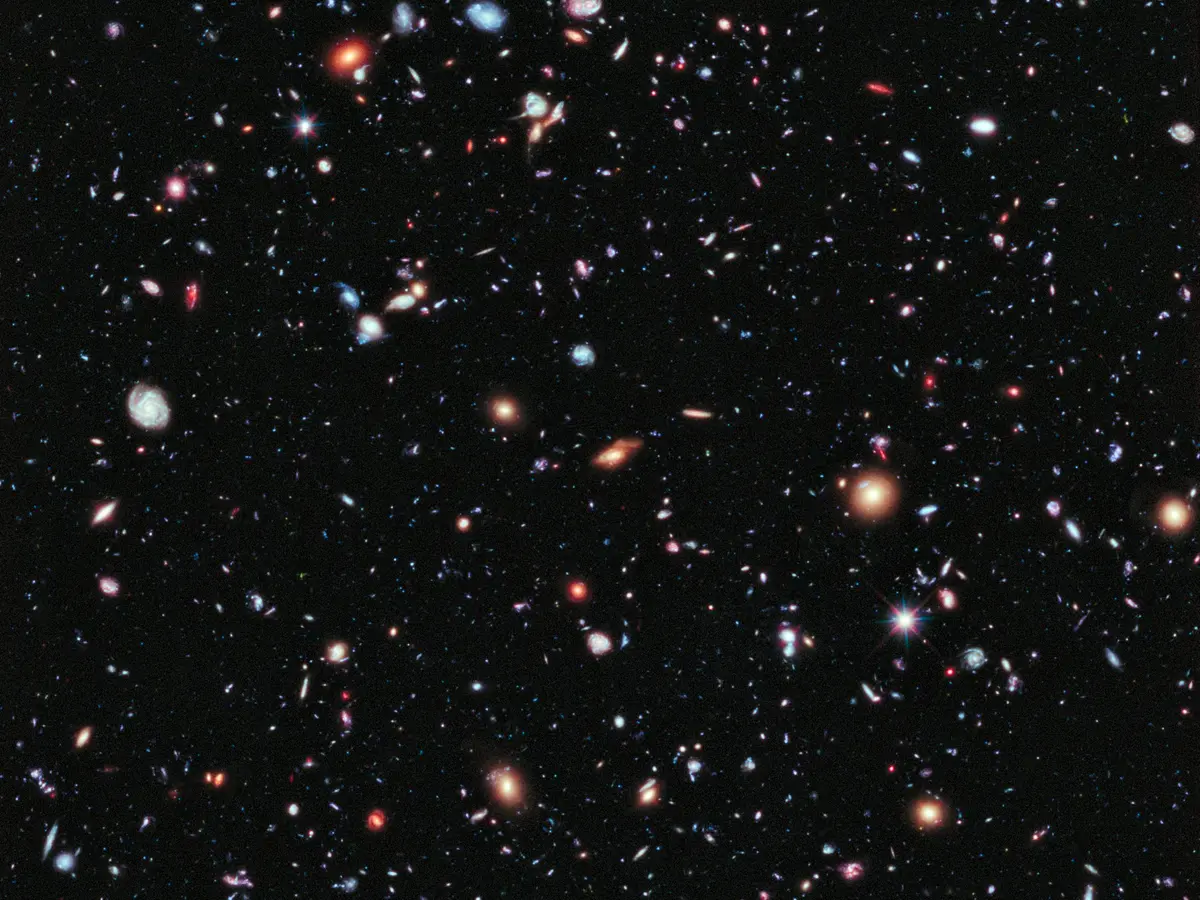
Far more than a camera on the ground can show. NASA's description of the Hubble Ultra Deep Field says the patch of sky it covers is just one-tenth the diameter of the full Moon, and that in ground-based photographs it is largely empty, with only a handful of Milky Way stars. Hubble stared at it for 11.3 days in total, across 800 exposures over 400 orbits. The result shows nearly 10,000 galaxies.
NASA compares peering into that field to looking through an eight-foot-long soda straw, about 2.4 meters (my conversion). A later version, the eXtreme Deep Field at the top of this page, combined 10 years of Hubble photographs of an even smaller central patch. NASA says it holds about 5,500 galaxies, and that the faintest are one ten-billionth the brightness of what the human eye can see.
That is the other half of the answer. Most galaxies are too faint to see unaided, so the sky between the few bright stars looks black. Even in Hubble's deepest picture, there is still dark space between the galaxies. For what the Webb telescope has added to the count, see my Webb discoveries guide, and for Hubble itself, my Hubble guide.
Has anyone measured how dark space really is?
Yes, and the spacecraft that did it is better known for Pluto. NASA reported in 2021 that space is not absolutely black. The universe has a feeble background glow from innumerable distant stars and galaxies, which astronomers call the cosmic optical background. It is the visible-light cousin of the microwave glow above.
Measuring it from Earth is nearly impossible, because sunlight reflects off dust in the inner solar system and creates a haze called zodiacal light. Even Hubble suffers from it. NASA says New Horizons, more than 4 billion miles out when the first observations were taken, saw an ambient sky 10 times darker than the darkest sky available to Hubble.
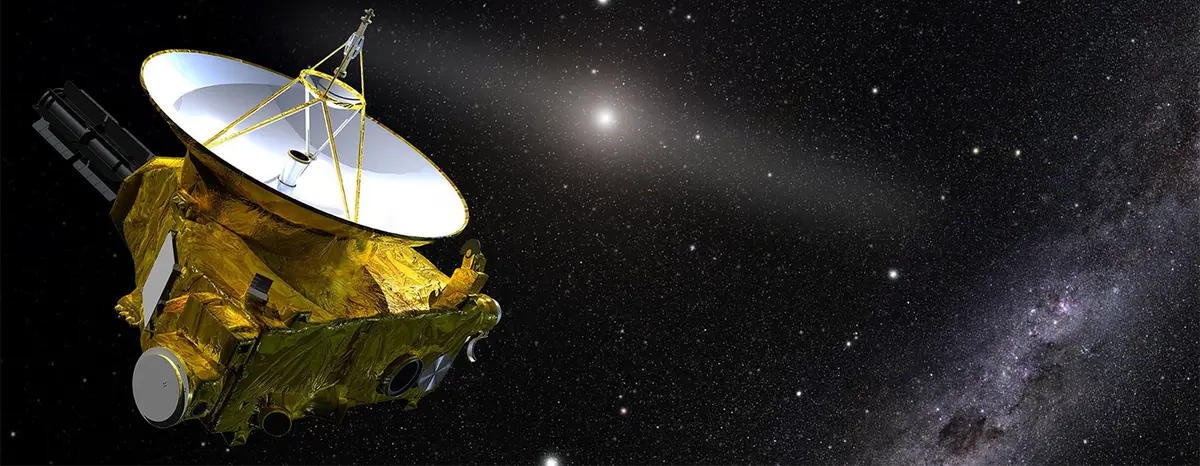
The first result, in January 2021, found about twice as much light as existing catalogs of galaxies could explain. The team's Marc Postman compared it to lying in a bedroom far from city lights when a neighbor a mile down the road opens the refrigerator, and the light bounces off the walls. A 2024 analysis changed the story. The team used far-infrared data from ESA's Planck to correct for sunlight bounced by Milky Way dust, which they had underestimated before.
With that fixed, STScI reported on August 28, 2024 that the remaining visible light was entirely consistent with the light of all galaxies over the past 12.6 billion years. New Horizons made the measurement from 5.4 billion miles (7.3 billion kilometers) away, 57 times farther from the Sun than Earth, using 24 separate imaging fields. Postman said there is no evidence for significant light from sources astronomers do not already know. Co-author Tod Lauer put it this way: "Looking outside the galaxies, we find darkness there and nothing more."
Why does the sky look dark to you tonight?
Three things stack together. The universe is young enough that only light from a limited range has arrived. The oldest light was stretched past what eyes can see. And the galaxies that do send visible light are mostly too faint to notice. The few that you can find unaided, like Andromeda, are covered in my naked-eye galaxy guide. Our own galaxy's stars fill most of the points you see overhead, and the size of that home is in my Milky Way guide.
The bright daytime sky has a different cause: air scattering sunlight, which I explain in why the sky is blue.
Frequently asked questions
Why is the night sky dark?
Because the universe has a finite age and is expanding. Light from the most distant sources has not had time to reach us, and the oldest light that has arrived was stretched into microwaves our eyes cannot see.
What is Olbers' paradox?
It is the puzzle that an endless, unchanging universe full of stars should have a sky as bright as a star's surface. The dark night sky shows that at least one of those assumptions is wrong.
Would the night sky be bright if the universe were infinite?
It would, if the universe were also unchanging and eternally old, because every line of sight would end on a star. Our universe has a finite age and is expanding, so the argument does not apply.
Does dust explain the dark sky?
No. Penn State's astronomy notes explain that in an endless universe the dust would absorb the starlight, heat up and glow, so the sky would still be bright.
Is space completely dark?
No. NASA says space has a faint background glow from distant galaxies, and the cosmic microwave background fills the sky with invisible light. New Horizons measured the visible part from 5.4 billion miles away.
Who solved the dark night sky puzzle?
Edgar Allan Poe described the idea in 1848, and Lord Kelvin gave the first satisfactory mathematical solution in 1901, according to historian Edward Harrison. The modern answer adds the expansion of the universe.
Why can Hubble see so many galaxies in a dark patch of sky?
Because it collects faint light for a long time. NASA says its Ultra Deep Field shows nearly 10,000 galaxies in a patch that looks nearly empty in ground-based photographs.
Sources
- NASA Science, "What is the Universe?" (accessed November 21, 2026). Used for the 13.8-billion-year age and the counts of stars and galaxies.
- Penn State, ASTRO 801, "Olbers' Paradox" (accessed November 21, 2026). Used for the lines of sight, the shell argument, the dust objection and the Poe quotation.
- Wikipedia, "Olbers' paradox" (accessed November 21, 2026). Used for the history, summarizing Edward Harrison's account, and for the redshift part of the answer.
- ESA, "Planck and the cosmic microwave background" (March 21, 2013; accessed November 21, 2026). Used for the 380,000 years, the stretching to 2.7 K and the photon count.
- NASA Scientific Visualization Studio, "Hubble Ultra Deep Field" (accessed November 21, 2026). Used for the galaxy count, the patch size and the exposure time.
- NASA, "Hubble Goes to the eXtreme to Assemble Farthest-Ever View of the Universe" (September 25, 2012; accessed November 21, 2026). Used for the eXtreme Deep Field.
- NASA Science, "New Horizons Spacecraft Answers Question: How Dark Is Space?" (January 13, 2021; accessed November 21, 2026). Used for the cosmic optical background and the 2021 result.
- STScI, "New Horizons Measurements Shed New Light on the Darkness of the Universe" (August 28, 2024; accessed November 21, 2026). Used for the 2024 measurement and the quotations.

Founder and editor, Orbit and Atom
I write Orbit and Atom to explain space and science in plain English, starting from what NASA, ESA and the mission teams publish. Every article lists its sources at the end so you can read them yourself.