Night Sky
Taurid Fireballs: Why November Brings the Brightest Meteors
Quick answer
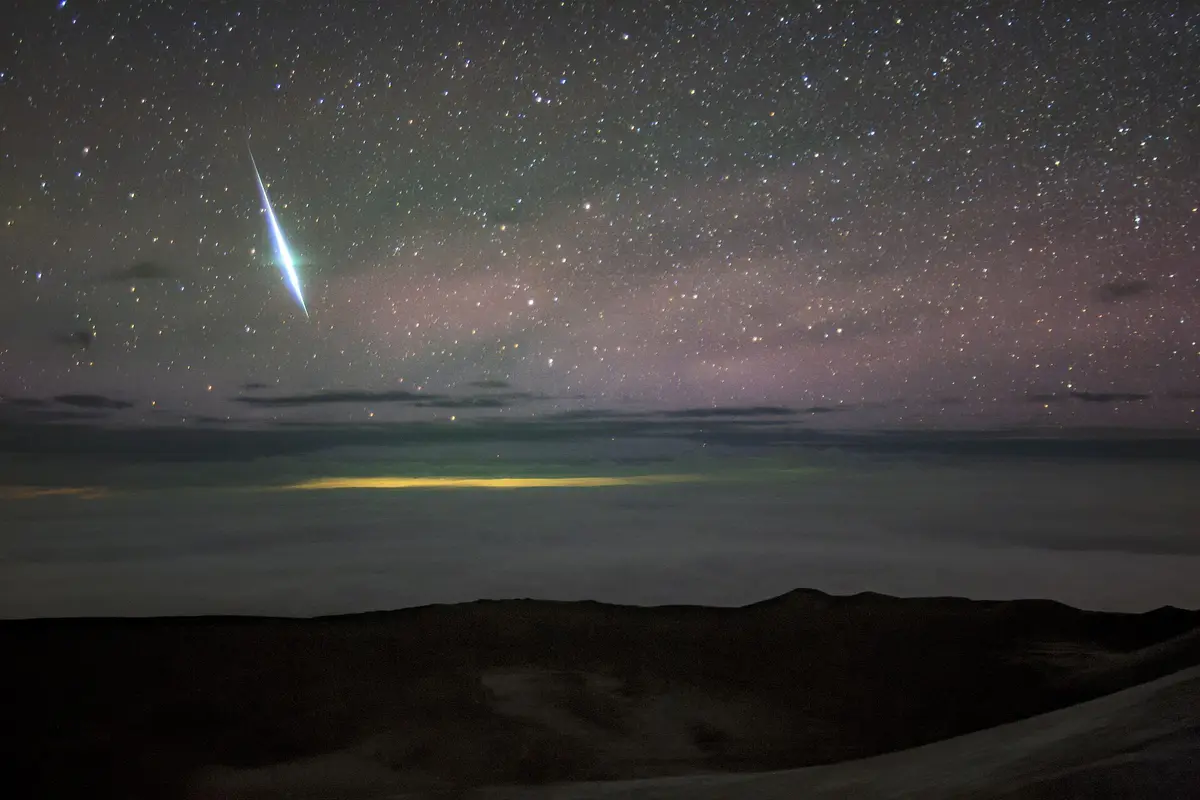
November brings bright meteors because Earth crosses the dust trail of Comet Encke, and the Taurids it feeds are known for fireballs. NASA expects only about five meteors an hour, but the Northern Taurids peak around November 12 under a thin 4% Moon, so a patient watcher can catch one as bright as Venus or brighter.
On this page
- When do the Taurids peak in 2026?
- How many Taurids will you really see?
- What is a fireball, and why do the Taurids make so many?
- Why are there two Taurid showers?
- Where and when should you look?
- What should you do if you see a fireball?
- Can a Taurid fireball drop a meteorite?
- What comes after the Taurids?
- FAQ
- Sources
The Taurids are a shower for people who like quality over quantity. In a good hour you may see only a handful of meteors, and then one of them lights up the sky like a falling lamp. That is a fireball, and the Taurids are one of the best sources of them all year.
Here is when the Taurids peak in 2026, why the dust of one small comet makes such bright meteors, and how to watch and report a fireball.
When do the Taurids peak in 2026?
There are two Taurid showers, and NASA's What's Up guide for November gives one peak for each: the Southern Taurids around November 5 and the Northern Taurids around November 12. The southern peak has passed, and the northern one falls on the night of November 11-12, with no Moon to get in the way.
The American Meteor Society (AMS) lists the Northern Taurids peaking on the night of November 11-12, with the Moon a waxing crescent only 4% lit. It calls the lunar conditions "very favorable." The southern peak night, November 4-5, had a 25% waning crescent.
| Shower | Active | Peak | Moon on peak night |
|---|---|---|---|
| Southern Taurids | Sep. 20 to Nov. 20 | Nov. 5 (fireball-swarm part) | 25% waning crescent |
| Northern Taurids | Oct. 20 to Dec. 10 | Nov. 11-12 | 4% waxing crescent |
Taurid dates in 2026. Sources: American Meteor Society (AMS), NASA.
Neither peak is sharp. The AMS says the Taurids are active for about two months and are most numerous in the first half of November. The southern shower runs until November 20 and the northern one until December 10, so nights after the peak still count.
How many Taurids will you really see?
Not many, and I would rather you know that before you go out. NASA says each Taurid shower produces only a handful of meteors an hour, around five under ideal conditions, and adds that an occasional bright fireball can make the wait worthwhile.
The AMS describes the Taurids as variable in strength from year to year. It also says that from mid-October to mid-December is the best period for a couple of Taurid fireballs each night, as long as the shower is not too weak. Treat that as the best case, not a promise for your sky.
This is also a quiet year for the Taurids. CNN reported on November 4 that meteors are less frequent this year, and it quoted Bill Cooke, head of NASA's Meteoroid Environment Office: "We're kind of in a lull before the thunderstorms occur." Cooke said Earth is predicted to cross a denser swarm of Taurid debris in 2032. I would treat a fireball this November as a bonus, not a given.
Fireballs are rare in general. The AMS says several thousand of them happen in the atmosphere every day, but most fall over oceans and empty land or in daylight. Experienced observers can expect about one magnitude -4 fireball for every 20 hours or so of watching. The Taurid season is when the odds tilt in your favor.
What is a fireball, and why do the Taurids make so many?
A fireball is a very bright meteor. NASA and the AMS both set the bar at about magnitude -4, as bright as the planet Venus or brighter. A bolide is a fireball that explodes in a bright flash at the end, often breaking into pieces, according to the AMS.
The Taurids make so many because of where they come from. NASA names Comet 2P/Encke as the parent of the Taurid stream. It is a small comet, with a nucleus about 2.98 miles (4.8 kilometers) across, but it has the shortest orbit of any known comet: 3.30 years. It last reached its closest point to the Sun in 2015.
NASA explains the fireballs this way: they come from larger particles of cometary material, and they can show larger bursts of light and color and last longer than an average meteor streak. The Taurids also hit at about 65,000 miles per hour (about 105,000 kilometers per hour), according to NASA. That sounds fast, but ESA puts a typical Leonid at 71 kilometers per second, which is more than twice as quick. Taurid fireballs are bright because of their size, not their speed.
Why are there two Taurid showers?
Because the stream seems to come from two spots in the constellation Taurus, the Bull. NASA says the Southern and Northern names refer to those two areas. The two showers overlap in time, and that matters for fireballs: the AMS says that when both are active in late October and early November, fireball activity sometimes rises noticeably.
The Southern Taurids are the more complicated of the pair. The AMS says they have two parts: an annual component that peaks on October 14, and a fireball-swarm component that peaks on November 5. It calls them "rich in fireballs" and says they often explain the jump in fireball reports from September through November. The Northern Taurids, in the AMS's words, are much like the southern ones but active a little later in the year.
NASA adds that the Taurids are often at their best around Halloween, which is why they are also called the "Halloween Fireballs." The Orionids, from Halley's Comet, come just before them, and the Leonids follow.
Where and when should you look?
Taurus, home of the bright Pleiades cluster, climbs into the eastern sky in the evening and stays up for most of the night. You do not need to find it, though. As with any shower, Taurid meteors can appear anywhere, and NASA's advice is to take in as much sky as you can. The AMS says most showers are best between midnight and dawn, and that is a good plan here too.
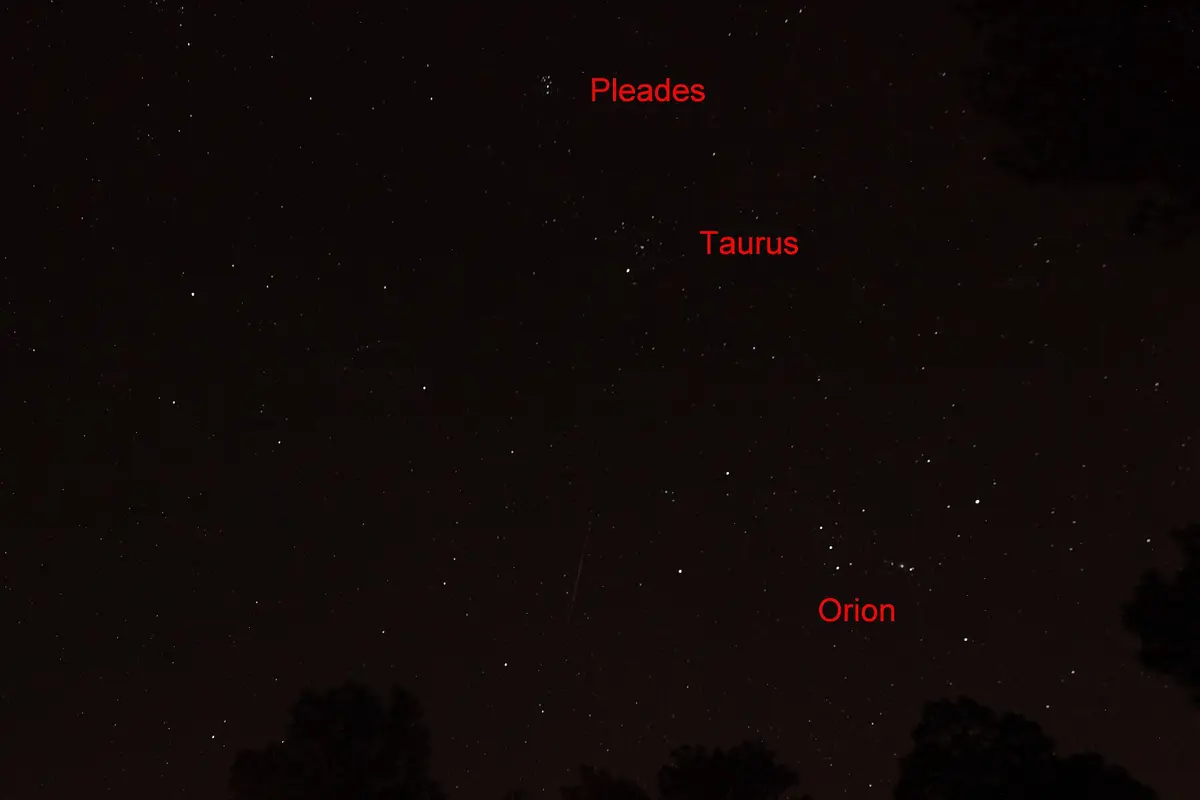
- Find a dark spot. NASA recommends a dark location. City glow hides the fainter Taurids, and there are few to spare.
- Give your eyes time. NASA says to allow about half an hour for them to adjust. Checking your phone resets the clock.
- Look up and wide. No telescope or binoculars are needed. A fireball crosses a large part of the sky, and your eyes take in more of it than any lens.
- Be patient. In my opinion, patience is the most useful thing you can bring. A watch of an hour or two with a few meteors and one bright one is a good Taurid night.
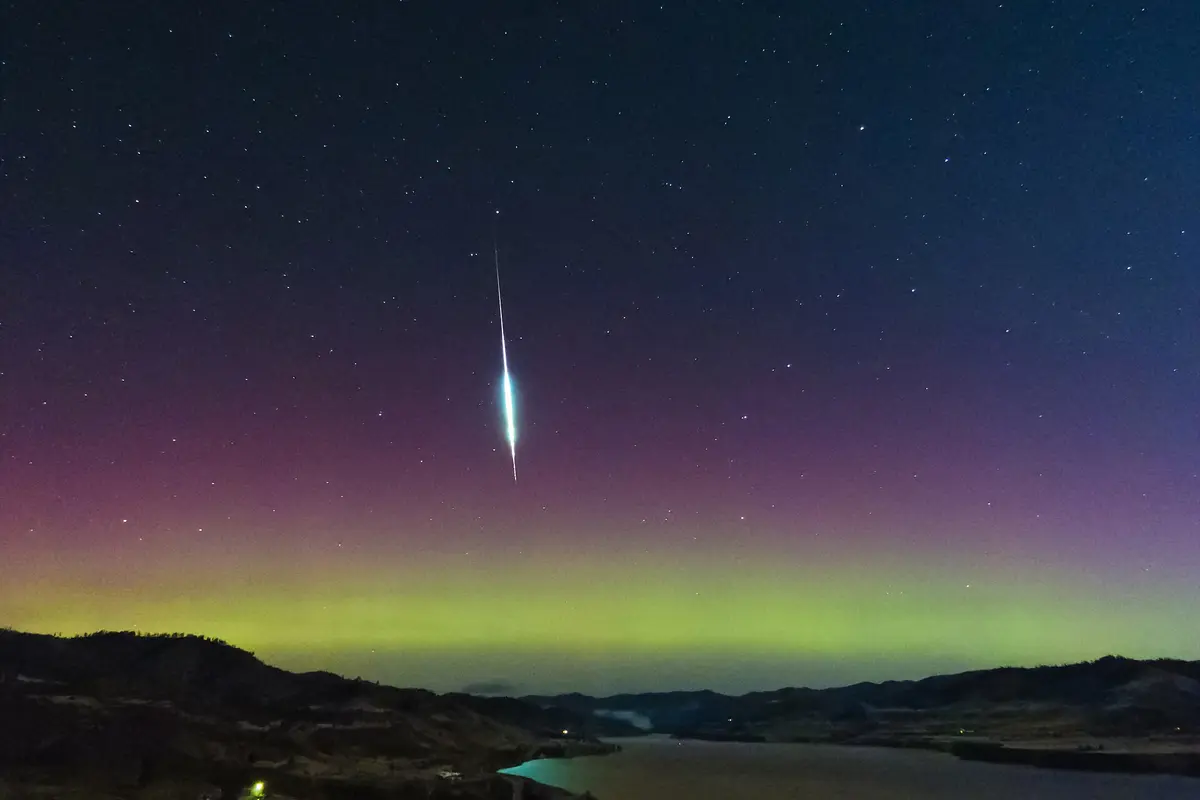
The aurora in the photo at the top of this page was a lucky extra. If you wonder how it works, my guide to what causes the northern lights explains it.
What should you do if you see a fireball?
Report it. The AMS collects fireball reports from around the world, and if several people saw the same event, it is sometimes possible to work out its path. Its online form is the easiest way to send one, at fireball.amsmeteors.org.
The AMS asks you to remember as much as you can:
- how bright it was
- how long it was across the sky
- its color
- how long it lasted
- where it began and ended, by the background stars or by compass direction and height above the horizon
Not every bright streak is a fireball. The AMS says many reports turn out to be contrails, the ice-crystal trails of high-flying airplanes, which can glow orange or red at sunrise and sunset. A fireball lasts only a few seconds, and a contrail stays in the sky for minutes or hours. If there were clouds above what you saw, it was not a fireball either, because meteors burn up far higher than the highest clouds.
Can a Taurid fireball drop a meteorite?
Almost certainly not. NASA says not to expect meteorites after a meteor shower, because most shower debris comes from comets, and comet material is fragile. In theory, NASA adds, the Taurids and the Geminids could send a meteorite down once in a while, but no remnants have been traced to them definitively. The AMS agrees that cometary material is so fragile it vaporizes readily in the atmosphere.
A bright Taurid fireball is a light show, then, and not something to go looking for on the ground.
What comes after the Taurids?
The Leonids are next. NASA's November guide points to the early mornings of November 17 and 18, after the Moon has set. My Leonid guide has the details, and the meteor shower calendar lists every shower through 2027. If you would like the planets too, my November planet guide shows what is up in the same sky.
More skywatching guides are in the Night Sky section.
Frequently asked questions
When do the Taurids peak in 2026?
NASA gives around November 5 for the Southern Taurids and around November 12 for the Northern Taurids. The American Meteor Society lists the peak nights as November 4-5 and November 11-12.
How many Taurid meteors can I see per hour?
NASA says each Taurid shower produces only a handful an hour, around five under ideal conditions. The Taurids are known for the occasional bright fireball rather than for numbers.
Is 2026 a good year for Taurid fireballs?
Not an especially strong one. CNN reported on November 4 that meteors are less frequent this year and quoted NASA's Bill Cooke calling it a lull. He said a denser swarm of Taurid debris is predicted for 2032.
What is a Taurid fireball?
A fireball is a meteor as bright as the planet Venus (about magnitude -4) or brighter. NASA says Taurid fireballs come from larger particles of cometary material shed by Comet 2P/Encke.
Which comet causes the Taurids?
Comet 2P/Encke, according to NASA. Its nucleus is about 2.98 miles (4.8 kilometers) across and it orbits the Sun every 3.30 years, the shortest period of any known comet.
Will the Moon spoil the Taurids in 2026?
No. The American Meteor Society lists a 4% lit waxing crescent on the Northern Taurid peak night, November 11-12, and calls the conditions very favorable. The southern peak night had a 25% waning crescent.
What is the best time to watch the Taurids?
The American Meteor Society says most showers are best between midnight and dawn. NASA advises a dark location, about half an hour for your eyes to adjust and as much open sky as you can see.
How do I report a fireball?
Use the American Meteor Society online form at fireball.amsmeteors.org. Note how bright it was, how long it lasted, its color and where it began and ended in the sky.
Can a Taurid fireball drop a meteorite?
Very unlikely. NASA says that in theory the Taurids could send down a meteorite once in a while, but none has been traced to them definitively. Comet material is fragile and mostly burns up.
Sources
- NASA Science, "What's Up: November 2026 Skywatching Tips from NASA": Taurid peaks, rate and viewing tips (accessed November 7 and 12, 2026)
- NASA Science, "2P/Encke": parent comet, orbit, speed and fireballs (accessed November 7, 2026)
- NASA Science, "Meteors and Meteorites: Facts": Taurids and meteorites (accessed November 7, 2026)
- American Meteor Society, "Meteor Shower Calendar 2026/2027": Taurid dates and Moon conditions (accessed November 7 and 12, 2026)
- American Meteor Society, "Major Meteor Showers": how the Taurids vary (accessed November 7 and 12, 2026)
- CNN (via KRDO), Dharma Niles, "The Southern Taurid meteor shower will bring rare fireballs tonight" (November 4, 2026): Bill Cooke on this year's lull and the 2032 swarm (accessed November 12, 2026)
- American Meteor Society, "Fireball FAQ": what a fireball is, how often they occur, contrails and how to report one (accessed November 7, 2026)
- European Space Agency, "About the Leonids": Leonid speed

Founder and editor, Orbit and Atom
I write Orbit and Atom to explain space and science in plain English, starting from what NASA, ESA and the mission teams publish. Every article lists its sources at the end so you can read them yourself.