Night Sky
Geminid Meteor Shower 2026: Peak Night and When to Look
Quick answer
The Geminid meteor shower peaks on the night of December 13 into the morning of December 14, 2026, and it is usually the best of the year. NASA expects 40 to 50 meteors an hour under dark skies, up to 120 in perfect conditions. A thin crescent Moon sets in the early evening, so the sky is dark all night. Start around 10 p.m. and stay into the hours before dawn, when the shower is strongest.
On this page
- When is the Geminid meteor shower in 2026?
- Which night should you watch?
- How many Geminids will you see?
- Will the Moon get in the way?
- What time is best to watch the Geminids?
- Why do the Geminids come from an asteroid?
- How do you watch the Geminids?
- What if it is cloudy on the peak night?
- FAQ
- Sources
The Geminids are the meteor shower that people who like meteor showers tend to plan their winter around. They are bright, they run for hours, and unlike most showers they are already worth watching in the evening, not only at 4 a.m. In 2026 they also get a gift: a thin crescent Moon that is gone from the sky before the show gets going.
Here is when the Geminids peak, why the sources do not quite agree on the exact moment, how many meteors to expect and what to do on the night.
When is the Geminid meteor shower in 2026?
NASA lists the Geminids as active from December 4 to December 17, 2026, with the peak on the night of Sunday, December 13, into the morning of Monday, December 14. The American Meteor Society (AMS) names the same night. NASA also says the Geminids are visible across the globe because of a "nearly 24-hour broad maximum," so the nights just before and after the peak are worth a look too.
If you go looking for the exact peak time, you will find that sources differ. That is normal, and it matters less than it sounds, because the Geminid maximum is wide.
| Source | Peak | Rate |
|---|---|---|
| NASA | Dec. 13-14 | 40-50 an hour, up to 120 |
| AMS | Dec. 13-14 | "Usually the strongest" of the year |
| IMO | Dec. 14, 14:00 UT | ZHR 150 |
| EarthSky | Dec. 14, 5:44 UT | Up to 120 |
What the main sources say about the 2026 Geminids. The NASA row is the broad maximum; the IMO time is the center of its broad maximum and EarthSky's is a predicted time. Sources: NASA, AMS, the International Meteor Organization (IMO) and EarthSky, read November 21, 2026.
The IMO calendar adds a useful detail: over the last two decades, the best-reported maxima have all landed between 21:00 UT on December 13 and 18:00 UT on December 14. In other words, nobody can promise a clock time, and you do not need one. The practical question is which dark hours to use, and that depends on where you live.
Which night should you watch?
For most readers in North America and Europe, the answer is the night of December 13-14, the one NASA and the AMS name. It is dark, the Moon is out of the way and the radiant is high for most of it. By my own reading of the IMO's time, the center of the maximum (14:00 UT on December 14) falls in daylight in the Americas and Europe, so the following night, December 14-15, is a fair second choice, with the shower tapering off but still active.
In East Asia and Australia, 14:00 UT on December 14 is late evening or night, so the evening of the 14th is the time to watch there. In my opinion, the best plan anywhere is to pick whichever of the two nights has the clearer forecast and not to chase the minute.
How many Geminids will you see?
NASA says to expect 40 to 50 meteors an hour under dark skies, and up to 120 an hour in perfect conditions. The IMO's figure is higher, a zenithal hourly rate (ZHR) of 150. ZHR is the rate an observer would count with the radiant straight overhead and a perfectly dark, clear sky, so real counts are always lower. The honest range for a good dark site is a few dozen an hour, and for a lit suburb it is far fewer.
The Geminids did not always look like this. NASA says they first appeared in the mid-1800s with only 10 to 20 meteors an hour, and they have grown into one of the major showers of the year. The AMS calls them usually the strongest of the year, and the IMO calls the Geminids the best and most reliable of the major annual showers.
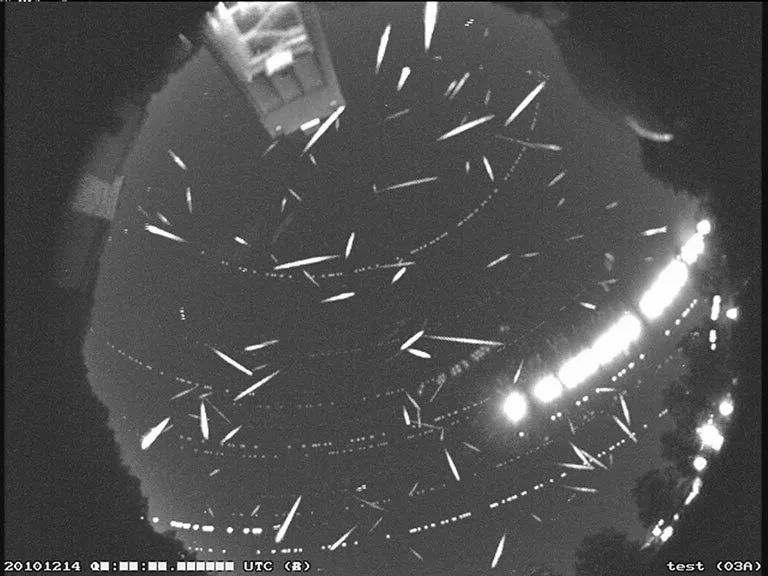
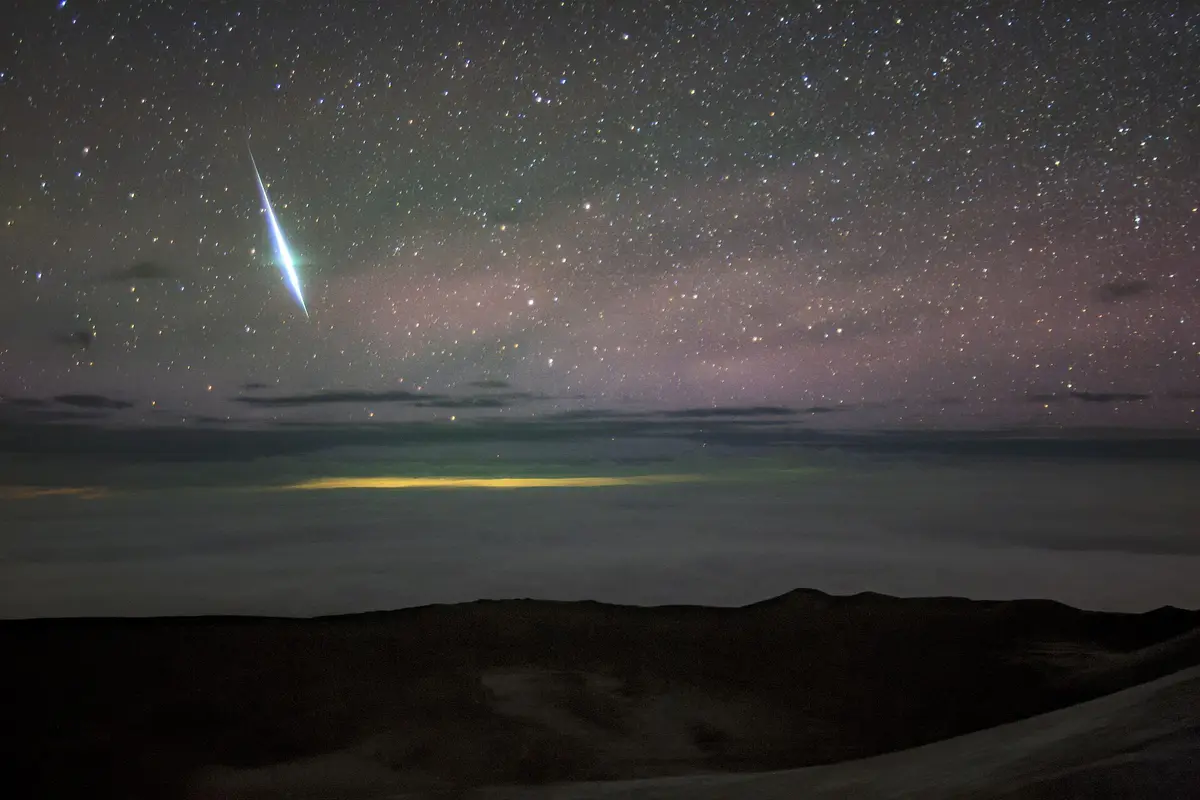
The Geminids are also bright. NASA describes them as bright and fast meteors that tend to be yellow, and the AMS says they are often intensely colored. The IMO adds that Geminids are known for bright meteors and fireballs, and that during most returns a larger share of the bright ones came toward the end of the main maximum, so staying out late can pay off.
Will the Moon get in the way?
No, and that is the best news of the year. The AMS lists the Moon on the peak night as a 15% lit waxing crescent, with "limited moonlight interference." The IMO calls the maximum "moon-free." First quarter falls on December 17, a few days after the peak.
By my own calculation with astronomy software, the crescent Moon sets on the evening of December 13 at about 8:40 p.m. in New York, 8:35 p.m. in Chicago, 9:00 p.m. in Los Angeles and 8:00 p.m. in London. On the evening of December 14 it sets about an hour later, near 9:45 p.m. in New York. Either way, it is gone before the shower is at full strength.
What time is best to watch the Geminids?
NASA says the Geminids are best seen during the night and the predawn hours, and that the shower starts around 9 or 10 p.m., which makes it a good one for younger viewers. The AMS adds that this is the one major shower with good activity before midnight, because Gemini is well placed from about 10 p.m.
The reason is the radiant, the spot the meteors seem to fly out of. It sits in the constellation Gemini, near the bright star Castor. By my calculation, it rises in the late afternoon in New York, Chicago and London, stands about 45 degrees high at 10 p.m. and climbs to about 80 degrees, nearly overhead, around 2 a.m. in New York (about 70 degrees in London). The IMO also says the radiant culminates near 2 a.m. local time. That is why the shower builds through the night and why about 2 a.m. is the sweet spot.
As with every shower, NASA says you should not stare only at the radiant. Meteors can show up anywhere in the sky, and the ones far from the radiant leave the longest trails.
South of the equator the show is weaker. The AMS says Geminids are visible from the Southern Hemisphere only in the middle of the night and at a reduced rate, because the radiant does not climb as high.
Why do the Geminids come from an asteroid?
Most meteor showers come from comets. The Geminids come from an asteroid, 3200 Phaethon, and that makes them an oddity. NASA says Phaethon takes 1.4 years to orbit the Sun and is small, about 3.17 miles (5.10 kilometers) across. It was found on October 11, 1983, by the Infrared Astronomical Satellite, and astronomer Fred Whipple realized it is the source of the Geminids.
Scientists are not sure how to define it. NASA says Phaethon is either a "dead comet" or a "rock comet," a new kind of object astronomers are discussing. Its orbit is as elongated as a comet's, but it grows no tail near the Sun and its spectrum looks like a rocky asteroid. The Geminid grains are also dense: NASA gives 2 to 3 grams per cubic centimeter, several times the 0.3 of ordinary comet dust.
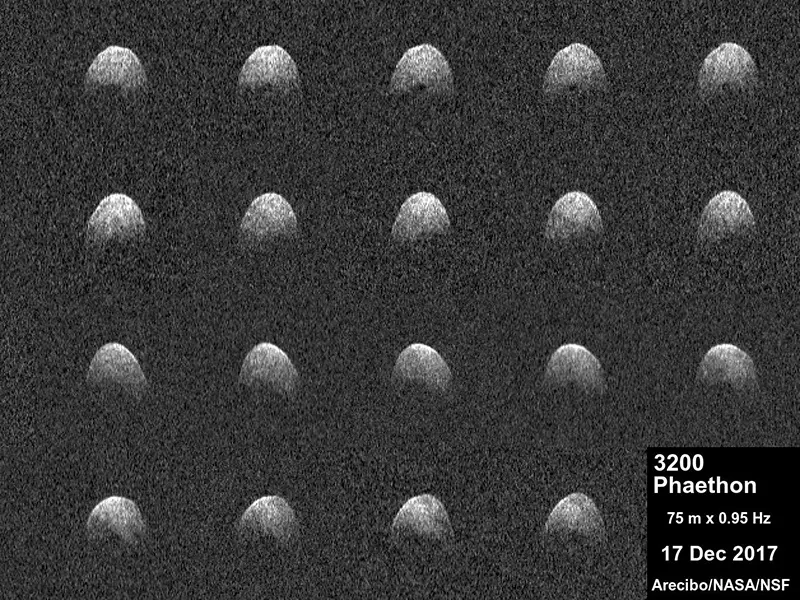
The grains hit the air at about 22 miles (35 kilometers) per second, according to NASA. That is slower than the Leonids, which ESA puts at about 71 kilometers per second (see my Leonid guide), and it fits what the AMS says: Geminids are medium-slow, so they usually do not leave glowing trains that last. What you get instead are bright, unhurried streaks.
How do you watch the Geminids?
- Get away from lights. NASA's first tip is to find an area well away from city lights or street lights.
- Dress for winter. NASA says to come prepared for winter temperatures with a sleeping bag, a blanket or a lawn chair. December nights are long, and the cold is what ends most watching sessions.
- Lie back with your feet toward the south. That is NASA's advice for the Geminids, so you can take in as much of the sky as possible.
- Give your eyes 30 minutes. NASA says your eyes need about that long to adapt to the dark. A phone screen resets the clock.
- Plan two sessions if you can. A first look around 10 p.m., when the radiant is already up, and a longer one near 2 a.m. The show lasts until dawn.
Skip the telescope and the binoculars. They show a tiny patch of sky, and the Geminids can appear in any part of it.
What if it is cloudy on the peak night?
Try the next night. The broad maximum means December 12-13 and December 14-15 will both show Geminids, at lower rates than the peak. If you have a cloudy forecast for several nights, a drive to a clearer area can be worth it more than waiting for the exact night.
The Geminids are not the last shower of the year. The AMS lists the Ursids for December 21-22 under a Moon 89% lit, which will hide most of them, and the Quadrantids for January 3-4 under a thin 18% crescent. My meteor shower calendar has the full list. If you want to practice first, the Taurids are still active this month.
For what else is overhead this season, browse the Night Sky guides.
Frequently asked questions
When do the Geminids peak in 2026?
On the night of December 13 into the morning of December 14, 2026, according to NASA and the American Meteor Society. The shower is active from December 4 to 17, and NASA says the maximum is broad, lasting nearly 24 hours.
How many Geminid meteors can I see per hour?
NASA says 40 to 50 meteors an hour under dark skies, and up to 120 in perfect conditions. The International Meteor Organization gives a zenithal hourly rate of 150, which is an ideal-sky figure, so real counts are lower.
What is the best time of night to watch the Geminids?
Around 2 a.m. local time, when the radiant is highest, according to EarthSky and the IMO. NASA says the shower starts around 9 or 10 p.m. and lasts until dawn, so you can also see good meteors in the evening.
Will moonlight spoil the 2026 Geminids?
No. The AMS lists a 15% lit waxing crescent on the peak night, and the IMO calls the maximum moon-free. By my calculation the Moon sets between about 8 and 9 p.m. on December 13 in New York, Chicago, Los Angeles and London.
Which direction should I look to see the Geminids?
Anywhere in the sky. The meteors seem to come from the constellation Gemini, but NASA says not to look only there, because the Geminids are visible throughout the sky. NASA suggests lying flat with your feet toward the south.
Why do the Geminids come from an asteroid, not a comet?
NASA says the source is 3200 Phaethon, an asteroid that may be a dead comet or a "rock comet." It grows no tail near the Sun, its spectrum looks rocky and its debris is several times denser than comet dust.
Can I see the Geminids from the Southern Hemisphere?
Yes, but fewer. The AMS says they are visible from the Southern Hemisphere only in the middle of the night and at a reduced rate, because the radiant does not climb as high there.
Sources
- NASA Science, "Geminids" (page last updated August 13, 2026; accessed November 21, 2026): dates, rate, speed, Phaethon and viewing tips
- American Meteor Society, "2026/2027 Meteor Shower Calendar": peak night, Moon, Southern Hemisphere (accessed November 21, 2026)
- International Meteor Organization, "2026 Meteor Shower Calendar" (36th edition, PDF; accessed November 21, 2026): time of maximum, ZHR and radiant
- EarthSky, "Everything you need to know: Geminid meteor shower" (accessed November 21, 2026): predicted peak time and first quarter Moon

Founder and editor, Orbit and Atom
I write Orbit and Atom to explain space and science in plain English, starting from what NASA, ESA and the mission teams publish. Every article lists its sources at the end so you can read them yourself.