Night Sky
How to Find Orion and the Orion Nebula in the Night Sky
Quick answer
To find Orion, look for three bright stars in a short, nearly straight row: Orion's Belt. This season it climbs into the evening sky in the east. The Orion Nebula hangs just below the belt, in the hunter's sword, and NASA says you can see it with your own eyes as a fuzzy "star" from a moderately dark sky. Binoculars show far more detail.
On this page
Orion is the constellation most people can find on the first try, and this is the time of year it comes back. It rises in the east in the evening, and for the next few months it dominates the winter sky. Inside it, below three famous stars, sits one of the few nebulae you can pick out without a telescope.
Here is how to find the hunter, how to tell his two brightest stars apart, where to look for the nebula and how to use your own hand as a ruler.
When and where can you see Orion this winter?
In the Northern Hemisphere, Orion climbs into the evening sky from the east as the weeks go by. NASA's Night Sky Network says January evenings place it in the east and southeast, and NASA's pages on the nebula call January the best month to see it. The constellation is already up this week. The table below shows how much earlier it appears as winter goes on.
| Date | Rises | Highest | At 9 p.m. |
|---|---|---|---|
| Nov. 19 | 7:40 p.m. | 1:40 a.m. | 14° |
| Dec. 1 | 6:55 p.m. | 1 a.m. | 23° |
| Dec. 15 | 6 p.m. | midnight | 32° |
| Jan. 1 | 5 p.m. | 11 p.m. | 42° |
| Jan. 15 | 4 p.m. | 10 p.m. | 47° |
When Orion's Belt rises, when it is highest and how high it stands at 9 p.m. Times are approximate, from about 40° north latitude (for example Philadelphia, Denver or Madrid), standard time. My calculation for the middle star of the belt, Alnilam; shift them a little for your own location.
In plain terms: tonight the belt is only about a fist and a half above the horizon at 9 p.m., and it is best to wait until 10 or 11 p.m. By mid-December it is a comfortable height by 9 p.m., and by mid-January it is nearly at its peak in the early evening. Look toward the southeast first, then south as the night goes on.
If you live in the Southern Hemisphere, Orion is a summer constellation. EarthSky points out that you should turn a northern-sky chart upside down and look toward the north. NASA says Orion can be seen from around the world.
How do you find Orion's Belt?
Go outside on a clear night, wait until Orion is a few fists high, and look for three bright stars close together in an almost straight line. NASA says this is the easiest way to find Orion: those three stars are the hunter's belt. Two brighter stars to the north mark his shoulders, and two more to the south are his feet, which gives the whole constellation the shape of an hourglass.
The belt is also a ready-made ruler. NASA's Night Sky Network says the three belt stars make a line about 3 degrees long. That is about three pinky fingers held at arm's length, since NASA counts each pinky as roughly 1 degree. A full Moon, by comparison, is about half a degree wide.
The three stars look alike, but they are not neighbors. NASA gives the distances as about 800 light-years for Alnitak, 1,300 for Alnilam and 900 for Mintaka. And Mintaka is not even a single star: NASA says it is a system of five. What looks like a tidy row of three lights is really a line of sight across a stretch of the Milky Way.
How do you tell Betelgeuse from Rigel?
By color. Betelgeuse marks Orion's right shoulder, and NASA calls it a red supergiant. It is the reddish-orange star to the north of the belt. Rigel marks his left foot, to the south, and NASA calls it a blue supergiant. It shines blue-white, and NASA says that difference in color is noticeable even from Earth. Rigel is the brightest star in Orion, about 860 light-years away according to NASA, even though Betelgeuse is closer.
Both are about a fist from the belt. By my own calculation from their positions, Betelgeuse and Rigel each sit roughly 9 to 10 degrees from the middle of the belt, and NASA's Chandra mission counts a fist at arm's length as about 10 degrees. A fist above the belt is the red shoulder, and a fist below it is the blue foot.
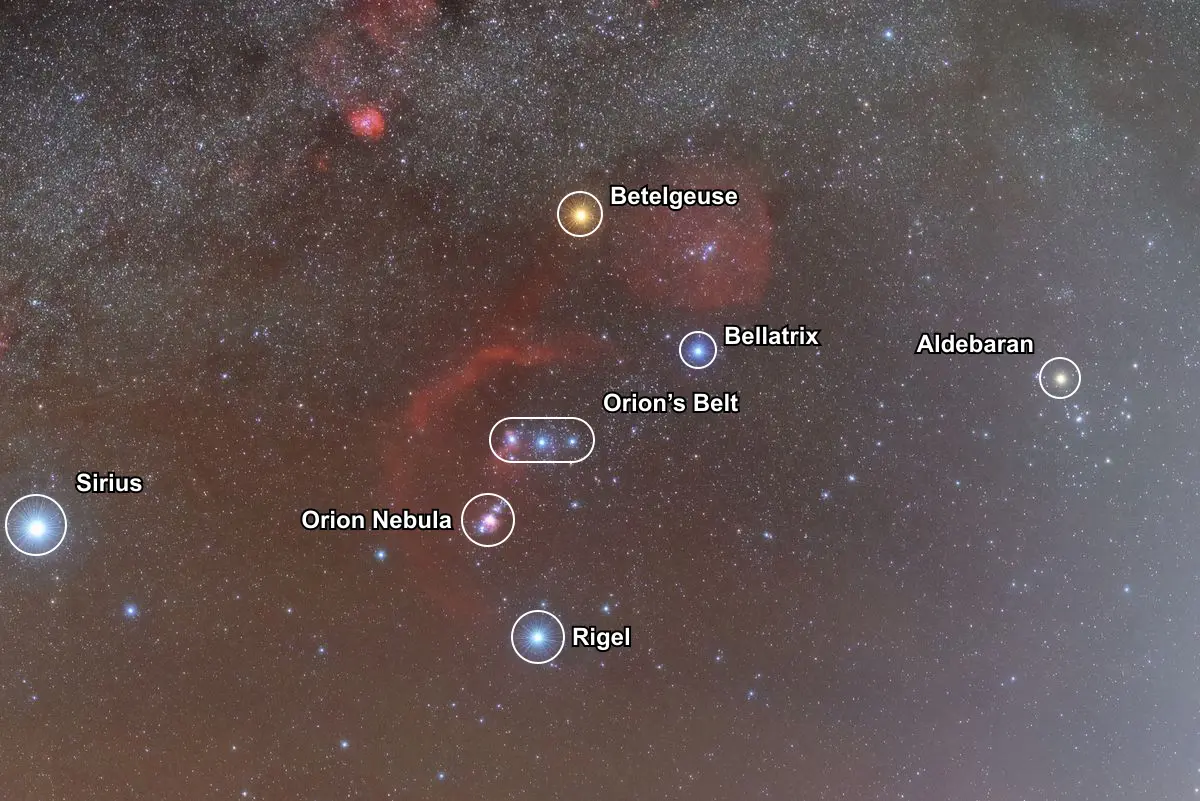
Betelgeuse has a story of its own. NASA says it is destined to end in a supernova, though it does not look ready to explode any time soon. I tell that story in my guide to when Betelgeuse will explode, and my supernova guide explains what happens when a star like it finishes its life. In my opinion, knowing that the orange star at the top of the photo above will one day vanish makes it much more interesting to look at.
Where is the Orion Nebula?
Below the belt. NASA says the nebula, also known as Messier 42 or M42, sits in the "sword" of Orion, below the first star of the belt, Alnitak. Follow the sword south from Alnitak and the fuzzy point you reach is the nebula. By my calculation from the star positions, it is about 3.7 degrees below Alnitak, about the length of the belt itself or three to four pinkies.
It does not look like a star, and that is the clue. NASA describes it as a fuzzy "star" in the middle of the sword, and says it can be seen with the naked eye under moderately dark skies. NASA lists its brightness as magnitude 4.0, which is easy to spot on a dark night but easy to lose to street lights. If you only see a normal point of light, try moving away from the nearest lamp, or use binoculars. NASA calls Orion a great way to test how dark your sky is.
What does the nebula look like in binoculars?
A lot more than a smudge. NASA says binoculars or a telescope show much more detail in the glowing cloud, such as the Trapezium: four young stars arranged in the shape of a keystone, or a baseball diamond. They sit at the heart of the nebula, and NASA's Hubble page says all of them were born together.
My advice is to start with binoculars, because they are easy to point and show the whole nebula with its bright core. I would treat the four Trapezium stars as a small-telescope target and not expect them from binoculars alone. Leaning against a wall or a post keeps the view steadier than holding them in the air.
What is the Orion Nebula?
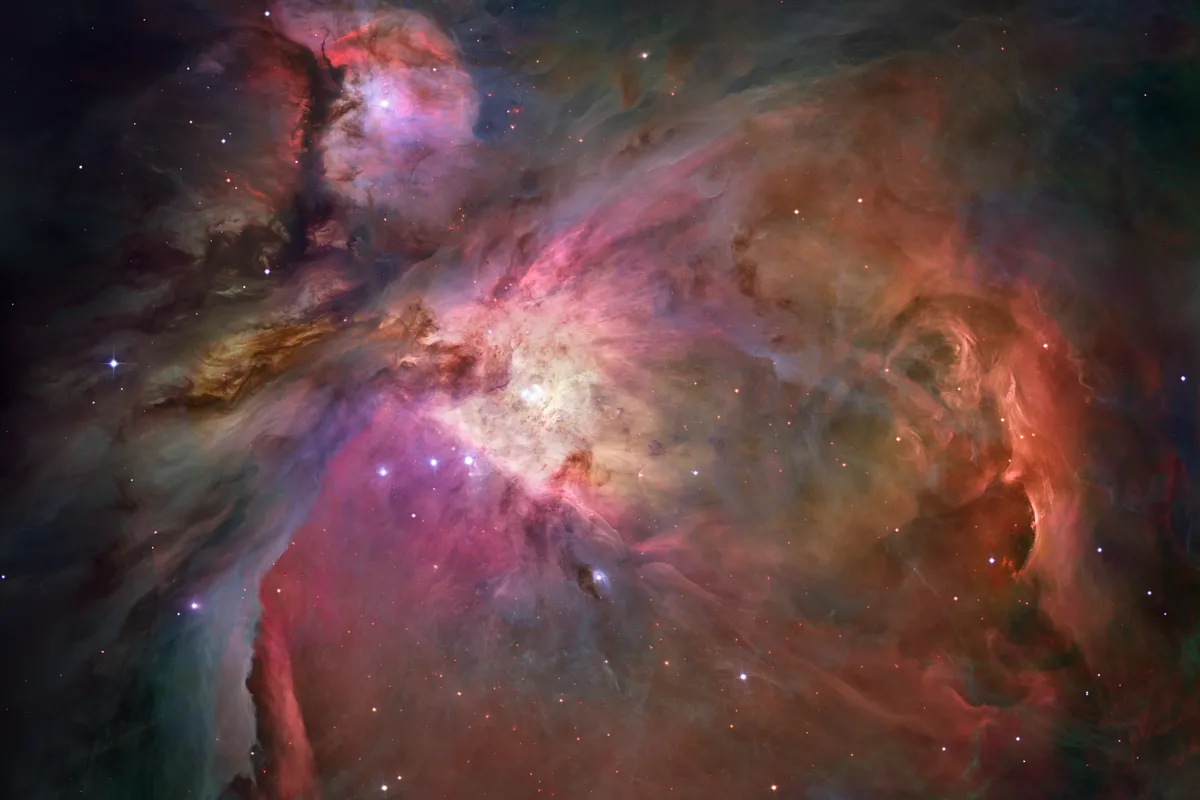
A stellar nursery: a huge cloud of gas and dust where new stars are forming. NASA's Night Sky Network gives its width as about 24 light-years. NASA says it is the closest large star-forming region to Earth.
The distance depends on which page you read. NASA's Hubble page gives 1,500 light-years, while other NASA pages say 1,300 and 1,450. I use "about 1,500" and treat the rest as the usual range of an object that is hard to measure.
The Hubble mosaic at the top of this page is made from 520 images in five colors, plus ground-based photos, according to ESA/Hubble. It shows more than 3,000 stars, including faint red brown dwarfs, and the mosaic covers about the apparent size of the full Moon. The bright core is where four massive young stars carve out a cavity in the cloud with their ultraviolet light. NASA adds that the Maya of Mesoamerica saw this part of the sky as the Cosmic Hearth, the fire of creation, which is a good name for a place where stars are being made. It has also been a target for the James Webb Space Telescope, which NASA says imaged the Orion Bar, a region where starlight is slowly eroding the cloud, and found a planet-forming disk named d203-506.
The light you see tonight left the nebula about 1,500 years ago (my arithmetic, using the NASA distance).
Which nights are best to look?
The ones with little moonlight. From NASA's data, the full Moon falls on November 24, and moonlight will wash out the faint parts of the nebula for a few nights on either side. By my calculation the next new Moon is on December 9 (00:52 UTC), so the darkest evenings are roughly the week around it. The full Moon comes again on December 24 and the next new Moon on January 7, 2027.
Planets can help too. My guide to the planets in November shows what else is up, and the Pleiades, another easy winter target, are the subject of my October guide to the Moon and the Pleiades. If you want another challenge after Orion, the farthest thing you can see with the naked eye is a good next target.
Frequently asked questions
Can you see the Orion Nebula with the naked eye?
Yes. NASA says it can be spotted with the naked eye under moderately dark skies, as a fuzzy "star" in the middle of Orion's sword. Binoculars or a small telescope show much more.
Where is the Orion Nebula in relation to Orion's Belt?
Just below it. NASA says the nebula sits in the sword of Orion, below the first star of the belt, Alnitak. By my calculation it is about 3.7 degrees from Alnitak, roughly three to four pinky widths at arm's length.
What is the best month to see Orion and the Orion Nebula?
January, according to NASA, when Orion stands in the east and southeast in the evening. In the Northern Hemisphere you can already see it late in the evening in November and earlier each week after that.
How far away is the Orion Nebula?
About 1,500 light-years, according to NASA's Hubble page. Other NASA pages give 1,300 and 1,450 light-years, so treat it as roughly 1,300 to 1,500. It is the closest large star-forming region to Earth.
How can you tell Betelgeuse from Rigel?
By color. NASA calls Betelgeuse a red supergiant, at Orion's shoulder, and Rigel a blue supergiant, at his foot. Rigel is the brightest star in the constellation.
Is Orion visible south of the equator?
Yes. NASA says the constellation can be seen from around the world. EarthSky notes that in the Southern Hemisphere it appears upside down in the northern sky, and that it is a summer constellation there.
Sources
- NASA Science, "Discovering the Universe Through the Constellation Orion" (accessed November 19, 2026)
- NASA Science, "Messier 42 (The Orion Nebula)" (accessed November 19, 2026)
- NASA Night Sky Network, "December's Night Sky Notes: A Flame in the Sky, the Orion Nebula" (December 1, 2023)
- NASA Night Sky Network, "Measure the Night Sky" (updated December 1, 2025)
- Chandra X-ray Observatory, "Scale" (hand measurements; accessed November 19, 2026)
- ESA/Hubble, "Hubble's sharpest view of the Orion Nebula" (heic0601a)
- NASA/JPL-Caltech, "The Sword of Orion" (Spitzer)
- EarthSky, "Orion the Hunter is easy to spot" (accessed November 19, 2026)
- NOIRLab, Image of the Week iotw2319a (photo credit: KPNO/NOIRLab/NSF/AURA/T. Slovinský, CC BY 4.0)

Founder and editor, Orbit and Atom
I write Orbit and Atom to explain space and science in plain English, starting from what NASA, ESA and the mission teams publish. Every article lists its sources at the end so you can read them yourself.