Stars & Galaxies
How Do Astronomers Find Planets Around Other Stars?
Quick answer
Astronomers find planets around other stars mostly by watching for a tiny dip in a star's light when a planet crosses in front of it, called the transit method. NASA's archive credits it with 4,785 of the 6,451 planets confirmed so far. Most of the rest came from stars that wobble under a planet's pull. A few hundred more come from gravity lensing, direct photos and position tracking.
On this page
- How many exoplanets have been found?
- How does the transit method work?
- What is the radial velocity (wobble) method?
- Can astronomers take a picture of an exoplanet?
- What is gravitational microlensing?
- Does astrometry find planets too?
- How do the five methods compare?
- How do astronomers learn what a planet is like?
- What comes next in the search?
- FAQ
- Sources
No telescope has ever shown you a planet around a Sun-like star the way a photo shows a house. Planets are tiny and dim, and they sit next to stars that are billions of times brighter. So astronomers mostly do not look for the planet. They look for what it does to its star.
That has been enough to confirm thousands of worlds. Here is how the five main methods work, how many planets each one has found and what is coming next.
How many exoplanets have been found?
As of October 15, 2026, the NASA Exoplanet Archive lists 6,451 confirmed planets. NASA says the official count passed 6,000 in September 2025, and that this is only a small piece of the picture: "out of the billions that we believe exist." The archive updates weekly, so the number will be a little higher by the time you read this.
Here is where they came from. I did the percentages myself from the archive's own counts by discovery method.
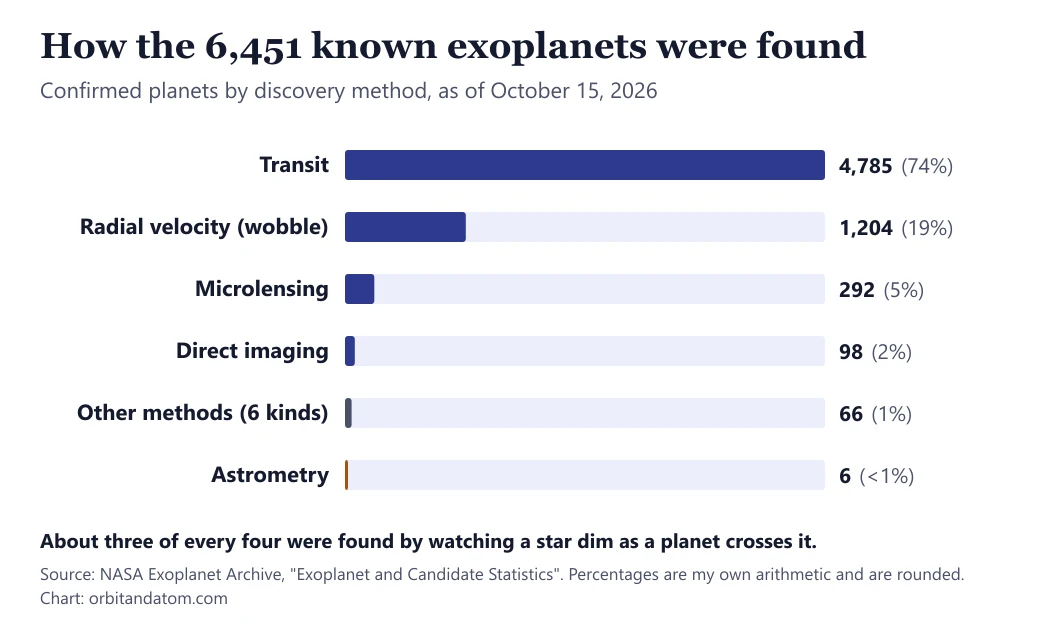
One method dominates, and a second one is far behind it. The other three together account for a few hundred planets, which is part of why I find them the most interesting.
How does the transit method work?
It catches the shadow. When a planet crosses in front of its star, as seen from Earth, it blocks a little of the starlight. NASA describes it as Kepler "detected planets by observing transits, or tiny dips in the brightness of a star that occur when a planet crosses in front of the star." Repeat dips at the same spacing mean something is orbiting.
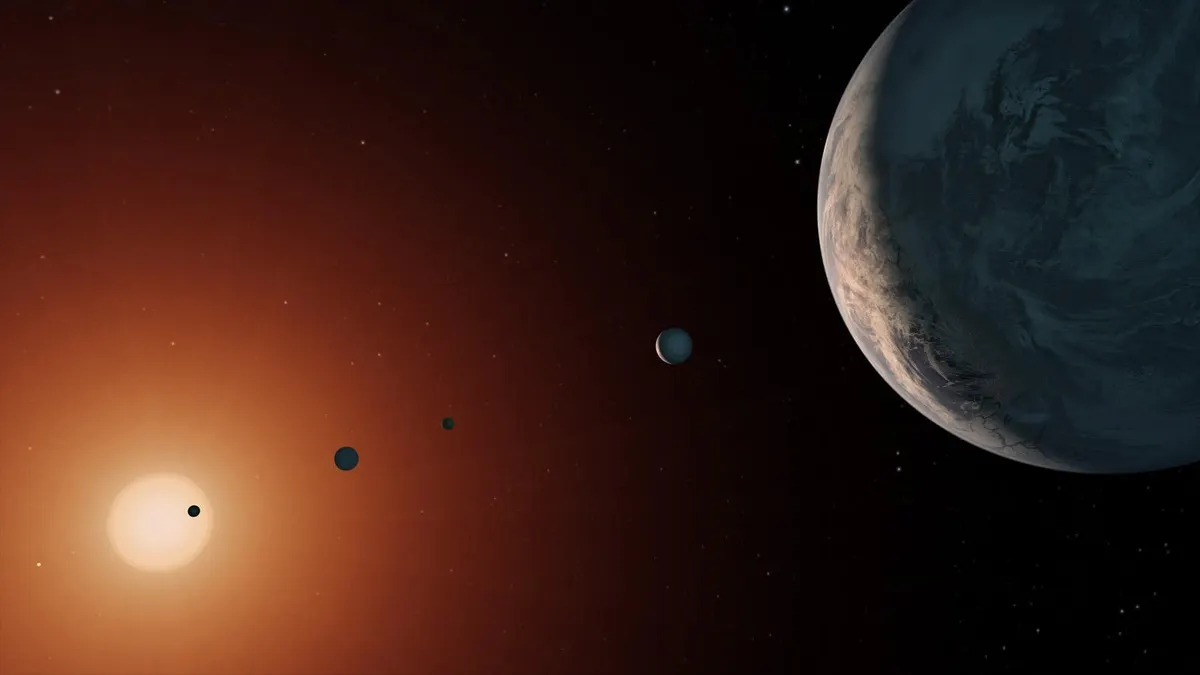
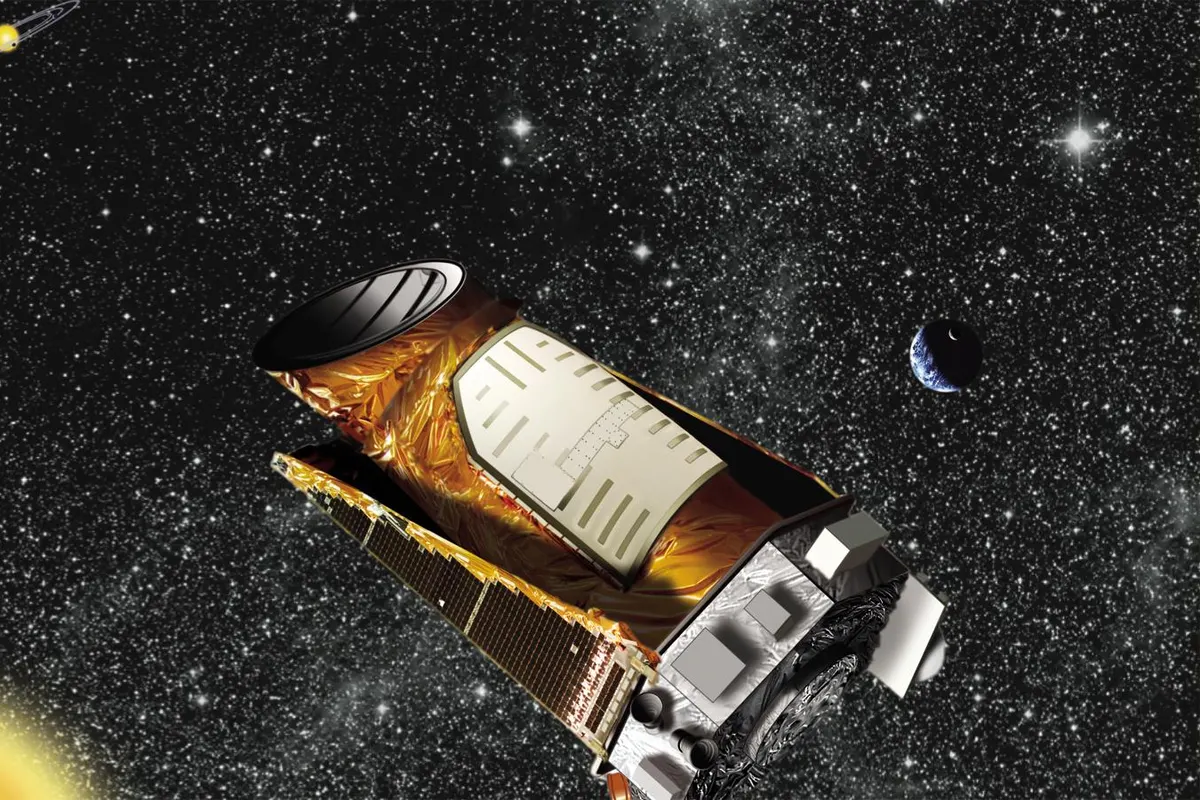
This is the workhorse. NASA's Kepler stared at one patch of sky with about 150,000 stars from 2009 until it was retired on October 30, 2018. According to the archive, Kepler found 2,787 confirmed planets and its extended K2 mission added 550. The TESS telescope, launched on April 18, 2018, has 1,012 confirmed planets and 8,151 candidates still waiting.
That gap is worth a pause. A dip in a star's light is a candidate, not yet a planet, and the archive keeps the two lists apart. By my math, that is roughly eight candidates for every confirmed planet, so I expect the count to keep climbing for years without any new telescope.
The limit is geometry. The method only works when the planet's orbit happens to line up edge-on from our point of view, so many planets are missed. I would think of every transit count as a lower bound.
What is the radial velocity (wobble) method?
It measures the tug. A planet pulls on its star as it orbits, so the star wobbles a little toward and away from us. NASA says this method measures changes in a star's "radial velocity," and ESA adds that it works by "spotting 'wobbles' in its star's motion."
It is also the method behind the first planet found around a Sun-like star. In October 1995, NASA says, a European team announced a planet around the star 51 Pegasi, and two astronomers at California's Lick Observatory confirmed it. The planet, 51 Pegasi b, is "a hot, star-hugging gas giant believed to be about half the size of Jupiter," and it tugged so hard in its four-day orbit that the wobble was "obvious to earthly telescopes."
Today the archive lists 1,204 planets found this way. Because the wobble gets bigger with a heavier planet, the method gives astronomers a planet's pull, and a transit gives its size. Put the two together and you can start to tell a rocky planet from a gas giant.
Can astronomers take a picture of an exoplanet?
Sometimes, but only a few. The archive counts 98 planets found by direct imaging. NASA says such images "have been mainly confined to giant planets still so hot from their fresh creation that they remain self-luminous." In other words, the planet is bright because it is young and hot, not because it reflects much light.
The hard part is the star's glare. NASA's answer is the coronagraph, which "is meant to dim the overwhelming glare of stars to reveal the planets in orbit around them." It is a set of masks, prisms and detectors inside the telescope. NASA says its Roman Space Telescope will test one in space as a technology demonstration.
What is gravitational microlensing?
It uses a star as a magnifying glass. NASA explains that the gravity of a foreground star magnifies the light of a background star that passes just behind it. If the foreground star has a planet, that planet shows up as a second, smaller spike in brightness.
The archive lists 292 planets found this way. ESA points out the catch: these detections "are unrepeatable as the stars will never align again." The upside is distance. Microlensing can reach planets near the center of the galaxy, and NASA's 2015 map puts the farthest microlensing planet it shows near the center of the galaxy, about 25,000 light-years away, far beyond the neighborhood where most other planets were found.
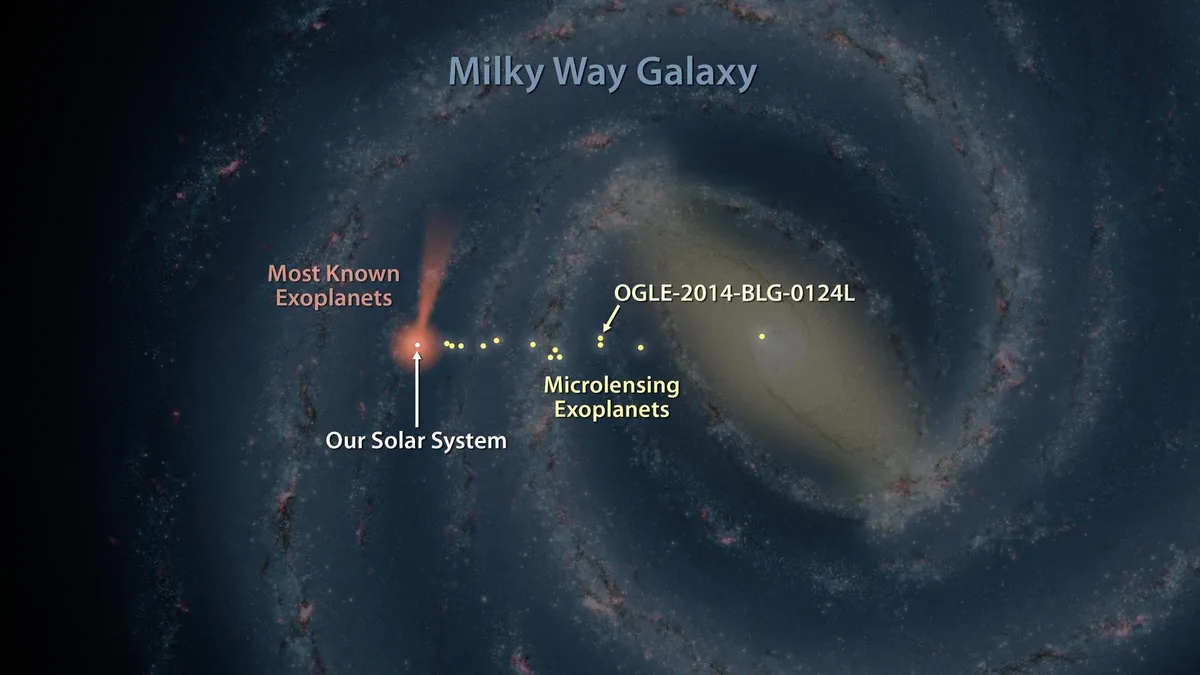
For how big those distances are, see my light-year guide.
Does astrometry find planets too?
Barely yet, but that is about to change. Astrometry tracks the tiny shift in a star's position as it wobbles around its common center with a planet. ESA says it needs very precise data, so "only a handful of planets have been discovered this way." The archive agrees: 6.
The reason to watch it is Gaia. ESA's Gaia mapped the position, brightness and motion of more than a billion stars, and ESA says it is "expected to find some tens of thousands of exoplanets." Gaia finished its observations on January 15, 2025, and ESA lists its next big data release for December 2026. One limit ESA gives: Gaia planets will typically be heavier than Earth, and it "will not be able to find any 'Earth twin.'"
How do the five methods compare?
| Method | What astronomers watch | Planets | Example |
|---|---|---|---|
| Transit | A star dims as a planet crosses it | 4,785 | Kepler, TESS |
| Radial velocity | A star wobbles toward and away from us | 1,204 | 51 Pegasi b |
| Microlensing | A foreground star magnifies a background star | 292 | Ground telescopes |
| Direct imaging | The planet's own light, after blocking the star | 98 | Young, hot giants |
| Astrometry | A star's position shifts on the sky | 6 | Gaia (data coming) |
The five main discovery methods. Counts are confirmed planets in the NASA Exoplanet Archive on October 15, 2026.
How do astronomers learn what a planet is like?
By going back to the same light. NASA calls one technique "transit spectroscopy": when starlight passes through a planet's atmosphere on its way to us, the atmosphere leaves a mark that shows what it is made of. That is how the James Webb Space Telescope reads exoplanet air, which I cover in my guide to Webb's biggest discoveries.
Size matters too. ESA's Cheops, launched on December 18, 2019, measures the size of planets already known around bright, nearby stars, in the super-Earth to Neptune range. With a planet's mass from a wobble and its size from a transit, ESA says you can work out its bulk density.
What comes next in the search?
The next big step is a planet like ours. ESA's Plato mission is planned for launch in April 2027 on an Ariane 6, with 26 cameras watching more than 200,000 stars. ESA says it will look for "Earth-sized planets in the habitable zones around Sun-like stars."
It will join Gaia's data and NASA's Roman Space Telescope, which NASA says will use microlensing from space and test a coronagraph. My read is that the next ten years will be about quality rather than quantity: fewer headlines about a new number, more about what a few nearby worlds are made of. For the planets closer to home, start with The Planets in Order From the Sun.
More explainers are in the Stars & Galaxies section.
Frequently asked questions
How are exoplanets found?
Mostly by the transit method, which watches for a tiny dip in a star's light when a planet crosses in front of it. The second most productive method is radial velocity, which detects a star wobbling under a planet's pull.
How many exoplanets have been confirmed?
The NASA Exoplanet Archive listed 6,451 confirmed planets on October 15, 2026. NASA says the official count passed 6,000 in September 2025, and the archive updates weekly.
Which method has found the most exoplanets?
The transit method, with 4,785 confirmed planets, about three in four of the total by my arithmetic. Radial velocity is second, with 1,204.
Can we see exoplanets directly?
A few, yes. The archive counts 98 planets found by direct imaging. NASA says these have mostly been giant planets still hot from their formation, because they glow on their own.
What was the first exoplanet found around a Sun-like star?
51 Pegasi b, announced in October 1995 and found with the radial velocity method. NASA describes it as a hot gas giant, believed to be about half the size of Jupiter, that orbits its star in about four days.
What did the Kepler and TESS telescopes do?
Both look for transits. Kepler operated from 2009 to October 2018 and found 2,787 confirmed planets. TESS launched in April 2018 and has 1,012 confirmed planets, with 8,151 more candidates waiting for confirmation.
Will we find another Earth?
Astronomers are working on it. ESA's Plato, planned for April 2027, will search for Earth-sized planets in the habitable zones of Sun-like stars. Finding one is not guaranteed.
Sources
- NASA Exoplanet Archive, home page: 6,451 confirmed planets, 1,012 from TESS and 8,151 TESS candidates (accessed October 31, 2026)
- NASA Exoplanet Archive, "Exoplanet and Candidate Statistics": planets by discovery method and by mission (accessed October 31, 2026)
- NASA Science, "How We Find and Classify Exoplanets" (page last updated September 14, 2026; accessed October 31, 2026). Used for the methods, 51 Pegasi b and the coronagraph.
- NASA Science, "30 Years of Exoplanets" (last updated July 23, 2026; accessed October 31, 2026)
- NASA Science, Exoplanets (accessed October 31, 2026)
- NASA Science, "Kepler/K2" (last updated January 5, 2026; accessed October 31, 2026)
- NASA Science, "TESS" (last updated August 13, 2026; accessed October 31, 2026)
- ESA, "How to find an exoplanet" (accessed October 31, 2026)
- ESA, "Sailing among the stars: Gaia's role in discovering distant worlds" (April 22, 2024; accessed October 31, 2026)
- ESA, Gaia mission page: end of observations and data release schedule (accessed October 31, 2026)
- ESA, Cheops mission page (accessed October 31, 2026)
- ESA, Plato mission page (accessed October 31, 2026)
- NASA/Ames/JPL-Caltech, "Kepler in Space Artist Concept" (PIA11824)
- NASA/JPL-Caltech, "TRAPPIST-1 System - Artist Concept" (PIA21751)
- NASA/JPL-Caltech, "Map of Exoplanets Found in Our Galaxy Artist Concept" (PIA19333, April 14, 2015)

Founder and editor, Orbit and Atom
I write Orbit and Atom to explain space and science in plain English, starting from what NASA, ESA and the mission teams publish. Every article lists its sources at the end so you can read them yourself.