Night Sky
Total Solar Eclipse on Aug. 2, 2027: Where Totality Lasts Over 6 Minutes
Quick answer
The total solar eclipse on Aug. 2, 2027 can be seen from southern Spain, Gibraltar, Morocco, Algeria, Tunisia, Libya, Egypt, Saudi Arabia, Yemen and Somalia. Totality lasts longest in Egypt, 6 minutes 23 seconds near Luxor, the second-longest total eclipse of the 21st century. Cádiz gets about 3 minutes, and the rest of Europe sees a partial eclipse.
On this page
- Where will the Aug. 2, 2027 total solar eclipse be visible?
- How long will totality last, and is it the longest of the century?
- Where is the best place to watch the eclipse?
- What will the rest of Europe see?
- What happens during a total solar eclipse?
- How can you watch the eclipse safely?
- How should you choose where to go?
- So where should you watch it?
- FAQ
- Sources
At about 10:00 universal time on Monday, Aug. 2, 2027, the Moon's shadow will sit over central Egypt. Anyone inside a strip 160 miles (258 km) wide will see the Sun blotted out for 6 minutes and 23 seconds, according to NASA. That is almost two minutes longer than the best seat at the April 2024 eclipse over North America, which got 4 minutes 28 seconds.
The same shadow starts in the Atlantic, crosses the Strait of Gibraltar and runs along the whole of North Africa before leaving over the Indian Ocean. Here is where it falls, how long it lasts in each place, what the rest of Europe will see and how to watch without hurting your eyes. The eclipse is just under nine months away.
Where will the Aug. 2, 2027 total solar eclipse be visible?
NASA lists totality over southern Spain and North Africa, including Morocco, Algeria, Tunisia, Libya and Egypt, then Saudi Arabia and Yemen. Its eclipse catalog also names Somalia, where the path reaches the coast before heading out over the Indian Ocean. Gibraltar sits inside the band too, in my calculation. A partial eclipse covers most of Europe, much of Africa, the Middle East, Southeast Asia, eastern Canada and northern Maine, according to NASA.
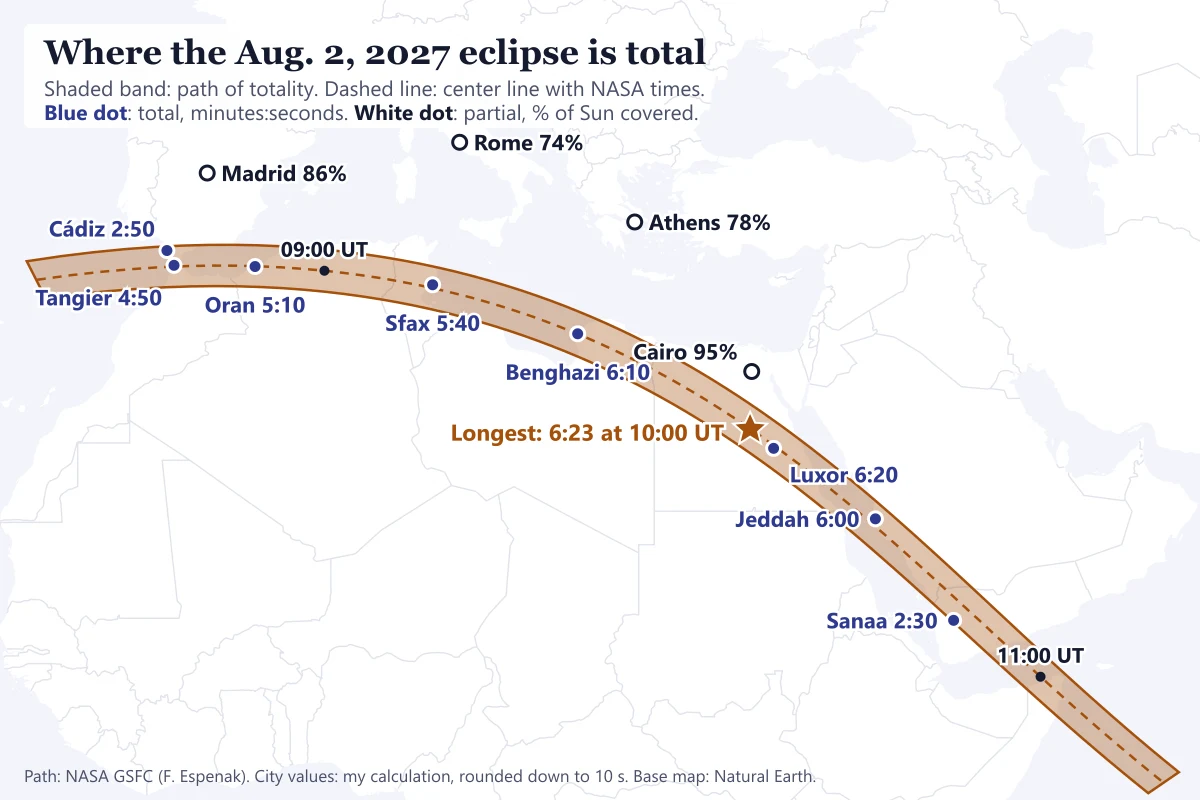
The shadow also keeps a tight schedule. NASA's map has the Moon's darkest shadow touching Earth at about 08:23 UT and leaving at about 11:50 UT, a trip of roughly three and a half hours. Greatest eclipse is at about 10:07 UT, at 25.5°N 33.2°E, in southern Egypt, not far from Luxor.
How long will totality last, and is it the longest of the century?
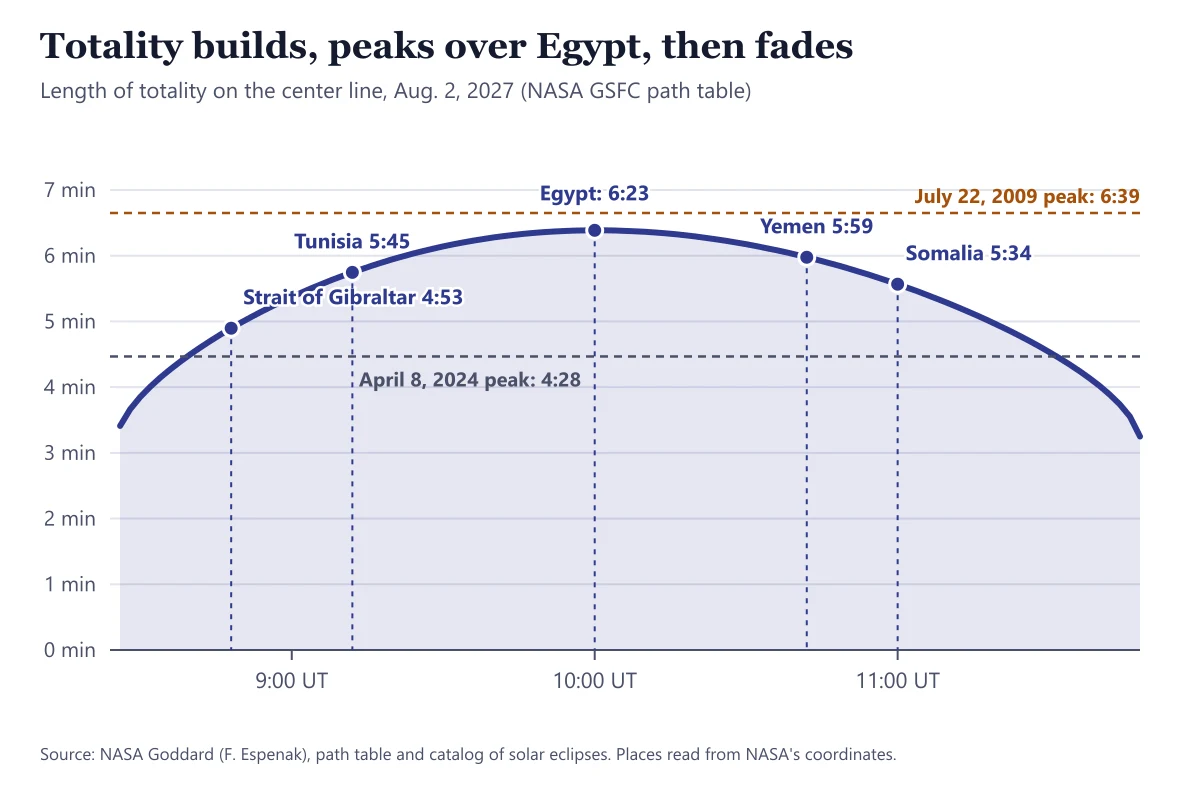
The longest totality is 6 minutes 23.2 seconds, on the center line at 26°49'N 31°08'E in central Egypt at 10:00 UT. NASA says you can be hundreds of miles from that exact point and still get a total within a fraction of a second of the maximum, as long as you stay within several miles of the center line. NASA's table shows how the length builds, peaks over Egypt and fades again.
It is not the longest of the century, whatever the headlines say. I went through NASA's tables for 2001 to 2100, which list 68 total eclipses. Only four last 6 minutes or more:
| Date | Totality | Where |
|---|---|---|
| July 22, 2009 | 6:39 | India, Nepal, China, central Pacific |
| Aug. 2, 2027 | 6:23 | Spain, North Africa, Saudi Arabia, Yemen, Somalia |
| Aug. 12, 2045 | 6:06 | Southern U.S., Caribbean, Venezuela, Brazil |
| May 22, 2096 | 6:06 | Indonesia, central Pacific |
Total solar eclipses of 6 minutes or more, 2001 to 2100. Source: NASA Goddard, solar eclipse decade tables. Duration is on the center line at greatest eclipse.
So 2027 is the second-longest, and the longest one still to come this century. For comparison, NASA puts the April 8, 2024 eclipse at 4 minutes 28 seconds. Three of them, 2009, 2027 and 2045, belong to the same family, Saros 136, which repeats every 18 years and 11 days. Each return is a bit shorter: 6:39 in 2009, 6:23 now, then 6:06 in 2045, 5:49 in 2063, 5:33 in 2081 and 5:18 in 2099.
NASA's tables show a pattern behind the length. The four 6-minute eclipses all have a magnitude of 1.074 to 1.080, which means the Moon's disk is 7 to 8 percent wider than the Sun's at greatest eclipse. April 2024 had 1.057. The bigger the Moon looks compared with the Sun, the longer it covers it, which is why the Moon's changing distance matters, as I explain in how far away the Moon is.
Where is the best place to watch the eclipse?
It depends on what you want: the longest totality, the highest Sun or the easiest trip. Here are the main cities and towns inside the band, west to east.
| Place | Totality | Peak (UT) | Sun height |
|---|---|---|---|
| Málaga, Spain | 1:50 | 08:48 | 39° |
| Cádiz, Spain | 2:50 | 08:46 | 37° |
| Gibraltar | 4:20 | 08:47 | 38° |
| Tarifa, Spain | 4:40 | 08:47 | 38° |
| Tangier, Morocco | 4:50 | 08:46 | 38° |
| Oran, Algeria | 5:10 | 08:53 | 43° |
| Sfax, Tunisia | 5:40 | 09:11 | 56° |
| Benghazi, Libya | 6:10 | 09:30 | 68° |
| Asyut, Egypt | 6:10 | 09:59 | 81° |
| Luxor, Egypt | 6:20 | 10:05 | 82° |
| Jeddah, Saudi Arabia | 6:00 | 10:25 | 76° |
| Sanaa, Yemen | 2:30 | 10:45 | 67° |
Totality in cities inside the path. Source: my calculation (Astronomy Engine, sea level), rounded down to the nearest 10 seconds; the path comes from NASA. Times are UT. Sun height is at the peak.
Two things stand out. First, the long totality is in the east: the length grows from under 3 minutes in Cádiz to more than 6 in Egypt. Second, the Sun's height changes a lot. In Spain the eclipsed Sun sits about 38 degrees above the horizon, while in Luxor it is nearly overhead at 82 degrees. In my opinion, for a first total eclipse, the Egyptian sky is the stronger show, and the Spanish coast is the easier trip.
What does the eclipse look like in Spain and Morocco?
Spain gets the thin end of the band. ESA's map shows totality hugging the south coast, 3 minutes at Cádiz and up to 5 minutes in Algeria. The path barely clips the Spanish mainland, so where you stand in Spain matters. Málaga, near the northern limit, has under 2 minutes in my calculation, while Tarifa has almost 5. Tangier, across the Strait in Morocco, is close to the center line.
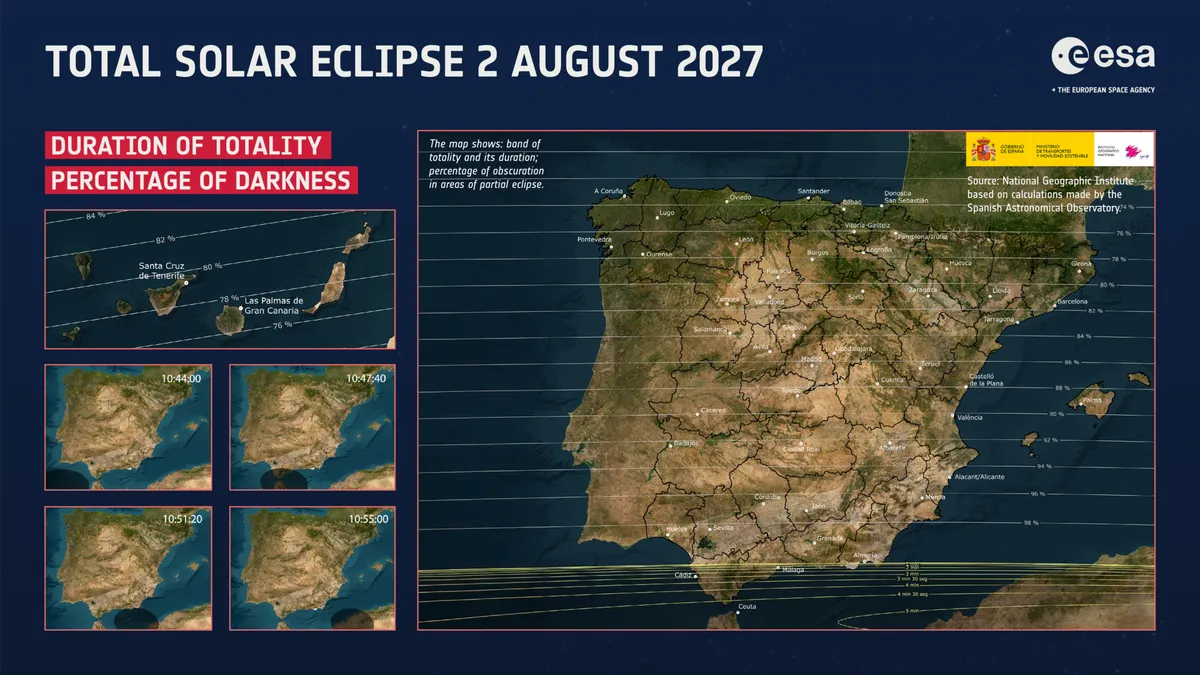
The shadow crosses Iberia between 10:44 and 10:55 a.m. CEST, according to ESA. At Cádiz the peak is about 10:47 a.m. local time.
Does a near miss count?
No. Seville is 98 percent covered, Granada 99 and Algiers 99.8 in my calculation, and Aswan in Egypt is also 99.8. None of them gets totality. NASA's eye-safety page makes the point from the other side: even when 99 percent of the Sun is hidden, the remaining crescent is still intense enough to burn the retina, even though the light level is comparable to twilight.
What about Egypt, Saudi Arabia and Yemen?
Egypt has the longest show. Luxor, Asyut and the stretch between them get about 6 minutes, with the Sun almost overhead. Cairo and Alexandria sit outside the band, at 95 and 93 percent. East of Egypt the path crosses the Red Sea, and in my calculation Jeddah has about 6 minutes while Sanaa in Yemen is near the southern edge with 2 and a half. Check your government's current travel advice before choosing a country. I have not covered that here.
What will the rest of Europe see?
A partial eclipse, with the Moon taking a bite out of the Sun. The share depends on how close you are to the path. ESA's map puts the Pyrenees at 76 percent of darkness and the Canary Islands at 76 to 82 percent. My numbers for larger cities:
| City | Sun covered | Peak (UT) |
|---|---|---|
| Lisbon | 92% | 08:44 |
| Madrid | 86% | 08:51 |
| Barcelona | 82% | 08:58 |
| Athens | 78% | 09:32 |
| Rome | 74% | 09:12 |
| Istanbul | 59% | 09:39 |
| Paris | 51% | 09:01 |
| London | 42% | 09:00 |
| Berlin | 34% | 09:13 |
| Moscow | 9% | 09:39 |
Partial eclipse in European cities. Source: my calculation (Astronomy Engine, sea level). "Sun covered" is the share of the Sun's area hidden at the peak.
In North America it is a sunrise eclipse. NASA lists a partial eclipse in eastern Canada and northern Maine. In my calculation the Sun is only 4 degrees above the horizon at St. John's, Newfoundland, with about 29 percent covered, and just below the horizon at the peak in northern Maine. Not a reason to fly anywhere.
What happens during a total solar eclipse?
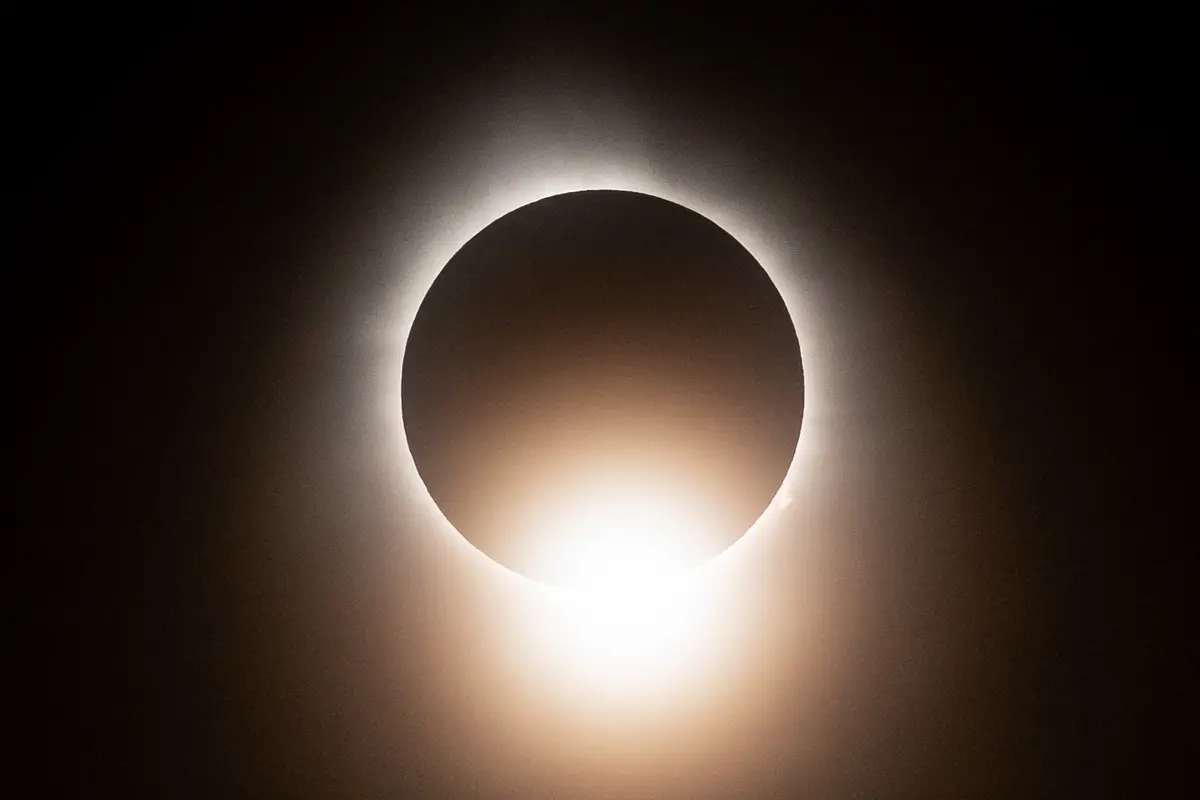
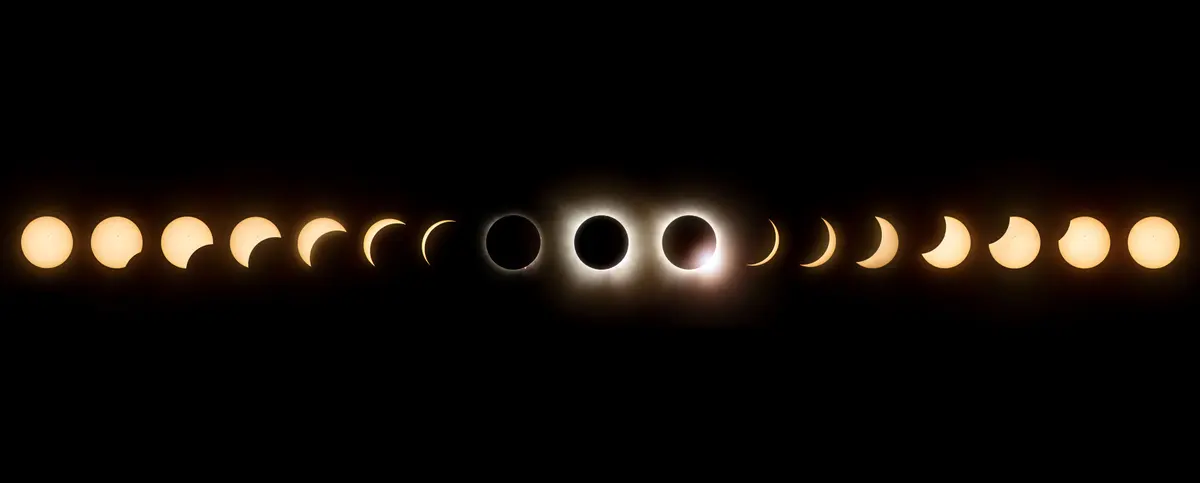
The Moon takes a little over an hour to cover the Sun, based on my calculation, for example from 07:40 to about 08:45 UT in Cádiz. Then, for a few minutes, the Moon blocks the Sun completely. ESA describes the result as daytime darkness, with the Sun's faintly glowing outer atmosphere, the corona, visible around the black disk. Then the Sun comes back, and the Moon needs about as long again to move off.
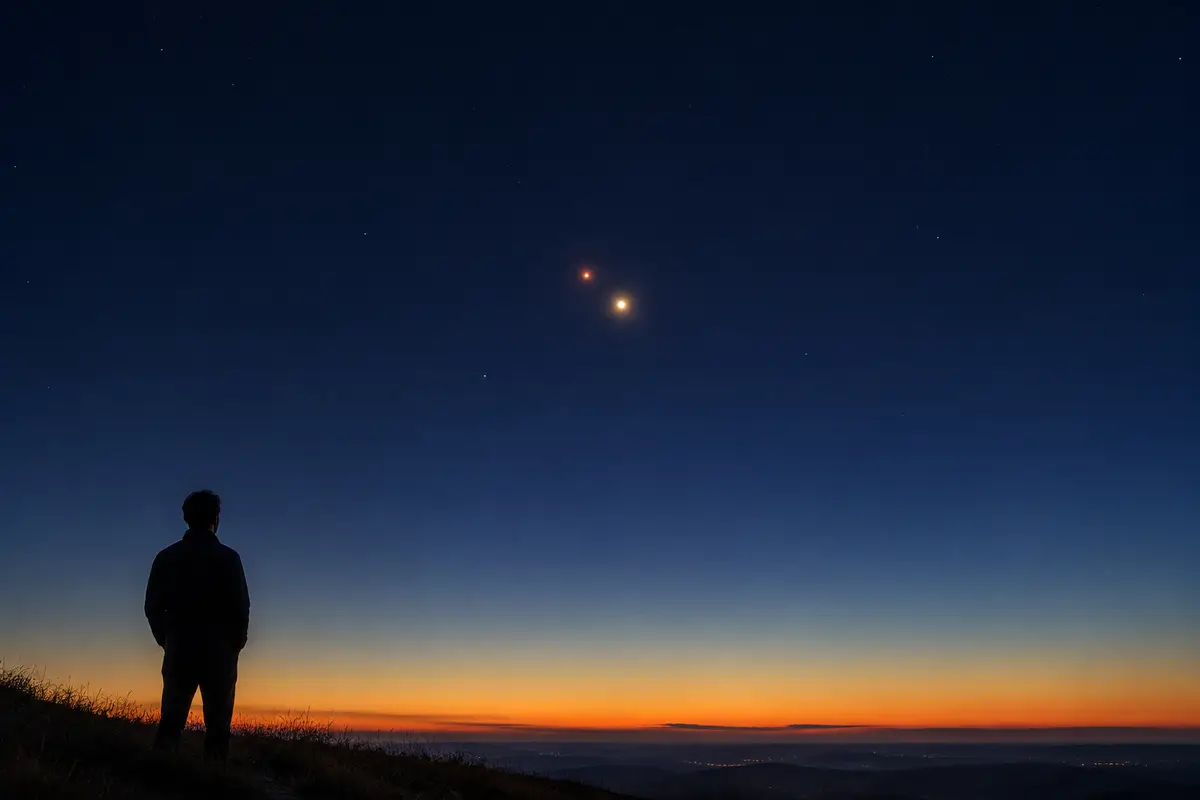
The corona is also the region that sends out the solar wind behind the aurora, which I cover in what causes the northern lights. Why it is hotter than the Sun's surface is still an open question, which I explain in how hot the Sun is. And there is a bonus for a clear sky: in my calculation Venus will be only about 3 degrees from the Sun that morning, Mercury 10 degrees and Jupiter 22, all bright enough to be worth looking for, with Venus the best bet. I have not found a NASA or ESA page that says this, so treat it as my estimate. If you want to know which planet is which, my planet-order guide helps.
How can you watch the eclipse safely?
NASA's rule is simple. Looking at the Sun is only safe with the naked eye when the Moon completely covers its bright face. You will know it is safe when you can no longer see any part of the Sun through eclipse glasses or a solar viewer. As soon as even a little of the bright Sun returns, put the glasses back on. Before and after totality, and anywhere outside the path, you need protection the whole time.

- Use real solar glasses. NASA says safe viewers are thousands of times darker than sunglasses and should meet the ISO 12312-2 standard. Regular sunglasses, no matter how dark, are not safe.
- Check them first. If a pair is torn, scratched or damaged, throw it away, and supervise children.
- Keep cameras and binoculars separate. Never look at the Sun through a camera lens, binoculars or telescope while wearing eclipse glasses. Those need a solar filter on the front of the optics.
- No glasses? Use a pinhole projector, such as a hole punched in an index card, with your back to the Sun. Never look at the Sun through the pinhole.
How should you choose where to go?
NASA's advice is to watch the weather forecasts a day or two before the eclipse and pick the spot with the best chance of a cloud-free sky. As its page puts it, it is better to see a shorter eclipse from clear sky than a longer eclipse under clouds. NASA also notes that its predictions leave out mountains and valleys along the Moon's edge, which can shift the length by about 1 to 3 seconds. That is too small to matter for planning.
My read: with weather as the real deciding factor, being able to move along the path is worth more than an extra minute of totality. Egypt and Spain are the two obvious bases, one with the longest totality and one a short trip from the rest of Europe. If you plan to go, I would book early.
Spain gets a lot of eclipses in a short time. ESA notes a total eclipse on Aug. 12, 2026 across the north of the country, this one in the far south and an annular eclipse on Jan. 26, 2028. My meteor shower calendar has the Perseids peaking on Aug. 12-13, ten days after the eclipse, and for the nights before it my Sky This Month guides start with November 2026.
So where should you watch it?
For the longest totality, Egypt, between Asyut and Luxor, at about 6 minutes 20 seconds under an almost overhead Sun. For the shortest trip from Europe, Tarifa or Tangier at nearly 5 minutes. Cádiz and Málaga give less than 3 minutes. Anywhere else in Europe, the eclipse is partial and needs eye protection the whole time.
Frequently asked questions
Where will the Aug. 2, 2027 total solar eclipse be visible?
NASA lists totality over southern Spain, Morocco, Algeria, Tunisia, Libya, Egypt, Saudi Arabia and Yemen, and its catalog also names Somalia. A partial eclipse covers most of Europe, much of Africa, the Middle East, Southeast Asia, eastern Canada and northern Maine.
How long will totality last on Aug. 2, 2027?
The maximum is 6 minutes 23.2 seconds, on the center line in central Egypt, according to NASA. In Spain ESA gives about 3 minutes at Cádiz and up to 5 minutes in Algeria. In Spain and Egypt the whole eclipse, from the first bite to the last, lasts more than two hours in my calculation.
Is the 2027 eclipse the longest of the century?
No. NASA's tables put the July 22, 2009 eclipse at 6 minutes 39 seconds. The 2027 eclipse is second, and it is the longest still to come: the next ones over 6 minutes are Aug. 12, 2045 and May 22, 2096, both at 6 minutes 6 seconds.
What time is the eclipse in Spain?
ESA shows the Moon's shadow crossing the Iberian Peninsula between 10:44 and 10:55 a.m. CEST. At Cádiz, my calculation puts totality at about 10:47 a.m. local time, which is 08:47 UT.
Can you see the 2027 eclipse from the United States?
Barely. NASA lists a partial eclipse in northern Maine and eastern Canada. In my calculation it happens around sunrise, with the Sun only 4 degrees above the horizon in St. John's, Newfoundland, and just below it in northern Maine.
Is it safe to look at the eclipse without glasses?
Only during totality, when the Moon completely covers the Sun's bright face and you can no longer see any part of it. Before and after, and anywhere a partial eclipse is all you get, you need solar glasses that meet ISO 12312-2, or a pinhole projector. Regular sunglasses are not safe.
Does 99 percent of the Sun covered count as a total eclipse?
No. NASA's eye-safety page says that even with 99 percent of the Sun hidden, the remaining crescent can cause a retinal burn, and the light level is only comparable to twilight. Only the path of totality gets the full effect.
Sources
- NASA Goddard, Fred Espenak, "Total Solar Eclipse of 2027 Aug 02" (accessed November 3, 2026)
- NASA Goddard, Fred Espenak, "Path of the Total Solar Eclipse of 2027 Aug 02" (accessed November 3, 2026)
- NASA Goddard, "Eclipses During 2027" (accessed November 3, 2026)
- NASA Goddard, "Solar Eclipses: 2001 - 2010," and the following decade tables through 2100 (accessed November 3, 2026)
- NASA Science, "Future Eclipses" (accessed November 3, 2026)
- NASA Science, "Eclipse Viewing Safety" (accessed November 3, 2026)
- NASA Goddard, B. Ralph Chou, "Eye Safety During Solar Eclipses" (accessed November 3, 2026)
- ESA, "Total solar eclipse 2 August 2027 - Map of totality in Spain" (accessed November 3, 2026)
- ESA, "European solar eclipses" (accessed November 3, 2026)

Founder and editor, Orbit and Atom
I write Orbit and Atom to explain space and science in plain English, starting from what NASA, ESA and the mission teams publish. Every article lists its sources at the end so you can read them yourself.