Solar System & Missions
Why Has No Spacecraft Ever Landed on Mercury?
Quick answer
No spacecraft has landed on Mercury because the hard part is slowing down. The Sun's pull speeds a probe up on the way in, and ESA says shedding that speed takes years of planetary flybys just to reach orbit. Mercury has almost no air to help, and its surface swings from 430 °C to -180 °C. NASA's MESSENGER orbited, then crashed on purpose in 2015.
On this page
Spacecraft have landed on Mars and on the Moon. Mercury, the innermost planet, has never had one, and the reason is not what most people expect.
Heat is part of it, but the bigger problem is speed, and it starts long before any landing attempt. Here is what ESA and NASA say about it, how the one spacecraft that orbited Mercury ended, and what is arriving next.
Has any spacecraft ever reached Mercury?
Yes, three have, and none has touched down gently. ESA calls Mercury the least explored of the four rocky inner planets: it took until 2011 for the first spacecraft to enter orbit around it, while Jupiter, much farther away, got an orbiter in 1995.
| Mission | What it did | Outcome |
|---|---|---|
| Mariner 10 (NASA) | Three flybys, 1974-75 | Never orbited Mercury |
| MESSENGER (NASA) | First orbiter, from 2011 | Crashed on purpose, 2015 |
| BepiColombo (ESA/JAXA) | Two orbiters, launched 2018 | Orbit planned Nov. 21, 2026 |
Missions to Mercury. Sources: ESA ("Why does it take so long to get to Mercury?" and "Three reasons why we know so little about Mercury"), NASA Science (MESSENGER) and ESA's BepiColombo arrival page, read November 8, 2026.
Mariner 10 passed within 327 km of the surface on its closest approach, according to ESA, but it only flew by. MESSENGER and BepiColombo were built to stay.
Why is Mercury so hard to reach?
Because getting there means braking, not accelerating. Mercury sits deep in the Sun's gravity. A spacecraft heading in speeds up as it falls toward the Sun, and ESA says that to be captured by Mercury's gravity it has to arrive slowly enough, so it must first throw away a huge amount of orbital energy.
ESA describes the scale like this: it is a bit like falling down a cliff millions of kilometers high and landing softly on a moving target halfway down. Burning it all off with thrusters alone would take so much fuel that the spacecraft would be too heavy to launch, even on the most powerful rocket. ESA adds that, by some estimates, it takes less energy to reach Pluto than to reach Mercury.
The workaround is the gravity assist: passing close to a planet to trade energy with it without spending fuel. Those assists are why the trip is so slow. Mariner 10, which only flew past, took 147 days. NASA says MESSENGER needed nearly seven years from its August 3, 2004 launch, with flybys of Earth, Venus (twice) and Mercury (three times). ESA says BepiColombo needed seven years and nine gravity assists to get into position.
If you want the order of the planets and where Mercury sits, my list of the planets from the Sun has the distances. For why the star at the center is so important here, see how hot the Sun is.
Why is landing harder than orbiting?
In orbit, a spacecraft can keep circling for years. To land, it has to cancel its remaining speed completely, and Mercury gives it almost nothing to work with. NASA describes the planet's atmosphere as a thin exosphere made of atoms knocked off the surface. With so little air, a parachute has nothing to push against, which is my inference, not a line from NASA or ESA. The brakes would have to be rockets.
NASA's own study of a possible lander shows what that looks like. In the concept, a solid rocket motor fires for 75 seconds to remove most of the orbital energy, then a liquid-fueled engine steers the final landing with laser radar scanning for hazards.
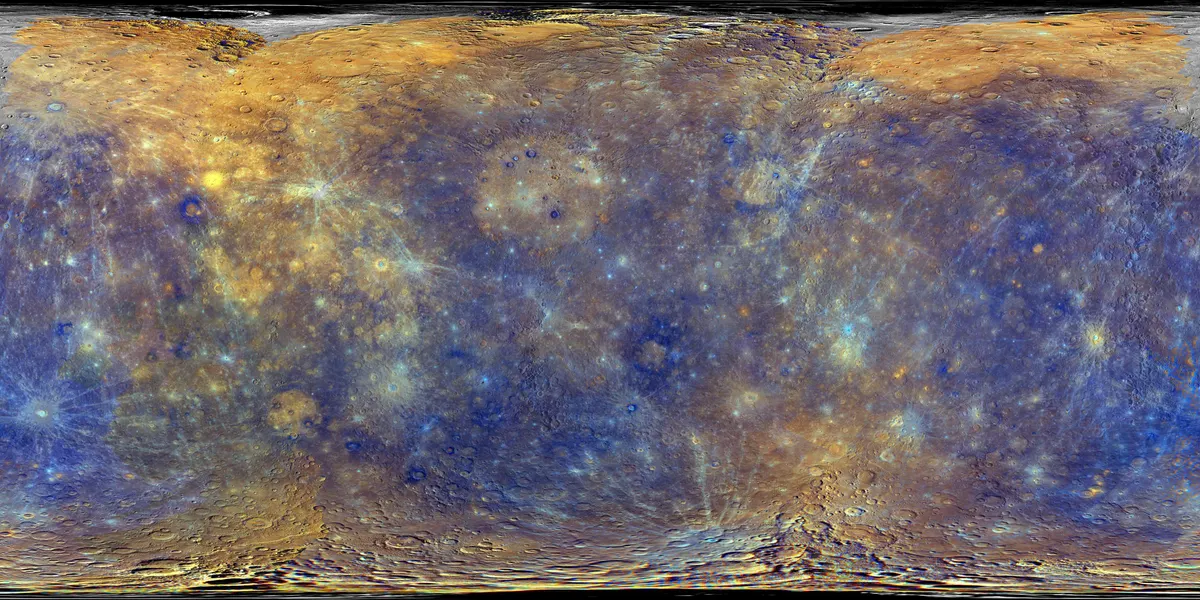
Then comes the heat. NASA says daytime surface temperatures can reach 430 °C (800 °F), and with no atmosphere to hold the warmth, nights drop to -180 °C (-290 °F). Sunlight can be up to seven times brighter than at Earth. A day and night on Mercury lasts 176 Earth days, according to NASA, so a lander would face long stretches of both extremes.
In the NASA concept, the lander touches down at dusk to get about 30 hours of sunlight, runs on a radioisotope power source through the night, and stops working shortly after sunrise, when conditions exceed what it can take.
Did MESSENGER land on Mercury?
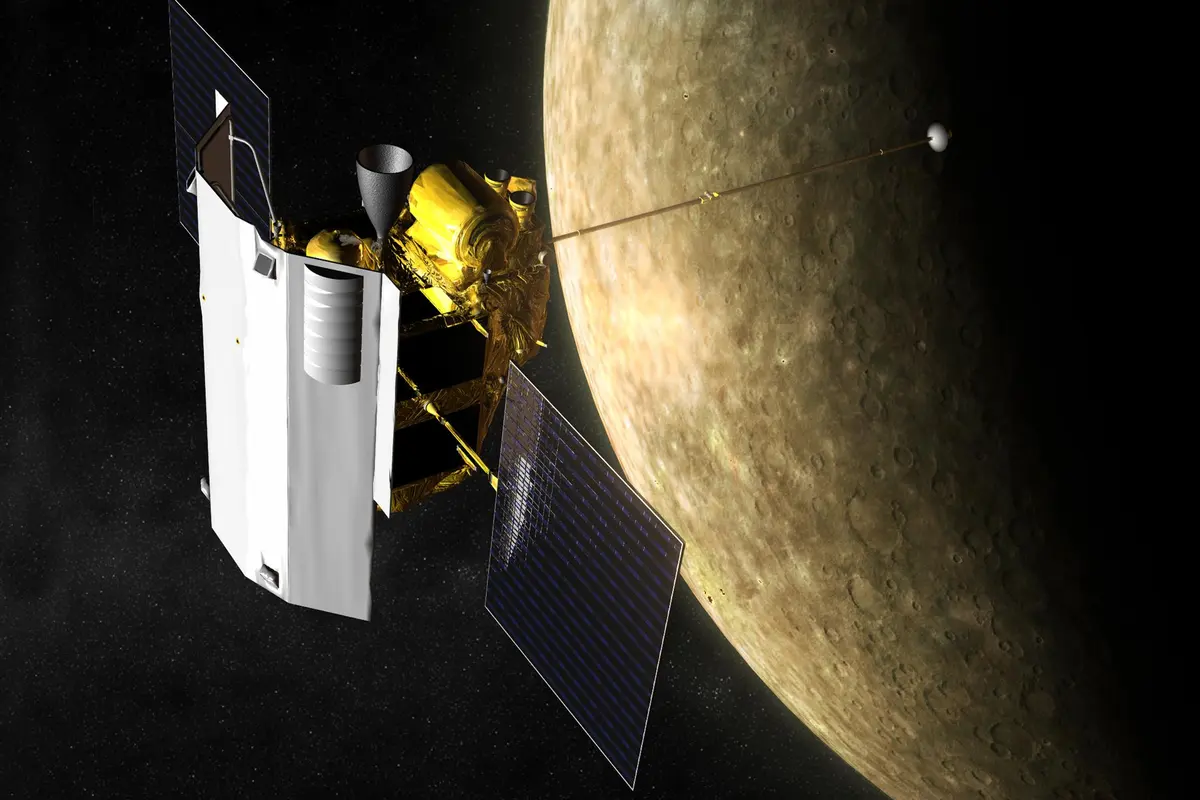
No. It crashed, and that was the plan. NASA says MESSENGER entered orbit on March 18, 2011 (UT), the first spacecraft ever to orbit Mercury, and stayed for more than four years. Its imaging instrument had mapped the entire planet in high-resolution black and white and in color by 2012.
Its fuel was what ran out. Controllers lowered the orbit to only about 25 kilometers above the surface in September 2014 and used the last maneuvers to stretch the science. On April 30, 2015, MESSENGER hit Mercury at about 14,080 kilometers per hour (8,750 miles per hour), near the Janácek crater in the Suisei Planitia region, creating a new crater.
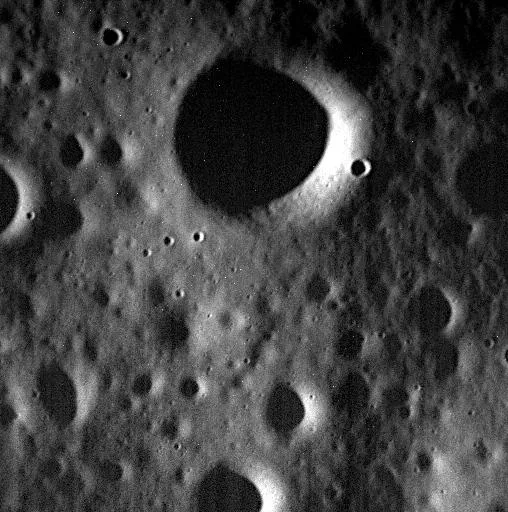
A crash at that speed is not a landing. A landing means the spacecraft arrives intact and keeps working, which nothing has done on Mercury.
Has anyone planned a Mercury lander?
Yes, twice, and neither is flying. Europe's BepiColombo was once going to carry a lander. In November 2003, ESA's Science Programme Committee cut it for money reasons, and the agency said that landing on a planet so near the Sun "was a bridge too far in present circumstances."
NASA later funded a concept study for a Mercury lander. In the study, a lander would launch on a Falcon Heavy in 2035, reach Mercury in 2045 and work on the surface for about one Mercury year (88 Earth days) with 11 instruments. The study's authors say the 2023-2032 planetary science decadal survey judged the idea to have "exceptional scientific merit" and considered it a candidate flagship mission.
None of the NASA or ESA pages I read shows an approved landing mission. In my opinion, the concept's 2045 arrival date says more than anything else about how hard the problem is.
What is BepiColombo doing at Mercury now?
It is about to become the second spacecraft to orbit the planet. ESA and JAXA's BepiColombo launched in 2018 with two orbiters, ESA's Mercury Planetary Orbiter and JAXA's Mio, and it will be the first mission to orbit Mercury with two spacecraft at once.
- September 3, 2026: the propulsion module that carried the stack so far separated, as ESA confirmed.
- November 21, 2026: the combined spacecraft is due to enter orbit around Mercury.
- December 9-10, 2026: the two orbiters separate from each other.
- April 2027: the science phase is set to begin.
These are ESA's planned dates, from a page it last updated on September 21, so a day could still shift. I will update this page once ESA confirms the orbit. BepiColombo is an orbiter, not a lander, so Mercury's surface stays out of reach for now.
Can you see Mercury from Earth?
Yes, with the naked eye, but it takes planning because it never strays far from the Sun. In November 2026 it is a morning object, and my planets guide for the month covers when to try. For another ESA probe that relies on gravity assists, this time on its way to Jupiter, see my Juice guide.
Frequently asked questions
Has any spacecraft landed on Mercury?
No. Mariner 10 only flew past, MESSENGER orbited and crashed on purpose in 2015, and BepiColombo is an orbiter due to arrive in November 2026.
Why is it so hard to land on Mercury?
A spacecraft heading toward Mercury speeds up in the Sun's gravity and has to shed that speed. Mercury has almost no atmosphere for a parachute, and its surface swings from 430 °C by day to -180 °C by night, according to NASA.
Is it harder to reach Mercury than Pluto?
ESA says that by some estimates it takes less energy to reach Pluto. A probe going to Mercury has to throw away energy, and one going outward does not.
What happened to NASA's MESSENGER?
It ran out of fuel and hit Mercury on April 30, 2015, at about 14,080 kilometers per hour. NASA planned the impact after more than four years in orbit.
When will BepiColombo arrive at Mercury?
ESA's schedule has it entering orbit on November 21, 2026. The two orbiters are due to separate on December 9-10, and the science phase is set to begin in April 2027.
Will there ever be a Mercury lander?
Not yet. ESA cut a lander from BepiColombo in 2003, and NASA has studied a concept that would launch in 2035 and arrive in 2045. None of the sources I read shows an approved mission.
Sources
- ESA, "Why does it take so long to get to Mercury?" (accessed November 8, 2026). Used for slowing down, gravity assists, Mariner 10 and the Pluto comparison.
- ESA, "Three reasons why we know so little about Mercury" (accessed November 8, 2026). Used for the 2011 first orbit, the nine flybys and the 327 km closest approach.
- ESA, "Latest updates: BepiColombo's arrival at Mercury" (last updated September 21, 2026; accessed November 8, 2026). Used for the arrival schedule.
- NASA Science, "MESSENGER" (accessed November 8, 2026). Used for the launch, orbit, mapping and impact.
- NASA Science, "Mercury Facts" (accessed November 8, 2026). Used for temperatures, the exosphere and the length of a day.
- ESA, "Critical decisions on Cosmic Vision" (press release 75-2003, November 7, 2003; accessed November 8, 2026). Used for the cancelled BepiColombo lander.
- C. M. Ernst et al., "A Mercury Lander Mission Concept Study" (NASA Planetary Mission Concept Studies; accessed November 8, 2026). Used for the lander concept.
- NASA/Johns Hopkins University Applied Physics Laboratory/Carnegie Institution of Washington, "One of the Last" (PIA19445)
- NASA/Johns Hopkins University Applied Physics Laboratory/Carnegie Institution of Washington, "MESSENGER at Mercury Artist Concept" (PIA18145)
- NASA/Johns Hopkins University Applied Physics Laboratory/Carnegie Institution of Washington, "Enhanced Color Mercury Map" (PIA17386)

Founder and editor, Orbit and Atom
I write Orbit and Atom to explain space and science in plain English, starting from what NASA, ESA and the mission teams publish. Every article lists its sources at the end so you can read them yourself.