Atoms & Physics
What Is Antimatter, and Where Does It Exist?
Quick answer
Antimatter is the mirror twin of ordinary matter: every particle has an antiparticle with the same mass and the opposite electric charge, and the two annihilate on contact, leaving only energy. Tiny amounts appear in thunderstorms, cosmic-ray collisions, PET scans and the center of the Milky Way, and CERN makes it in the lab. Almost none is left in the universe, and nobody knows why.
On this page
Antimatter sounds like science fiction, but physicists have made it on purpose for decades, and parts of it show up in places as ordinary as a hospital scan and a thunderstorm. It is also tied to one of the biggest open questions in physics.
Here is what antimatter is, where it exists in nature, how CERN makes and holds it, and why the universe seems to have so little of it. I use CERN, NASA and ESA pages for every number.
What is antimatter?
Antimatter is made of antiparticles. CERN says every type of matter particle has a corresponding antiparticle with matching properties, except for the opposite electrical charge. The electron's twin is the positron, which has the same mass but a positive charge. The proton's twin is the antiproton, which is negative.
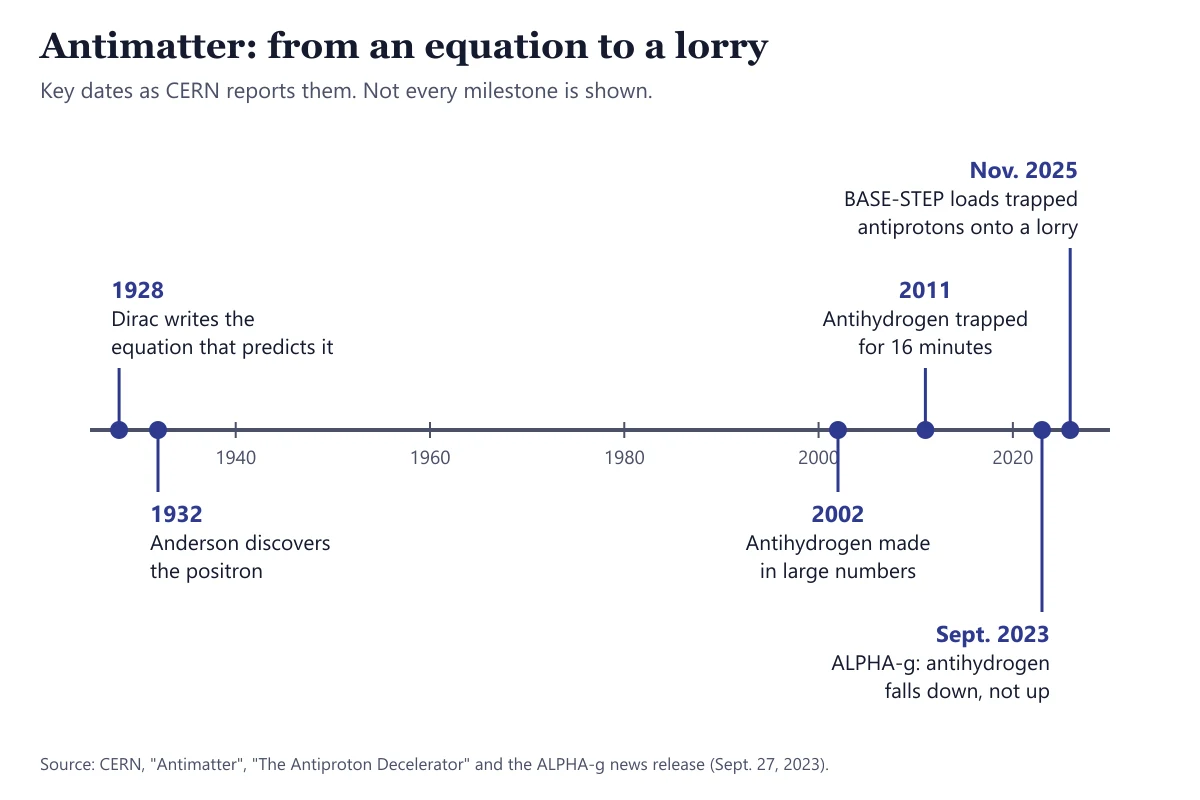
The idea began on paper. In 1928, British physicist Paul Dirac wrote down an equation that combined quantum theory with special relativity, which I explain in my guide to time dilation, and it pointed to a particle like the electron but with the opposite charge. Carl Anderson found that particle, the positron, in 1932.
| Ordinary matter | Antimatter twin | What changes |
|---|---|---|
| Electron | Positron | Charge flips from negative to positive |
| Proton | Antiproton | Charge flips from positive to negative |
| Hydrogen atom (electron around a proton) | Antihydrogen (positron around an antiproton) | Same structure, mirrored charges |
Matter and its antimatter twin. Source: CERN, "Antimatter" and the ALPHA-g news release (Sept. 27, 2023).
The part that makes antimatter special is what happens when the two meet. CERN says particles and antiparticles are always produced in pairs, and that they annihilate upon contact, leaving only energy behind, mostly as photons and pions. If you want the parts that make up an ordinary atom first, start with What Is Inside an Atom?
Where does antimatter exist in nature?
In very small amounts, and usually for a moment. CERN says antimatter does not occur naturally, except for single particles produced in nuclear or cosmic ray interactions. Four places show how that looks in practice.
| Where | What happens |
|---|---|
| Thunderstorms | NASA's Fermi saw positrons from beams that storms launch upward |
| Cosmic-ray and nuclear collisions | Single antiparticles are produced now and then (CERN) |
| PET scans | A radioactive tracer gives off positrons inside the body |
| Center of the Milky Way | ESA's Integral mapped a cloud of annihilating positrons |
Where antimatter appears. Sources: NASA, ESA, NIBIB (NIH) and CERN (see Sources).
Do thunderstorms make antimatter?
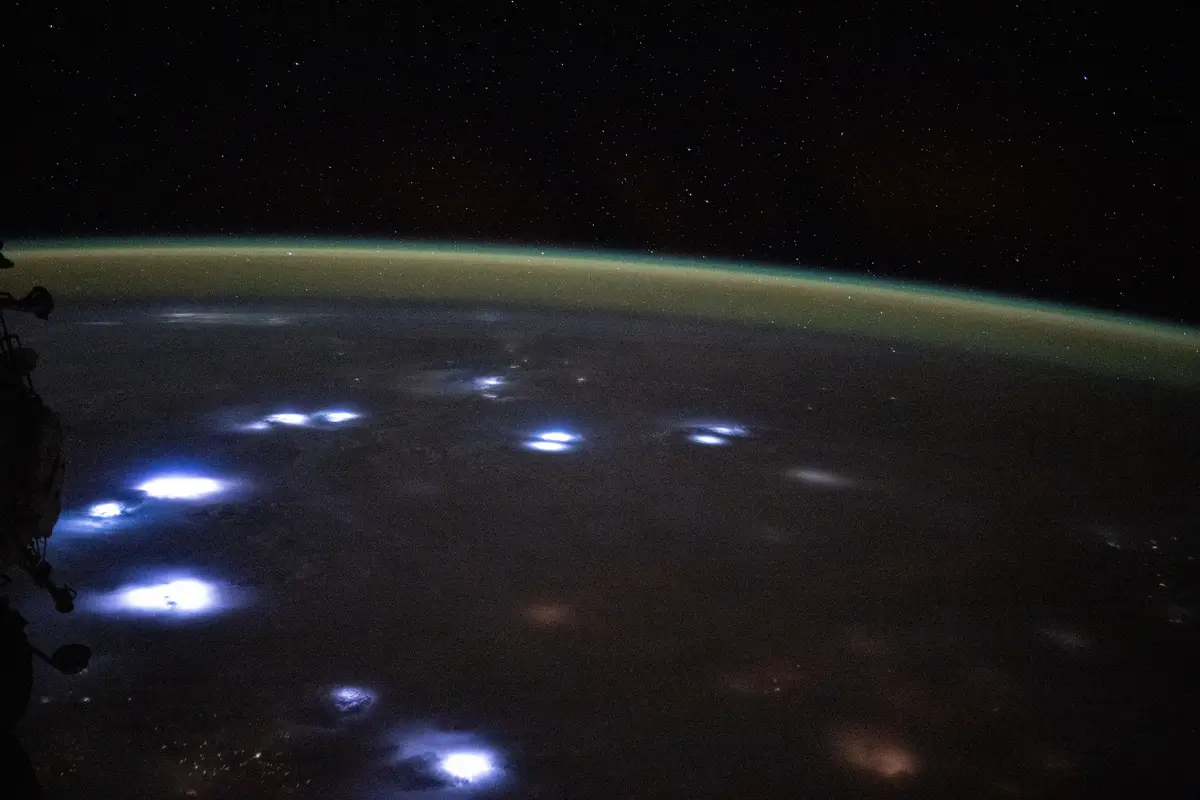
Yes, according to NASA. In January 2011 the agency reported that Fermi's Gamma-ray Burst Monitor had detected gamma rays with energies of 511,000 electron volts, a signal that an electron has met its antimatter counterpart, a positron. The source is a terrestrial gamma-ray flash, or TGF, a burst of gamma rays from a thunderstorm. NASA said the GBM had identified 130 of them from August 2008 to the end of 2010 and estimated that about 500 occur daily worldwide, though most go undetected.
The best example came on Dec. 14, 2009. Fermi was over Egypt, but the active storm was in Zambia, some 2,800 miles to the south, so the spacecraft could not have seen the flash directly. Particles from the storm reached it anyway. "These signals are the first direct evidence that thunderstorms make antimatter particle beams," said Michael Briggs of Fermi's Gamma-ray Burst Monitor team at the University of Alabama in Huntsville.
Is there antimatter in our galaxy?
There is a cloud of it in the middle of the Milky Way, and ESA's Integral gamma-ray observatory mapped it. Positron-electron annihilation leaves a signature, gamma rays carrying 511 thousand electron volts of energy, and ESA's first large-scale sky map of that glow showed large amounts of antimatter in the central parts of our Galaxy. In 2008 ESA reported that the cloud is lopsided. The researchers' simple estimate was that about half, and possibly all, of the antimatter comes from X-ray binaries, which are pairs of stars where one is a compact object pulling in gas.
Notice that the signature is the same 511,000 electron volts NASA saw over Africa. Antimatter in the wild is announced by one number.
Is antimatter used in medicine?
Yes. A PET scan, short for positron emission tomography, uses it every day. The U.S. National Institute of Biomedical Imaging and Bioengineering (NIBIB) explains that doctors inject a radioactive tracer, often fluorodeoxyglucose labeled with fluorine-18, that gives off positrons. When a positron meets an electron in the body, the pair annihilate and produce two gamma-ray photons that shoot off in opposite directions, and the scanner uses them to map where the tracer went. The amount of antimatter in each case is tiny, and it exists for a very short time.
How does CERN make antimatter?
With a proton beam and a block of metal. CERN's Antiproton Decelerator takes a proton beam from the Proton Synchrotron and fires it into the block. The collisions create many secondary particles, including lots of antiprotons. Magnets keep the antiprotons on track and strong electric fields slow them down, through several cycles of cooling and deceleration, to around a tenth of the speed of light. A newer ring called ELENA cuts their energy by a factor of 50, from 5.3 to 0.1 million electron volts.
To build antihydrogen, CERN says its ALPHA experiment brings antiprotons and positrons together in a trap. The Antiproton Decelerator produced large numbers of antihydrogen atoms for the first time in 2002. When it runs, CERN says, it delivers about 400 million antiprotons per hour to experiments, which can capture about 10% of them.
How can antimatter be stored?
Away from all matter, because any contact between a particle and its antiparticle destroys both. CERN says that means extremely high vacuum. The best vacuum ever reported in an experiment on Earth, 5 x 10-19 millibar, was reached in the BASE experiment, where antiprotons were stored for more than a year. BASE's own page cites a record of 600 days.
Charged particles like antiprotons can be held in electromagnetic traps that confine them inside a magnetic field. Antihydrogen has no charge, but its atoms are slightly magnetic, so they can be held in a very strong, specially shaped magnetic field, first shown by ALPHA. In 2011 the experiment reported trapping antihydrogen for over 16 minutes, and CERN now says it can be stored for many hours.
How much antimatter has CERN made?
Very little. CERN says the largest traps, GBAR and PUMA, can hold up to about a billion antiparticles of the same charge, equal to about 10-18 kilograms. Even running the Antimatter Factory non-stop for a year, it says, the total antiprotons delivered would be about 300 billion, which is still only 3 x 10-16 kilograms.
| Measure | CERN's figure |
|---|---|
| Antiprotons delivered in one year of non-stop running | About 300 billion, or 3 x 10-16 kg |
| Energy of all of them if annihilated | About 500 joules |
| Equivalent | A 100 W light bulb for five seconds |
How much there is. Source: CERN, "Antimatter" (FAQ).
That answers the fuel question. Antimatter releases all of its mass as energy, but CERN's numbers show there is almost nothing to burn. In my view, its value is as a research tool, not as an energy source, and CERN's own figure for a year of production is a bulb that glows for five seconds.
It is also not dangerous at this scale. In November 2025, CERN's BASE-STEP experiment trapped antiprotons in a transportable trap and loaded them onto a lorry, so that other laboratories could study them. The trap holds between 100 and 1,000 antiparticles, and CERN says that if it failed, the energy released would be about a millionth of a joule.
Does antimatter fall up or down?
Down, as far as the best test can tell. On Sept. 27, 2023, CERN reported that its ALPHA-g apparatus had measured where antihydrogen atoms annihilate after the trap's magnetic field was switched off. The team trapped groups of about 100 atoms, one group at a time, and averaged seven release trials. Within the precision of the experiment, which CERN gives as about 20% of g, antihydrogen falls to Earth the same way as ordinary hydrogen.
CERN called it the first direct experiment to observe a gravitational effect on the motion of antimatter, and added that the next step is to measure the acceleration as precisely as possible. I would read this as "no surprise yet", not as "case closed".
Why is there so little antimatter in the universe?
Nobody knows, and CERN calls it one of the greatest challenges in physics today. CERN's account is that in the very first moments of the Big Bang, the hot, dense universe was filled with pairs of particles and antiparticles. If matter and antimatter are always created and destroyed together, today's universe should hold equal amounts of both.
It does not. The Universe appears to contain almost no antimatter. CERN's current best explanation is that some unknown mechanism created a tiny excess of matter after the Big Bang, about one extra particle for every billion antiparticles. Everything you can see, stars and planets included, is that leftover. It is a different puzzle from dark matter, though both point to something about the universe that physics has not yet explained. For a look at how far telescopes see back toward that early universe, try Webb's biggest discoveries.
Particles from space meet our atmosphere in a gentler way too: the northern lights are charged particles meeting the air.
So what is antimatter, in one line?
Matter's mirror image: the same mass, the opposite charge, and a disappearing act when the two touch. It is real, it is rare, and it is already in use in PET scans. The open mystery is not how to make it but why the universe kept almost none. My read: the most interesting number in this article is not 500 joules but one extra particle per billion.
Frequently asked questions
What is antimatter in simple terms?
Antimatter is made of antiparticles, which have the same mass as ordinary particles and the opposite electric charge. CERN says particles and antiparticles are produced in pairs and annihilate on contact, leaving only energy, mostly photons and pions.
Where does antimatter exist naturally?
In tiny amounts. CERN says antimatter does not occur naturally except for single particles produced in nuclear or cosmic ray interactions. NASA's Fermi also detected positrons from thunderstorms, and ESA's Integral mapped a cloud of annihilating positrons in the center of the Milky Way.
Is antimatter dangerous?
Not at the amounts made today. CERN says a year of non-stop antiproton production would release about 500 joules if annihilated, enough to light a 100 W bulb for five seconds. For the transportable BASE-STEP trap, CERN says a failure would release about a millionth of a joule.
Is antimatter used in medicine?
Yes, in PET scans. NIBIB explains that a radioactive tracer gives off positrons, each positron annihilates with an electron, and the two gamma-ray photons that result travel in opposite directions, which lets the scanner locate the tracer.
Does antimatter fall up?
No evidence says so. In 2023, CERN's ALPHA-g experiment reported that antihydrogen falls to Earth the same way as ordinary matter, within a precision of about 20% of g. CERN says the next step is to measure it more precisely.
Why is there so little antimatter in the universe?
It is an open question. CERN says matter and antimatter should have been created in equal amounts, and that the best explanation is a tiny excess of matter after the Big Bang, about one extra particle per billion antiparticles. The mechanism behind it is unknown.
Could antimatter power a spaceship?
Not with today's production. CERN says a year of non-stop antiproton production yields only about 3 x 10^-16 kilograms, equal to roughly 500 joules of energy. That is far too little to power anything large.
Sources
- CERN, "Antimatter" (accessed November 6, 2026)
- CERN, "The Antiproton Decelerator" (accessed November 6, 2026)
- CERN, "ALPHA" (accessed November 6, 2026)
- CERN, "BASE" (accessed November 6, 2026)
- CERN, "ALPHA experiment at CERN observes the influence of gravity on antimatter" (September 27, 2023)
- NASA, "NASA's Fermi Catches Thunderstorms Hurling Antimatter into Space" (January 10, 2011; accessed November 6, 2026)
- ESA, "Integral discovers the Galaxy's antimatter cloud is lopsided" (January 9, 2008)
- ESA, "Integral science highlights" (December 31, 2003)
- NIBIB (NIH), "Nuclear Medicine" (reviewed September 2025; accessed November 6, 2026)

Founder and editor, Orbit and Atom
I write Orbit and Atom to explain space and science in plain English, starting from what NASA, ESA and the mission teams publish. Every article lists its sources at the end so you can read them yourself.